This research paper was written and researched by Kevin Gibson, a Fall 2023 intern from the University of Texas at Tyler. The paper was edited by Rachel Anthony, the Education Manager at the Tyler Museum of Art.
You can download his research paper below:
It is only natural for us as humans to protect what we hold dear. Being that artworks hold pieces of our history and culture, it only makes sense that we would have this same feeling towards them. They represent the concepts that have molded us and show how far we have come as a species. This same idea of endearment is exactly what drives the beliefs on artwork conservation. We feel the need to protect and conserve our legacy so that the future may not only learn from us, but also remember us. Bjorn Wiinblad (Fig. 1) is no different in that he is an artist that created a lasting legacy that deserves attention and conservation. Within this research topic, we will be examining specific paper pieces created by Wiinblad in condition reports. The goal is to theorize a process in which we would take to conserve these pieces. Before we begin this analysis, it is important we discuss the artist so that we understand what it is we are trying to achieve with this research.

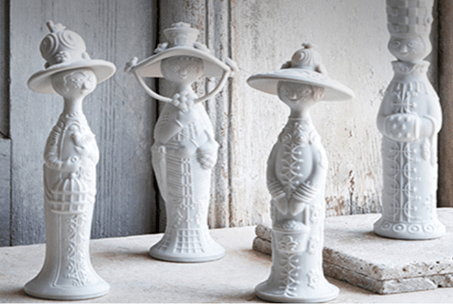
Bjorn Winblad (1918-2006), who hails from Copenhagen, Denmark, created artwork that contrasts greatly from the stylized and minimal Nordic compositions that the area was known for at the time. Wiinblad developed exuberant and colorful works with the utilization of multiple medias, including ceramics (Fig.2), textiles, printmaking, ink & paper, painting. Wiinblad’s work perfectly reflected his personal mantra of, “Bring people Joy.”[1] Beginning his professional career as a typographer, at his father’s behest, he would finish his schooling by 1940. Afterwards, he would go into his artistic career in force by enrolling in graphic school at the Royal Academy of Fine Arts. [2] Wiinblad would debut an exhibition in 1945 at Palægade in his hometown of Copenhagen. With an extensive body of work, this exhibition would have him noticed by Jacob E. Bang, the artistic director of Nymolle. Bang would bring on Wiinblad into their studio and effectively launch his career.[3] Gaining commissions for costume and stage design in Paris, as well as a ceramics exhibition in New York by 1950, it is no wonder Wiinblad would get commissions from the metropolis of Dallas, Texas.[4]
Focusing in on Bjorn Wiinblad’s time in Texas, we can really see the vast body of work that he created through the varying commissions and involvements within this specific city. Dallas had a love for Wiinblad that not many other cities, except maybe Copenhagen, could compare. Ranging from the 1960’s to the early 1990’s, Wiinblad’s resume in Dallas is not to be ignored. Starting in 1954, he designed a poster for Neiman-Marcus’ Fashion week.[5] This poster design would create for him a strong and long running relationship with Stanley Marcus himself. Marcus would then help promote Wiinblad’s career by providing him with interior design projects for influential patrons all over Dallas.[6] In 1965, Wiinblad would create the costume and set design for Shakespeare’s The Tempest, as performed by the Dallas Theater Center. Additionally he would act as co-director for the production. Later he would design the set and costumes for the center’s production of The Nutcracker in 1984.[7] Wiinblad would also house five large ceramic commissions within Dallas’ World Trade Center. This is followed by having an extensive hand in the designing of Dallas’ Hilton Anatole Hotel, which houses his large bronze casted pieces, The Gossips.[8] These are just a few examples of his exploits in Dallas and show the range in which he worked just within the city.
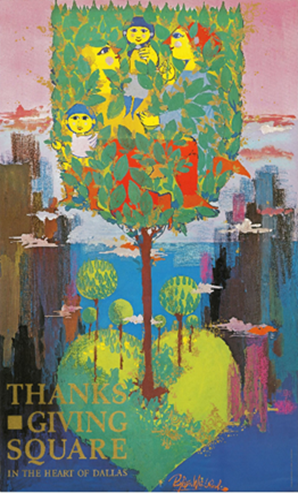
A major artistic achievement in Bjorn Wiinblad’s career was his still beloved poster for the Thanksgiving Foundation and his record breaking tapestries for Trammell Crow in the now closed Dallas Apparel Mart. Concerning the Thanksgiving Foundation, Bjorn was contacted via typed letter in August 1967 about creating posters for the following year.[9] Wiinblad would create three thousand prints of the famed Thanksgiving Foundation poster (Fig.3) that can still be bought for charitable purposes from the Foundation today.[10] These posters were heralded for their originality and how the design reflected the great sense of community Dallas residence felt for their city. In an interpretation made by an unknown critic within the Thanksgiving Foundation, The Family-United in Thanksgiving is described with this same feeling of centralized community.[11] Going further to describe how this transcendent sense of community is represented through the choices in composition made by Wiinblad.[12]
Although the Dallas Apparel Mart would close down in 2003, during the height of its life in the 1970s, Wiinblad would be approached by Trammell Crow who was a Dallas Real Estate mogul, to create works of art for the Apparel Mart. Originally commissioned to make one large tapestry, Wiinblad would settle on five designs based on the tale Arabian Nights, which would result in the largest tapestries on record and largest loom created for a textile project.[13] These pieces would come to be known as Scheherazade Tapestries.[14] Wiinblad would pass away in 2006, but not without first securing a deal with Rosendahl Design Group, to create a long lasting and continuing legacy.
The debate on whether conservation is an essential part of the life cycle of an artwork is a topic that is surprisingly debated more than one would think. It is important to state that this research analysis is first and foremost a hypothetical on the process of conserving a select choice of artworks. We will use a set definition of methods to standardize how to conserve these works of art. Conservation is defined by the fact that anyone who practices it understands that they will never achieve true authenticity again, since all actions done in its name are reversible.[15] There is an idea of “Minimum Intervention” when approaching conservation, which stresses the stabilization of the piece so that it can be understood in its most authentic form.[16] Even if a piece is losing parts of itself to time that can never be brought back, that is unequivocally its most authentic form to date. However, stabilization allows the leeway to attempt restorations on the pieces themselves by puzzling together what remains. This allows the conservator to bring the artwork to as close to current authentic form as possible.
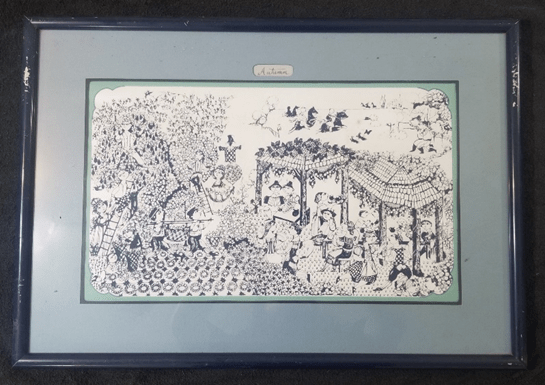

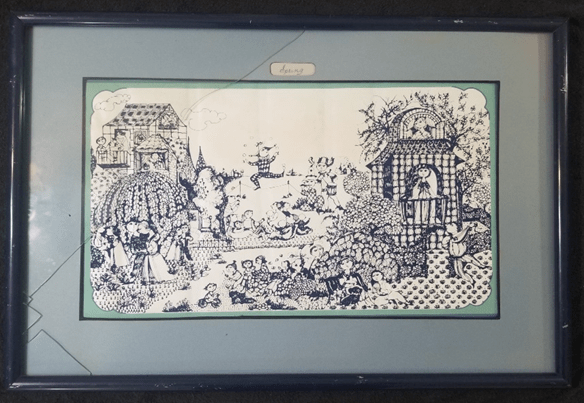
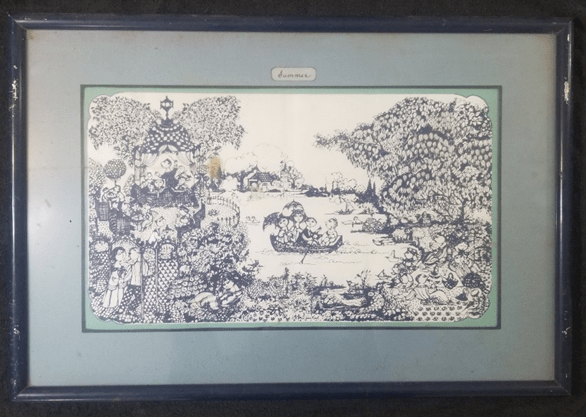
Understanding Bjorn Wiinblad’s history provides important context to possible conservation methods. There are four lithographs to be examined through a conservation lens. Each composition represents an archaic visualization of Dutch culture within a season of the year, as portrayed in Bjorn Wiinblad’s commonly used whimsical style. This style is accentuated by his pencil-like strokes of the litho-crayon that was used to apply his compositions to the block before printing. Common iconography associated with each season can be found within each composition: harvest and hunting for Autumn (Fig. 4), ice skating and sledding in Winter (Fig. 5), flowering landscape filled with love and street performing in Spring (Fig. 6), and paddled boat rides for the Summer (Fig. 7) While the landscapes and buildings change, all the compositions revolve around a lake or field somewhere in composition. This observation gives us a sense of greater depth in composition from Wiinblad when he made these pieces.
There are no type of paper works that are guaranteed a long life without the help of protection. These types of works are particularly fragile as degradation from direct sunlight can cause content to fade in just a few days.[17] Additionally, other factors that affect paper works are: storage and display atmosphere, UV and damage from electrical light fixtures, size, quality of paper, quality of storage and display vessels such as frames and sleeves. All of these contribute to the overall wellbeing of a piece as well as the conservation of the pieces for historical and artistic conservation. Using our previously defined conservation, we will focus on the means needed to protect paper works. Stabilizing and preserving them without the use of modern technique in a restorative manner.[18] After we analyze the data from the piece’s condition reports we will begin our discussion on how best to conserve them.
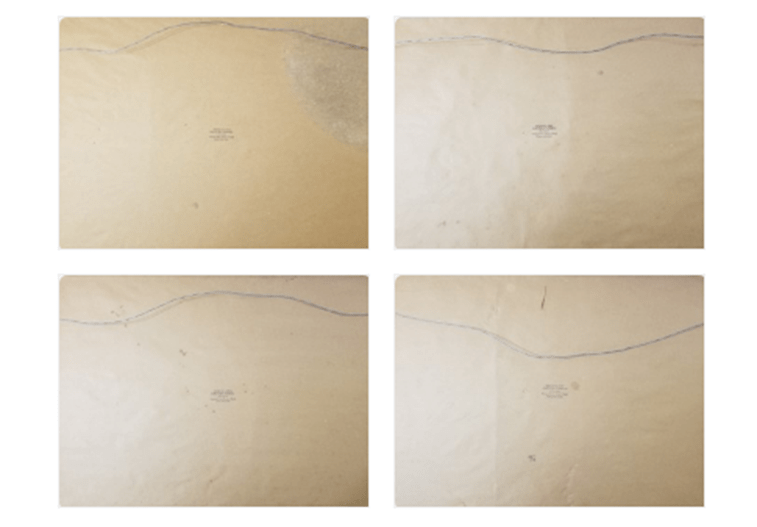
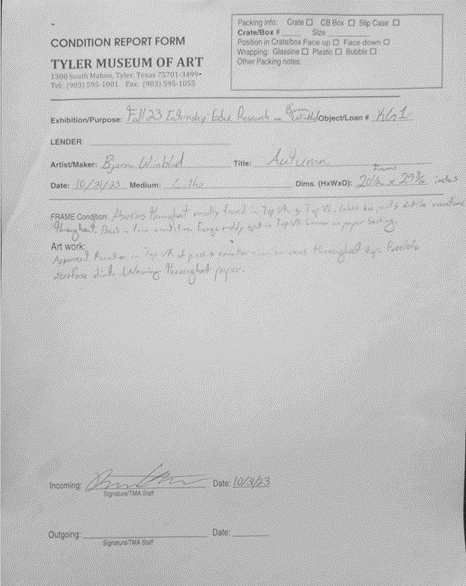
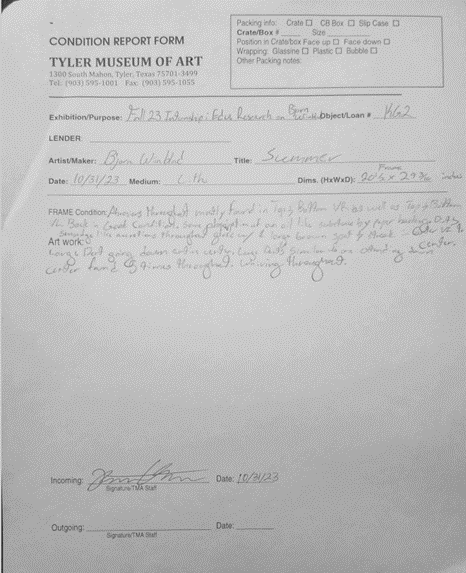
Using written condition reports, we begin with the frames of the pieces. Upon initial examination, we find that the frames are in relatively good condition with roughly the same damages reflected across all frames. Most notably of these overlying damages are the continuous abrasions on the front facing side of the frame, mostly concentrated to the top visual right and top visual left of all frames.[19] Examining the backs of all the frames (Fig. 8), we find these to be in relatively fair condition as well. Some mold is spotted on the backs of two pieces, specifically Autumn and Winter. However, it seems to have died out some time ago leaving behind the stain of said mold.[20] Absorption of what seems to be an oil like substance is noted on two pieces, Summer and Spring , as well as some small abrasions throughout the back of Winter.[21] Although the mold and other damage can be worrying for the health of the piece itself, it must be noted that all this is on the surface of the paper backing which is enforced by some type of hardboard separating the paper back from the back of the piece itself. Although this damage appears minimal at the moment, it will need to be addressed once the conservation of Wiinblad’s pieces begin.
The glass throughout all the pieces carry dirt, paint, and smudge like accretions speckled throughout.[22] Most notably, a large red-brown accretion can be found on the glass of Summer. The mark streaks from center of the piece, through the center, to the visual left or the edge of the frame.[23] Other than these accretions, the only severe damage to the glass on any of these pieces can be found on Spring. The glass of this piece is almost completely smashed out with one large remnant present in the top visual left corner of the frame, extending over into top center, and down and into the bottom visual left. Three much smaller pieces of glass are also noted as present in the bottom visual left of the frames edge.[24]
Although the damage to the pieces would be considered extensive in nature, it must be noted that the compositions are not hindered by the impairments presented within the condition report forms. Cockling and rippling are present within all pieces.[25] In three of four pieces: Summer, Winter, and Spring, a significant fold like dent is apparent. It seems as if the pieces had been folded around the back binding of a book and flattened back out before framing.[26] This fold around can be found five times within both Summer and Winter,[27] and six times within Spring.[28] In the case of all the pieces, when talking about the multiple folds described, it is interesting to note that the dents are equidistant from themselves and spread across the page evenly.[29]
Shifting on to the more personal damages accrued independently by each piece, registered from least damaged to most within the condition logs, we start with Summer. This piece is the most pristine of the collection, suffering only from the shared damages experienced amongst other pieces within this series of works.[30] Autumn would be the next piece in terms of damage sustained, suffering from minor accretions speckled throughout the visual top of piece,\ and a dirt-like accretion found in the top visual right of piece.[31] Winter comes in third in terms of least damaged. Other than the previously stated shared damage found in all compositions, Winter has a small accretion located on the border of bottom visual left and bottom center.[32]
Spring is the most damaged within the series. Being that the glass is broken out in this piece, it comes as no surprise that this is the roughest work in the series. Much like the cockling seen throughout all these pieces, the exposed top visual right of the matt board has begun to warp in a manner similar to the damage experienced by the piece itself.[33] Accretions, such as surface dirt, can also be found throughout the exposed mat board itself.[34] The mat board found unexposed, and still under glass, is in relatively pristine condition. Although exposed, some precautions had obviously been taken to protect this piece after its protective layer had been shattered, as this was the only piece that had been covered in a plastic wrap. Even if this is the best route to protect this piece, it is possible that without the protective plastic layer, the condition of this would have experienced severe degradation. Damage still managed to manifest through in the form of small accretions throughout, and concentrated to the visual top of piece. The most notable damage of all would more than likely be the obvious large streaking accretion located at the base of center, just above the artist’s signature, directly on the work itself.[35]
Now, the hypothesis of conservation will be discussed on how the artworks should be conserved in a professional manner. Beginning with the removal of the pieces from the frames, we will contemplate the repair processes most likely to be done to them. In a perfect museum setting, one would hope there is a department specifically integrated to repair and construct frames. However, in most cases, one will have to take them to a professional framer for this job. As this is a purely theoretical situation, we will discuss what we would do to conserve these frames in the figurative seat of a professional conservator. The frames are aluminum, in decent condition, and are obviously made with the composition and coloring of the pieces in mind. Thus, we will opt to keep them. They will be conserved along with the artwork, instead of dismissing them and custom ordering new frames for all four pieces. A frame is created for a piece to maintain the protection of most paper works and should be considered a part of the museum acquisition itself.[36] Because of this ideal, there is an overall standard in which works on paper should be framed.[37] Before any work is done on the frames, they will be removed. Assuming that the inside matting is well done and held to proper framing standards, the first course of action would be to remove the dustcovers. We will replace any dust covers that have stains from a previous mold build up, oils, and tears. Next will be the removal of the artwork. If they are properly secured by the standards we expect, we should be removing a moisture barrier, backing board, and our mat set up.[38] At this point of removal, we will replace our glass. We will also go on to replicate and replace the mat set up for Spring as it is the only matt board to have been warped. Now that our art and matting is removed, our artwork will be set aside to work on later. It will be faced up and separated to minimize external damage as we work on the frames. Given our actual frame damage is minimal, we will opt for in-painting, a common technique used for frame conservation. This process is done by replicating color, copying medium, and reapplying it onto areas of loss.[39]
Carefully removing each artwork from their mat, we would set each aside and work on them individually. However, as the damages between each piece are similar, we will describe the process as if we were working on all pieces simultaneously. All works would first need to go under a dry surface cleaning process to remove any excess debris from the artwork. This will ensure that the loose debris will not damage the works further when wetted in the humidification process the pieces will experience later.[40] The dry-cleaning process will begin by brushing any loose debris off the surface with a very soft, fine brush. Afterwards gentle rubbing with a variety of brushes, sponges, and vinyl erasers can be applied at conservator discretion so as not to alter the composition of the piece in any other way.[41] After all excessive accretions have been removed to the best of ability without damage, a soft suction vacuum will be applied to the piece to remove the accretions without bushing them off for further damage.[42]
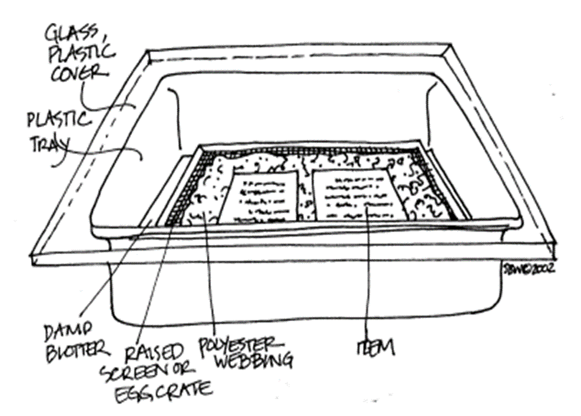
Following the conclusion of dry-cleaning, our pieces would next enter a humidification process that will flatten out our folds noted in the condition reports and help lift some of the stains left behind by the surface accretions.[43] All of the pieces will go into a humidification chamber (Fig. 9). This chamber is created by first obtaining a plastic tray with a cover. A damp blotter, usually made of an absorbent paper like material, is placed in the bottom to act as our moisture source. From there, we place a raised screen with polyester webbing on top. This will separate our piece from the moisture source.[44] After we put our artwork upon the webbing, we cover the tray and leave it for two to three hours, sponging up any lifted accretions, rotating once, and repeating the process as necessary.[45] Due to the lacking severity of the folds in our pieces, it will not be surprising that they will not be completely relaxed out of the paper. However, the drying process should help allow them to flatten, even if there is an evident crease where once a fold had been.[46]
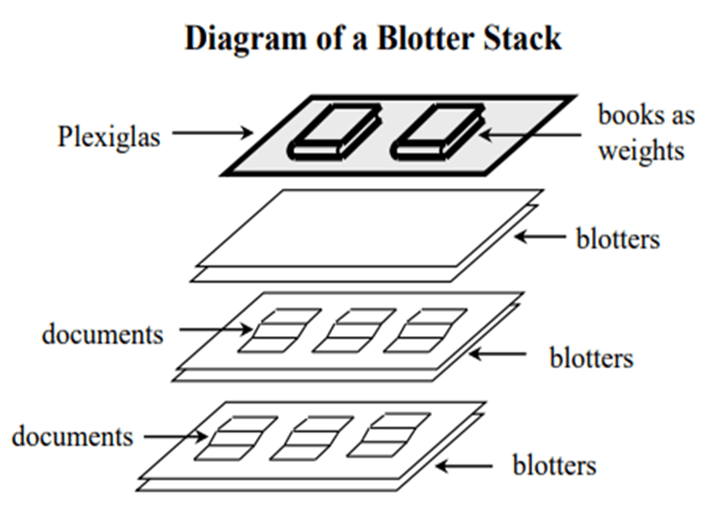
Once we are satisfied with the results of humidification, the drying process commences. (Fig. 10) Through the placement of dry blotters and weights, we should be able to achieve the flattening desired in the conservation of this piece. By placing two dry blotters that are larger than our pieces on the bottom level, we create our ground to lay down our first piece to dry. We, then, place two more dry blotters. This is followed by plexiglass and our source of weight to allow even pressure to be exuded on the piece.[47] It is important to keep in mind that we do not put too much weight on the piece, instead it should be only enough to allow even pressure to flatten it.[48] This can be left overnight, at a twelve-hour minimum. The pieces do not need to be flattened out as if they were never damaged. They need to be flat enough that they can relax comfortably in frame once again for optimal stability. Assuming our frames are done at this point, the final steps would be to refit the artworks in their mats before placing them back into the frames. The works are topped off with fresh dust covers to replace the old ones.
The primary goal is to keep the integrity of these pieces. That truly starts and ends with good quality storage. The preventative measures incorporated into the storage, which includes framing, take into account the atmosphere and lighting. Temperature and humidity being the main defining factors of paper work decay.[49] So, we must make sure that we take great caution in our final step towards the overall conservation of these pieces. We store them in a room with a temperature range of forty to sixty-eight degrees Fahrenheit and a humidity range between thirty to fifty percent humidity. Forty degrees and forty percent humidity are best option when applicable.[50].
We have defined conservation, as it pertains specifically to the subject pieces of Bjorn Wiinblad’s prints. We also established who Bjorn Wiinblad was and why his legacy should be conserved through his historical achievements through the critical analysis of his artwork. Through the use of written condition reports done on the pieces, we analyzed the damage presented. This process allowed us to have a baseline of damages to assess as we began the analysis. Finally, we detailed a complete and comprehensive plan on how best to go about restoring these pieces to a near authentic state using the methods of a professional conservator. We should use this information to take better action towards the conservation of paper artworks.
Footnotes
[1] “Om Bjørn Wiinblad,” Bjørn Wiinblad, accessed September 7, 2023, https://www.bjornwiinblad.dk/om/.
[2] Ibid, “Om Bjørn Wiinblad”
[3] “Bjorn Wiinblad,” Haute Curature, accessed September 7, 2023, https://hautecurature.com/collections/bjorn-wiinblad.
[4] Ibid, “Bjorn Wiinblad,” Haute Curature
[5] Angela Enright, “Bjorn Again in Dallas,” D Magazine, November 17, 2013, https://www.dmagazine.com/publications/d-magazine/1984/december/bjorn-again-in-dallas/.
[6] Ibid, Angela Enright
[7] Ibid, Angela Enright
[8] Angela Enright, “Bjorn Again in Dallas,” D Magazine, November 17, 2013, https://www.dmagazine.com/publications/d-magazine/1984/december/bjorn-again-in-dallas/.
[9] Peter Stewart, [Peter Stewart to Bjorn Wiinblad, August 1, 1967], letter, August 1, 1967; (https://texashistory.unt.edu/ark:/67531/metapth1196866/: accessed September 8, 2023), University of North Texas Libraries, The Portal to Texas History, https://texashistory.unt.edu; crediting The Thanks-Giving Foundation.
[10] Peter Stewert [Letter from Peter Stewart to Bjorn Wiinblad, November 27, 1968], letter, November 27, 1968; (https://texashistory.unt.edu/ark:/67531/metapth1196796/: accessed September 8, 2023), University of North Texas Libraries, The Portal to Texas History, https://texashistory.unt.edu; crediting The Thanks-Giving Foundation.
[11] Thanks-Giving Square Foundation. An Interpretation: “The Family – United in Thanksgiving”, text, Date Unknown; (https://texashistory.unt.edu/ark:/67531/metapth1196826/: accessed November 2, 2023), University of North Texas Libraries, The Portal to Texas History, https://texashistory.unt.edu; crediting The Thanks-Giving Foundation.
[12] Ibid, Thanks-Giving Square Foundation.
[13] “The Apparel Mart Tapestries in Dallas by Bjorn Wiinblad,” Worthpoint, accessed September 10, 2023, https://www.worthpoint.com/worthopedia/apparel-mart-tapestries-dallas-bjorn-127625987.
[14] Angela Enright, “Bjorn Again in Dallas,” D Magazine, November 17, 2013, https://www.dmagazine.com/publications/d-magazine/1984/december/bjorn-again-in-dallas/.
[15] Michèle Valerie Cloonan and Christopher Clarkson, “6.1 Laws of Conservation,” Chapter Section, in Preserving Our Heritage: Perspectives from Antiquity to the Digital Age (Chicago, IL: Neal-Schuman, an imprint of American Library Association, 2015), 328
[16] Michèle Valerie Cloonan and Christopher Clarkson, “6.2 Minimum Intervention in the Treatment of Books,” Chapter Section, in Preserving Our Heritage: Perspectives from Antiquity to the Digital Age (Chicago, IL: Neal-Schuman, an imprint of American Library Association, 2015), 328–38. 329-330
[17] Harold W. Tribolet, Rare Book & Paper Repair Techniques (Nashville: American Association for State and Local History, 1970).
[18] Marie Kessel, “A Legal Discussion on Failed Restorations,” Center for Art Law, April 1, 2021, https://itsartlaw.org/2021/04/01/a-legal-discussion-on-failed-restorations/.
[19] Kevin Gibson, “Condition Report Form: Fall 2023 Internship Education Research on Bjorn Wiinblad,” (Condition Report Form, Tyler Museum of Art, 2023), 1-4 (1-4)
[20] Ibid, Kevin Gibson, (1, 3, 4)
[21] Ibid, Kevin Gibson, (2, 4)
[22] Kevin Gibson, “Condition Report Form: Fall 2023 Internship Education Research on Bjorn Wiinblad,” (Condition Report Form, Tyler Museum of Art, 2023), 1-4 (1-4)
[23] Ibid. Kevin Gibson, (2)
[24] Ibid, Kevin Gibson, (4)
[25] Ibid, Kevin Gibson, (1-4)
[26] Ibid, Kevin Gibson, (2-4)
[27] Ibid, Kevin Gibson, (2-3)
[28] Ibid, Kevin Gibson, (4)
[29] Kevin Gibson, “Condition Report Form: Fall 2023 Internship Education Research on Bjorn Wiinblad,” (Condition Report Form, Tyler Museum of Art, 2023), 1-4 (2,4)
[30] Ibid, Kevin Gibson, (2)
[31] Ibid, Kevin Gibson, (1)
[32] Ibid, Kevin Gibson, (3)
[33] Ibid, Kevin Gibson, (4)
[34] Ibid, Kevin Gibson, (4)
[35] Kevin Gibson, “Condition Report Form: Fall 2023 Internship Education Research on Bjorn Wiinblad,” (Condition Report Form, Tyler Museum of Art, 2023), 1-4, (4)
[36] Stephen Hackney. “The Development of a Conservation Framing Policy at Tate”. Accessed September 4, 2023. https://www.conservationphysics.org/mm/hackney/hackney_p.pdf.
[37] “Collections Care.” Preservation Guidelines for Matting and Framing – Collections Care (Preservation, Library of Congress). Accessed October 12, 2023. https://www.loc.gov/preservation/care/mat.html.
[38] “Collections Care.” Preservation Guidelines for Matting and Framing – Collections Care (Preservation, Library of Congress). Accessed October 12, 2023. https://www.loc.gov/preservation/care/mat.html.
[39] “Frames.” Australian Institute for the Conservation of Cultural Material, September 25, 2022. https://aiccm.org.au/carer-guide/frames/.
[40] Conn, Donia. Humidification and Flattening of Paper. Accessed November 15, 2023. https://www.ala.org/alcts/sites/ala.org.alcts/files/content/Humidification%20and%20Flattening%20of%20Paper.pdf.
[41] “Conservation Procedure: 7.2 Surface Cleaning Paper.” Preservation leaflet – northeast document conservation center. Accessed October 12, 2023. https://www.nedcc.org/assets/media/documents/Preservation%20Leaflets/7-2_SurfaceCleaning_2018.pdf.
[42] “Conservation Procedure: 7.2 Surface Cleaning Paper.” Preservation leaflet – northeast document conservation center. Accessed October 12, 2023. https://www.nedcc.org/assets/media/documents/Preservation%20Leaflets/7-2_SurfaceCleaning_2018.pdf.
[43] Patricia Morris, “Conserving Works of Art on Paper: Suggestions from an Expert on the Care and Conservation of Valuable Works on Paper,” The collector’s guide: Conserving works in paper, accessed October 26, 2023, https://collectorsguide.com/fa/fa010.shtml.
[44] Stephanie Watkins, Practical Considerations for Humidification and Flattening Paper, 2002, https://cool.culturalheritage.org/coolaic/sg/bpg/annual/v21/bpga21-15.pdf.
[45] Conn, Donia. Humidification and Flattening of Paper. Accessed November 15, 2023. https://www.ala.org/alcts/sites/ala.org.alcts/files/content/Humidification%20and%20Flattening%20of%20Paper.pdf.
[46]“Humidification and Flattening of Documents – Missouri Secretary of State,” sos.mo.gov, accessed November 15, 2023, https://www.sos.mo.gov/CMSImages/LocalRecords/HumidificationandFlattening.pdf.
[47] Ibid.
[48] Ibid.
[49] Ross Harvey, Martha Mahard, and Donia Conn, “The Environment,” Chapter, in The Preservation Management Handbook: A 21st-Century Guide for Libraries, Archives, and Museums (Lanham etc.: Rowman & Littlefield, 2020), 95–118, 95-96.
[50] Ross Harvey, Martha Mahard, and Conia Conn, “Putting It All Together: Environment and Storage Quick Reference Guide,” Chapter, in The Preservation Management Handbook: A 21st-Century Guide for Libraries, Archives, and Museums, 2nd ed. (Lanham etc.: Rowman & Littlefield, 2020), 135–44, 138.
Condition Reports


Bibliography
“Bjorn Wiinblad,” HauteCurature, Updated 2023, Accessed September 7, 2023, https://hautecurature.com/collections/bjorn-wiinblad.
Cloonan, Michèle Valerie, and Christopher Clarkson. “6.1 Laws of Conservation.” Chapter Section. In Preserving Our Heritage: Perspectives from Antiquity to the Digital Age, 328. Chicago, IL: Neal-Schuman, an imprint of American Library Association, 2015.
Cloonan, Michèle Valerie, and Christopher Clarkson. “6.2 Minimum Intervention in the Treatment of Books.” Chapter Section. In Preserving Our Heritage: Perspectives from Antiquity to the Digital Age, 328–338. Chicago, IL: Neal-Schuman, an imprint of American Library Association, 2015.
Cloonan, Michèle Valerie, and Caroline K Keck. “6.4 The Role of the Conservator.” Chapter Section. In Preserving Our Heritage: Perspectives from Antiquity to the Digital Age, 341–345. Chicago, IL: Neal-Schuman, an imprint of American Library Association, 2015.
“Collections Care.” Preservation Guidelines for Matting and Framing – Collections Care (Preservation, Library of Congress). Updated 2023, Accessed October 12, 2023. https://www.loc.gov/preservation/care/mat.html.
Conn, Donia. Humidification and Flattening of Paper. Updated 2016, Accessed November 15, 2023. https://www.ala.org/alcts/sites/ala.org.alcts/files/content/Humidification%20and%20Flattening%20of%20Paper.pdf .
“Conservation Procedure: 7.2 Surface Cleaning Paper.” Preservation leaflet – northeast document conservation center. Updated 2018, Accessed October 12, 2023. https://www.nedcc.org/assets/media/documents/Preservation%20Leaflets/7-2_SurfaceCleaning_2018.pdf.
Enright Angela, “Bjorn Again in Dallas,” D Magazine, November 17, 2013, accessed, September 20, 2023 https://www.dmagazine.com/publications/d-magazine/1984/december/bjorn-again-in-dallas/.
“Frames.” Australian Institute for the Conservation of Cultural Material, September 25, 2022, accessed November 2, 2023. https://aiccm.org.au/carer-guide/frames/.
Gibson, Kevin. “Condition Report Form: Fall 2023 Internship Education Research on Bjorn Wiinblad.” Condition Report Form, Tyler Museum of Art, 2023.
Hackney, Stephen. “The Development of a Conservation Framing Policy at Tate”. 2007 Accessed September 4, 2023. https://www.conservationphysics.org/mm/hackney/hackney_p.pdf.
Harvey, Ross, Martha Mahard, and Donia Conn. “Paper Objects and Books.” Chapter. In The Preservation Management Handbook: A 21st-Century Guide for Libraries, Archives, and Museums, 2nd ed., 145–76. Lanham etc.: Rowman & Littlefield, 2020.
Harvey, Ross, Martha Mahard, and Conia Conn. “Putting It All Together: Environment and Storage Quick Reference Guide.” Essay. In The Preservation Management Handbook: A 21st-Century Guide for Libraries, Archives, and Museums, 2nd ed., 135–44. Lanham etc.: Rowman & Littlefield, 2020.
Harvey, Ross, Martha Mahard, and Donia Conn. “The Environment” Chapter. In The Preservation Management Handbook: A 21st-Century Guide for Libraries, Archives, and Museums, 2nd ed., 95-118. Lanham etc.: Rowman & Littlefield, 2020.
“Humidification and Flattening of Documents – Missouri Secretary of State.” sos.mo.gov. Updated April 2018. Accessed November 15, 2023. https://www.sos.mo.gov/CMSImages/LocalRecords/HumidificationandFlattening.pdf.
Kessel, Marie. “A Legal Discussion on Failed Restorations.” Center for Art Law, April 1, 2021, accessed September 21, 2023 https://itsartlaw.org/2021/04/01/a-legal-discussion-on-failed-restorations/.
Morris, Patricia. “Conserving Works of Art on Paper: Suggestions from an Expert on the Care and Conservation of Valuable Works on Paper.” The collector’s guide: Conserving works in paper. Updated, September 24, 2007, Accessed October 26, 2023. https://collectorsguide.com/fa/fa010.shtml.
“Om Bjørn Wiinblad,” Bjørn Wiinblad, Updated 2023, Accessed September 7, 2023, https://www.bjornwiinblad.dk/om/.
Stewart, Peter [Peter Stewart to Bjorn Wiinblad, August 1, 1967], letter, August 1, 1967; (https://texashistory.unt.edu/ark:/67531/metapth1196866/: accessed September 8, 2023), University of North Texas Libraries, The Portal to Texas History, https://texashistory.unt.edu; crediting The Thanks-Giving Foundation.
Stewart, Peter [Letter from Peter Stewart to Bjorn Wiinblad, November 27, 1968], letter, November 27, 1968; (https://texashistory.unt.edu/ark:/67531/metapth1196796/: accessed September 8, 2023), University of North Texas Libraries, The Portal to Texas History, https://texashistory.unt.edu; crediting The Thanks-Giving Foundation.
Thanks-Giving Square Foundation. An Interpretation: “The Family – United in Thanksgiving“, text, Date Unknown; (https://texashistory.unt.edu/ark:/67531/metapth1196826/: accessed November 2, 2023), University of North Texas Libraries, The Portal to Texas History, https://texashistory.unt.edu; crediting The Thanks-Giving Foundation.
“The Apparel Mart Tapestries in Dallas by Bjorn Wiinblad,” Worthpoint, Updated 2023, accessed September 10, 2023, https://www.worthpoint.com/worthopedia/apparel-mart-tapestries-dallas-bjorn-127625987.
Tribolet, Harold W. Rare Book & Paper Repair Techniques. Nashville: American Association for State and Local History, 1970.
Watkins, Stephanie. Practical Considerati2023,for Humidification and Flattening Paper, 2002, Accessed October 26, 2023 https://cool.culturalheritage.org/coolaic/sg/bpg/annual/v21/bpga21-15.pdf.
For more educational resources created by the Tyler Museum of Art, visit our YouTube page by clicking on the YouTube button or clicking the link below.

And stay updated with the Tyler Museum of Art’s events by visiting our Facebook and Instagram pages:


If you use or reference this research project, please leave a comment with your feedback.
Thank you for visiting the Tyler Museum of Art’s Education Blog!
 Tyler Museum of Art Education Blog
One thought on “Conserving our Energies: A Process Theorization on How to Stabilize and Conserve Paper Works Created by Bjorn Wiinblad”