
This lesson plan was researched and written by Nicole Hinton, a Spring 2025 University of Texas at Tyler Intern at the Tyler Museum of Art. The lesson plan was edited by Rachel Anthony, the Tyler Museum of Art’s Education Manager.
This lesson plan contains the National Learning Standards for Visual Arts and the Texas TEKS for Elementary, Middle, and High School art teachers. Students will study terracotta folk art created in Mexico. Then, the students will create their own ceramic animals.
If you use or reference this lesson plan, please leave a comment with your feedback. The lesson plan can be downloaded in the link below.

Anonymous, Pig, 1990, Terracotta, 5 inches, 2.5 inches, 6.5 inches, Tyler Museum of Art, Tyler, Texas.
Anonymous, Duck, 1974, Terracotta, dimensions not noted, Tyler Museum of Art, Tyler, Texas.
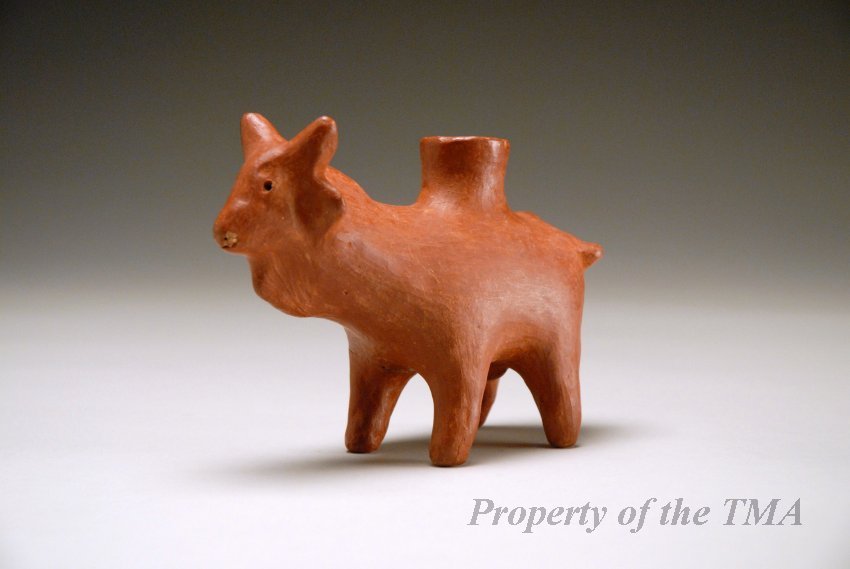
Anonymous, Candlestick Bull, Terracotta, not dated, 4.5 inches, 2 inches, 6 inches, Tyler Museum of Art, Tyler, Texas.
Culture: Mexican
Subject: Fine Art, Art History
Collection: Tyler Museum of Art’s Permanent Collection
Grades: Elementary School, Middle School and High School
Topics: Artistic Practices, Art History, Critical Thinking, Folklore, and Ceramics.
Art Vocabulary
Activity Vocabulary:
Artist Biography
- The artists who created the artworks , Pig, Duck, and Candlestick Bull were all created by anonymous artists in the estimated region of Oaxaca, Mexico.
- Anonymous, a name given to someone whose identity is unknown, or the person wishes not to be known.[1]
- An anonymous artist can be either intentional or unintentional. An artist can willingly choose to not share one’s identity due to personal beliefs or from fear of persecution. The artist’s name could also be lost due to lack of information or the artwork itself could lack an identifying logo, such as a signature. [2]
- Pig
- Pig is a smaller sculptural ceramic pig created in 1990 in Tavehue/La Villa Atla, Oaxaca, Mexico, using terracotta clay. The pig is crafted by hand and hollow inside. On the surface, the artist’s finger indentions can be seen smoothing out the clay. Its body has four simplified legs, with a similar style of tail. Its head consists of a protruding set of ears and a nose. The eyes and nostrils are carved to simple pinholes, finishing out its features.[3]
- Duck
- Duck is a set of ceramic ducks created in 1974 in Ocotlan, Oaxaca, Mexico. The ducks are made with terracotta clay. Each duck has their own unique design that is created with a white clay slip painting. The larger duck has a rounded and smooth lower body and no legs can be seen. It does, however, have a small pointed tail at its rear. The larger duck appears to have a longer torso and neck. Like its partner, it is given a handle. The use of the handle could simply be for decoration or have a functional purpose. The white slip details consist of a painted beak, an eye, eyebrows, a zig-zag collar (implying feathers), a painted tail, and a decorated wing. The wing is a leaf shape and aligned with dots. The smaller duck is similar in style. This duck is also without legs, has an attached handle on its back, and is decorated with white slip. This slip adds features, such as a nose, a dot for an eye, a curved line for and eyebrow, a collar of zig-zagging lines that wrap around its neck twice, a white coated tail, and a unique wing. The wing is decorated differently than its larger counter part. It is done with a large line starting from its neck and ending just before its tail. From that line, there are numerous smaller lines extending outwards in multiple directions.[4]
- Candlestick Bull
- Candlestick Bull is a ceramic shaped bull. While the date of its creation is currently unknown, it is from the Oaxaca area in Mexico. The bull can be seen with four simplified legs. Under the bulls chin is ”sagging” clay. This gives the implication of a saggy or muscular neck. The bulls facial features are simplified to a pinched snout with a very small carved hole for a nose and carved upward line for a mouth. The eye is a larger carved hole. On top its head are two pinched horns extending outwards. Below the horns are ears pinched in a similar fashion. On the backside of the bull is a small pointed tail. On the bulls back is a protruding open hold that can be used to hold a candlestick. [5]
Activity Vocabulary
- Folk Art is a traditional form of artwork that is handcrafted. The artists creating these pieces will generally be self taught. Folk Art is made to express ones culture. This is a type of artwork that is made for a community of people. [6]
- Ceramics is a form of art that are objects made of fired clay at high temperatures. Ceramics can either be functional or sculptural. [7]
- Clay is fine earth materials that is formed by decomposing igneous rocks. When clay is wet it is easily malleable. When fired to high temperatures, it becomes rock hard. [8]
- Terracotta is a type of clay that is a natural orange/ brown color.[9]
- Slip is finely ground clay particles mixed with water. Slip can be numerous colors depending on the clay body or when mixed with dyes. Slip can be decorative, used to join pieces to each other, or be extruded onto a surface giving a raised texture.[10]
- Air Dry Clay is a type of clay that when exposed to air will dry and harden. This type of clay is not meant to be fired When added to water, it will lose its form. This clay can be painted with acrylic or tempera paints. Likewise, when mixed with tempera, acrylic paint, or dyes, it can become colored clay. [11]
- Kilns are furnaces built with heat resistant materials for firing ceramics. Heat can be produced by using electricity, propane, wood, or natural gas.[12]
- Pit-firing is a method of firing clay as a reduction form. It is done by digging a hole into the ground called a “pit”. The artwork is then placed into the pit. Materials like wood, pine, and leaves are placed on top and set on fire. After firing the pieces can be uncovered and are then ready for the next process. Artists can choose to paint their ceramic works with acrylic paint, tempera paint, or slip.[13]
[1] “Anonymous”, Cambridge University Press and Assessment, Last Updated 2025, Accessed January 22, 2025, https://dictionary.cambridge.org/us/dictionary/english/anonymous
[2] Ibid
[3] “Browse Record: Pig”, Tyler Museum of Art, Last Updated 2010, Accessed January 22, 2025, https://tylermuseum.pastperfectonline.com/webobject/FAE816DC-6C6E-4929-A48C-324907858224
[4] “Browse Record: Duck”, Tyler Museum of Art, Last updated 2010, Accessed January 22, 2025, https://tylermuseum.pastperfectonline.com/webobject/77E3962F-344B-4F6B-AC67-624612802465
[5] “Browse Record: Candlestick, Bull”, Tyler Museum of Art, Last Updated 2010, Accessed January 22, 2025, https://tylermuseum.pastperfectonline.com/webobject/6C82DCDE-0CB0-467A-BBD6-708618749604
[6] “What is Folk Art?”, Museum of International Folk Art , Accessed on January 24, 2025, https://www.internationalfolkart.org/learn/what-is-folk-art.html
[7] “Ceramic Vocabulary”, The American Museum of Ceramic Art, Education Department, Accessed on January 22, 2025, https://www.amoca.org/wp-content/uploads/2013/08/Ceramic-Vocabulary.pdf
[8] Ibid
[9] “What is Terracotta?”, The National Center for Families Learning: Wonderopolis, Last updated on January 22, 1998, https://www.wonderopolis.org/wonder/what-is-terracotta
[10] “Ceramic Vocabulary”, The American Museum of Ceramic Art, Education Department, Accessed on January 22, 2025, https://www.amoca.org/wp-content/uploads/2013/08/Ceramic-Vocabulary.pdf
[11] “An In-Depth Look at Air Dry Clay”, Amanda Heyn, Last Updated on July 20, 2017, https://theartofeducation.edu/2017/07/depth-look-air-dry-clay/
[12] “Ceramic Vocabulary”, The American Museum of Ceramic Art, Education Department, Accessed on January 22, 2025, https://www.amoca.org/wp-content/uploads/2013/08/Ceramic-Vocabulary.pdf
[13] “Decorative Pit Firing”, Stephen Adams, Last updated on January 22, 1998, https://groups.csail.mit.edu/mac/users/adams/Pottery/pit.html
Bibliography: Resources for Vocabulary and Lesson Plan
Adams, Stephen. “Decorative Pit Firing.” Last Updated on January 22, 1998. https://groups.csail.mit.edu/mac/users/adams/Pottery/pit.html
Cambridge University Press and Assessment. “Anonymous.” Last Updated 2025. Accessed January 22, 2025. https://dictionary.cambridge.org/us/dictionary/english/anonymous
Heyn, Amanda. “An In-Depth Look at Air Dry Clay.” Last Updated on July 20, 2017. https://theartofeducation.edu/2017/07/depth-look-air-dry-clay/
Museum of International Folk Art. “What is Folk Art?” Accessed on January 24, 2025. https://www.internationalfolkart.org/learn/what-is-folk-art.html
Office of the Secretary of State. “§117.102: Art, Kindergarten, Adopted 2013.” Texas Education Agency: Education, updated 2013, accessed January 5, 2022, https://texreg.sos.state.tx.us/public/readtac$ext.TacPage?sl=R&app=9&p_dir=&p_rloc=&p_tloc=&p_ploc=&pg=1&p_tac=&ti=19&pt=2&ch=117&rl=102.
Office of the Secretary of State. “§117.105: Art, Grade 1, Adopted 2013.” Texas Education Agency: Education, updated 2013, accessed January 5, 2022, https://texreg.sos.state.tx.us/public/readtac$ext.TacPage?sl=R&app=9&p_dir=&p_rloc=&p_tloc=&p_ploc=&pg=1&p_tac=&ti=19&pt=2&ch=117&rl=105.
Office of the Secretary of State. “§117.108: Art, Grade 2, Adopted 2013.” Texas Education Agency: Education, updated 2013, accessed January 5, 2022, https://texreg.sos.state.tx.us/public/readtac$ext.TacPage?sl=R&app=9&p_dir=&p_rloc=&p_tloc=&p_ploc=&pg=1&p_tac=&ti=19&pt=2&ch=117&rl=108.
Office of the Secretary of State. “§117.111: Art, Grade 3, Adopted 2013.” Texas Education Agency: Education, updated 2013, accessed January 5, 2022, https://texreg.sos.state.tx.us/public/readtac$ext.TacPage?sl=R&app=9&p_dir=&p_rloc=&p_tloc=&p_ploc=&pg=1&p_tac=&ti=19&pt=2&ch=117&rl=111.
Office of the Secretary of State. “§117.114: Art, Grade 4, Adopted 2013.” Texas Education Agency: Education, updated 2013, accessed January 5, 2022, https://texreg.sos.state.tx.us/public/readtac$ext.TacPage?sl=R&app=9&p_dir=&p_rloc=&p_tloc=&p_ploc=&pg=1&p_tac=&ti=19&pt=2&ch=117&rl=114.
Office of the Secretary of State. “§117.117: Art, Grade 5, Adopted 2013.” Texas Education Agency: Education, updated 2013, accessed January 5, 2022, https://texreg.sos.state.tx.us/public/readtac$ext.TacPage?sl=R&app=9&p_dir=&p_rloc=&p_tloc=&p_ploc=&pg=1&p_tac=&ti=19&pt=2&ch=117&rl=117.
Office of the Secretary of State. “§117.202: Art, Middle School 1, Adopted 2013.” Texas Education Agency: Education, updated 2013, accessed January 5, 2022, https://texreg.sos.state.tx.us/public/readtac$ext.TacPage?sl=R&app=9&p_dir=&p_rloc=&p_tloc=&p_ploc=&pg=1&p_tac=&ti=19&pt=2&ch=117&rl=202.
Office of the Secretary of State. “§117.203: Art, Middle School 2, Adopted 2013.” Texas Education Agency: Education, updated 2013, accessed January 5, 2022, https://texreg.sos.state.tx.us/public/readtac$ext.TacPage?sl=R&app=9&p_dir=&p_rloc=&p_tloc=&p_ploc=&pg=1&p_tac=&ti=19&pt=2&ch=117&rl=203.
Office of the Secretary of State. “§117.204: Art, Middle School 3, Adopted 2013.” Texas Education Agency: Education, updated 2013, accessed January 5, 2022, https://texreg.sos.state.tx.us/public/readtac$ext.TacPage?sl=R&app=9&p_dir=&p_rloc=&p_tloc=&p_ploc=&pg=1&p_tac=&ti=19&pt=2&ch=117&rl=204.
Office of the Secretary of State. “§117.302: Art, Level I, Adopted 2013.” Texas Education Agency: Education, updated 2013, accessed January 5, 2022, https://texreg.sos.state.tx.us/public/readtac$ext.TacPage?sl=R&app=9&p_dir=&p_rloc=&p_tloc=&p_ploc=&pg=1&p_tac=&ti=19&pt=2&ch=117&rl=302.
Office of the Secretary of State. “§117.303: Art, Level II, Adopted 2013.” Texas Education Agency: Education, updated 2013, accessed January 5, 2022, https://texreg.sos.state.tx.us/public/readtac$ext.TacPage?sl=R&app=9&p_dir=&p_rloc=&p_tloc=&p_ploc=&pg=1&p_tac=&ti=19&pt=2&ch=117&rl=303.
Office of the Secretary of State. “§117.304: Art, Level III, Adopted 2013.” Texas Education Agency: Education, updated 2013, accessed January 5, 2022, https://texreg.sos.state.tx.us/public/readtac$ext.TacPage?sl=R&app=9&p_dir=&p_rloc=&p_tloc=&p_ploc=&pg=1&p_tac=&ti=19&pt=2&ch=117&rl=304.
Office of the Secretary of State. “§117.305: Art, Level IV, Adopted 2013.” Texas Education Agency: Education, updated 2013, accessed January 5, 2022, https://texreg.sos.state.tx.us/public/readtac$ext.TacPage?sl=R&app=9&p_dir=&p_rloc=&p_tloc=&p_ploc=&pg=1&p_tac=&ti=19&pt=2&ch=117&rl=305.
Ragan, Rosalins. “Elements of Art.” In Art Talk, 61 – 211. Edited by Bennett and McKnight Division. San Francisco: Glencoe Publishing Company, 1988.
Ragan, Rosalins. “The Principles of Design.” In Art Talk, 211 – 347. Edited by Bennett and McKnight Division. San Francisco: Glencoe Publishing Company, 1988.
The American Museum of Ceramic Art, Education Department. “Ceramic Vocabulary.” Accessed on January 22, 2025. https://www.amoca.org/wp-content/uploads/2013/08/Ceramic-Vocabulary.pdf
The National Center for Families Learning: Wonderopolis. “What is Terracotta?” Last Updated on January 22, 1998. https://www.wonderopolis.org/wonder/what-is-terracotta
Tyler Museum of Art. “Browse Record: Candlestick, Bull.” Last Updated 2010. Accessed January 22, 2025. https://tylermuseum.pastperfectonline.com/webobject/6C82DCDE-0CB0-467A-BBD6-708618749604
Tyler Museum of Art. “Browse Record: Duck.” Last Updated 2010. Accessed January 22, 2025. https://tylermuseum.pastperfectonline.com/webobject/77E3962F-344B-4F6B-AC67-624612802465
Tyler Museum of Art. “Browse Record: Pig.” Last Updated 2010. Accessed January 22, 2025. https://tylermuseum.pastperfectonline.com/webobject/FAE816DC-6C6E-4929-A48C-324907858224
Elementary School Lesson Plans: National Learning Standards
Goals:
Elementary School Students of all levels will be able to do the following:
- Identify the principles of design used in the artwork;
- Identify the elements of design used in the artwork;
- Study the artworks of the Pig, Duck, Candlestick Bull;
- Create a hand built imaginative or realistic animal using ceramic or air dry clay;
- Decorate the hand-built animal using colored or non-colored slip;
- And be able to answer the question, “What does Folk Art mean to you?”
National Learning Standards for Visual Arts:
Pre-Kindergarten, Kindergarten, First Grade, Second Grade, Third Grade, Fourth Grade, Fifth Grade
Pre-Kindergarten:
- Creating
- Anchor Standard 1
- Creating: Generate and conceptualize artistic ideas and work.
- VA:Cr1.1.Pka: Engage in self-directed play with materials;
- VA:Cr1.2.Pka: Engage in self-directed, creative making.
- Creating: Generate and conceptualize artistic ideas and work.
- Anchor Standard 2
- Creating: Organize and develop artistic ideas and work.
- VA:Cr2.1.PKa: Use a variety of artmaking tools;
- VA:Cr2.2.PKa: Share materials with others;
- Creating: Organize and develop artistic ideas and work.
- Anchor Standard 3
- Creating: Refine and complete artistic work.
- VA:Cr3.1.PKa: Share and talk about personal artwork.
- Creating: Refine and complete artistic work.
- Anchor Standard 1
- Responding
- Anchor Standard 7
- Responding: Perceive and analyze artistic work
- VA:Re.7.1.PKa: Recognize art in one’s environment.
- Responding: Perceive and analyze artistic work
- Anchor Standard 8
- Responding: Interpret intent and meaning in artistic work.
- VA:Re8.1.PKa: Interpret art by identifying and describing subject matter.
- Responding: Interpret intent and meaning in artistic work.
- Anchor Standard 7
- Connecting
- Anchor Standard 10
- Connecting: Synthesize and relate knowledge and personal experiences to make art.
- VA:Cn10.1.PKa: Explore the world using descriptive and expressive words and art-making.
- Connecting: Synthesize and relate knowledge and personal experiences to make art.
- Anchor Standard 11
- Connecting: Relate artistic ideas and works with societal, cultural, and historical context to deepen understanding
- VA:Cn11.1.PKa: Recognize that people make art.
- Connecting: Relate artistic ideas and works with societal, cultural, and historical context to deepen understanding
- Anchor Standard 10
Kindergarten:
- Creating
- Anchor Standard 1
- Creating: Generate and conceptualize artistic ideas and work.
- VA:Cr1.1.Ka: Engage in exploration and imaginative play with materials.
- Creating: Generate and conceptualize artistic ideas and work.
- Anchor Standard 2
- Creating: Organize and develop artistic ideas and work.
- VA:Cr2.1.Ka: Through experimentation, build skills in various media and approaches to art-making.
- VA:Cr2.2.Ka: Identify safe and non-toxic art materials, tools, and equipment.
- Creating: Organize and develop artistic ideas and work.
- Anchor Standard 1
- Responding
- Anchor Standard 7
- Responding: Perceive and analyze artistic work
- VA:Re.7.1.Ka: Identify uses of art within one’s personal environment.
- Responding: Perceive and analyze artistic work
- Anchor Standard 8
- Responding: Interpret intent and meaning in artistic work.
- VA:Re8.1.Ka: Interpret art by identifying subject matter and describing relevant details.
- Responding: Interpret intent and meaning in artistic work.
- Anchor Standard 9
- Responding: Apply criteria to evaluate artistic work.
- VA:Re9.1.Ka: Explain reasons for selecting a preferred artwork
- Responding: Apply criteria to evaluate artistic work.
- Anchor Standard 7
- Connecting
- Anchor Standard 10
- Connecting: Synthesize and relate knowledge and personal experiences to make art.
- VA:Cn10.1.Ka: Create art that tells a story about a life experience.
- Connecting: Synthesize and relate knowledge and personal experiences to make art.
- Anchor Standard 11
- Connecting: Relate artistic ideas and works with societal, cultural, and historical context to deepen understanding
- VA:Cn11.1.Ka: Identify a purpose of an artwork.
- Connecting: Relate artistic ideas and works with societal, cultural, and historical context to deepen understanding
- Anchor Standard 10
First Grade
- Creating
- Anchor Standard 1
- Creating: Generate and conceptualize artistic ideas and work.
- VA:Cr1.1.1a: Engage collaboratively in exploration and imaginative play with materials.
- Creating: Generate and conceptualize artistic ideas and work.
- Anchor Standard 2
- Creating: Organize and develop artistic ideas and work.
- VA:Cr2.1.1a: Explore uses of materials and tools to create works of art or design.
- VA:Cr2.2.1a: Demonstrate safe and proper procedures for using materials, tools, and equipment while making art.
- VA:Cr2.3.1a: Identify and classify uses of everyday objects through drawings, diagrams, sculptures, or other visual means.
- Creating: Organize and develop artistic ideas and work.
- Anchor Standard 3
- Creating: Refine and complete artistic work.
- VA:Cr3.1.1a: Use art vocabulary to describe choices while creating art.
- Creating: Refine and complete artistic work.
- Anchor Standard 1
- Responding
- Anchor Standard 7
- Responding: Perceive and analyze artistic work
- VA:Re.7.1.1a: Select and describe works of art that illustrate daily life experiences of one’s self and others
- VA:Re.7.2.1a: Compare images that represent the same subject
- Responding: Perceive and analyze artistic work
- Anchor Standard 8
- Responding: Interpret intent and meaning in artistic work.
- VA:Re8.1.1a: Interpret art by categorizing subject matter and identifying the characteristics of form
- Responding: Interpret intent and meaning in artistic work.
- Anchor Standard 7
- Connecting
- Anchor Standard 11
- Connecting: Relate artistic ideas and works with societal, cultural, and historical context to deepen understanding
- VA:Cn11.1.1a: Understand that people from different places and times have made art for a variety of reasons.
- Connecting: Relate artistic ideas and works with societal, cultural, and historical context to deepen understanding
- Anchor Standard 11
Second Grade
- Creating
- Anchor Standard 1
- Creating: Generate and conceptualize artistic ideas and work.
- VA:Cr1.2.2a: Make art or design with various materials and tools to explore personal interests, questions, and curiosity
- Anchor Standard 2
- Creating: Organize and develop artistic ideas and work.
- VA:Cr2.1.2a: Experiment with various materials and tools to explore personal interests in a work of art or design
- VA:Cr2.2.2a: Demonstrate safe procedures for using and cleaning art tools, equipment, and studio spaces
- Creating: Organize and develop artistic ideas and work.
- Anchor Standard 1
- Responding
- Anchor Standard 7
- Responding: Perceive and analyze artistic work
- VA:Re.7.1.2a: Perceive and describe aesthetic characteristics of one’s natural world and constructed environments
- VA:Re.7.2.2a: Categorize images based on expressive properties
- Responding: Perceive and analyze artistic work
- Anchor Standard 8
- Responding: Interpret intent and meaning in artistic work.
- VA:Re8.1.2a: Interpret art by identifying the mood suggested by a work of art and describing relevant subject matter and characteristics of form
- Responding: Interpret intent and meaning in artistic work.
- Anchor standard 9
- Responding: Apply criteria to evaluate artistic work.
- VA:Re9.1.2a: Use learned art vocabulary to express preferences about artwork
- Responding: Apply criteria to evaluate artistic work.
- Anchor Standard 7
- Connecting
- Anchor Standard 10
- Connecting: Synthesize and relate knowledge and personal experiences to make art.
- VA:Cn10.1.2a: Create works of art about events in home, school, or community life
- Connecting: Synthesize and relate knowledge and personal experiences to make art.
- Anchor Standard 11
- Connecting: Relate artistic ideas and works with societal, cultural, and historical context to deepen understanding
- VA:Cn11.1.2a: Compare and contrast cultural uses of artwork from different times and places.
- Connecting: Relate artistic ideas and works with societal, cultural, and historical context to deepen understanding
- Anchor Standard 10
Third Grade
- Creating
- Anchor Standard 1
- Creating: Generate and conceptualize artistic ideas and work.
- VA:Cr1.1.3a: Elaborate on an imaginative idea.
- VA:Cr1.2.3a: Apply knowledge of available resources, tools, and technologies to investigate personal ideas through the art-making process.
- Creating: Generate and conceptualize artistic ideas and work.
- Anchor Standard 2
- Creating: Organize and develop artistic ideas and work.
- VA:Cr2.1.3a: Create personally satisfying artwork using a variety of artistic processes and materials.
- VA:Cr2.2.3a: Demonstrate an understanding of the safe and proficient use of materials, tools, and equipment for a variety of artistic processes.
- Creating: Organize and develop artistic ideas and work.
- Anchor Standard 3
- Creating: Refine and complete artistic work.
- VA:Cr3.1.3a: Elaborate visual information by adding details in an artwork to enhance emerging meaning.
- Creating: Refine and complete artistic work.
- Anchor Standard 1
- Responding
- Anchor Standard 7
- Responding: Perceive and analyze artistic work
- VA:Re.7.1.3a: Speculate about processes an artist uses to create a work of art.
- VA:Re.7.2.3a: Determine messages communicated by an image.
- Responding: Perceive and analyze artistic work
- Anchor Standard 8
- Responding: Interpret intent and meaning in artistic work.
- VA:Re8.1.3a: Interpret art by analyzing use of media to create subject matter, characteristics of form, and mood.
- Anchor Standard 9
- Responding: Apply criteria to evaluate artistic work.
- VA:Re9.1.3a: Evaluate an artwork based on given criteria.
- Responding: Apply criteria to evaluate artistic work.
- Responding: Interpret intent and meaning in artistic work.
- Anchor Standard 7
- Connecting
- Anchor Standard 11
- Connecting: Relate artistic ideas and works with societal, cultural, and historical context to deepen understanding
- VA:Cn11.1.3a: Recognize that responses to art change depending on knowledge of the time and place in which it was made.
- Connecting: Relate artistic ideas and works with societal, cultural, and historical context to deepen understanding
- Anchor Standard 11
Fourth Grade
- Creating
- Anchor Standard 1
- Creating: Generate and conceptualize artistic ideas and work.
- VA:Cr1.1.4a: Brainstorm multiple approaches to a creative art or design problem.
- VA:Cr1.2.4a: Collaboratively set goals and create artwork that is meaningful and has purpose to the makers.
- Creating: Generate and conceptualize artistic ideas and work.
- Anchor Standard 2
- Creating: Organize and develop artistic ideas and work.
- VA:Cr2.1.4a: Explore and invent art-making techniques and approaches.
- VA:Cr2.2.4a: When making works of art, utilize and care for materials, tools, and equipment in a manner that prevents danger to oneself and others.
- VA:Cr2.3.4a: Document, describe, and represent regional constructed environments.
- Creating: Organize and develop artistic ideas and work.
- Anchor Standard 1
- Responding
- Anchor Standard 7
- Responding: Perceive and analyze artistic work
- VA:Re.7.1.4a: Compare responses to a work of art before and after working in similar media.
- VA:Re.7.2.4a: Analyze components in visual imagery that convey messages.
- Responding: Perceive and analyze artistic work
- Anchor Standard 8
- Responding: Interpret intent and meaning in artistic work.
- VA:Re8.1.4a: Interpret art by referring to contextual information and analyzing relevant subject matter, characteristics of form, and use of media.
- Responding: Interpret intent and meaning in artistic work.
- Anchor Standard 9
- Responding: Apply criteria to evaluate artistic work.
- VA:Re9.1.4a: Apply one set of criteria to evaluate more than one work of art.
- Responding: Apply criteria to evaluate artistic work.
- Anchor Standard 7
- Connecting
- Anchor Standard 10
- Connecting: Synthesize and relate knowledge and personal experiences to make art.
- VA:Cn10.1.4a: Create works of art that reflect community cultural traditions.
- Connecting: Synthesize and relate knowledge and personal experiences to make art.
- Anchor Standard 11
- Connecting: Relate artistic ideas and works with societal, cultural, and historical context to deepen understanding
- VA:Cn11.1.4a: Through observation, infer information about time, place, and culture in which a work of art was created.
- Connecting: Relate artistic ideas and works with societal, cultural, and historical context to deepen understanding
- Anchor Standard 10
Fifth Grade
- Creating
- Anchor Standard 1
- Creating: Generate and conceptualize artistic ideas and work.
- VA:Cr1.2.5a: Identify and demonstrate diverse methods of artistic investigation to choose an approach for beginning a work of art.
- Creating: Generate and conceptualize artistic ideas and work.
- Anchor Standard 2
- Creating: Organize and develop artistic ideas and work.
- VA:Cr2.1.5a: Experiment and develop skills in multiple art-making techniques and approaches through practice.
- VA:Cr2.2.5a: Demonstrate quality craftsmanship through care for and use of materials, tools, and equipment.
- Creating: Organize and develop artistic ideas and work.
- Anchor Standard 1
- Responding
- Anchor Standard 7
- Responding: Perceive and analyze artistic work
- VA:Re.7.2.5a: Identify and analyze cultural associations suggested by visual imagery.
- Responding: Perceive and analyze artistic work
- Anchor Standard 9
- Responding: Apply criteria to evaluate artistic work.
- VA:Re9.1.5a: Recognize differences in criteria used to evaluate works of art depending on styles, genres, and media as well as historical and cultural contexts.
- Responding: Apply criteria to evaluate artistic work.
- Anchor Standard 7
- Connecting
- Anchor Standard 10
- Connecting: Synthesize and relate knowledge and personal experiences to make art.
- VA:Cn10.1.5a: Apply formal and conceptual vocabularies of art and design to view surroundings in new ways through art-making.
- Connecting: Synthesize and relate knowledge and personal experiences to make art.
- Anchor Standard 11
- Connecting: Relate artistic ideas and works with societal, cultural, and historical context to deepen understanding
- VA:Cn11.1.5a: Identify how art is used to inform or change beliefs, values, or behaviors of an individual or society.
- Connecting: Relate artistic ideas and works with societal, cultural, and historical context to deepen understanding
- Anchor Standard 10
Elementary School Lesson Plans: Texas Essential Knowledge and Skills (TEKS)
Goals:
Elementary School Students of all levels will be able to do the following:
- Identify the principles of design used in the artwork;
- Identify the elements of design used in the artwork;
- Study the artworks of the Pig, Duck, Candlestick Bull;
- Create a hand built imaginative or realistic animal using ceramic or air dry clay;
- Decorate the hand built animal using colored or non-colored slip;
- And be able to answer the question, “What does Folk Art mean to you?”
Texas Elementary School TEKS:
Kindergarten, First Grade, Second Grade, Third Grade, Fourth Grade, and Fifth Grade
Kindergarten
- §117.102.b.1.B
- Foundations: Observation and Perception:
- identify the elements of art, including line, shape, color, texture, and form, and the principles of design, including repetition/pattern and balance, in the environment.
- §117.102.b.2. A / B / C
- Creative Expression:
- create artworks using a variety of lines, shapes, colors, textures, and forms;
- arrange components intuitively to create artworks;
- use a variety of materials to develop manipulative skills while engaging in opportunities for exploration through drawing, painting, printmaking, constructing artworks, and sculpting, including modeled forms.
- Creative Expression:
- Foundations: Observation and Perception:
- §117.102.b.3. A / B / C / D
- Historical and Cultural Relevance:
- identify simple subjects expressed in artworks;
- share ideas about personal experiences such as family and friends and develop awareness and sensitivity to differing experiences and opinions through artwork;
- identify the uses of art in everyday life;
- relate visual art concepts to other disciplines.
- Historical and Cultural Relevance:
- §117.102.b.4.A / B / C
- Critical Evaluation and Response:
- express ideas about personal artworks or portfolios;
- express ideas found in collections such as real or virtual art museums, galleries, portfolios, or exhibitions using original artworks created by artists or peers;
- Critical Evaluation and Response:
First Grade
- §117.105.b.1.A / B
- Foundations: Observation and Perception:
- identify similarities, differences, and variations among subjects in the environment using the senses;
- identify the elements of art, including line, shape, color, texture, and form, and the principles of design, including emphasis, repetition/pattern, and balance, in nature and human-made environments.
- Foundations: Observation and Perception:
- §117.105.b.2. A / B / C
- Creative Expression:
- invent images that combine a variety of lines, shapes, colors, textures, and forms;
- place components in orderly arrangements to create designs;
- increase manipulative skills necessary for using a variety of materials to produce drawings, paintings, prints, constructions, and sculptures, including modeled forms.
- Creative Expression:
- §117.105.b.3. A / B / C / D
- Historical and Cultural Relevance:
- identify simple ideas expressed in artworks through different media;
- demonstrate an understanding that art is created globally by all people throughout time;
- discuss the use of art in everyday life;
- relate visual art concepts to other disciplines.
- Historical and Cultural Relevance:
- §117.105.b.4.A
- Critical Evaluation and Response:
- explain ideas about personal artworks;
- Critical Evaluation and Response:
Second Grade
- §117.108.b.1.A / B
- Foundations: Observation and Perception:
- compare and contrast variations in objects and subjects from the environment using the senses;
- identify the elements of art, including line, shape, color, texture, form, and space, and the principles of design, including emphasis, repetition/pattern, movement/rhythm, and balance.
- Foundations: Observation and Perception:
- §117.108.b.2. A / B / C
- Creative Expression:
- express ideas and feelings in personal artworks using a variety of lines, shapes, colors, textures, forms, and space;
- create compositions using the elements of art and principles of design;
- identify and practice skills necessary for producing drawings, paintings, prints, constructions, and sculpture, including modeled forms, using a variety of materials.
- Creative Expression:
- §117.108.b.3. A / B / D
- Historical and Cultural Relevance:
- interpret stories, content, and meanings in a variety of artworks;
- examine historical and contemporary artworks created by men and women, making connections to various cultures;
- relate visual art concepts to other disciplines.
- Historical and Cultural Relevance:
- §117.108.b.4. A / C
- Critical Evaluation and Response:
- support reasons for preferences in personal artworks;
- compile collections of artwork such as physical artwork, electronic images, sketchbooks, or portfolios for the purposes of self evaluations or exhibitions.
- Critical Evaluation and Response:
Third Grade
- §117.111.b.1.A / B / C
- Foundations: Observation and Perception:
- explore ideas from life experiences about self, peers, family, school, or community and from the imagination as sources for original works of art;
- use appropriate vocabulary when discussing the elements of art, including line, shape, color, texture, form, space, and value, and the principles of design, including emphasis, repetition/pattern, movement/rhythm, contrast/variety, balance, proportion, and unity;
- discuss the elements of art as building blocks and the principles of design as organizers of works of art.
- Foundations: Observation and Perception:
- §117.111.b.2. A / B / C
- Creative Expression
- integrate ideas drawn from life experiences to create original works of art;
- create compositions using the elements of art and principles of design;
- produce drawings; paintings; prints; sculpture, including modeled forms; and other art forms such as ceramics, fiber art, constructions, mixed media, installation art, digital art and media, and photographic imagery using a variety of materials.
- Creative Expression
- §117.111.b.3. A / B / D
- Historical and Cultural Relevance:
- identify simple main ideas expressed in artworks from various times and places;
- compare and contrast artworks created by historical and contemporary men and women, making connections to various cultures;
- investigate the connections of visual art concepts to other disciplines.
- Historical and Cultural Relevance:
- §117.111.b.4. A
- Critical Evaluation and Response
- evaluate the elements of art, principles of design, or expressive qualities in artworks of self, peers, and historical and contemporary artists;
- Critical Evaluation and Response
Fourth Grade
- §117.114.b.1.A / B / C
- Foundations: Observation and Perception:
- explore and communicate ideas drawn from life experiences about self, peers, family, school, or community and from the imagination as sources for original works of art;
- use appropriate vocabulary when discussing the elements of art, including line, shape, color, texture, form, space, and value, and the principles of design, including emphasis, repetition/pattern, movement/rhythm, contrast/variety, balance, proportion, and unity;
- discuss the elements of art as building blocks and the principles of design as organizers of works of art.
- Foundations: Observation and Perception:
- §117.114.b.2. A / B / C
- Creative Expression:
- integrate ideas drawn from life experiences to create original works of art;
- create compositions using the elements of art and principles of design; and
- produce drawings; paintings; prints; sculpture, including modeled forms; and other art forms such as ceramics, fiber art, constructions, mixed media, installation art, digital art and media, and photographic imagery using a variety of art media and materials.
- Creative Expression:
- §117.114.b.3. A / B / D
- Historical and Cultural Relevance:
- compare content in artworks for various purposes such as the role art plays in reflecting life, expressing emotions, telling stories, or documenting history and traditions;
- compare purpose and content in artworks created by historical and contemporary men and women, making connections to various cultures;
- investigate connections of visual art concepts to other disciplines.
- Historical and Cultural Relevance:
- §117.114.b.4. A / B
- Critical Evaluation and Response
- evaluate the elements of art, principles of design, intent, or expressive qualities in artworks of self, peers, and historical and contemporary artists.
- use methods such as written or oral response or artist statements to identify emotions found in collections of artworks created by self, peers, and major historical or contemporary artists in real or virtual portfolios, galleries, or art museums;
- Critical Evaluation and Response
Firth Grade
- §117.117.b.1.A / B / C
- Foundations: Observation and Perception:
- develop and communicate ideas drawn from life experiences about self, peers, family, school, or community and from the imagination as sources for original works of art;
- use appropriate vocabulary when discussing the elements of art, including line, shape, color, texture, form, space, and value, and the principles of design, including emphasis, repetition/pattern, movement/rhythm, contrast/variety, balance, proportion, and unity; and
- discuss the elements of art as building blocks and the principles of design as organizers of works of art.
- Foundations: Observation and Perception:
- §117.117.b.2. A / B / C
- Creative Expression:
- integrate ideas drawn from life experiences to create original works of art;
- create compositions using the elements of art and principles of design;
- produce drawings; paintings; prints; sculpture, including modeled forms; and other art forms such as ceramics, fiber art, constructions, digital art and media, and photographic imagery using a variety of materials.
- Creative Expression:
- §117.117.b.3. A / B / D
- Historical and Cultural Relevance:
- compare the purpose and effectiveness of artworks from various times and places, evaluating the artist’s use of media and techniques, expression of emotions, or use of symbols;
- compare the purpose and effectiveness of artworks created by historic and contemporary men and women, making connections to various cultures;
- investigate connections of visual art concepts to other disciplines.
- Historical and Cultural Relevance:
- §117.117.b.4. A
- Critical Evaluation and Response
- evaluate the elements of art, principles of design, general intent, media and techniques, or expressive qualities in artworks of self, peers, or historical and contemporary artists;
- Critical Evaluation and Response
Elementary Art Activities
Questions for Elementary School Students:
- Examine (Anonymous, Pig). Identify where each element of art is located in the artwork.
- Examine (Anonymous, Duck). Identify where each principle of art is located in the artwork.
- Examine (Anonymous, Candlestick Bull). Identify where each element of art is located in the artwork.
- Class discussion: What is Folk Art?
- Class discussion: What does Folk Art mean to you?
Activity: Elementary School Fine Arts
- Activity Setting: Classroom
- Materials: Air Dry Clay/ Terracotta, Water, Carving tools, Sponge, Tempera (for air dry clay), Acrylic Paint (optional for air dry clay), Colored slip.
- Subject: Art history, Ceramics.
- National Learning Standards: Pre-Kindergarten, Kindergarten, First Grade, Second Grade, Third Grade, Fourth Grade, and Fifth Grade
- Texas TEKS: Kindergarten, First Grade, Second Grade, Third Grade, Fourth Grade, and Fifth Grade
- Duration: Extended Project
Students will begin with a ball of clay, either air dry or terracotta, and begin to pinch with their fingers to form the body of the animals. Once students have an animal body complete, students will use a sponge or their fingers to smooth out any ridges. Then, using carving tools or colored slip, the class will begin adding in final details and decorations to the animals. The goal is to create a ceramic animal that is in the style of the studied Folk Art.
Activity: Elementary School Art History
- Activity Setting: Classroom
- Materials: Pencil/ Pen on Paper or Word Document
- Subject: Art history, Folk Art.
- National Learning Standards: Pre-Kindergarten, Kindergarten, First Grade, Second Grade, Third Grade, Fourth Grade, and Fifth Grade
- Texas TEKS: Kindergarten, First Grade, Second Grade, Third Grade, Fourth Grade, and Fifth Grade
- Duration: Extended Project
Students will write a small paragraph of 3 to 5 sentences explaining how the art work they created at the end of the project was influenced by Mexican Folk Art. In this paragraph, students should answer these questions:
“How was your slip or color designs impacted by the designs on the, Duck?”
“ How did the Pig, Duck, Candlestick, Bull, impact the animal you choose to create?”
Middle School Lesson Plans: National Learning Standards
Goals:
Middle School Students of all Levels will be able to do the following:
- Identify the principles of design used in the artwork;
- Identify the elements of design used in the artwork;
- Create a hand built imaginative or realistic animal using ceramic or air dry clay;
- Decorate the hand built animal using colored or non-colored slip;
- And be able to answer the question, “What makes Folk Art unique compared to other styles of art?”
National Learning Standards for Visual Arts:
Sixth Grade, Seventh Grade, and Eighth Grade
Sixth Grade
- Creating
- Anchor Standard 1
- Creating: Generate and conceptualize artistic ideas and work.
- VA:Cr1.2.6a: Formulate an artistic investigation of personally relevant content for creating art.
- Creating: Generate and conceptualize artistic ideas and work.
- Anchor Standard 2
- Creating: Organize and develop artistic ideas and work.
- VA:Cr2.1.6a: Demonstrate openness in trying new ideas, materials, methods, and approaches in making works of art and design.
- VA:Cr2.2.6a: Explain environmental implications of conservation, care, and clean-up of art materials, tools, and equipment.
- Creating: Organize and develop artistic ideas and work.
- Anchor standard 3
- Creating: Refine and complete artistic work.
- VA:Cr3.1.6a: Reflect on whether personal artwork conveys the intended meaning and revise accordingly
- Creating: Refine and complete artistic work.
- Anchor Standard 1
- Responding
- Anchor Standard 7
- Responding: Perceive and analyze artistic work
- VA:Re.7.1.6a: Identify and interpret works of art or design that reveal how people live around the world and what they value.
- VA:Re.7.2.6a: Analyze ways that visual components and cultural associations suggested by images influence ideas, emotions, and actions.
- Responding: Perceive and analyze artistic work
- Anchor Standard 8
- Responding: Interpret intent and meaning in artistic work.
- VA:Re8.1.6a: Interpret art by distinguishing between relevant and non-relevant contextual information and analyzing subject matter, characteristics of form and structure, and use of media to identify ideas and mood conveyed.
- Responding: Interpret intent and meaning in artistic work.
- Anchor Standard 9
- Responding: Apply criteria to evaluate artistic work.
- VA:Re9.1.6a: Develop and apply relevant criteria to evaluate a work of art.
- Responding: Apply criteria to evaluate artistic work.
- Anchor Standard 7
- Connecting
- Anchor Standard 10
- Connecting: Synthesize and relate knowledge and personal experiences to make art.
- VA:Cn10.1.6a: Generate a collection of ideas reflecting current interests and concerns that could be investigated in art-making.
- Connecting: Synthesize and relate knowledge and personal experiences to make art.
- Anchor Standard 11
- Connecting: Relate artistic ideas and works with societal, cultural, and historical context to deepen understanding
- VA:Cn11.1.6a: Analyze how art reflects changing times, traditions, resources, and cultural uses.
- Connecting: Relate artistic ideas and works with societal, cultural, and historical context to deepen understanding
- Anchor Standard 10
Seventh Grade
- Creating
- Anchor standard 1
- Creating: Generate and conceptualize artistic ideas and work.
- VA:Cr1.1.7a: Apply methods to overcome creative blocks.
- VA:Cr1.2.7a: Develop criteria to guide making a work of art or design to meet an identified goal.
- Creating: Generate and conceptualize artistic ideas and work.
- Anchor Standard 2
- Creating: Organize and develop artistic ideas and work.
- VA:Cr2.1.7a: Demonstrate persistence in developing skills with various materials, methods, and approaches in creating works of art or design
- VA:Cr2.3.7a: Apply visual organizational strategies to design and produce a work of art, design, or media that clearly communicates information or idea
- Creating: Organize and develop artistic ideas and work.
- Anchor standard 1
- Responding
- Anchor Standard 7
- Responding: Perceive and analyze artistic work
- VA:Re.7.1.7a: Explain how the method of display, the location, and the experience of an artwork influence how it is perceived and valued.
- Responding: Perceive and analyze artistic work
- Anchor Standard 8
- Responding: Interpret intent and meaning in artistic work.
- VA:Re8.1.7a: Interpret art by analyzing art-making approaches, the characteristics of form and structure, relevant contextual information, subject matter, and use of media to identify ideas and mood conveyed.
- Responding: Interpret intent and meaning in artistic work.
- Anchor Standard 7
- Connecting
- Anchor Standard 10
- Connecting: Synthesize and relate knowledge and personal experiences to make art.
- VA:Cn10.1.7a: Individually or collaboratively create visual documentation of places and times in which people gather to make and experience art or design in the community.
- Connecting: Synthesize and relate knowledge and personal experiences to make art.
- Anchor Standard 11
- Connecting: Relate artistic ideas and works with societal, cultural, and historical context to deepen understanding
- VA:Cn11.1.7a: Analyze how response to art is influenced by understanding the time and place in which it was created, the available resources, and cultural uses.
- Connecting: Relate artistic ideas and works with societal, cultural, and historical context to deepen understanding
- Anchor Standard 10
Eighth Grade
- Creating
- Anchor Standard 2
- Creating: Organize and develop artistic ideas and work.
- VA:Cr2.1.8a: Demonstrate willingness to experiment, innovate, and take risks to pursue ideas, forms, and meanings that emerge in the process of art-making or designing.
- VA:Cr2.3.8a: Select, organize, and design images and words to make visually clear and compelling presentations.
- Creating: Organize and develop artistic ideas and work.
- Anchor Standard 3
- Creating: Refine and complete artistic work.
- VA:Cr3.1.8a: Apply relevant criteria to examine, reflect on, and plan revisions for a work of art or design in progress.
- Creating: Refine and complete artistic work.
- Anchor Standard 2
- Responding
- Anchor standard 7
- Responding: Perceive and analyze artistic work
- VA:Re.7.1.8a: Explain how a person’s aesthetic choices are influenced by culture and environment and impact the visual image that one conveys to others.
- VA:Re.7.2.8a: Compare and contrast contexts and media in which viewers encounter images that influence ideas, emotions, and actions.
- Responding: Perceive and analyze artistic work
- Anchor Standard 8
- Responding: Interpret intent and meaning in artistic work.
- VA:Re8.1.8a: Interpret art by analyzing how the interaction of subject matter, characteristics of form and structure, use of media, art-making approaches, and relevant contextual information contributes to understanding messages or ideas and mood conveyed.
- Responding: Interpret intent and meaning in artistic work.
- Anchor standard 7
- Connecting
- Anchor Standard 10
- Connecting: Synthesize and relate knowledge and personal experiences to make art.
- VA:Cn10.1.8a: Make art collaboratively to reflect on and reinforce positive aspects of group identity.
- Connecting: Synthesize and relate knowledge and personal experiences to make art.
- Anchor Standard 11
- Connecting: Relate artistic ideas and works with societal, cultural, and historical context to deepen understanding
- VA:Cn11.1.8a: Distinguish different ways art is used to represent, establish, reinforce, and reflect group identity.
- Connecting: Relate artistic ideas and works with societal, cultural, and historical context to deepen understanding
- Anchor Standard 10
Middle School Lesson Plans: Texas Essential Knowledge and Skills (TEKS)
Goals:
Middle School Students of all Levels will be able to do the following:
- Identify the principles of design used in the artwork;
- Identify the elements of design used in the artwork;
- Study the artworks of the Pig, Duck, Candlestick Bull;
- Create a hand built imaginative or realistic animal using ceramic or air dry clay;
- Decorate the hand built animal using colored or non-colored slip;
- And be able to answer the question, “What makes Folk Art unique compared to other styles of art?”
Texas Middle School TEKS:
Art 1, Art 2, Art 3
Art 1
- §117.202.c.1.A / B / C / D
- Foundations: Observation and Perception:
- identify and illustrate concepts from direct observation, original sources, personal experiences, and communities such as family, school, cultural, local, regional, national, and international;
- understand and apply the elements of art, including line, shape, color, texture, form, space, and value, as the fundamentals of art in personal artworks using art vocabulary appropriately;
- understand and apply the principles of design, including emphasis, repetition/pattern, movement/rhythm, contrast/variety, balance, proportion, and unity, in personal artworks using art vocabulary appropriately;
- discuss the expressive properties of artworks such as appropriation, meaning, narrative, message, and symbol using art vocabulary accurately.
- Foundations: Observation and Perception:
- §117.202.c.2.A / C
- Creative Expression:
- create original artworks based on direct observations, original sources, personal experiences, and the community;
- produce artworks, including drawings, paintings, prints, sculptures/modeled forms, ceramics, fiber art, photographic imagery, and digital art and media, using a variety of materials.
- Creative Expression:
- §117.202.c.3.A / B
- Historical and Cultural Relevance:
- identify the influence of historical and political events in artworks;
- identify examples of art that convey universal themes such as beliefs, cultural narrative, life cycles, the passage of time, identity, conflict, and cooperation
- Historical and Cultural Relevance:
Art 2
- §117.203.b.1.A / C / D
- Foundations: Observation and Perception:
- identify and illustrate ideas from direct observation, original sources, imagination, personal experiences, and communities such as family, school, cultural, local, regional, national, and international;
- compare and contrast the principles of design, including emphasis, repetition/pattern, movement/rhythm, contrast/variety, balance, proportion, and unity, in personal artworks using vocabulary accurately;
- understand and apply the expressive properties of artworks such as appropriation, meaning, narrative, message, and symbol using art vocabulary accurately.
- Foundations: Observation and Perception:
- §117.203.b.1.A / C
- Creative Expression:
- create original artworks that express a variety of ideas based on direct observations, original sources, and personal experiences, including memory, identity, imagination, and the community;
- apply technical skills effectively using a variety of materials to produce artworks, including drawings, paintings, prints, sculptures/modeled forms, ceramics, fiber art, photographic imagery, and digital art and media;
- Creative Expression:
- §117.203.b.3.B
- Historical and Cultural Relevance:
- analyze selected artworks to determine contemporary relevance in relationship to universal themes such as belief, cultural narrative, life cycles, the passage of time, identity, conflict, and cooperation;
- Historical and Cultural Relevance:
Art 3
- §117.203.b.1.A / B / C
- Foundations: Observation and Perception:
- identify and illustrate concepts from direct observation, original sources, imagination, personal experience, and communities such as family, school, cultural, local, regional, national, and international;
- evaluate the elements of art, including line, shape, color, texture, form, space, and value, as the fundamentals of art in personal artworks using vocabulary accurately;
- evaluate the principles of design, including emphasis, repetition/pattern, movement/rhythm, contrast/variety, balance, proportion, and unity, in personal artworks using vocabulary accurately;
- Foundations: Observation and Perception:
- §117.203.b.1.A / C
- Creative Expression:
- create original artworks expressing themes found through direct observation; original sources; personal experiences, including memory, identity, and imagination; and the community;
- create artworks by selecting appropriate art materials, including drawings, paintings, prints, sculptures/modeled forms, ceramics, fiber art, photographic imagery, and digital art and media;
- Creative Expression:
- §117.203.b.3.B / D
- Historical and Cultural Relevance:
- analyze cultural ideas expressed in artworks relating to social, political, and environmental themes such as environment/nature, conflict and power, relationships to others, and reality/fantasy;
- compare and contrast career and avocational opportunities in art such as various design, museum, and fine arts fields.
- Historical and Cultural Relevance:
- §117.203.b.4.A
- Critical Evaluation and Response:
- create written and oral responses about personal or collaborative artworks addressing purpose, technique, organization, judgment, and personal expression;
- Critical Evaluation and Response:
Middle School Art Activities
Questions for Middle School Students:
- Examine (Anonymous, Pig). Identify where each element of art is located in the artwork.
- Examine (Anonymous, Duck). Identify where each principle of art is located in the artwork.
- Examine (Anonymous, Candlestick Bull). Identify where each principle of art is located in the artwork.
- What does Folk Art mean to you? Explain.
- In what ways does Folk Art impact a culture? Explain.
Activity: Middle School Fine Arts
- Activity Setting: Classroom
- Materials: Air dry clay/ Terracotta, Water, Carving tools, Sponge, Tempera (for air dry clay), Acrylic paint (optional for air dry clay), Colored slip.
- Subject: Ceramics
- National Learning Standards: Sixth Grade, Seventh Grade, and Eighth Grade
- Texas TEKS: Art 1, Art 2, Art 3
- Duration: Extended Project
Students will begin with a ball of clay, either air dry or terracotta, and begin to pinch with their fingers to form the body of the animals. Once students have an animal body complete, the class will use a sponge or their fingers to smooth out any ridges. Then, using carving tools or colored slip, students will begin adding in final details and decorations to the animals. The goal is to create a ceramic animal that is in the style of the studied Folk Art.
Activity: Middle School Art History
- Activity Setting: Classroom
- Materials: Pencil/ Pen on Paper or Word Document
- Subject: Art History, Folk Art
- National Learning Standards: Sixth Grade, Seventh Grade, and Eighth Grade
- Texas TEKS: Art 1, Art 2, Art 3
- Duration: Extended Project
Students will write a small paragraph of 3 to 5 sentences explaining how the art work they created at the end of the project was influenced by Mexican folk art. In this paragraph students should answer these questions:
“How was your slip or color designs impacted by the designs on the, Duck?”
“ How did the Pig, Duck, Candlestick, Bull, impact the animal you choose to create?”
High School Lesson Plan: National Learning Standards
Goals:
High School Students of all Levels will be able to do the following:
- Identify the principles of design used in the artwork;
- Identify the elements of design used in the artwork;
- Study the artworks of the Pig, Duck, Candlestick Bull;
- Create a hand built imaginative or realistic animal using ceramic or air dry clay;
- Decorate in detail the hand built animal using colored or non-colored slip;
- And be able to answer the questions, “What makes Folk Art unique compared to other styles of art?” and “How would your own life experiences impact the Folk Art you would make?”
National Learning Standards for Visual Arts:
High School Proficient, High School Accomplished, and High School Advanced
High School Proficient
- Creating
- Anchor Standard 1
- Creating: Generate and conceptualize artistic ideas and work.
- VA:Cr1.1.Ia: Use multiple approaches to begin creative endeavors.
- VA:Cr1.2.Ia: Shape an artistic investigation of an aspect of present-day life using a contemporary practice of art or design.
- Creating: Generate and conceptualize artistic ideas and work.
- Anchor Standard 1
- Presenting
- Anchor Standard 4
- Presenting: Select, analyze, and interpret artistic work for presentation.
- VA: Pr4.1.Ia: Analyze, select, and curate artifacts and/or artworks for presentation and preservation.
- Presenting: Select, analyze, and interpret artistic work for presentation.
- Anchor Standard 5
- Anchor Standard 6
- Presenting: Convey meaning through the presentation of artistic work.
- VA:Pr6.1.Ia: Analyze and describe the impact that an exhibition or collection has on personal awareness of social, cultural, or political beliefs and understandings.
- Presenting: Convey meaning through the presentation of artistic work.
- Anchor Standard 6
- Anchor Standard 4
- Responding
- Anchor Standard 7
- Responding: Perceive and analyze artistic work
- VA:Re.7.1.Ia: Hypothesize ways in which art influences perception and understanding of human experiences.
- VA:Re.7.2.Ia: Analyze how one’s understanding of the world is affected by experiencing visual imagery.
- Responding: Perceive and analyze artistic work
- Anchor Standard 8
- Responding: Interpret intent and meaning in artistic work.
- VA:Re8.1.Ia: Interpret an artwork or collection of works, supported by relevant and sufficient evidence found in the work and its various contexts.
- Responding: Interpret intent and meaning in artistic work.
- Anchor Standard 7
- Connecting
- Anchor Standard 10
- Connecting: Synthesize and relate knowledge and personal experiences to make art.
- VA:Cn10.1.Ia: Document the process of developing ideas from early stages to fully elaborated ideas.
- Connecting: Synthesize and relate knowledge and personal experiences to make art.
- Anchor Standard 11
- Connecting: Relate artistic ideas and works with societal, cultural, and historical context to deepen understanding
- VA:Cn11.1.Ia: Describe how knowledge of culture, traditions, and history may influence personal responses to art.
- Connecting: Relate artistic ideas and works with societal, cultural, and historical context to deepen understanding
- Anchor Standard 10
High School Accomplished
- Creating
- Anchor Standard 1
- Creating: Generate and conceptualize artistic ideas and work.
- VA:Cr1.2.IIa: Choose from a range of materials and methods of traditional and contemporary artistic practices to plan works of art and design.
- Creating: Generate and conceptualize artistic ideas and work.
- Anchor Standard 2
- Creating: Organize and develop artistic ideas and work.
- VA:Cr2.1.IIa: Through experimentation, practice, and persistence, demonstrate acquisition of skills and knowledge in a chosen art form.
- VA:Cr2.2.IIa: Demonstrate awareness of ethical implications of making and distributing creative work.
- Creating: Organize and develop artistic ideas and work.
- Anchor Standard 1
- Presenting
- Anchor Standard 6
- Presenting: Convey meaning through the presentation of artistic work.
- VA:Pr6.1.IIa: Make, explain, and justify connections between artists or artwork and social, cultural, and political history.
- Presenting: Convey meaning through the presentation of artistic work.
- Anchor Standard 6
- Responding
- Anchor Standard 7
- Responding: Perceive and analyze artistic work
- VA:Re.7.1.IIa: Recognize and describe personal aesthetic and empathetic responses to the natural world and constructed environments.
- Responding: Perceive and analyze artistic work
- Anchor Standard 8
- Responding: Interpret intent and meaning in artistic work.
- VA:Re8.1.IIa: Identify types of contextual information useful in the process of constructing interpretations of an artwork or collection of works.
- Responding: Interpret intent and meaning in artistic work.
- Anchor Standard 7
- Connecting
- Anchor Standard 10
- Connecting: Synthesize and relate knowledge and personal experiences to make art.
- VA:Cn10.1.IIa: Utilize inquiry methods of observation, research, and experimentation to explore unfamiliar subjects through art-making.
- Connecting: Synthesize and relate knowledge and personal experiences to make art.
- Anchor Standard 11
- Connecting: Relate artistic ideas and works with societal, cultural, and historical context to deepen understanding
- VA:Cn11.1.IIa: Compare uses of art in a variety of societal, cultural, and historical contexts and make connections to uses of art in contemporary and local contexts.
- Connecting: Relate artistic ideas and works with societal, cultural, and historical context to deepen understanding
- Anchor Standard 10
High School Advanced
- Creating
- Anchor Standard 1
- Creating: Generate and conceptualize artistic ideas and work.
- VA:Cr1.2.IIIa: Choose from a range of materials and methods of traditional and contemporary artistic practices, following or breaking established conventions, to plan the making of multiple works of art and design based on a theme, idea, or concept.
- Creating: Generate and conceptualize artistic ideas and work.
- Anchor Standard 2
- Creating: Organize and develop artistic ideas and work.
- VA:Cr2.1.IIIa: Experiment, plan, and make multiple works of art and design that explore a personally meaningful theme, idea, or concept.
- VA:Cr2.2.IIIa: Demonstrate understanding of the importance of balancing freedom and responsibility in the use of images, materials, tools, and equipment in the creation and circulation of creative work.
- VA:Cr2.3.IIIa: Demonstrate in works of art or design how visual and material culture defines, shapes, enhances, inhibits, and/or empowers people’s lives.
- Creating: Organize and develop artistic ideas and work.
- Anchor Standard 1
- Responding
- Anchor Standard 7
- Responding: Perceive and analyze artistic work
- VA:Re.7.1.IIIa: Analyze how responses to art develop over time based on knowledge of and experience with art and life.
- VA:Re.7.2.IIIa: Determine the commonalities within a group of artists or visual images attributed to a particular type of art, timeframe, or culture.
- Responding: Perceive and analyze artistic work
- Anchor Standard 8
- Responding: Interpret intent and meaning in artistic work.
- VA:Re8.1.IIIa: Analyze differing interpretations of an artwork or collection of works in order to select and defend a plausible critical analysis.
- Responding: Interpret intent and meaning in artistic work.
- Anchor Standard 7
- Connecting
- Anchor Standard 10
- Connecting: Synthesize and relate knowledge and personal experiences to make art.
- VA:Cn10.1.IIIa: Synthesize knowledge of social, cultural, historical, and personal life with art-making approaches to create meaningful works of art or design.
- Connecting: Synthesize and relate knowledge and personal experiences to make art.
- Anchor Standard 11
- Connecting: Relate artistic ideas and works with societal, cultural, and historical context to deepen understanding
- VA:Cn11.1.IIIa: Appraise the impact of an artist or a group of artists on the beliefs, values, and behaviors of a society.
- Connecting: Relate artistic ideas and works with societal, cultural, and historical context to deepen understanding
- Anchor Standard 10
High School Lesson Plan: Texas Essential Knowledge and Skills (TEKS)
Goals:
High School Students of all Levels will be able to do the following:
- Identify the principles of design used in the artwork;
- Identify the elements of design used in the artwork;
- Study the artworks of the Pig, Duck, Candlestick Bull;
- Create a hand built imaginative or realistic animal using ceramic or air dry clay;
- Decorate in detail the hand built animal using colored or non-colored slip;
- And be able to answer the questions, “What makes Folk Art unique compared to other styles of art?” and “How would your own life experiences impact the Folk Art you would make?”
Texas High School TEKS:
Art Level I, Level II, Level III, and Level IV
Level I
- §117.302.c.1.A / B / C / D
- Foundations: Observation and Perception:
- consider concepts and ideas from direct observation, original sources, experiences, and imagination for original artwork;
- identify and understand the elements of art, including line, shape, color, texture, form, space, and value, as the fundamentals of art in personal artwork;
- identify and understand the principles of design, including emphasis, repetition/pattern, movement/rhythm, contrast/variety, balance, proportion, and unity, in personal artwork;
- make judgments about the expressive properties such as content, meaning, message, and metaphor of artwork using art vocabulary accurately.
- Foundations: Observation and Perception:
- §117.302.c.2.A / D / F
- Creative Expression:
- use visual solutions to create original artwork by problem solving through direct observation, original sources, experiences, narrations, and imagination;
- create original artwork to communicate thoughts, feelings, ideas, or impressions;
- demonstrate effective use of art media and tools in drawing, painting, printmaking, sculpture, ceramics, fiber art, design, and digital art and media.
- Creative Expression:
- §117.302.c.3.B
- Historical and Cultural Relevance
- describe general characteristics in artwork from a variety of cultures, which might also include personal identity and heritage;
- Historical and Cultural Relevance
Level II
- §117.303.c.1.A / B / C / D
- Foundations: Observation and Perception:
- use visual comparisons to illustrate concepts and ideas from direct observation, original sources, experiences, narration, and imagination for original artworks;
- identify and apply the elements of art, including line, shape, color, texture, form, space, and value, as the fundamentals of art in personal artworks;
- identify and apply the principles of design, including emphasis, repetition/pattern, movement/rhythm, contrast/variety, balance, proportion, and unity in personal artworks;
- explore suitability of art media and processes to express specific ideas such as content, meaning, message, appropriation, and metaphor relating to visual themes of artworks using art vocabulary accurately.
- Foundations: Observation and Perception:
- §117.303.c.2.A / B / D / F
- Creative Expression:
- create original artwork using multiple solutions from direct observation, original sources, experiences, and imagination in order to expand personal themes that demonstrate artistic intent;
- apply design skills in creating practical applications, clarifying presentations, and examining consumer choices in order to make successful design decisions;
- create original artwork to communicate thoughts, feelings, ideas, or impressions;
- select from a variety of art media and tools to communicate specific ideas in drawing, painting, printmaking, sculpture, ceramics, fiber art, jewelry, mixed media, photography, and digital art and media.
- Creative Expression:
- §117.303.c.3.A / C
- Historical and Cultural Relevance:
- examine selected historical periods or styles of art to identify general themes and trends;
- collaborate on community-based art projects;
- Historical and Cultural Relevance:
Level III
- §117.304.c.1.C / D
- Foundations: Observation and Perception:
- compare and contrast the principles of design, including emphasis, repetition/pattern, movement/rhythm, contrast/variety, balance, proportion, and unity, in personal artwork;
- explore the suitability of art media and processes and select those appropriate to express specific ideas such as content, meaning, message, and metaphor relating to visual themes to interpret the expressive qualities of artwork.
- Foundations: Observation and Perception:
- §117.304.c.2.A / D / F
- Creative Expression:
- create original artwork using multiple solutions from direct observation, original sources, experiences, and imagination in order to expand personal themes that demonstrate artistic intent;
- create original artwork to communicate thoughts, feelings, ideas, or impressions;
- select from a variety of art media and tools to express intent in drawing, painting, printmaking, sculpture, ceramics, fiber art, design, digital art and media, photography, jewelry, and mixed media.
- Creative Expression:
- §117.304.c.3.A
- Historical and Cultural Relevance:
- research selected historical periods, artists, general themes, trends, and styles of art;
- Historical and Cultural Relevance:
Level IV
- §117.305.c.1.A / B / C / D
- Foundations: Observation and Perception:
- consider concepts and themes for personal artwork that integrate an extensive range of visual observations, experiences, and imagination;
- compare and contrast the elements of art, including line, shape, color, texture, form, space, and value, as the fundamentals of art in personal artwork;
- compare and contrast the principles of design, including emphasis, repetition/pattern, movement/rhythm, contrast/variety, balance, proportion, and unity, in personal artwork;
- discriminate between art media and processes to express complex visual relationships such as content, meaning, message, and metaphor using extensive art vocabulary.
- Foundations: Observation and Perception:
- §117.305.c.2.A / B / D / F
- Creative Expression:
- produce an original body of artwork that integrates information from a variety of sources, including original sources, and demonstrates sustained self-directed investigations into specific themes such as a series or concentration of works;
- evaluate and justify design ideas and concepts to create a body of personal artwork;
- create original artwork to communicate thoughts, feelings, ideas, or impressions;
- create artwork, singularly and in a series, by selecting from a variety of art materials and tools appropriate to course work in drawing, painting, printmaking, sculpture, ceramics, fiber art, design, digital art and media, photography, jewelry, and mixed media.
- Creative Expression:
- §117.305.c.3.A / B
- Historical and Cultural Relevance:
- research and report on selected historical periods, artists, general themes, trends, and styles of art;
- analyze and evaluate the influence of contemporary cultures on artwork;
- Historical and Cultural Relevance:
High School Art Activities
Questions for High School Students:
- Examine Anonymous, Pig. Identify where each element of art is located in the artwork.
- Examine Anonymous, Duck. Identify where each principle of art is located in the artwork.
- Examine Anonymous, Candlestick Bull. Identify where each principle of art is located in the artwork.
- What does Folk Art mean to you? Explain.
- In what ways can Folk Art impact the art world? Explain.
- Why is Folk Art important? Explain.
Activity: High School Fine Arts
- Activity Setting: Classroom and/or outdoor location
- Materials: Air dry clay/ Terracotta, Water, Carving tools, Sponge, Tempera (for air dry clay), Acrylic paint (optional for air dry clay), Colored slip
- Subject: Ceramics
- National Learning Standard in Visual Arts: High School Proficient, high School Accomplished, and High School Advanced
- Texas TEKS: Art Level I, Level II, Level III, and Level IV
- Duration: Extended Project
Students will begin with a ball of clay, either air dry or terracotta, and begin to pinch with their fingers to form the body of the animals. Once students have an animal body complete, students will use a sponge or their fingers to smooth out any ridges. Then using carving tools or colored slip, students will begin adding in final details and decorations to the animals. Students in upper grade levels should have more advanced details in features and the over design.
Activity: High School Art History
- Activity Setting: Classroom
- Materials: Pencil/ Pen on Paper or Word Document
- Subject: Art History, Folk Art
- National Learning Standard in Visual Arts: High School Proficient, high School Accomplished, and High School Advanced
- Texas TEKS: Art Level I, Level II, Level III, and Level IV
- Duration: Extended Project
Students will write a one page paper explaining how the art work they created at the end of the project was influenced by their own culture and Mexican Folk Art. In this paragraph, students should answer these questions:
“How did their own culture impacts the art they created today?”
“What is folk art?”
“ How did the Pig, Duck, Candlestick, Bull, impact the animal you choose to create?”
For more educational resources created by the Tyler Museum of Art, visit our YouTube page by clicking on the YouTube button or clicking the link below.

And stay updated with the Tyler Museum of Art’s events by visiting our Facebook and Instagram pages:


If you use or references this lesson plan, please leave a comment with your feedback.
Thank you for visiting the Tyler Museum of Art’s Education Blog!
 Tyler Museum of Art Education Blog