
This lesson plan contains the National Learning Standards for Visual Arts and the Texas TEKS for High School art teachers. The students will study the Abstract Expressionism found in Dick Wray’s painting Untitled. They will learn about his gesture style of painting and his painting philosophy. After discussions, the class will create their own Abstract Expressionist painting. Once the students have completed their compositions, they will write an artist statement.
If you use or reference this lesson plan, please leave a comment with your feedback. The lesson plan can be downloaded in the link below.
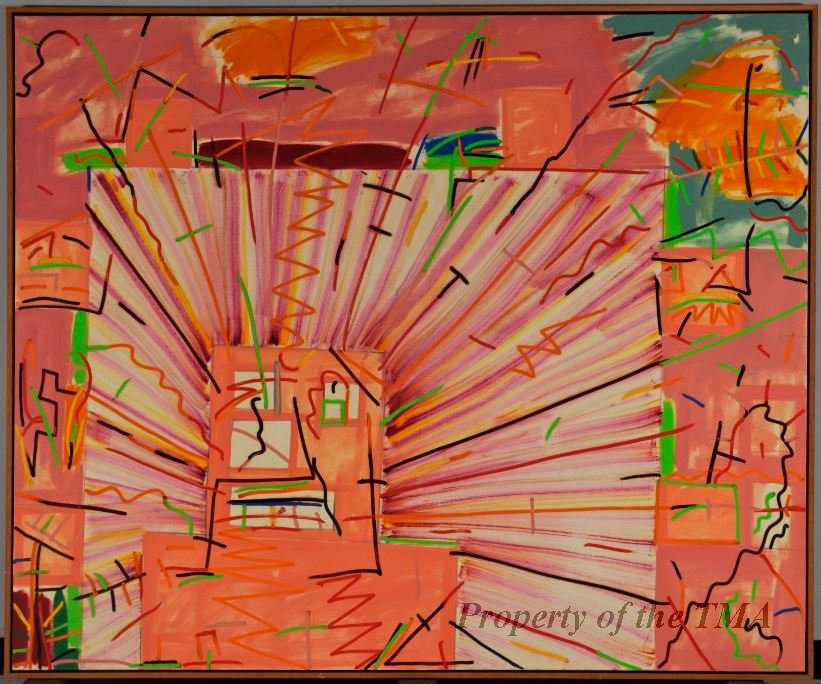
Dick Wray, Untitled, 1979, oil on canvas, 65 inches X 79.25 inches, Tyler Museum of Art, Tyler, Texas
Culture: American
Subject: Fine Art, Art History
Collection: Tyler Museum of Art’s Permanent Collection
Grades: Elementary School, Middle School and High School
Topics: Artistic Practices, Art History, Critical Thinking, Abstract Expressionism, Artist Statement
Art Vocabulary
Activity Vocabulary:
Dick Wray
- Dick Wray was born in 1933 and died in 2011.[1]
- As a teenager, he studied art at the Museum of Fine Arts in Houston.[2]
- He served in the United States Army between 1953 – 1955.[3]
- After serving in the army, he enrolled at the University of Houston’s School of Architecture where he studied for three years.[4]
- To complete his studies, he traveled to the fine arts academy Kunstakademie Düsseldorf, located in Düsseldorf, Germany.[5]
- Wray learned how to strike a balance between abstraction, expressionism, and representative imagery. He paired these lessons with a wild manipulation of paint he learned from Paris and New York. The result was an Abstract Expressionist style.[6]
- He resisted being known as a Texas Artist. He preferred building a unique style that was intrinsic to him. This allowed his painting to stand out and bring him notoriety in the Houston art scene.[7]
- He had a lengthy exhibition record, vowing to be shown in an exhibition or gallery showcase every year of his artistic career.[8]
- In addition to his exhibitions, he was awarded prominent accolades, such as the National Endowment for the Arts Artist Grant.[9]
Untitled, 1979, Oil on Canvas
- Untitled is a bold exploration of how to layer paint on the canvas in a quick and responsive manner.[10]
- Designed to be a large painting, the work allows Wray to exhibit his full range of movement. He stood at the center of the piece and, with each line and color added, allows the motion of his fully extended arm to create the trajectory of the paint strokes.[11]
- A face and upper torso can vaguely be seen amongst the chaos of color. Built from rectangular elements, the figure appears to be the center of the larger explosion.
- The array of lines are contained by a larger rectangle that surrounds the figure.
- The outside of this containment is a wash of loose lines, shapes, and seemingly rudimentary color blocking.
- This finished piece rejects the neatness and control often found in painting.
- It has been noted that the gestured lines that dance across the composition could be a vague representation of Wray’s alter-ego named Mr. Crow. This character was a stick-figure bird wearing a top hat.[12]
Abstract Expressionism:
- Abstract Expressionism is an art movement where the artists decided to break away from traditional painting methods to instead focus on representing the human mind.[13]
- To create something that is not tangible, the artists used vivid colors, gestural lines, layered color fields, and expressive applications of pigment to evoke different psychological states.[14]
- Developing after World War II, the Abstract Expressionists initially wanted to express their fears, frustrations, and sorrow about the aftermath of the war. The movement evolved into an examination of the human experience.[15]
- Dick Wray’s work falls within the gesture style of Abstract Expressionism.
Elements of Design[16]:
- Artists use the elements of design to create the foundation of the artwork. The elements of art include: line, shape, form, space, color, and texture.
Line:
- An element of design; line is created on a surface with a pointed moving tool. Lines can range in size, width, texture, and presentation. Common types of line are vertical, horizontal, diagonal, zig-zag, and curved.
Shape:
- An element of design; shape is a two-dimensional enclosed space that represents either an organic shape or a geometric shape. Geometric shapes include squares, circles, rectangles, triangles and other standard geometric shapes. Organic shapes include natural non-geometric shapes that are developed from curvilinear lines.
Form:
- An element of design; form is a three-dimensional enclosed space that represents organic and geometric shapes in a third space. Geometric forms include cubes, spheres, triangular prisms, rectangular prisms, and cones. Organic shapes include three-dimensional forms observed in nature, such as trees, rivers, and rocks.
Space:
- An element of design; this term defines the surface area between, before, and behind an object in a composition.
Color:
- An element of design; this term defines the pigments used in a painting. Color can be organized into categories, such as: hues, values, complements, and intensity.
Texture:
- An element of design; this term defines an artwork’s surface. The artist’s use of the chosen medium creates either implied or actual texture.
Principles of Design[17]:
- Artists used principles of design to build upon the foundational elements of design. This includes the following: rhythm, movement, balance, proportion, variety, emphasis, and unity.
Rhythm/ Pattern:
- A principle of design; this term defines the repetitive imagery and elements of design found in a composition.
Movement:
- A principle of design; this term defines the visual movement observed in a painting. This can be identified as kinetic movement or implied movement. Additionally, movement can be defined as how the viewer’s eye moves throughout the composition.
Balance:
- A principle of design; this term defines the arrangement of the presented imagery with the elements of design. It refers to either asymmetrical compositions or symmetrical compositions.
Proportion:
- A principle of design; this term defines the comparative size between objects in the composition. It can refer to the imagery within a painting or the size between a sculpture and a real object.
Variety:
- A principle of design; this term defines the combination of imagery, objects, and ideas in an artwork.
Emphasis:
- A principle of design; this term defines the most prominent area in a composition. The viewer’s eye is drawn to this point because the artist used a mixture of the elements and principles of design.
Unity:
- A principle of design; this term defines how the elements and principles of design are combined within a composition.
[1] “Dick Wray (1933 – 2011)”, Foltz Gallery, updated 2023, accessed August 11, 2025, https://foltzgallery.com/artist/dick-wray#biography.
[2] Ibid.
[3] Ibid.
[4] Ibid.
[5] Ibid.
[6] Katie Robinson Edwards, “The 1950’s and Houston”, in Midcentury Modern Art in Texas, (Austin: University of Texas Press, 2014), 201.
[7] Ibid.
[8] Bill Davenport, “Dick Wray, 1933 – 2011”, Glasstire Magazine, updated January 9, 2011, accessed August 11, 2025, https://glasstire.com/2011/01/09/dick-wray-1933-2011/.
[9] “Dick Wray (1933 – 2011)”, Foltz Gallery, updated 2023, accessed August 11, 2025, https://foltzgallery.com/artist/dick-wray#biography.
[10] Ned Rifkin, “Dick Wray”, in Response: An Exhibition Organized by the Tyler Museum of Art: February 9 – March, 1980, (Tyler: Tyler Museum of Art, 1980), 12 – 13.
[11] Ibid.
[12] Ibid.
[13] Stella Paul, “Abstract Expressionism”, The Metropolitan Museum of Art, updated October 1, 2004, accessed August 12, 2025, https://www.metmuseum.org/essays/abstract-expressionism.
[14] Ibid.
[15] Ibid.
[16] Rosalins Ragan, “Elements of Art,” in Art Talk, 61 – 211, edited by Bennett and McKnight Division, (San Francisco: Glencoe Publishing Company, 1988).
[17] Rosalins Ragan, “Principles of Design,” in Art Talk, 211 – 347, edited by Bennett and McKnight Division, (San Francisco: Glencoe Publishing Company, 1988).
Bibliography: Resources for Vocabulary and Lesson Plan
Davenport, Bill. “Dick Wray, 1933 – 2011”. Glasstire Magazine. Updated January 9, 2011. Accessed August 11, 2025. https://glasstire.com/2011/01/09/dick-wray-1933-2011/.
“Dick Wray (1933 – 2011)”. Foltz Gallery. Updated 2023. Accessed August 11, 2025. https://foltzgallery.com/artist/dick-wray#biography.
Edwards, Katie Robinson. “The 1950’s and Houston”. In Midcentury Modern Art in Texas. Austin: University of Texas Press, 2014.
Office of the Secretary of State. “§117.102: Art, Kindergarten, Adopted 2013.” Texas Education Agency: Education, updated 2013, accessed January 5, 2022, https://texreg.sos.state.tx.us/public/readtac$ext.TacPage?sl=R&app=9&p_dir=&p_rloc=&p_tloc=&p_ploc=&pg=1&p_tac=&ti=19&pt=2&ch=117&rl=102.
Office of the Secretary of State. “§117.105: Art, Grade 1, Adopted 2013.” Texas Education Agency: Education, updated 2013, accessed January 5, 2022, https://texreg.sos.state.tx.us/public/readtac$ext.TacPage?sl=R&app=9&p_dir=&p_rloc=&p_tloc=&p_ploc=&pg=1&p_tac=&ti=19&pt=2&ch=117&rl=105.
Office of the Secretary of State. “§117.108: Art, Grade 2, Adopted 2013.” Texas Education Agency: Education, updated 2013, accessed January 5, 2022, https://texreg.sos.state.tx.us/public/readtac$ext.TacPage?sl=R&app=9&p_dir=&p_rloc=&p_tloc=&p_ploc=&pg=1&p_tac=&ti=19&pt=2&ch=117&rl=108.
Office of the Secretary of State. “§117.111: Art, Grade 3, Adopted 2013.” Texas Education Agency: Education, updated 2013, accessed January 5, 2022, https://texreg.sos.state.tx.us/public/readtac$ext.TacPage?sl=R&app=9&p_dir=&p_rloc=&p_tloc=&p_ploc=&pg=1&p_tac=&ti=19&pt=2&ch=117&rl=111.
Office of the Secretary of State. “§117.114: Art, Grade 4, Adopted 2013.” Texas Education Agency: Education, updated 2013, accessed January 5, 2022, https://texreg.sos.state.tx.us/public/readtac$ext.TacPage?sl=R&app=9&p_dir=&p_rloc=&p_tloc=&p_ploc=&pg=1&p_tac=&ti=19&pt=2&ch=117&rl=114.
Office of the Secretary of State. “§117.117: Art, Grade 5, Adopted 2013.” Texas Education Agency: Education, updated 2013, accessed January 5, 2022, https://texreg.sos.state.tx.us/public/readtac$ext.TacPage?sl=R&app=9&p_dir=&p_rloc=&p_tloc=&p_ploc=&pg=1&p_tac=&ti=19&pt=2&ch=117&rl=117.
Office of the Secretary of State. “§117.202: Art, Middle School 1, Adopted 2013.” Texas Education Agency: Education, updated 2013, accessed January 5, 2022, https://texreg.sos.state.tx.us/public/readtac$ext.TacPage?sl=R&app=9&p_dir=&p_rloc=&p_tloc=&p_ploc=&pg=1&p_tac=&ti=19&pt=2&ch=117&rl=202.
Office of the Secretary of State. “§117.203: Art, Middle School 2, Adopted 2013.” Texas Education Agency: Education, updated 2013, accessed January 5, 2022, https://texreg.sos.state.tx.us/public/readtac$ext.TacPage?sl=R&app=9&p_dir=&p_rloc=&p_tloc=&p_ploc=&pg=1&p_tac=&ti=19&pt=2&ch=117&rl=203.
Office of the Secretary of State. “§117.204: Art, Middle School 3, Adopted 2013.” Texas Education Agency: Education, updated 2013, accessed January 5, 2022, https://texreg.sos.state.tx.us/public/readtac$ext.TacPage?sl=R&app=9&p_dir=&p_rloc=&p_tloc=&p_ploc=&pg=1&p_tac=&ti=19&pt=2&ch=117&rl=204.
Office of the Secretary of State. “§117.302: Art, Level I, Adopted 2013.” Texas Education Agency: Education, updated 2013, accessed January 5, 2022, https://texreg.sos.state.tx.us/public/readtac$ext.TacPage?sl=R&app=9&p_dir=&p_rloc=&p_tloc=&p_ploc=&pg=1&p_tac=&ti=19&pt=2&ch=117&rl=302.
Office of the Secretary of State. “§117.303: Art, Level II, Adopted 2013.” Texas Education Agency: Education, updated 2013, accessed January 5, 2022, https://texreg.sos.state.tx.us/public/readtac$ext.TacPage?sl=R&app=9&p_dir=&p_rloc=&p_tloc=&p_ploc=&pg=1&p_tac=&ti=19&pt=2&ch=117&rl=303.
Office of the Secretary of State. “§117.304: Art, Level III, Adopted 2013.” Texas Education Agency: Education, updated 2013, accessed January 5, 2022, https://texreg.sos.state.tx.us/public/readtac$ext.TacPage?sl=R&app=9&p_dir=&p_rloc=&p_tloc=&p_ploc=&pg=1&p_tac=&ti=19&pt=2&ch=117&rl=304.
Office of the Secretary of State. “§117.305: Art, Level IV, Adopted 2013.” Texas Education Agency: Education, updated 2013, accessed January 5, 2022, https://texreg.sos.state.tx.us/public/readtac$ext.TacPage?sl=R&app=9&p_dir=&p_rloc=&p_tloc=&p_ploc=&pg=1&p_tac=&ti=19&pt=2&ch=117&rl=305.
Paul, Stella. “Abstract Expressionism”. The Metropolitan Museum of Art. Updated October 1, 2004. Accessed August 12, 2025. https://www.metmuseum.org/essays/abstract-expressionism.
Ragan, Rosalins. “Elements of Art.” In Art Talk, 61 – 211. Edited by Bennett and McKnight Division. San Francisco: Glencoe Publishing Company, 1988.
Ragan, Rosalins. “The Principles of Design.” In Art Talk, 211 – 347. Edited by Bennett and McKnight Division. San Francisco: Glencoe Publishing Company, 1988.
Rifkin, Ned. “Dick Wray”. In Response: An Exhibition Organized by the Tyler Museum of Art: February 9 – March, 1980. Tyler: Tyler Museum of Art, 1980.
High School Lesson Plan: National Learning Standards
Goals:
High School Students of all Levels will be able to do the following:
- Identify the principles of design used in the artwork;
- Identify the elements of design used in the artwork;
- Discuss Abstract Expressionism with a specific focus on the Gesture style;
- Discuss Dick Wray’s artwork Untitled and how he uses Abstract Expressionism in this composition;
- Create an Abstract Expressionist painting that uses the Gesture style;
- And, write an artist statement that explains the decisions made to create the painting.
National Learning Standards for Visual Arts:
High School Proficient, High School Accomplished, and High School Advanced
High School Proficient
- Creating
- Anchor Standard 1
- Creating: Generate and conceptualize artistic ideas and work.
- VA:Cr1.1.Ia: Use multiple approaches to begin creative endeavors.
- VA:Cr1.2.Ia: Shape an artistic investigation of an aspect of present-day life using a contemporary practice of art or design.
- Creating: Generate and conceptualize artistic ideas and work.
- Anchor Standard 2
- Creating: Organize and develop artistic ideas and work.
- VA:Cr2.1.Ia: Engage in making a work of art or design without having a preconceived plan.
- Creating: Organize and develop artistic ideas and work.
- Anchor Standard 3
- Creating: Refine and complete artistic work.
- VA:Cr3.1.Ia: Apply relevant criteria from traditional and contemporary cultural contexts to examine, reflect on, and plan revisions for works of art and design in progress.
- Creating: Refine and complete artistic work.
- Anchor Standard 1
- Responding
- Anchor Standard 8
- Responding: Interpret intent and meaning in artistic work.
- VA:Re8.1.Ia: Interpret an artwork or collection of works, supported by relevant and sufficient evidence found in the work and its various contexts.
- Responding: Interpret intent and meaning in artistic work.
- Anchor Standard 9
- Responding: Apply criteria to evaluate artistic work.
- VA:Re9.1.Ia: Establish relevant criteria in order to evaluate a work of art or collection of works.
- Responding: Apply criteria to evaluate artistic work.
- Anchor Standard 8
- Connecting
- Anchor Standard 10
- Connecting: Synthesize and relate knowledge and personal experiences to make art.
- VA:Cn10.1.Ia: Document the process of developing ideas from early stages to fully elaborated ideas.
- Connecting: Synthesize and relate knowledge and personal experiences to make art.
- Anchor Standard 11
- Connecting: Relate artistic ideas and works with societal, cultural, and historical context to deepen understanding
- VA:Cn11.1.Ia: Describe how knowledge of culture, traditions, and history may influence personal responses to art.
- Connecting: Relate artistic ideas and works with societal, cultural, and historical context to deepen understanding
- Anchor Standard 10
High School Accomplished
- Creating
- Anchor Standard 1
- Creating: Generate and conceptualize artistic ideas and work.
- VA:Cr1.1.IIa: Individually or collaboratively formulate new creative problems based on student’s existing artwork.
- VA:Cr1.2.IIa: Choose from a range of materials and methods of traditional and contemporary artistic practices to plan works of art and design.
- Creating: Generate and conceptualize artistic ideas and work.
- Anchor Standard 2
- Creating: Organize and develop artistic ideas and work.
- VA:Cr2.1.IIa: Through experimentation, practice, and persistence, demonstrate acquisition of skills and knowledge in a chosen art form.
- Creating: Organize and develop artistic ideas and work.
- Anchor Standard 1
- Presenting
- Anchor Standard 6
- Presenting: Convey meaning through the presentation of artistic work.
- VA:Pr6.1.IIa: Make, explain, and justify connections between artists or artwork and social, cultural, and political history.
- Presenting: Convey meaning through the presentation of artistic work.
- Anchor Standard 6
- Responding
- Anchor Standard 7
- Responding: Perceive and analyze artistic work
- VA:Re.7.1.IIa: Recognize and describe personal aesthetic and empathetic responses to the natural world and constructed environments.
- VA:Re.7.2.IIa: Evaluate the effectiveness of an image or images to influence ideas, feelings, and behaviors of specific audiences.
- Responding: Perceive and analyze artistic work
- Anchor Standard 8
- Responding: Interpret intent and meaning in artistic work.
- VA:Re8.1.IIa: Identify types of contextual information useful in the process of constructing interpretations of an artwork or collection of works.
- Responding: Interpret intent and meaning in artistic work.
- Anchor Standard 9
- Responding: Apply criteria to evaluate artistic work.
- VA:Re9.1.IIa: Determine the relevance of criteria used by others to evaluate a work of art or collection of works.
- Responding: Apply criteria to evaluate artistic work.
- Anchor Standard 7
- Connecting
- Anchor Standard 10
- Connecting: Synthesize and relate knowledge and personal experiences to make art.
- VA:Cn10.1.IIa: Utilize inquiry methods of observation, research, and experimentation to explore unfamiliar subjects through art-making.
- Connecting: Synthesize and relate knowledge and personal experiences to make art.
- Anchor Standard 11
- Connecting: Relate artistic ideas and works with societal, cultural, and historical context to deepen understanding
- VA:Cn11.1.IIa: Compare uses of art in a variety of societal, cultural, and historical contexts and make connections to uses of art in contemporary and local contexts.
- Connecting: Relate artistic ideas and works with societal, cultural, and historical context to deepen understanding
- Anchor Standard 10
High School Advanced
- Creating
- Anchor Standard 1
- Creating: Generate and conceptualize artistic ideas and work.
- VA:Cr1.1.IIIa: Visualize and hypothesize to generate plans for ideas and directions for creating art and design that can affect social change.
- VA:Cr1.2.IIIa: Choose from a range of materials and methods of traditional and contemporary artistic practices, following or breaking established conventions, to plan the making of multiple works of art and design based on a theme, idea, or concept.
- Creating: Generate and conceptualize artistic ideas and work.
- Anchor Standard 2
- Creating: Organize and develop artistic ideas and work.
- VA:Cr2.1.IIIa: Experiment, plan, and make multiple works of art and design that explore a personally meaningful theme, idea, or concept.
- VA:Cr2.3.IIIa: Demonstrate in works of art or design how visual and material culture defines, shapes, enhances, inhibits, and/or empowers people’s lives.
- Creating: Organize and develop artistic ideas and work.
- Anchor Standard 3
- Creating: Refine and complete artistic work.
- VA:Cr3.1.IIIa: Reflect on, re-engage, revise, and refine works of art or design considering relevant traditional and contemporary criteria as well as personal artistic vision.
- Creating: Refine and complete artistic work.
- Anchor Standard 1
- Presenting
- Anchor Standard 4
- Presenting: Select, analyze, and interpret artistic work for presentation.
- VA: Pr4.1.IIIa: Critique, justify, and present choices in the process of analyzing, selecting, curating, and presenting artwork for a specific exhibit or event.
- Presenting: Select, analyze, and interpret artistic work for presentation.
- Anchor Standard 4
- Responding
- Anchor Standard 7
- Responding: Perceive and analyze artistic work
- VA:Re.7.1.IIIa: Analyze how responses to art develop over time based on knowledge of and experience with art and life.
- VA:Re.7.2.IIIa: Determine the commonalities within a group of artists or visual images attributed to a particular type of art, timeframe, or culture.
- Responding: Perceive and analyze artistic work
- Anchor Standard 8
- Responding: Interpret intent and meaning in artistic work.
- VA:Re8.1.IIIa: Analyze differing interpretations of an artwork or collection of works in order to select and defend a plausible critical analysis.
- Responding: Interpret intent and meaning in artistic work.
- Anchor Standard 9
- Responding: Apply criteria to evaluate artistic work.
- VA:Re9.1.IIIa: Construct evaluations of a work of art or collection of works based on differing sets of criteria.
- Responding: Apply criteria to evaluate artistic work.
- Anchor Standard 7
- Connecting
- Anchor Standard 10
- Connecting: Synthesize and relate knowledge and personal experiences to make art.
- VA:Cn10.1.IIIa: Synthesize knowledge of social, cultural, historical, and personal life with art-making approaches to create meaningful works of art or design.
- Connecting: Synthesize and relate knowledge and personal experiences to make art.
- Anchor Standard 11
- Connecting: Relate artistic ideas and works with societal, cultural, and historical context to deepen understanding
- VA:Cn11.1.IIIa: Appraise the impact of an artist or a group of artists on the beliefs, values, and behaviors of a society.
- Connecting: Relate artistic ideas and works with societal, cultural, and historical context to deepen understanding
- Anchor Standard 10
High School Lesson Plan: Texas Essential Knowledge and Skills (TEKS)
Goals:
High School Students of all Levels will be able to do the following:
- Identify the principles of design used in the artwork;
- Identify the elements of design used in the artwork;
- Discuss Abstract Expressionism with a specific focus on the Gesture style;
- Discuss Dick Wray’s artwork Untitled and how he uses Abstract Expressionism in this composition;
- Create an Abstract Expressionist painting that uses the Gesture style;
- And, write an artist statement that explains the decisions made to create the painting.
Texas High School TEKS:
Art Level I, Level II, Level III, and Level IV
Level I
- §117.302.c.1.A / B / C / D
- Foundations: Observation and Perception:
- consider concepts and ideas from direct observation, original sources, experiences, and imagination for original artwork;
- identify and understand the elements of art, including line, shape, color, texture, form, space, and value, as the fundamentals of art in personal artwork;
- identify and understand the principles of design, including emphasis, repetition/pattern, movement/rhythm, contrast/variety, balance, proportion, and unity, in personal artwork;
- make judgments about the expressive properties such as content, meaning, message, and metaphor of artwork using art vocabulary accurately.
- Foundations: Observation and Perception:
- §117.302.c.2.A / D / F
- Creative Expression:
- use visual solutions to create original artwork by problem solving through direct observation, original sources, experiences, narrations, and imagination;
- create original artwork to communicate thoughts, feelings, ideas, or impressions;
- demonstrate effective use of art media and tools in drawing, painting, printmaking, sculpture, ceramics, fiber art, design, and digital art and media.
- Creative Expression:
- §117.302.c.3.A / B
- Historical and Cultural Relevance
- compare and contrast historical and contemporary styles while identifying general themes and trends;
- describe general characteristics in artwork from a variety of cultures, which might also include personal identity and heritage;
- Historical and Cultural Relevance
- §117.302.c.4.A / D
- Critical Evaluation and Response
- interpret, evaluate, and justify artistic decisions in artwork by self, peers, and other artists such as that in museums, local galleries, art exhibits, and websites;
- select and analyze original artwork, portfolios, and exhibitions to form precise conclusions about formal qualities, historical and cultural contexts, intentions, and meanings.
- Critical Evaluation and Response
Level II
- §117.303.c.1.A / B / C / D
- Foundations: Observation and Perception:
- use visual comparisons to illustrate concepts and ideas from direct observation, original sources, experiences, narration, and imagination for original artworks;
- identify and apply the elements of art, including line, shape, color, texture, form, space, and value, as the fundamentals of art in personal artworks;
- identify and apply the principles of design, including emphasis, repetition/pattern, movement/rhythm, contrast/variety, balance, proportion, and unity in personal artworks;
- explore suitability of art media and processes to express specific ideas such as content, meaning, message, appropriation, and metaphor relating to visual themes of artworks using art vocabulary accurately.
- Foundations: Observation and Perception:
- §117.303.c.2.A / D / F
- Creative Expression:
- create original artwork using multiple solutions from direct observation, original sources, experiences, and imagination in order to expand personal themes that demonstrate artistic intent;
- create original artwork to communicate thoughts, feelings, ideas, or impressions;
- select from a variety of art media and tools to communicate specific ideas in drawing, painting, printmaking, sculpture, ceramics, fiber art, jewelry, mixed media, photography, and digital art and media.
- Creative Expression:
- §117.303.c.3.A / B
- Historical and Cultural Relevance:
- examine selected historical periods or styles of art to identify general themes and trends;
- analyze specific characteristics in artwork from a variety of cultures;
- Historical and Cultural Relevance:
- §117.303.c.4.A / B / C / E
- Critical Evaluation and Response:
- interpret, evaluate, and justify artistic decisions in artwork by self, peers, and other artists such as that in museums, local galleries, art exhibits, and websites;
- evaluate and analyze artwork using a method of critique such as describing the artwork, analyzing the way it is organized, interpreting the artist’s intention, and evaluating the success of the artwork;
- use responses to artwork critiques to make decisions about future directions in personal work;
- select and analyze original artwork, portfolios, and exhibitions to form precise conclusions about formal qualities, historical and cultural contexts, intentions, and meanings.
- Critical Evaluation and Response:
Level III
- §117.304.c.1.A / B / C / D
- Foundations: Observation and Perception:
- analyze visual characteristics of sources to illustrate concepts, demonstrate flexibility in solving problems, create multiple solutions, and think imaginatively;
- compare and contrast the elements of art, including line, shape, color, texture, form, space, and value, as the fundamentals of art in personal artwork;
- compare and contrast the principles of design, including emphasis, repetition/pattern, movement/rhythm, contrast/variety, balance, proportion, and unity, in personal artwork;
- explore the suitability of art media and processes and select those appropriate to express specific ideas such as content, meaning, message, and metaphor relating to visual themes to interpret the expressive qualities of artwork.
- Foundations: Observation and Perception:
- §117.304.c.2.A / D / F
- Creative Expression:
- create original artwork using multiple solutions from direct observation, original sources, experiences, and imagination in order to expand personal themes that demonstrate artistic intent;
- create original artwork to communicate thoughts, feelings, ideas, or impressions;
- select from a variety of art media and tools to express intent in drawing, painting, printmaking, sculpture, ceramics, fiber art, design, digital art and media, photography, jewelry, and mixed media.
- Creative Expression:
- §117.304.c.3.A / B
- Historical and Cultural Relevance:
- research selected historical periods, artists, general themes, trends, and styles of art;
- distinguish the correlation between specific characteristics and influences of various cultures and contemporary artwork;
- Historical and Cultural Relevance:
- §117.304.c.4.A / B / C / D
- Critical Evaluation and Response:
- interpret, evaluate, and justify artistic decisions in artwork such as that in museums, local galleries, art exhibits, and websites based on evaluation of developmental progress, competency in problem solving, and a variety of visual ideas;
- evaluate and analyze artwork using a method of critique such as describing the artwork, analyzing the way it is organized, interpreting the artist’s intention, and evaluating the success of the artwork;
- analyze personal artwork in order to create a written response such as an artist’s statement reflecting intent, inspiration, the elements of art and principles of design within the artwork, and measure of uniqueness;
- use responses to artwork critiques to make decisions about future directions in personal work;
- Critical Evaluation and Response:
Level IV
- §117.305.c.1.A / B / C / D
- Foundations: Observation and Perception:
- consider concepts and themes for personal artwork that integrate an extensive range of visual observations, experiences, and imagination;
- compare and contrast the elements of art, including line, shape, color, texture, form, space, and value, as the fundamentals of art in personal artwork;
- compare and contrast the principles of design, including emphasis, repetition/pattern, movement/rhythm, contrast/variety, balance, proportion, and unity, in personal artwork;
- discriminate between art media and processes to express complex visual relationships such as content, meaning, message, and metaphor using extensive art vocabulary.
- Foundations: Observation and Perception:
- §117.305.c.2.A / D / F
- Creative Expression:
- produce an original body of artwork that integrates information from a variety of sources, including original sources, and demonstrates sustained self-directed investigations into specific themes such as a series or concentration of works;
- create original artwork to communicate thoughts, feelings, ideas, or impressions;
- create artwork, singularly and in a series, by selecting from a variety of art materials and tools appropriate to course work in drawing, painting, printmaking, sculpture, ceramics, fiber art, design, digital art and media, photography, jewelry, and mixed media.
- Creative Expression:
- §117.305.c.3.A / B
- Historical and Cultural Relevance:
- research and report on selected historical periods, artists, general themes, trends, and styles of art;
- analyze and evaluate the influence of contemporary cultures on artwork;
- Historical and Cultural Relevance:
- §117.305.c.4.A / B / C / D
- Critical Evaluation and Response:
- develop evaluative criteria to justify artistic decisions in artwork such as that in museums, local galleries, art exhibits, and websites based on a high level of creativity and expertise in one or more art areas;
- evaluate and analyze artwork using a method of critique such as describing the artwork, analyzing the way it is organized, interpreting the artist’s intention, and evaluating the success of the artwork;
- analyze personal artwork in order to create a written response such as an artist’s statement reflecting intent, inspiration, the elements of art and principles of design within the artwork, and the measure of uniqueness;
- use responses to artwork critiques to make decisions about future directions in personal work;
- Critical Evaluation and Response:
High School Art Activities
Questions for High School Students:
- Examine Dick Wray’s painting Untitled. Identify where each element of art is located in the artwork.
- Examine Dick Wray’s painting Untitled. Identify where each principle of art is located in the artwork.
- What is Abstract Expressionism?
- Explain the gesture style found within this art movement.
- Why do you think an artist would choose to name their Abstract Expressionist artwork Untitled?
- Do you think Wray’s work is successful in its use of the gesture style? Explain your answer.
Activity: High School Fine Arts
- Activity Setting: Classroom and/or outdoor location
- Materials: Oil Paint or Acrylic Paint
- Subject: Painting, Abstract Expressionism
- National Learning Standard in Visual Arts: High School Proficient, high School Accomplished, and High School Advanced
- Texas TEKS: Art Level I, Level II, Level III, and Level IV
- Duration: Extended Project
The students will study the Abstract Expressionism found in Dick Wray’s painting Untitled. They will learn about his gesture style of painting and his painting philosophy. After discussions, the class will create their own Abstract Expressionist painting.
The students will make a plan of how they will construct their compositions. The final product does not need to look exactly like the draft. Instead, it will help them determine the best way to incorporate the elements and principles of design together.
Once the drafts are completed and approved by the teacher, the students can begin painting. The teacher can choose allow the project to be completed with oil paints or acrylic paints. The students will paint in the gesture style of Abstract Expressionism to create a unique piece.
Activity: High School Art History
- Activity Setting: Classroom
- Materials: Pencil/ Pen on Paper or Word Document
- Subject: Painting, Abstract Expressionism, Artist Statement
- National Learning Standard in Visual Arts: High School Proficient, high School Accomplished, and High School Advanced
- Texas TEKS: Art Level I, Level II, Level III, and Level IV
- Duration: Extended Project
Once the students have completed their compositions, they will write an artist statement. They need to answer the following questions:
- Did you have an inspiration for this piece? Yes or no?
- If you did have an inspiration, explain how it helped you plan the exhibition.
- If you did not have an inspiration, explain how you designed this composition without this guidance.
- Explain how you incorporated the elements and principles of design into this composition.
- Did you find it difficult working in Abstract Expressionism? Why or why not?
- Would you continue to work in an Abstract Expressionist style? Why or why not?
For more educational resources created by the Tyler Museum of Art, visit our YouTube page by clicking on the YouTube button or clicking the link below.

And stay updated with the Tyler Museum of Art’s events by visiting our Facebook and Instagram pages:


If you use or references this lesson plan, please leave a comment with your feedback.
Thank you for visiting the Tyler Museum of Art’s Education Blog!
 Tyler Museum of Art Education Blog