This lesson plan was researched and written by Kaylee Marcil, a Fall 2025 University of Texas at Tyler Intern at the Tyler Museum of Art. The lesson plan was edited by Rachel Anthony, the Tyler Museum of Art’s Education Manager.
This lesson plan contains the National Learning Standards for Visual Arts and the Texas TEKS for Elementary, Middle, and High School art teachers. The students will study the printmaking style found in Jack Beal’s Pond Lilies.
If you use or reference this lesson plan, please leave a comment with your feedback. The lesson plan can be downloaded in the link below.
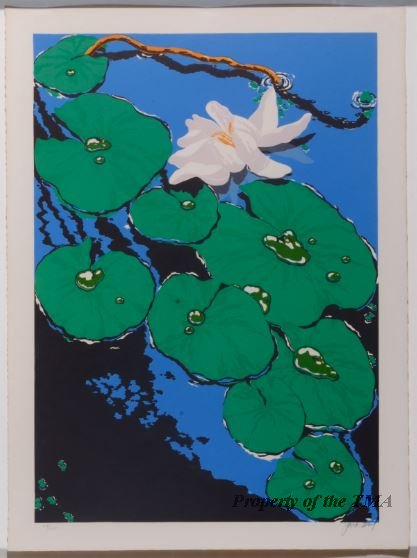
Jack Beal, Pond Lilies, 1971, lithograph, 30 inches X 22.125 inches, Tyler Museum of Art, Tyler, Texas.
Culture: American
Subject: Fine Art, Art History
Collection: Tyler Museum of Art’s Permanent Collection
Grades: Elementary School, Middle School and High School
Topics: Artistic Practices, Art History, Critical Thinking, Printmaking, and Lithography
Art Vocabulary
Activity Vocabulary:
Jack Beal
- He was born in Richmond, Virginia on June 25, 1931, and died on August 29, 2013, in Oneonta, New York.[1]
- He went to the College of William and Mary Norfolk Division Polytechnic Institute from 1950 to 1953, where he majored in biology and anatomy.[2]
- In 1953 he moved to Chicago and began studying at the School of the Art Institute of Chicago.[3]
- He met his wife, Sondra Freckelton, at the Art Institute. They got married in 1955 and moved to New York City a year later.[4]
- They were a part of the Artists Tenants Association, which was an organization that advocated for artists to have proper illuminated studios.[5]
- He was inspired by artists like Cezanne and Matisse.[6]
- Beal’s work began in the abstract expressionist style, but he moved to realism as he felt it was more relatable to life. [7]
- Seventeenth century Dutch art had a profound impact in how he liked to depict life and people.[8]
- He studied with artists like Kathleen Blackshear, Arshile Gorkey, and the “Wells Street Group.”[9]
- He contributed to the ‘New Realism’ movement of the 1960’s.[10]
- He experimented with flat colors in the late 60’s.[11]
- Beal completed a commission for the U.S. Department of Labor division in Washington, D.C. in 1977.[12]
- A History of Labor featured themes of colonization, settlement, industry, and technology.[13]
- In 1986, Beal embarked on an over fifteen-year journey to complete The Return of Spring with parts of it installed in 2001 and 2005.[14]
- His artwork can be found in New York, Virgina, Altana, Delaware, Washington D.C., Chicago, Minnesota, and California.[15]
Pond Lilies, 1971, Lithograph
- This is a print of a water lily flower with nine lily pads floating on top of a body of water.
- There are several water droplets across the lily pads, making them appear flat in nature.
- The flower petals appear to be wilting.
- The analogous blue and green colors appear both vibrant and flat.
- The white lily is the brightest point of the piece, which creates emphasis.
- Black shadows and white outlines around the lily pads show movement in the water.
- The diagonal angle of the two-dimensional lily pads makes the piece balanced with the flower at the top.
- Each color on this lithograph print would have been a separate layer, resulting in a seven-layer print.
A Move Towards Modernism
- Jack Beal experimented with both expressionistic and realistic painting at the same time. Previously, he abandoned abstraction in his art. He would later define himself as New Realist painter alongside other artists.[16]
- It was during the late 1960’s that he would develop a flat color style and make hard edge paintings. Hard edge paintings involve the use of flat colors with defined hard lines.[17]
- Modernism is a general term referencing twentieth century art after the 1960’s. Some key points of Modernism include moving away from Realism and favoring abstraction, use of flat colors and lines, and emphasis on the medium and process.[18]
- This artwork, Pond Lilies can be seen as a Modernist piece as it favors an abstraction of nature, experimentation with flat forms and colors, and a focus on material that requires a specific process.[19]
- After his experimentation with hard edge paintings, his realist friends rejected his new style, which caused him to paint natural figures again.[20]
- In the 1970’s he completed realistic and narrative murals that explored the social life in America.[21]
Activity Vocabulary:
- Printmaking is the process of transferring images across multiple surfaces. There is a wide range of methods.[22]
- A matrix is the material in which the images reside in, such as a linoleum plate or a woodblock. In the case of lithography, the matrix is a stone.[23]
- A lithograph is a printmaking method that uses a stone tablet, gum arabic, a lithograph crayon, oil and water to make a chemically reacted print.[24]
- Kitchen Lithography uses common household materials that mimic the printmaking method of traditional lithography. This is a great method for beginning artists who may not have access to professional grade materials, but still want an economic way of experiencing printmaking.[25]
- An edition is a total number of prints in a series.[26]
- A key is the primary outline that holds the image together and can be printed in the first or last layer in a multi-step print.[27]
- An ink slab is a surface used for mixing and rolling out ink.[28]
- A bead is a line of ink across the surface.
- A brayer is a hand roller tool used for inking.[29]
Elements of Design[30]:
- Artists use the elements of design to create the foundation of the artwork. The elements of art include: line, shape, form, space, color, and texture.
Line:
- An element of design; line is created on a surface with a pointed moving tool. Lines can range in size, width, texture, and presentation. Common types of line are vertical, horizontal, diagonal, zig-zag, and curved.
Shape:
- An element of design; shape is a two-dimensional enclosed space that represents either an organic shape or a geometric shape. Geometric shapes include squares, circles, rectangles, triangles and other standard geometric shapes. Organic shapes include natural non-geometric shapes that are developed from curvilinear lines.
Form:
- An element of design; form is a three-dimensional enclosed space that represents organic and geometric shapes in a third space. Geometric forms include cubes, spheres, triangular prisms, rectangular prisms, and cones. Organic shapes include three-dimensional forms observed in nature, such as trees, rivers, and rocks.
Space:
- An element of design; this term defines the surface area between, before, and behind an object in a composition.
Color:
- An element of design; this term defines the pigments used in a painting. Color can be organized into categories, such as: hues, values, complements, and intensity.
Texture:
- An element of design; this term defines an artwork’s surface. The artist’s use of the chosen medium creates either implied or actual texture.
Principles of Design[31]:
- Artists used principles of design to build upon the foundational elements of design. This includes the following: rhythm, movement, balance, proportion, variety, emphasis, and unity.
Rhythm/ Pattern:
- A principle of design; this term defines repetitive imagery and elements of design found in a composition.
Movement:
- A principle of design; this term defines the visual movement observed in a painting. This can be identified as kinetic movement or implied movement. Additionally, movement can be defined as how the viewer’s eye moves throughout the composition.
Balance:
- A principle of design; this term defines the arrangement of the presented imagery with the elements of design. It refers to either asymmetrical compositions or symmetrical compositions.
Proportion:
- A principle of design; this term defines the comparative size between objects in the composition. It can refer to the imagery within a painting or the size between a sculpture and a real object.
Variety:
- A principle of design; this term defines the combination of imagery, objects, and ideas in an artwork.
Emphasis:
- A principle of design; this term defines the most prominent area in a composition. The viewer’s eye is drawn to this point because the artist used a mixture of the elements and principles of design.
Unity:
- A principle of design; this term defines how the elements and principles of design are combined within a composition.
[1] “Jack Beal Biography,” The Annex Galleries, accessed August 12, 2025, https://www.annexgalleries.com/artists/biography/3945/Beal/Jack.
[2] “Beal, Jack (1931-2013),” The Johnson Collection, accessed August 12, 2025, https://thejohnsoncollection.org/jack-beal/.
[3] Ibid.
[4] Ibid.
[5] “Beal, Jack (1931-2013),” The Johnson Collection, accessed August 12, 2025, https://thejohnsoncollection.org/jack-beal/.
[6] Ibid.
[7] “Jack Beal (American, 1931-2013),” Bates College Museum of Art, accessed August 13, 2025, https://www.bates.edu/museum/exhibitions/jack-beal- biography/#:~:text=Jack%20Beal %20(American%2C%201931%2D,based%20on%20the%20human%20experience.
[8] Ibid.
[9] Jack Beal, “Oral history interview with Jack Beal,” interview by Paul Cummings, Archives of American Art, Smithsonian,
March 7, 1968, audio, https://www.si.edu/object/oral-history-interview-jack-beal-1968-march-27:AAADCD_oh_212000.
[10] “Jack Beal,” Minneapolis Institute of Art, accessed August 13, 2025, https://collections.artsmia.org/art/136914/buds-jack-beal.
[11] “Estate of Jack Beal,” George Adams Gallery, accessed August 13, 2025, https://www.georgeadamsgallery.com/artists/estate-of-jack-beal?view=slider#2.
[12] “The History of Labor in America, U.S. General Services Administration, accessed August 13, 2025, https://art.gsa.gov/artworks/23052/the-history-of-labor-in-america#:~:text=Beal’s%20goal%20was%20to%20depict,and%20bartering%20with%20two%20trappers.
[13] Ibid.
[14] “Estate of Jack Beal,” George Adams Gallery, accessed August 13, 2025, https://www.georgeadamsgallery.com/artists/estate-of-jack-beal?view=slider#2.
[15] Ibid.
[16] Ibid.
[17] “Hard Edge Painting,” Tate, accessed September 9, 2025, https://www.tate.org.uk/art/art-terms/h/hard-edge-painting.
[18] “Modernism,” Tate, accessed September 9, 2025, https://www.tate.org.uk/art/art-terms/m/modernism.
[19] Ibid.
[20] “Estate of Jack Beal,” George Adams Gallery, accessed September 9, 2025, https://www.georgeadamsgallery.com/artists/estate-of-jack-beal?view=slider#2.
[21] Ibid.
[22] “What is Printmaking,” The Metropolitan Museum of Art, accessed August 21, 2025 https://www.metmuseum.org/about-the-met/collection-areas/drawings-and-prints/materials-and-techniques/printmaking.
[23] Ibid.
[24] “Lithograph,” The Metropolitan Museum of Art, accessed August 19, 2025, https://www.metmuseum.org/about-the-met/collection-areas/drawings-and-prints/materials-and-techniques/printmaking/lithograph.
[25] Sadie Tierney, “Kitchen Litho,” accessed August 21, 2025, https://rableygallery.com/news/kitchen-litho-by-sadie-tierney/.
[26] “Printmaking through the Ages,” Utah Museum of Fine Arts, accessed September 2, 2025, https://umfa.utah.edu/sites/default/files/2017-10/Printmaking-through-the-Ages.pdf., 6.
[27] Holly Newnham, “Glossary of Printmaking Terminology,” Handprinted, posted September 12, 2019, accessed September 9, 2025, https://blog.handprinted.co.uk/2019/09/12/printmaking-terminology/#:~:text=Key%20block%20%E2%80%93%20the%20key%20layer,Shop%20for%20lino%20here.
[28] “Ink Slab,” accessed August 28, 2025, https://art-design-glossary.musabi.ac.jp/ink-slab/#:~:text=A%20printmaker%20uses%20an%20ink,slab%20and%20the%20ink%20stable.
[29] “Printmaking through the Ages,” Utah Museum of Fine Arts, accessed September 2, 2025, https://umfa.utah.edu/sites/default/files/2017-10/Printmaking-through-the-Ages.pdf., 6.
[30] Rosalins Ragan, “Elements of Art,” in Art Talk, 61 – 211, edited by Bennett and McKnight Division, (San Francisco: Glencoe Publishing Company, 1988).
[31] Rosalins Ragan, “Principles of Design,” in Art Talk, 211 – 347, edited by Bennett and McKnight Division, (San Francisco: Glencoe Publishing Company, 1988).
Bibliography: Resources for Vocabulary and Lesson Plan
Bates College Museum of Art. “Jack Beal (American, 1931-2013).” Accessed August 13, 2025. https://www.bates.edu/museum/exhibitions/jack-beal- biography/#:~:text=Jack%20Beal %20(American%2C%201931%2D,based%20on%20the%20human%20experience.
Beal, Jack. “Oral history interview with Jack Beal.” Interview by Paul Cummings. Archives of American Art, Smithsonian. March 7, 1968. Audio, https://www.si.edu/object/oral-history-interview-jack-beal-1968-march-27:AAADCD_oh_212000.
George Adams Gallery. “Estate of Jack Beal.” Accessed August 13, 2025. https://www.georgeadamsgallery.com/artists/estate-of-jack-beal?view=slider#2.
Hornbrook, Jessie. “Kitchen Lithography – Full Demo.” April 4, 2020. YouTube Video, 30:18, https://www.youtube.com/watch?v=n76zcF3JQW8.
Minneapolis Institute of Art. “Jack Beal.” Accessed August 13, 2025. https://collections.artsmia.org/art/136914/buds-jack-beal.
Musashino Art University. “Ink Slab.” Accessed August 28, 2025. https://art-design-glossary.musabi.ac.jp/ink-slab/#:~:text=A%20printmaker%20uses%20an%20ink,slab%20and%20the%20ink%20stable
Newnham, Holly. “Glossary of Printmaking Terminology.” Handprinted. Posted September 12, 2019. Accessed September 9, 2025. https://blog.handprinted.co.uk/2019/09/12/printmaking-terminology/#:~:text=Key%20block%20%E2%80%93%20the%20key%20layer,Shop%20for%20lino%20here.
Office of the Secretary of State. “§117.102: Art, Kindergarten, Adopted 2013.” Texas Education Agency: Education, updated 2013, accessed January 5, 2022, https://texreg.sos.state.tx.us/public/readtac$ext.TacPage?sl=R&app=9&p_dir=&p_rloc=&p_tloc=&p_ploc=&pg=1&p_tac=&ti=19&pt=2&ch=117&rl=102.
Office of the Secretary of State. “§117.105: Art, Grade 1, Adopted 2013.” Texas Education Agency: Education, updated 2013, accessed January 5, 2022, https://texreg.sos.state.tx.us/public/readtac$ext.TacPage?sl=R&app=9&p_dir=&p_rloc=&p_tloc=&p_ploc=&pg=1&p_tac=&ti=19&pt=2&ch=117&rl=105.
Office of the Secretary of State. “§117.108: Art, Grade 2, Adopted 2013.” Texas Education Agency: Education, updated 2013, accessed January 5, 2022, https://texreg.sos.state.tx.us/public/readtac$ext.TacPage?sl=R&app=9&p_dir=&p_rloc=&p_tloc=&p_ploc=&pg=1&p_tac=&ti=19&pt=2&ch=117&rl=108.
Office of the Secretary of State. “§117.111: Art, Grade 3, Adopted 2013.” Texas Education Agency: Education, updated 2013, accessed January 5, 2022, https://texreg.sos.state.tx.us/public/readtac$ext.TacPage?sl=R&app=9&p_dir=&p_rloc=&p_tloc=&p_ploc=&pg=1&p_tac=&ti=19&pt=2&ch=117&rl=111.
Office of the Secretary of State. “§117.114: Art, Grade 4, Adopted 2013.” Texas Education Agency: Education, updated 2013, accessed January 5, 2022, https://texreg.sos.state.tx.us/public/readtac$ext.TacPage?sl=R&app=9&p_dir=&p_rloc=&p_tloc=&p_ploc=&pg=1&p_tac=&ti=19&pt=2&ch=117&rl=114.
Office of the Secretary of State. “§117.117: Art, Grade 5, Adopted 2013.” Texas Education Agency: Education, updated 2013, accessed January 5, 2022, https://texreg.sos.state.tx.us/public/readtac$ext.TacPage?sl=R&app=9&p_dir=&p_rloc=&p_tloc=&p_ploc=&pg=1&p_tac=&ti=19&pt=2&ch=117&rl=117.
Office of the Secretary of State. “§117.202: Art, Middle School 1, Adopted 2013.” Texas Education Agency: Education, updated 2013, accessed January 5, 2022, https://texreg.sos.state.tx.us/public/readtac$ext.TacPage?sl=R&app=9&p_dir=&p_rloc=&p_tloc=&p_ploc=&pg=1&p_tac=&ti=19&pt=2&ch=117&rl=202.
Office of the Secretary of State. “§117.203: Art, Middle School 2, Adopted 2013.” Texas Education Agency: Education, updated 2013, accessed January 5, 2022, https://texreg.sos.state.tx.us/public/readtac$ext.TacPage?sl=R&app=9&p_dir=&p_rloc=&p_tloc=&p_ploc=&pg=1&p_tac=&ti=19&pt=2&ch=117&rl=203.
Office of the Secretary of State. “§117.204: Art, Middle School 3, Adopted 2013.” Texas Education Agency: Education, updated 2013, accessed January 5, 2022, https://texreg.sos.state.tx.us/public/readtac$ext.TacPage?sl=R&app=9&p_dir=&p_rloc=&p_tloc=&p_ploc=&pg=1&p_tac=&ti=19&pt=2&ch=117&rl=204.
Office of the Secretary of State. “§117.302: Art, Level I, Adopted 2013.” Texas Education Agency: Education, updated 2013, accessed January 5, 2022, https://texreg.sos.state.tx.us/public/readtac$ext.TacPage?sl=R&app=9&p_dir=&p_rloc=&p_tloc=&p_ploc=&pg=1&p_tac=&ti=19&pt=2&ch=117&rl=302.
Office of the Secretary of State. “§117.303: Art, Level II, Adopted 2013.” Texas Education Agency: Education, updated 2013, accessed January 5, 2022, https://texreg.sos.state.tx.us/public/readtac$ext.TacPage?sl=R&app=9&p_dir=&p_rloc=&p_tloc=&p_ploc=&pg=1&p_tac=&ti=19&pt=2&ch=117&rl=303.
Office of the Secretary of State. “§117.304: Art, Level III, Adopted 2013.” Texas Education Agency: Education, updated 2013, accessed January 5, 2022, https://texreg.sos.state.tx.us/public/readtac$ext.TacPage?sl=R&app=9&p_dir=&p_rloc=&p_tloc=&p_ploc=&pg=1&p_tac=&ti=19&pt=2&ch=117&rl=304.
Office of the Secretary of State. “§117.305: Art, Level IV, Adopted 2013.” Texas Education Agency: Education, updated 2013, accessed January 5, 2022, https://texreg.sos.state.tx.us/public/readtac$ext.TacPage?sl=R&app=9&p_dir=&p_rloc=&p_tloc=&p_ploc=&pg=1&p_tac=&ti=19&pt=2&ch=117&rl=305.
Ragan, Rosalins. “Elements of Art.” In Art Talk, 61 – 211. Edited by Bennett and McKnight Division. San Francisco: Glencoe Publishing Company, 1988.
Ragan, Rosalins. “The Principles of Design.” In Art Talk, 211 – 347. Edited by Bennett and McKnight Division. San Francisco: Glencoe Publishing Company, 1988.
Tate. “Hard Edge Painting.” Accessed September 9, 2025. https://www.tate.org.uk/art/art-terms/h/hard-edge-painting.
Tate. “Modernism.” Accessed September 9, 2025. https://www.tate.org.uk/art/art-terms/m/modernism.
The Annex Galleries. “Jack Beal Biography.” Accessed August 12, 2025. https://www.annexgalleries.com/artists/biography/3945/Beal/Jack.
The Johnson Collection. “Beal, Jack (1931-2013).” Accessed August 12, 2025. https://thejohnsoncollection.org/jack-beal/.
The Metropolitan Museum of Art. “Lithograph.” Accessed August 19, 2025. https://www.metmuseum.org/about-the-met/collection-areas/drawings-and-prints/materials-and-techniques/printmaking/lithograph.
The Metropolitan Museum of Art. “What is Printmaking.” Accessed August 21, 2025 https://www.metmuseum.org/about-the-met/collection-areas/drawings-and-prints/materials-and-techniques/printmaking.
Tierney, Sadie. “Kitchen Litho.” Accessed August 21, 2025. https://rableygallery.com/news/kitchen-litho-by-sadie-tierney/.
Tyler Museum of Art. “Browse Record: Pond Lilies.” Accessed August 12, 2025. https://tylermuseum.pastperfectonline.com/webobject/E2A40879-18A6-49AA-8DD4-110225230080.
U.S. General Services Administration. “The History of Labor in America.” Accessed August 13, 2025. https://art.gsa.gov/artworks/23052/the-history-of-labor-in-america#:~:text=Beal’s%20goal%20was%20to%20depict,and%20bartering%20with%20two%20trappers.
Utah Museum of Fine Arts. “Printmaking through the Ages.” Accessed September 2, 2025. https://umfa.utah.edu/sites/default/files/2017-10/Printmaking-through-the-Ages.pdf., 6.
Elementary School Lesson Plans: National Learning Standards
Goals:
Elementary School Students of all levels will be able to do the following:
- Identify the principles of design used in the artwork;
- Identify the elements of design used in the artwork;
- Create multiple copies of a two-dimensional image using mixed media;
- Be able to answer the question, “How is printmaking different from painting?”
National Learning Standards for Visual Arts:
Pre-Kindergarten, Kindergarten, First Grade, Second Grade, Third Grade, Fourth Grade, Fifth Grade
Pre-Kindergarten:
- Creating
- Anchor Standard 1
- Creating: Generate and conceptualize artistic ideas and work.
- VA:Cr1.1.Pka: Engage in self-directed play with materials;
- VA:Cr1.2.Pka: Engage in self-directed, creative making.
- Creating: Generate and conceptualize artistic ideas and work.
- Anchor Standard 2
- Creating: Organize and develop artistic ideas and work.
- VA:Cr2.1.PKa: Use a variety of artmaking tools;
- VA:Cr2.2.PKa: Share materials with others;
- VA:Cr2.3.PKa: Create and tell about art that communicates a story about a familiar place or object.
- Creating: Organize and develop artistic ideas and work.
- Anchor Standard 3
- Creating: Refine and complete artistic work.
- VA:Cr3.1.PKa: Share and talk about personal artwork.
- Creating: Refine and complete artistic work.
- Anchor Standard 1
- Responding
- Anchor Standard 7
- Responding: Perceive and analyze artistic work
- VA:Re.7.1.PKa: Recognize art in one’s environment.
- Responding: Perceive and analyze artistic work
- Anchor Standard 8
- Responding: Interpret intent and meaning in artistic work.
- VA:Re8.1.PKa: Interpret art by identifying and describing subject matter.
- Responding: Interpret intent and meaning in artistic work.
- Anchor Standard 7
- Connecting
- Anchor Standard 10
- Connecting: Synthesize and relate knowledge and personal experiences to make art.
- VA:Cn10.1.PKa: Explore the world using descriptive and expressive words and art-making.
- Connecting: Synthesize and relate knowledge and personal experiences to make art.
- Anchor Standard 11
- Connecting: Relate artistic ideas and works with societal, cultural, and historical context to deepen understanding
- VA:Cn11.1.PKa: Recognize that people make art.
- Connecting: Relate artistic ideas and works with societal, cultural, and historical context to deepen understanding
- Anchor Standard 10
Kindergarten:
- Creating
- Anchor Standard 1
- Creating: Generate and conceptualize artistic ideas and work.
- VA:Cr1.1.Ka: Engage in exploration and imaginative play with materials.
- VA:Cr1.2.Ka: Engage collaboratively in creative art-making in response to an artistic problem.
- Creating: Generate and conceptualize artistic ideas and work.
- Anchor Standard 2
- Creating: Organize and develop artistic ideas and work.
- VA:Cr2.1.Ka: Through experimentation, build skills in various media and approaches to art-making.
- VA:Cr2.2.Ka: Identify safe and non-toxic art materials, tools, and equipment.
- Creating: Organize and develop artistic ideas and work.
- Anchor Standard 3
- Creating: Refine and complete artistic work.
- VA:Cr3.1.Ka: Explain the process of making art while creating.
- Creating: Refine and complete artistic work.
- Anchor Standard 1
- Responding
- Anchor Standard 7
- Responding: Perceive and analyze artistic work
- VA:Re.7.1.Ka: Identify uses of art within one’s personal environment.
- VA:Re.7.2.Ka: Describe what an image represents.
- Responding: Perceive and analyze artistic work
- Anchor Standard 8
- Responding: Interpret intent and meaning in artistic work.
- VA:Re8.1.Ka: Interpret art by identifying subject matter and describing relevant details.
- Responding: Interpret intent and meaning in artistic work.
- Anchor Standard 9
- Responding: Apply criteria to evaluate artistic work.
- VA:Re9.1.Ka: Explain reasons for selecting a preferred artwork
- Responding: Apply criteria to evaluate artistic work.
- Anchor Standard 7
- Connecting
- Anchor Standard 11
- Connecting: Relate artistic ideas and works with societal, cultural, and historical context to deepen understanding
- VA:Cn11.1.Ka: Identify a purpose of an artwork.
- Connecting: Relate artistic ideas and works with societal, cultural, and historical context to deepen understanding
- Anchor Standard 11
First Grade
- Creating
- Anchor Standard 1
- Creating: Generate and conceptualize artistic ideas and work.
- VA:Cr1.1.1a: Engage collaboratively in exploration and imaginative play with materials.
- VA:Cr1.2.1a: Use observation and investigation in preparation for making a work of art.
- Creating: Generate and conceptualize artistic ideas and work.
- Anchor Standard 2
- Creating: Organize and develop artistic ideas and work.
- VA:Cr2.1.1a: Explore uses of materials and tools to create works of art or design.
- VA:Cr2.2.1a: Demonstrate safe and proper procedures for using materials, tools, and equipment while making art.
- Creating: Organize and develop artistic ideas and work.
- Anchor Standard 3
- Creating: Refine and complete artistic work.
- VA:Cr3.1.1a: Use art vocabulary to describe choices while creating art.
- Creating: Refine and complete artistic work.
- Anchor Standard 1
- Responding
- Anchor Standard 8
- Responding: Interpret intent and meaning in artistic work.
- VA:Re8.1.1a: Interpret art by categorizing subject matter and identifying the characteristics of form
- Responding: Interpret intent and meaning in artistic work.
- Anchor Standard 8
- Connecting
- Anchor Standard 11
- Connecting: Relate artistic ideas and works with societal, cultural, and historical context to deepen understanding
- VA:Cn11.1.1a: Understand that people from different places and times have made art for a variety of reasons.
- Connecting: Relate artistic ideas and works with societal, cultural, and historical context to deepen understanding
- Anchor Standard 11
Second Grade
- Creating
- Anchor Standard 1
- Creating: Generate and conceptualize artistic ideas and work.
- VA:Cr1.1.2a: Brainstorm collaboratively multiple approaches to an art or design problem
- VA:Cr1.2.2a: Make art or design with various materials and tools to explore personal interests, questions, and curiosity
- Creating: Generate and conceptualize artistic ideas and work.
- Anchor Standard 2
- Creating: Organize and develop artistic ideas and work.
- VA:Cr2.1.2a: Experiment with various materials and tools to explore personal interests in a work of art or design
- VA:Cr2.2.2a: Demonstrate safe procedures for using and cleaning art tools, equipment, and studio spaces
- Creating: Organize and develop artistic ideas and work.
- Anchor Standard 1
- Responding
- Anchor Standard 7
- Responding: Perceive and analyze artistic work
- VA:Re.7.1.2a: Perceive and describe aesthetic characteristics of one’s natural world and constructed environments
- Responding: Perceive and analyze artistic work
- Anchor Standard 8
- Responding: Interpret intent and meaning in artistic work.
- VA:Re8.1.2a: Interpret art by identifying the mood suggested by a work of art and describing relevant subject matter and characteristics of form
- Anchor standard 9
- Responding: Apply criteria to evaluate artistic work.
- VA:Re9.1.2a: Use learned art vocabulary to express preferences about artwork
- Responding: Apply criteria to evaluate artistic work.
- Responding: Interpret intent and meaning in artistic work.
- Anchor Standard 7
Third Grade
- Creating
- Anchor Standard 1
- Creating: Generate and conceptualize artistic ideas and work.
- VA:Cr1.1.3a: Elaborate on an imaginative idea.
- VA:Cr1.2.3a: Apply knowledge of available resources, tools, and technologies to investigate personal ideas through the art-making process.
- Creating: Generate and conceptualize artistic ideas and work.
- Anchor Standard 2
- Creating: Organize and develop artistic ideas and work.
- VA:Cr2.1.3a: Create personally satisfying artwork using a variety of artistic processes and materials.
- VA:Cr2.2.3a: Demonstrate an understanding of the safe and proficient use of materials, tools, and equipment for a variety of artistic processes.
- VA:Cr2.3.3a: Individually or collaboratively construct representations, diagrams, or maps of places that are part of everyday life.
- Creating: Organize and develop artistic ideas and work.
- Anchor Standard 3
- Creating: Refine and complete artistic work.
- VA:Cr3.1.3a: Elaborate visual information by adding details in an artwork to enhance emerging meaning.
- Creating: Refine and complete artistic work.
- Anchor Standard 1
- Responding
- Anchor Standard 7
- Responding: Perceive and analyze artistic work
- VA:Re.7.1.3a: Speculate about processes an artist uses to create a work of art.
- VA:Re.7.2.3a: Determine messages communicated by an image.
- Responding: Perceive and analyze artistic work
- Anchor Standard 8
- Responding: Interpret intent and meaning in artistic work.
- VA:Re8.1.3a: Interpret art by analyzing use of media to create subject matter, characteristics of form, and mood.
- Responding: Interpret intent and meaning in artistic work.
- Anchor Standard 7
Fourth Grade
- Creating
- Anchor Standard 1
- Creating: Generate and conceptualize artistic ideas and work.
- VA:Cr1.1.4a: Brainstorm multiple approaches to a creative art or design problem.
- VA:Cr1.2.4a: Collaboratively set goals and create artwork that is meaningful and has purpose to the makers.
- Creating: Generate and conceptualize artistic ideas and work.
- Anchor Standard 2
- Creating: Organize and develop artistic ideas and work.
- VA:Cr2.1.4a: Explore and invent art-making techniques and approaches.
- VA:Cr2.2.4a: When making works of art, utilize and care for materials, tools, and equipment in a manner that prevents danger to oneself and others.
- Creating: Organize and develop artistic ideas and work.
- Anchor Standard 1
- Responding
- Anchor Standard 7
- Responding: Perceive and analyze artistic work
- VA:Re.7.1.4a: Compare responses to a work of art before and after working in similar media.
- VA:Re.7.2.4a: Analyze components in visual imagery that convey messages.
- Responding: Perceive and analyze artistic work
- Anchor Standard 8
- Responding: Interpret intent and meaning in artistic work.
- VA:Re8.1.4a: Interpret art by referring to contextual information and analyzing relevant subject matter, characteristics of form, and use of media.
- Responding: Interpret intent and meaning in artistic work.
- Anchor Standard 7
- Connecting
- Anchor Standard 11
- Connecting: Relate artistic ideas and works with societal, cultural, and historical context to deepen understanding
- VA:Cn11.1.4a: Through observation, infer information about time, place, and culture in which a work of art was created.
- Connecting: Relate artistic ideas and works with societal, cultural, and historical context to deepen understanding
- Anchor Standard 11
Fifth Grade
- Creating
- Anchor Standard 1
- Creating: Generate and conceptualize artistic ideas and work.
- VA:Cr1.1.5a: Combine ideas to generate an innovative idea for art-making.
- VA:Cr1.2.5a: Identify and demonstrate diverse methods of artistic investigation to choose an approach for beginning a work of art.
- Creating: Generate and conceptualize artistic ideas and work.
- Anchor Standard 2
- Creating: Organize and develop artistic ideas and work.
- VA:Cr2.1.5a: Experiment and develop skills in multiple art-making techniques and approaches through practice.
- VA:Cr2.2.5a: Demonstrate quality craftsmanship through care for and use of materials, tools, and equipment.
- VA:Cr2.3.5a: Identify, describe, and visually document places and/or objects of personal significance.
- Creating: Organize and develop artistic ideas and work.
- Anchor Standard 3
- Creating: Refine and complete artistic work.
- VA:Cr3.1.5a: Create artist statements using art vocabulary to describe personal choices in art-making.
- Creating: Refine and complete artistic work.
- Anchor Standard 1
- Responding
- Anchor Standard 8
- Responding: Interpret intent and meaning in artistic work.
- VA:Re8.1.5a: Interpret art by analyzing characteristics of form and structure, contextual information, subject matter, visual elements, and use of media to identify ideas and mood conveyed.
- Responding: Interpret intent and meaning in artistic work.
- Anchor Standard 9
- Responding: Apply criteria to evaluate artistic work.
- VA:Re9.1.5a: Recognize differences in criteria used to evaluate works of art depending on styles, genres, and media as well as historical and cultural contexts.
- Responding: Apply criteria to evaluate artistic work.
- Anchor Standard 8
- Connecting
- Anchor Standard 10
- Connecting: Synthesize and relate knowledge and personal experiences to make art.
- VA:Cn10.1.5a: Apply formal and conceptual vocabularies of art and design to view surroundings in new ways through art-making.
- Connecting: Synthesize and relate knowledge and personal experiences to make art.
- Anchor Standard 10
Elementary School Lesson Plans: Texas Essential Knowledge and Skills (TEKS)
Goals:
Elementary School Students of all levels will be able to do the following:
- Identify the principles of design used in the artwork;
- Identify the elements of design used in the artwork;
- Create multiple copies of a two-dimensional image using mixed media;
- Be able to answer the question, “How is printmaking different from painting?”
Texas Elementary School TEKS:
Kindergarten, First Grade, Second Grade, Third Grade, Fourth Grade, and Fifth Grade
Kindergarten
- §117.102.b.1.B
- Foundations: Observation and Perception:
- identify the elements of art, including line, shape, color, texture, and form, and the principles of design, including repetition/pattern and balance, in the environment.
- Foundations: Observation and Perception:
- §117.102.b.2. A / B / C
- Creative Expression:
- create artworks using a variety of lines, shapes, colors, textures, and forms;
- arrange components intuitively to create artworks;
- use a variety of materials to develop manipulative skills while engaging in opportunities for exploration through drawing, painting, printmaking, constructing artworks, and sculpting, including modeled forms.
- Creative Expression:
- §117.102.b.3. A / C
- Historical and Cultural Relevance:
- identify simple subjects expressed in artworks;
- identify the uses of art in everyday life;
- Historical and Cultural Relevance:
- §117.102.b.4.A / B / C
- Critical Evaluation and Response:
- express ideas about personal artworks or portfolios;
- express ideas found in collections such as real or virtual art museums, galleries, portfolios, or exhibitions using original artworks created by artists or peers;
- compile collections of artwork such as physical artwork, electronic images, sketchbooks, or portfolios for the purposes of self-evaluations or exhibitions.
- Critical Evaluation and Response:
First Grade
- §117.105.b.1.B
- Foundations: Observation and Perception:
- identify the elements of art, including line, shape, color, texture, and form, and the principles of design, including emphasis, repetition/pattern, and balance, in nature and human-made environments.
- Foundations: Observation and Perception:
- §117.105.b.2. A / B / C
- Creative Expression:
- invent images that combine a variety of lines, shapes, colors, textures, and forms;
- place components in orderly arrangements to create designs;
- increase manipulative skills necessary for using a variety of materials to produce drawings, paintings, prints, constructions, and sculptures, including modeled forms.
- Creative Expression:
- §117.105.b.3. A / C
- Historical and Cultural Relevance:
- identify simple ideas expressed in artworks through different media;
- discuss the use of art in everyday life;
- Historical and Cultural Relevance:
- §117.105.b.4.A / B / C
- Critical Evaluation and Response:
- explain ideas about personal artworks;
- identify ideas found in collections such as real or virtual art museums, galleries, portfolios, or exhibitions using original artworks created by artists or peers.
- compile collections of artwork such as physical artwork, electronic images, sketchbooks, or portfolios for the purposes of self-evaluations or exhibitions.
- Critical Evaluation and Response:
Second Grade
- §117.108.b.1.B
- Foundations: Observation and Perception:
- identify the elements of art, including line, shape, color, texture, form, and space, and the principles of design, including emphasis, repetition/pattern, movement/rhythm, and balance.
- Foundations: Observation and Perception:
- §117.108.b.2. A / B / C
- Creative Expression:
- express ideas and feelings in personal artworks using a variety of lines, shapes, colors, textures, forms, and space;
- create compositions using the elements of art and principles of design;
- identify and practice skills necessary for producing drawings, paintings, prints, constructions, and sculpture, including modeled forms, using a variety of materials.
- Creative Expression:
- §117.108.b.3. A / C
- Historical and Cultural Relevance:
- interpret stories, content, and meanings in a variety of artworks;
- analyze how art affects everyday life and is connected to jobs in art and design;
- Historical and Cultural Relevance:
- §117.108.b.4. A / B / C
- Critical Evaluation and Response:
- support reasons for preferences in personal artworks;
- compare and contrast ideas found in collections such as real or virtual art museums, galleries, portfolios, or exhibitions using original artworks created by artists or peers;
- compile collections of artwork such as physical artwork, electronic images, sketchbooks, or portfolios for the purposes of self evaluations or exhibitions.
- Critical Evaluation and Response:
Third Grade
- §117.111.b.1.B / C
- Foundations: Observation and Perception:
- use appropriate vocabulary when discussing the elements of art, including line, shape, color, texture, form, space, and value, and the principles of design, including emphasis, repetition/pattern, movement/rhythm, contrast/variety, balance, proportion, and unity;
- discuss the elements of art as building blocks and the principles of design as organizers of works of art.
- Foundations: Observation and Perception:
- §117.111.b.2. B / C
- Creative Expression
- create compositions using the elements of art and principles of design;
- produce drawings; paintings; prints; sculpture, including modeled forms; and other art forms such as ceramics, fiber art, constructions, mixed media, installation art, digital art and media, and photographic imagery using a variety of materials.
- Creative Expression
- §117.111.b.3. C
- Historical and Cultural Relevance:
- connect art to career opportunities for positions such as architects, animators, cartoonists, engineers, fashion designers, film makers, graphic artists, illustrators, interior designers, photographers, and web designers;
- Historical and Cultural Relevance:
- §117.111.b.4. A / B / C
- Critical Evaluation and Response
- evaluate the elements of art, principles of design, or expressive qualities in artworks of self, peers, and historical and contemporary artists;
- use methods such as oral response or artist statements to identify main ideas found in collections of artworks created by self, peers, and major historical or contemporary artists in real or virtual portfolios, galleries, or art museums;
- compile collections of personal artworks such as physical artworks, electronic images, sketchbooks, or portfolios for purposes of self assessment or exhibition.
- Critical Evaluation and Response
Fourth Grade
- §117.114.b.1.B / C
- Foundations: Observation and Perception:
- use appropriate vocabulary when discussing the elements of art, including line, shape, color, texture, form, space, and value, and the principles of design, including emphasis, repetition/pattern, movement/rhythm, contrast/variety, balance, proportion, and unity;
- discuss the elements of art as building blocks and the principles of design as organizers of works of art.
- Foundations: Observation and Perception:
- §117.114.b.2. B / C
- Creative Expression:
- create compositions using the elements of art and principles of design; and
- produce drawings; paintings; prints; sculpture, including modeled forms; and other art forms such as ceramics, fiber art, constructions, mixed media, installation art, digital art and media, and photographic imagery using a variety of art media and materials.
- Creative Expression:
- §117.114.b.3. C
- Historical and Cultural Relevance:
- connect art to career opportunities for positions such as architects, animators, cartoonists, engineers, fashion designers, film makers, graphic artists, illustrators, interior designers, photographers, and web designers;
- Historical and Cultural Relevance:
- §117.114.b.4. A / B / C
- Critical Evaluation and Response
- evaluate the elements of art, principles of design, intent, or expressive qualities in artworks of self, peers, and historical and contemporary artists.
- use methods such as written or oral response or artist statements to identify emotions found in collections of artworks created by self, peers, and major historical or contemporary artists in real or virtual portfolios, galleries, or art museums;
- compile collections of personal artworks for purposes of self-assessment or exhibition such as physical artworks, electronic images, sketchbooks, or portfolios.
- Critical Evaluation and Response
Firth Grade
- §117.117.b.1.A / B / C
- Foundations: Observation and Perception:
- develop and communicate ideas drawn from life experiences about self, peers, family, school, or community and from the imagination as sources for original works of art;
- use appropriate vocabulary when discussing the elements of art, including line, shape, color, texture, form, space, and value, and the principles of design, including emphasis, repetition/pattern, movement/rhythm, contrast/variety, balance, proportion, and unity; and
- discuss the elements of art as building blocks and the principles of design as organizers of works of art.
- Foundations: Observation and Perception:
- §117.117.b.2. B / C
- Creative Expression:
- create compositions using the elements of art and principles of design;
- produce drawings; paintings; prints; sculpture, including modeled forms; and other art forms such as ceramics, fiber art, constructions, digital art and media, and photographic imagery using a variety of materials.
- Creative Expression:
- §117.117.b.3. A / C
- Historical and Cultural Relevance:
- compare the purpose and effectiveness of artworks from various times and places, evaluating the artist’s use of media and techniques, expression of emotions, or use of symbols;
- connect art to career opportunities for positions such as architects, animators, cartoonists, engineers, fashion designers, film makers, graphic artists, illustrators, interior designers, photographers, and web designers;
- Historical and Cultural Relevance:
- §117.117.b.4. A / B / C
- Critical Evaluation and Response
- evaluate the elements of art, principles of design, general intent, media and techniques, or expressive qualities in artworks of self, peers, or historical and contemporary artists;
- use methods such as written or oral response or artist statements to identify themes found in collections of artworks created by self, peers, and major historical or contemporary artists in real or virtual portfolios, galleries, or art museums;
- compile collections of personal artworks for purposes of self-assessment or exhibition such as physical artworks, electronic images, sketchbooks, or portfolios.
- Critical Evaluation and Response
Elementary Art Activities
Questions for Elementary School Students:
- Examine Jack Beal, Pond Lilies. Identify where each element of art is located in the artwork.
- Examine Jack Beal, Pond Lilies. Identify where each principle of art is located in the artwork.
- Class discussion: What is printmaking?
- Class discussion: What is the difference between a print and a painting?
- Class discussion: How can art be used in a job?
Activity: Elementary School Fine Arts
- Activity Setting: Classroom
- Materials: Mark making utensils such as 8b pencil, regular ballpoint pen, micron pen, sharpie/AP marker, or oil pastel. Plate preparation materials such as foil sheet, tape, plexiglass, finish level sandpaper (1000 or above), and bowl with water. Etching tools such as coca cola, vegetable/cooking oil, sponge, and a pan. Printing supplies such as a flex tool, brayer, oil-based etching ink, paper, gloves, plexiglass, wooden spoon, and a sturdy printing surface.
- Subject: Art History, Printmaking, and Modernism
- National Learning Standards: Pre-Kindergarten, Kindergarten, First Grade, Second Grade, Third Grade, Fourth Grade, and Fifth Grade
- Texas TEKS: Kindergarten, First Grade, Second Grade, Third Grade, Fourth Grade, and Fifth Grade
- Duration: Extended Project
Introduction: The students will explore the printmaking method of Kitchen Lithography to make a series of colored prints. Each edition should have a minimum of one color and a series of two total prints.
Steps:
- Prepare the plate-
- Wear gloves to prevent oils from fingerprints transferring to foil.
- Cut foil down to fill entire plexiglass.
- Wrap foil around plexiglass and tape foil on the backside to prevent sliding.
- Sand foil to make abrasion lines and texture the surface.
- Use matte side over shiny side for mark making.
- Wear gloves to prevent oils from fingerprints transferring to foil.
- Draw on the plate-
- Make marks with chosen scribe, can be mix media if desired.
- Use mark making tools from least greasy to most greasy materials. (i.e. pencil first, pen second, oil pastel third)
- Make marks with chosen scribe, can be mix media if desired.
- Etching process-
- Set up pan under plexiglass wrapped with foil.
- Hold plexiglass over pan at an angle, drawing facing out.
- Pour coca cola for 3-5 seconds on the matrix over the pan.
- Rotate image to get entire image etched.
- Coca-Cola can be reused.
- Degreasing the plate-
- Wipe matrix surface with water and sponge.
- Add cooking oil and wipe with a napkin across plate.
- Plate should not be immersed, but damp across the surface.
- In this step, the drawing is supposed to be erased since the cooking oil, and the markings will chemically react.
- Use outward motions to get rid of wrinkles from the foil.
- All the drawing marks should be gone at this point, and if not repeat the oil layers with wiping if necessary.
- It is best to repeat these oil layers at least twice, going through the second time buffing in small circular motions.
- For tighter lines, try to wipe away most, if not all the drawing marks. This creates what is called a ghost image, where only faint lines can be seen.
- The foil should be smooth with no wrinkles, they can show up as lines later when printing.
- Dampen the foil with water and wrung out sponge and wipe surface, but do not be aggressive or abrasive.
- Pools of water means there is too much water on the foil.
- Preparing the ink slab-
- Warm up the palette by scraping a bead of ink using a flex tool onto a glass surface.
- In a back-and-forth motion scrape up and lay down the ink.
- Ink can only be worked with after it has been warmed up with movement, this is called charging the ink.
- Climate can affect the temperature of the ink.
- Warm up the palette by scraping a bead of ink using a flex tool onto a glass surface.
- Rolling out an ink slab-
- Pull a bead of ink with the flex tool the width of the brayer.
- Use a brayer to lightly roll out an ink slab.
- The brayer should be used in vertical (up and down) and horizontal motions (left to right) to create an even square-like ink slab.
- A Velcro tone means there is too much ink on the surface and/or brayer.
- If there is too much ink on the surface, scrape up ink on the sides.
- The ink should sound like velvet instead.
- If the image has dried a dry roll can occur, where ink will adhere to the non-greased spots. To correct this issue, wet the sponge and wipe across the surface.
- Inking the plate-
- Now that the plate is ready to be inked, use the charged (or full of ink) brayer to ink the matrix.
- Use vertical (up and down) and horizontal (side to side) motions to cover the surface of the image.
- Create light layers of ink to prevent overuse of ink.
- Wiping the surface with water in between inking helps build up the layers on the matrix.
- Preparing the paper-
- Gloves can be removed at this step.
- Make sure paper is cut down to the size of the matrix, or slightly bigger.
- *Optional step- wetting the paper. Ink adheres better to damp surfaces as opposed to dry ones, but it is not a required step.
- *Spray water across the paper about 1-2 ft away. Make sure paper does not get soaking wet as it will be hand printed later. Or dip paper in a tub of water moving the papers from side to side and blot out the sheet with a towel and rolling pin.
- Hand Printing-
- This process does not require a printing press, but it can be used instead here. A ton of pressure is not necessary, and hand printing can be just as beneficial and economical as well.
- If the front of the hands is dirty, the back of the hands can be used to apply pressure and transfer the image.
- Any residue on the hands will transfer directly onto the paper.
- Holding the paper down with one hand, use a wooden spoon with the other to apply pressure to the paper.
- Rub the wooden spoon back and forth, this pressure and friction will cause the image to transfer onto the paper.
- *If using delicate paper place another sheet of paper on top of the matrix to prevent damage to the original paper.
- *To make a layered print series repeat all the previous steps with different designs and inks. It is best to have separate materials for each color or to clean up inking station between layers. Layers can take anywhere from 1-3 days to dry, depending on how well inked the prints were. The goal to printmaking is experimentation and repetition of steps.
- Clean Up-
- Wipe up excess ink with paper towels.
- Pour vegetable oil onto ink slab and roll brayer in the oiled surface. The oil will cause the ink to break down.
- After excess ink is removed, use soapy water to clean the brayer and plexiglasses.
- Throw away used napkins, foil, tape, and gloves.
- Signing the Edition-
- Each print should be signed by the student as follows:
- Left hand corner bottom of print edition number written as a fraction, (i.e. ½.
- Middle bottom under the image the title written.
- Right hand bottom corner student signature.
- Each print should be signed by the student as follows:
Activity: Elementary School Art History
- Activity Setting: Classroom
- Materials: Pencil/ Pen on Paper or Word Document
- Subject: Art History, Modernism
- National Learning Standards: Pre-Kindergarten, Kindergarten, First Grade, Second Grade, Third Grade, Fourth Grade, and Fifth Grade
- Texas TEKS: Kindergarten, First Grade, Second Grade, Third Grade, Fourth Grade, and Fifth Grade
- Duration: Extended Project
Examine your artwork and write an artist statement to go along with it. This should be a small paragraph consisting of 3-5 sentences explaining how the artwork they made was influenced by printmaking. These following questions should be addressed in the paragraph:
- How did you use elements and principles of design in your art?
- What did you create?
- Did Jack Beal’s Pond Lilies inspire you?
Middle School Lesson Plans: National Learning Standards
Goals:
Middle School Students of all Levels will be able to do the following:
- Identify the principles of design used in the artwork;
- Identify the elements of design used in the artwork;
- Create multiple copies of a two-dimensional image using mixed media;
- Understand the difference between printmaking and painting.
- Be able to answer the question, “How is lithography different from other printmaking methods?”
National Learning Standards for Visual Arts:
Sixth Grade, Seventh Grade, and Eighth Grade
Sixth Grade
- Creating
- Anchor Standard 1
- Creating: Generate and conceptualize artistic ideas and work.
- VA:Cr1.2.6a: Formulate an artistic investigation of personally relevant content for creating art.
- Creating: Generate and conceptualize artistic ideas and work.
- Anchor Standard 2
- Creating: Organize and develop artistic ideas and work.
- VA:Cr2.1.6a: Demonstrate openness in trying new ideas, materials, methods, and approaches in making works of art and design.
- Creating: Organize and develop artistic ideas and work.
- Anchor standard 3
- Creating: Refine and complete artistic work.
- VA:Cr3.1.6a: Reflect on whether personal artwork conveys the intended meaning and revise accordingly.
- Creating: Refine and complete artistic work.
- Anchor Standard 1
- Responding
- Anchor Standard 7
- Responding: Perceive and analyze artistic work
- VA:Re.7.1.6a: Identify and interpret works of art or design that reveal how people live around the world and what they value.
- VA:Re.7.2.6a: Analyze ways that visual components and cultural associations suggested by images influence ideas, emotions, and actions.
- Responding: Perceive and analyze artistic work
- Anchor Standard 8
- Responding: Interpret intent and meaning in artistic work.
- VA:Re8.1.6a: Interpret art by distinguishing between relevant and non-relevant contextual information and analyzing subject matter, characteristics of form and structure, and use of media to identify ideas and mood conveyed.
- Responding: Interpret intent and meaning in artistic work.
- Anchor Standard 7
- Connecting
- Anchor Standard 10
- Connecting: Synthesize and relate knowledge and personal experiences to make art.
- VA:Cn10.1.6a: Generate a collection of ideas reflecting current interests and concerns that could be investigated in art-making.
- Connecting: Synthesize and relate knowledge and personal experiences to make art.
- Anchor Standard 10
Seventh Grade
- Creating
- Anchor standard 1
- Creating: Generate and conceptualize artistic ideas and work.
- VA:Cr1.1.7a: Apply methods to overcome creative blocks.
- Creating: Generate and conceptualize artistic ideas and work.
- Anchor Standard 2
- Creating: Organize and develop artistic ideas and work.
- VA:Cr2.1.7a: Demonstrate persistence in developing skills with various materials, methods, and approaches in creating works of art or design.
- VA:Cr2.3.7a: Apply visual organizational strategies to design and produce a work of art, design, or media that clearly communicates information or ideas.
- Creating: Organize and develop artistic ideas and work.
- Anchor Standard 3
- Creating: Refine and complete artistic work.
- VA:Cr3.1.7a: Reflect on and explain important information about personal artwork in an artist statement or another format.
- Creating: Refine and complete artistic work.
- Anchor standard 1
- Responding
- Anchor Standard 7
- Responding: Perceive and analyze artistic work
- VA:Re.7.2.7a: Analyze multiple ways that images influence specific audiences.
- Responding: Perceive and analyze artistic work
- Anchor Standard 8
- Responding: Interpret intent and meaning in artistic work.
- VA:Re8.1.7a: Interpret art by analyzing art-making approaches, the characteristics of form and structure, relevant contextual information, subject matter, and use of media to identify ideas and mood conveyed.
- Responding: Interpret intent and meaning in artistic work.
- Anchor Standard 7
Eighth Grade
- Creating
- Anchor Standard 1
- Creating: Generate and conceptualize artistic ideas and work.
- VA:Cr1.1.8a: Document early stages of the creative process visually and/or verbally in traditional or new media.
- Creating: Generate and conceptualize artistic ideas and work.
- Anchor Standard 2
- Creating: Organize and develop artistic ideas and work.
- VA:Cr2.1.8a: Demonstrate willingness to experiment, innovate, and take risks to pursue ideas, forms, and meanings that emerge in the process of art-making or designing.
- VA:Cr2.3.8a: Select, organize, and design images and words to make visually clear and compelling presentations.
- Creating: Organize and develop artistic ideas and work.
- Anchor Standard 3
- Creating: Refine and complete artistic work.
- VA:Cr3.1.8a: Apply relevant criteria to examine, reflect on, and plan revisions for a work of art or design in progress.
- Creating: Refine and complete artistic work.
- Anchor Standard 1
- Responding
- Anchor standard 7
- Responding: Perceive and analyze artistic work
- VA:Re.7.1.8a: Explain how a person’s aesthetic choices are influenced by culture and environment and impact the visual image that one conveys to others.
- VA:Re.7.2.8a: Compare and contrast contexts and media in which viewers encounter images that influence ideas, emotions, and actions.
- Responding: Perceive and analyze artistic work
- Anchor Standard 8
- Responding: Interpret intent and meaning in artistic work.
- VA:Re8.1.8a: Interpret art by analyzing how the interaction of subject matter, characteristics of form and structure, use of media, art-making approaches, and relevant contextual information contributes to understanding messages or ideas and mood conveyed.
- Responding: Interpret intent and meaning in artistic work.
- Anchor standard 7
Middle School Lesson Plans: Texas Essential Knowledge and Skills (TEKS)
Goals:
Middle School Students of all Levels will be able to do the following:
- Identify the principles of design used in the artwork;
- Identify the elements of design used in the artwork;
- Create multiple copies of a two-dimensional image using mixed media;
- Understand the difference between printmaking and painting;
- Be able to answer the question, “How is lithography different from other printmaking methods?”
Texas Middle School TEKS:
Art 1, Art 2, Art 3
Art 1
- §117.202.c.1.B / C / D
- Foundations: Observation and Perception:
- understand and apply the elements of art, including line, shape, color, texture, form, space, and value, as the fundamentals of art in personal artworks using art vocabulary appropriately;
- understand and apply the principles of design, including emphasis, repetition/pattern, movement/rhythm, contrast/variety, balance, proportion, and unity, in personal artworks using art vocabulary appropriately;
- discuss the expressive properties of artworks such as appropriation, meaning, narrative, message, and symbol using art vocabulary accurately.
- Foundations: Observation and Perception:
- §117.202.c.2.B / C
- Creative Expression:
- apply the art-making process to solve problems and generate design solutions;
- produce artworks, including drawings, paintings, prints, sculptures/modeled forms, ceramics, fiber art, photographic imagery, and digital art and media, using a variety of materials.
- Creative Expression:
- §117.202.c.3.D
- Historical and Cultural Relevance:
- explore career and avocational opportunities in art such as various design, museum, and fine arts fields.
- Historical and Cultural Relevance:
- §117.202.c.4.A / B / C / D
- Critical Evaluation and Response
- create written or oral responses to artwork using appropriate art vocabulary;
- analyze original artworks using a method of critique such as describing the artwork, analyzing the way it is organized, interpreting the artist’s intention, and evaluating the success of the artwork;
- develop a portfolio;
- investigate and explore original artworks in a variety of venues outside of the classroom such as museums, galleries, or community art;
- Critical Evaluation and Response
Art 2
- §117.203.b.1.B / C / D
- Foundations: Observation and Perception:
- compare and contrast the elements of art, including line, shape, color, texture, form, space, and value, as the fundamentals of art in personal artworks using vocabulary accurately;
- compare and contrast the principles of design, including emphasis, repetition/pattern, movement/rhythm, contrast/variety, balance, proportion, and unity, in personal artworks using vocabulary accurately;
- understand and apply the expressive properties of artworks such as appropriation, meaning, narrative, message, and symbol using art vocabulary accurately.
- Foundations: Observation and Perception:
- §117.203.b.1.A / B / C
- Creative Expression:
- create original artworks that express a variety of ideas based on direct observations, original sources, and personal experiences, including memory, identity, imagination, and the community;
- apply the art-making process to solve problems and generate design solutions;
- apply technical skills effectively using a variety of materials to produce artworks, including drawings, paintings, prints, sculptures/modeled forms, ceramics, fiber art, photographic imagery, and digital art and media;
- Creative Expression:
- §117.203.b.3.D
- Historical and Cultural Relevance:
- identify career and avocational choices in art such as various design, museum, and fine arts fields.
- Historical and Cultural Relevance:
- §117.203.b.4.A / B / C / D
- Critical Evaluation and Response:
- create written or oral responses about personal or collaborative artworks addressing purpose, technique, organization, judgment, and personal expression;
- analyze original artworks using a method of critique such as describing the artwork, analyzing the way it is organized, interpreting the artist’s intention, and evaluating the success of the artwork;
- develop a portfolio that demonstrates progress;
- investigate and explore original artworks in a variety of venues outside of the classroom such as museums, galleries, or community art;
- Critical Evaluation and Response:
Art 3
- §117.203.b.1.B / C / D
- Foundations: Observation and Perception:
- evaluate the elements of art, including line, shape, color, texture, form, space, and value, as the fundamentals of art in personal artworks using vocabulary accurately;
- evaluate the principles of design, including emphasis, repetition/pattern, movement/rhythm, contrast/variety, balance, proportion, and unity, in personal artworks using vocabulary accurately;
- compare and contrast the expressive properties of artworks, including appropriation, meaning, narrative, message, and symbol, using vocabulary accurately.
- Foundations: Observation and Perception:
- §117.203.b.1.A / B / C
- Creative Expression:
- create original artworks expressing themes found through direct observation; original sources; personal experiences, including memory, identity, and imagination; and the community;
- apply the art-making process to solve problems and generate design solutions;
- create artworks by selecting appropriate art materials, including drawings, paintings, prints, sculptures/modeled forms, ceramics, fiber art, photographic imagery, and digital art and media;
- Creative Expression:
- §117.203.b.3. D
- Historical and Cultural Relevance:
- compare and contrast career and avocational opportunities in art such as various design, museum, and fine arts fields.
- Historical and Cultural Relevance:
- §117.203.b.4.A / B / C
- Critical Evaluation and Response:
- create written and oral responses about personal or collaborative artworks addressing purpose, technique, organization, judgment, and personal expression;
- analyze original artworks and portfolios using a method of critique such as describing the artwork, analyzing the way it is organized, interpreting the artist’s intention, and evaluating the success of the artwork;
- investigate and explore original artworks in a variety of venues outside of the classroom such as museums, galleries, or community art;
- Critical Evaluation and Response:
Middle School Art Activities
Questions for Middle School Students:
- Examine Jack Beal, Pond Lilies. Identify where each element of art is located in the artwork.
- Examine Jack Beal, Pond Lilies. Identify where each principle of art is located in the artwork.
- Class discussion: What is the purpose of a key image?
- Class discussion: What is the definition of lithography?
- Class discussion: How is color lithography different from traditional lithography?
- Class discussion: How can art and design be applied to an career or avocation in the art field?
Activity: Middle School Fine Arts
- Activity Setting: Classroom
- Materials: Mark making utensils such as 8b pencil, regular ballpoint pen, micron pen, sharpie/AP marker, or oil pastel. Plate preparation materials such as foil sheet, tape, plexiglass, finish level sandpaper (1000 or above), and bowl with water. Etching tools such as coca cola, vegetable/cooking oil, sponge, and a pan. Printing supplies such as a flex tool, brayer, oil based etching ink, paper, gloves, plexiglass, wooden spoon, and a sturdy printing surface.
- Subject: Art History, Printmaking, Lithography, and Modernism
- National Learning Standards: Sixth Grade, Seventh Grade, and Eighth Grade
- Texas TEKS: Art 1, Art 2, Art 3
- Duration: Extended Project
- Introduction: The students will explore the printmaking method of Kitchen Lithography to make a series of colored prints. Each edition should have a minimum of two colors and a series of four total prints.
- Prepare the plate-
- Wear gloves to prevent oils from fingerprints transferring to foil.
- Cut foil down to fill entire plexiglass.
- Wrap foil around plexiglass and tape foil on the backside to prevent sliding.
- Sand foil to make abrasion lines and texture the surface.
- Use matte side over shiny side for mark making.
- Draw on the plate-
- Make marks with chosen scribe, can be mix media if desired.
- Use mark making tools from least greasy to most greasy materials. (i.e. pencil first, pen second, oil pastel third)
- Etching process-
- Set up pan under plexiglass wrapped with foil.
- Hold plexiglass over pan at an angle, drawing facing out.
- Pour coca cola for 3-5 seconds on the matrix over the pan.
- Rotate image to get entire image etched.
- Coca-Cola can be reused.
- Degreasing the plate-
- Wipe matrix surface with water and sponge.
- Add cooking oil and wipe with a napkin across plate.
- Plate should not be immersed, but damp across the surface.
- In this step, the drawing is supposed to be erased since the cooking oil, and the markings will chemically react.
- Use outward motions to get rid of wrinkles from the foil.
- All the drawing marks should be gone at this point, and if not repeat the oil layers with wiping if necessary.
- It is best to repeat these oil layers at least twice, going through the second time buffing in small circular motions.
- For tighter lines, try to wipe away most, if not all the drawing marks. This creates what is called a ghost image, where only faint lines can be seen.
- The foil should be smooth with no wrinkles, they can show up as lines later when printing.
- Dampen the foil with water and wrung out sponge and wipe surface, but do not be aggressive or abrasive.
- Pools of water means there is too much water on the foil.
- Preparing the ink slab-
- Warm up the palette by scraping a bead of ink using a flex tool onto a glass surface.
- In a back-and-forth motion scrape up and lay down the ink.
- Ink can only be worked with after it has been warmed up with movement, this is called charging the ink.
- Warm up the palette by scraping a bead of ink using a flex tool onto a glass surface.
- Rolling out an ink slab-
- Pull a bead of ink with the flex tool the width of the brayer.
- Use a brayer to lightly roll out an ink slab.
- The brayer should be used in vertical (up and down) and horizontal motions (left to right) to create an even square-like ink slab.
- A Velcro tone means there is too much ink on the surface and/or brayer.
- If there is too much ink on the surface, scrape up ink on the sides.
- The ink should sound like velvet instead.
- If the image has dried a dry roll can occur, where ink will adhere to the non-greased spots. To correct this issue, wet the sponge and wipe across the surface.
- Inking the plate-
- Now that the plate is ready to be inked, use the charged (or full of ink) brayer to ink the matrix.
- Use vertical (up and down) and horizontal (side to side) motions to cover the surface of the image.
- Create light layers of ink to prevent overuse of ink.
- Wiping the surface with water in between inking helps build up the layers on the matrix.
- Preparing the paper-
- Gloves can be removed at this step.
- Make sure paper is cut down to the size of the matrix, or slightly bigger.
- *Optional step- wetting the paper. Ink adheres better to damp surfaces as opposed to dry ones, but it is not a required step.
- *Spray water across the paper about 1-2 ft away. Make sure paper does not get soaking wet as it will be hand printed later. Or dip paper in a tub of water moving the papers from side to side and blot out the sheet with a towel and rolling pin.
- Hand Printing-
- This process does not require a printing press, but it can be used instead here. A ton of pressure is not necessary, and hand printing can be just as beneficial and economical as well.
- If the front of the hands is dirty, the back of the hands can be used to apply pressure and transfer the image.
- Any residue on the hands will transfer directly onto the paper.
- Holding the paper down with one hand, use a wooden spoon with the other to apply pressure to the paper.
- Rub the wooden spoon back and forth, this pressure and friction will cause the image to transfer onto the paper.
- *If using delicate paper place another sheet of paper on top of the matrix to prevent damage to the original paper.
- *To make a layered print series repeat all the previous steps with different designs and inks. It is best to have separate materials for each color or to clean up inking station between layers. Layers can take anywhere from 1-3 days to dry, depending on how well inked the prints were. The goal to printmaking is experimentation and repetition of steps.
- Clean Up-
- Wipe up excess ink with paper towels.
- Pour vegetable oil onto ink slab and roll brayer in the oiled surface. The oil will cause the ink to break down.
- After excess ink is removed, use soapy water to clean the brayer and plexiglasses.
- Throw away used napkins, foil, tape, and gloves.
- Signing the Edition-
- Each print should be signed by the student as follows:
- Left hand corner bottom of print edition number written as a fraction, (i.e. ½.Middle bottom under the image the title written.
- Middle bottom under the image the title written.
- Right hand bottom corner student signature.
Activity: Middle School Art History
- Activity Setting: Classroom
- Materials: Pencil/ Pen on Paper or Word Document
- Subject: Art History and Modernism
- National Learning Standards: Sixth Grade, Seventh Grade, and Eighth Grade
- Texas TEKS: Art 1, Art 2, Art 3
- Duration: Extended Project
Examine your artwork and write an artist statement to go along with it. This should be a small paragraph consisting of 3-5 sentences explaining how the artwork they made was influenced by printmaking. These following questions should be addressed in the paragraph:
- What did you create?
- Why did you make this artwork?
- Did Jack Beal’s Pond Lilies inspire you, and how?
- Did layering colors affect the overall look of the design?
- What are the elements and principles of design and how did you use them in your art?
- Do you think the artwork you made was successful?
High School Lesson Plan: National Learning Standards
Goals:
High School Students of all Levels will be able to do the following:
- Identify the principles of design used in the artwork;
- Identify the elements of design used in the artwork;
- Create multiple copies of a two-dimensional image using mixed media;
- Understand the difference between printmaking and painting.
- Be able to answer the question, “How is lithography different from other printmaking methods?”
- Learn color layering techniques and understand color theory.
National Learning Standards for Visual Arts:
High School Proficient, High School Accomplished, and High School Advanced
High School Proficient
- Creating
- Anchor Standard 1
- Creating: Generate and conceptualize artistic ideas and work.
- VA:Cr1.1.Ia: Use multiple approaches to begin creative endeavors.
- Creating: Generate and conceptualize artistic ideas and work.
- Anchor Standard 2
- Creating: Organize and develop artistic ideas and work.
- VA:Cr2.2.Ia: Explain how traditional and non-traditional materials may impact human health and the environment and demonstrate safe handling of materials, tools, and equipment.
- Anchor Standard 3
- Creating: Refine and complete artistic work.
- VA:Cr3.1.Ia: Apply relevant criteria from traditional and contemporary cultural contexts to examine, reflect on, and plan revisions for works of art and design in progress.
- Creating: Refine and complete artistic work.
- Creating: Organize and develop artistic ideas and work.
- Anchor Standard 1
- Responding
- Anchor Standard 7
- Responding: Perceive and analyze artistic work
- VA:Re.7.2.Ia: Analyze how one’s understanding of the world is affected by experiencing visual imagery.
- Responding: Perceive and analyze artistic work
- Anchor Standard 8
- Responding: Interpret intent and meaning in artistic work.
- VA:Re8.1.Ia: Interpret an artwork or collection of works, supported by relevant and sufficient evidence found in the work and its various contexts.
- Responding: Interpret intent and meaning in artistic work.
- Anchor Standard 7
- Connecting
- Anchor Standard 10
- Connecting: Synthesize and relate knowledge and personal experiences to make art.
- VA:Cn10.1.Ia: Document the process of developing ideas from early stages to fully elaborated ideas.
- Connecting: Synthesize and relate knowledge and personal experiences to make art.
- Anchor Standard 11
- Connecting: Relate artistic ideas and works with societal, cultural, and historical context to deepen understanding
- VA:Cn11.1.Ia: Describe how knowledge of culture, traditions, and history may influence personal responses to art.
- Connecting: Relate artistic ideas and works with societal, cultural, and historical context to deepen understanding
- Anchor Standard 10
High School Accomplished
- Creating
- Anchor Standard 1
- Creating: Generate and conceptualize artistic ideas and work.
- VA:Cr1.1.IIa: Individually or collaboratively formulate new creative problems based on student’s existing artwork.
- VA:Cr1.2.IIa: Choose from a range of materials and methods of traditional and contemporary artistic practices to plan works of art and design.
- Creating: Generate and conceptualize artistic ideas and work.
- Anchor Standard 2
- Creating: Organize and develop artistic ideas and work.
- VA:Cr2.1.IIa: Through experimentation, practice, and persistence, demonstrate acquisition of skills and knowledge in a chosen art form.
- Creating: Organize and develop artistic ideas and work.
- Anchor Standard 1
- Responding
- Anchor Standard 7
- Responding: Perceive and analyze artistic work
- VA:Re.7.1.IIa: Recognize and describe personal aesthetic and empathetic responses to the natural world and constructed environments.
- VA:Re.7.2.IIa: Evaluate the effectiveness of an image or images to influence ideas, feelings, and behaviors of specific audiences.
- Responding: Perceive and analyze artistic work
- Anchor Standard 8
- Responding: Interpret intent and meaning in artistic work.
- VA:Re8.1.IIa: Identify types of contextual information useful in the process of constructing interpretations of an artwork or collection of works.
- Responding: Interpret intent and meaning in artistic work.
- Anchor Standard 7
- Connecting
- Anchor Standard 10
- Connecting: Synthesize and relate knowledge and personal experiences to make art.
- VA:Cn10.1.IIa: Utilize inquiry methods of observation, research, and experimentation to explore unfamiliar subjects through art-making.
- Connecting: Synthesize and relate knowledge and personal experiences to make art.
- Anchor Standard 11
- Connecting: Relate artistic ideas and works with societal, cultural, and historical context to deepen understanding
- VA:Cn11.1.IIa: Compare uses of art in a variety of societal, cultural, and historical contexts and make connections to uses of art in contemporary and local contexts.
- Connecting: Relate artistic ideas and works with societal, cultural, and historical context to deepen understanding
- Anchor Standard 10
High School Advanced
- Creating
- Anchor Standard 1
- Creating: Generate and conceptualize artistic ideas and work.
- VA:Cr1.2.IIIa: Choose from a range of materials and methods of traditional and contemporary artistic practices, following or breaking established conventions, to plan the making of multiple works of art and design based on a theme, idea, or concept.
- Creating: Generate and conceptualize artistic ideas and work.
- Anchor Standard 2
- Creating: Organize and develop artistic ideas and work.
- VA:Cr2.1.IIIa: Experiment, plan, and make multiple works of art and design that explore a personally meaningful theme, idea, or concept.
- Creating: Organize and develop artistic ideas and work.
- Anchor Standard 3
- Creating: Refine and complete artistic work.
- VA:Cr3.1.IIIa: Reflect on, re-engage, revise, and refine works of art or design considering relevant traditional and contemporary criteria as well as personal artistic vision.
- Creating: Refine and complete artistic work.
- Anchor Standard 1
- Responding
- Anchor Standard 7
- Responding: Perceive and analyze artistic work
- VA:Re.7.1.IIIa: Analyze how responses to art develop over time based on knowledge of and experience with art and life.
- Responding: Perceive and analyze artistic work
- Anchor Standard 7
- Connecting
- Anchor Standard 10
- Connecting: Synthesize and relate knowledge and personal experiences to make art.
- VA:Cn10.1.IIIa: Synthesize knowledge of social, cultural, historical, and personal life with art-making approaches to create meaningful works of art or design.
- Connecting: Synthesize and relate knowledge and personal experiences to make art.
- Anchor Standard 10
High School Lesson Plan: Texas Essential Knowledge and Skills (TEKS)
Goals:
High School Students of all Levels will be able to do the following:
- Identify the principles of design used in the artwork;
- Identify the elements of design used in the artwork;
- Create multiple copies of a two-dimensional image using mixed media;
- Understand the difference between printmaking and painting
- Be able to answer the question, “How is lithography different from other printmaking methods?”
- Learn color layering techniques and understand color theory.
Texas High School TEKS:
Art Level I, Level II, Level III, and Level IV
Level I
- §117.302.c.1.A / B / C / D
- Foundations: Observation and Perception:
- consider concepts and ideas from direct observation, original sources, experiences, and imagination for original artwork;
- identify and understand the elements of art, including line, shape, color, texture, form, space, and value, as the fundamentals of art in personal artwork;
- identify and understand the principles of design, including emphasis, repetition/pattern, movement/rhythm, contrast/variety, balance, proportion, and unity, in personal artwork;
- make judgments about the expressive properties such as content, meaning, message, and metaphor of artwork using art vocabulary accurately.
- Foundations: Observation and Perception:
- §117.302.c.2.A / B / D / E / F
- Creative Expression:
- use visual solutions to create original artwork by problem solving through direct observation, original sources, experiences, narrations, and imagination;
- communicate a variety of applications for design solutions;
- create original artwork to communicate thoughts, feelings, ideas, or impressions;
- collaborate to create original works of art;
- demonstrate effective use of art media and tools in drawing, painting, printmaking, sculpture, ceramics, fiber art, design, and digital art and media.
- Creative Expression:
- §117.302.c.3.D
- Historical and Cultural Relevance
- compare and contrast career and avocational opportunities in art.
- Historical and Cultural Relevance
- §117.302.c.4.A / B / C
- Critical Evaluation and Response
- interpret, evaluate, and justify artistic decisions in artwork by self, peers, and other artists such as that in museums, local galleries, art exhibits, and websites;
- evaluate and analyze artwork using a verbal or written method of critique such as describing the artwork, analyzing the way it is organized, interpreting the artist’s intention, and evaluating the success of the artwork;
- construct a physical or electronic portfolio by evaluating and analyzing personal original artwork to provide evidence of learning;
- Critical Evaluation and Response
Level II
- §117.303.c.1.A / B / C / D
- Foundations: Observation and Perception:
- use visual comparisons to illustrate concepts and ideas from direct observation, original sources, experiences, narration, and imagination for original artworks;
- identify and apply the elements of art, including line, shape, color, texture, form, space, and value, as the fundamentals of art in personal artworks;
- identify and apply the principles of design, including emphasis, repetition/pattern, movement/rhythm, contrast/variety, balance, proportion, and unity in personal artworks;
- explore suitability of art media and processes to express specific ideas such as content, meaning, message, appropriation, and metaphor relating to visual themes of artworks using art vocabulary accurately.
- Foundations: Observation and Perception:
- §117.303.c.2.A / D / E / F
- Creative Expression:
- create original artwork using multiple solutions from direct observation, original sources, experiences, and imagination in order to expand personal themes that demonstrate artistic intent;
- create original artwork to communicate thoughts, feelings, ideas, or impressions;
- collaborate to create original works of art;
- select from a variety of art media and tools to communicate specific ideas in drawing, painting, printmaking, sculpture, ceramics, fiber art, jewelry, mixed media, photography, and digital art and media.
- Creative Expression:
- §117.303.c.3.A / D
- Historical and Cultural Relevance:
- examine selected historical periods or styles of art to identify general themes and trends;
- examine and research career, entrepreneurial, and avocational opportunities in art.
- Historical and Cultural Relevance:
- §117.303.c.4.A / B / C / D
- Critical Evaluation and Response:
- interpret, evaluate, and justify artistic decisions in artwork by self, peers, and other artists such as that in museums, local galleries, art exhibits, and websites;
- evaluate and analyze artwork using a method of critique such as describing the artwork, analyzing the way it is organized, interpreting the artist’s intention, and evaluating the success of the artwork;
- use responses to artwork critiques to make decisions about future directions in personal work;
- construct a physical or electronic portfolio by evaluating and analyzing personal original artworks to provide evidence of learning;
- Critical Evaluation and Response:
Level III
- §117.304.c.1.A / B / C / D
- Foundations: Observation and Perception:
- analyze visual characteristics of sources to illustrate concepts, demonstrate flexibility in solving problems, create multiple solutions, and think imaginatively;
- compare and contrast the elements of art, including line, shape, color, texture, form, space, and value, as the fundamentals of art in personal artwork;
- compare and contrast the principles of design, including emphasis, repetition/pattern, movement/rhythm, contrast/variety, balance, proportion, and unity, in personal artwork;
- explore the suitability of art media and processes and select those appropriate to express specific ideas such as content, meaning, message, and metaphor relating to visual themes to interpret the expressive qualities of artwork.
- Foundations: Observation and Perception:
- §117.304.c.2.A / B / D / E / F
- Creative Expression:
- create original artwork using multiple solutions from direct observation, original sources, experiences, and imagination in order to expand personal themes that demonstrate artistic intent;
- solve visual problems and develop multiple solutions for designing ideas, creating practical applications, clarifying presentations, and evaluating consumer choices in order to make successful design decisions;
- create original artwork to communicate thoughts, feelings, ideas, or impressions;
- collaborate to create original works of art;
- select from a variety of art media and tools to express intent in drawing, painting, printmaking, sculpture, ceramics, fiber art, design, digital art and media, photography, jewelry, and mixed media.
- Creative Expression:
- §117.304.c.3.A / D
- Historical and Cultural Relevance:
- research selected historical periods, artists, general themes, trends, and styles of art;
- examine, research, and develop a plan of action for relevant career, entrepreneurial, and avocational art opportunities within a global economy.
- Historical and Cultural Relevance:
- §117.304.c.4.A / B / C / D / E
- Critical Evaluation and Response:
- interpret, evaluate, and justify artistic decisions in artwork such as that in museums, local galleries, art exhibits, and websites based on evaluation of developmental progress, competency in problem solving, and a variety of visual ideas;
- evaluate and analyze artwork using a method of critique such as describing the artwork, analyzing the way it is organized, interpreting the artist’s intention, and evaluating the success of the artwork;
- analyze personal artwork in order to create a written response such as an artist’s statement reflecting intent, inspiration, the elements of art and principles of design within the artwork, and measure of uniqueness;
- use responses to artwork critiques to make decisions about future directions in personal work;
- construct a physical or electronic portfolio by evaluating and analyzing personal original artwork to provide evidence of learning;
- Critical Evaluation and Response:
Level IV
- §117.305.c.1.A / B / C / D
- Foundations: Observation and Perception:
- consider concepts and themes for personal artwork that integrate an extensive range of visual observations, experiences, and imagination;
- compare and contrast the elements of art, including line, shape, color, texture, form, space, and value, as the fundamentals of art in personal artwork;
- compare and contrast the principles of design, including emphasis, repetition/pattern, movement/rhythm, contrast/variety, balance, proportion, and unity, in personal artwork;
- discriminate between art media and processes to express complex visual relationships such as content, meaning, message, and metaphor using extensive art vocabulary.
- Foundations: Observation and Perception:
- §117.305.c.2.A / B / D / E / F
- Creative Expression:
- produce an original body of artwork that integrates information from a variety of sources, including original sources, and demonstrates sustained self-directed investigations into specific themes such as a series or concentration of works;
- evaluate and justify design ideas and concepts to create a body of personal artwork;
- create original artwork to communicate thoughts, feelings, ideas, or impressions;
- collaborate to create original works of art;
- create artwork, singularly and in a series, by selecting from a variety of art materials and tools appropriate to course work in drawing, painting, printmaking, sculpture, ceramics, fiber art, design, digital art and media, photography, jewelry, and mixed media.
- Creative Expression:
- §117.305.c.3.A / B / D
- Historical and Cultural Relevance:
- research and report on selected historical periods, artists, general themes, trends, and styles of art;
- analyze and evaluate the influence of contemporary cultures on artwork;
- examine, research, and develop a plan of action for relevant career or entrepreneurial art opportunities within a global economy, justifying the choice.
- Historical and Cultural Relevance:
- §117.305.c.4.A / B / C / D / E / F
- Critical Evaluation and Response:
- develop evaluative criteria to justify artistic decisions in artwork such as that in museums, local galleries, art exhibits, and websites based on a high level of creativity and expertise in one or more art areas;
- evaluate and analyze artwork using a method of critique such as describing the artwork, analyzing the way it is organized, interpreting the artist’s intention, and evaluating the success of the artwork;
- analyze personal artwork in order to create a written response such as an artist’s statement reflecting intent, inspiration, the elements of art and principles of design within the artwork, and the measure of uniqueness;
- use responses to artwork critiques to make decisions about future directions in personal work;
- construct a physical or electronic portfolio by evaluating and analyzing personal original artwork to provide evidence of learning;
- evaluate a wide range of artwork to form conclusions about formal qualities, aesthetics, historical and cultural contexts, intents, and meanings.
- Critical Evaluation and Response:
High School Art Activities
Questions for High School Students:
- Examine Jack Beal, Pond Lilies. Identify where each element of art is located in the artwork.
- Examine Jack Beal, Pond Lilies. Identify where each principle of art is located in the artwork.
- Class discussion: What makes lithography different from other printmaking methods?
- Class discussion: What is color theory and why is it important?
- Class discussion: What does Modernism mean to you and how can it influence art?
- Class discussion: How can art be implemented in career, vocational, and entrepreneurship opportunities?
Activity: High School Fine Arts
- Activity Setting: Classroom and/or outdoor location
- Materials: Mark making utensils such as 8b pencil, regular ballpoint pen, micron pen, sharpie/AP marker, or oil pastel. Plate preparation materials such as foil sheet, tape, plexiglass, finish level sandpaper (1000 or above), and bowl with water. Etching tools such as coca cola, vegetable/cooking oil, sponge, and a pan. Printing supplies such as a flex tool, brayer, oil-based etching ink, paper, gloves, plexiglass, wooden spoon, and a sturdy printing surface.
- Subject: Art History, Printmaking, and Lithography
- National Learning Standard in Visual Arts: High School Proficient, high School Accomplished, and High School Advanced
- Texas TEKS: Art Level I, Level II, Level III, and Level IV
- Duration: Extended Project
- Introduction: The students will explore the printmaking method of Kitchen Lithography to make a series of colored prints. Each edition should have a minimum of three colors and a series of five to six total prints.
- Prepare the plate-
- Wear gloves to prevent oils from fingerprints transferring to foil.
- Cut foil down to fill entire plexiglass.
- Wrap foil around plexiglass and tape foil on the backside to prevent sliding.
- Sand foil to make abrasion lines and texture the surface.
- Use matte side over shiny side for mark making.
- Wear gloves to prevent oils from fingerprints transferring to foil.
- Draw on the plate-
- Make marks with chosen scribe, can be mix media if desired.
- Use mark making tools from least greasy to most greasy materials. (i.e. pencil first, pen second, oil pastel third)
- Etching process-
- Set up pan under plexiglass wrapped with foil.
- Hold plexiglass over pan at an angle, drawing facing out.
- Pour coca cola for 3-5 seconds on the matrix over the pan.
- Rotate image to get entire image etched.
- Coca-Cola can be reused.
- Degreasing the plate-
- Wipe matrix surface with water and sponge.
- Add cooking oil and wipe with a napkin across plate.
- Plate should not be immersed, but damp across the surface.
- In this step, the drawing is supposed to be erased since the cooking oil, and the markings will chemically react.
- Use outward motions to get rid of wrinkles from the foil.
- All the drawing marks should be gone at this point, and if not repeat the oil layers with wiping if necessary.
- It is best to repeat these oil layers at least twice, going through the second time buffing in small circular motions.
- For tighter lines, try to wipe away most, if not all the drawing marks. This creates what is called a ghost image, where only faint lines can be seen.
- The foil should be smooth with no wrinkles, they can show up as lines later when printing.
- Dampen the foil with water and wrung out sponge and wipe surface, but do not be aggressive or abrasive.
- Pools of water means there is too much water on the foil.
- Preparing the ink slab-
- Warm up the palette by scraping a bead of ink using a flex tool onto a glass surface.
- In a back-and-forth motion scrape up and lay down the ink.
- Ink can only be worked with after it has been warmed up with movement, this is called charging the ink.
- Warm up the palette by scraping a bead of ink using a flex tool onto a glass surface.
- Rolling out an ink slab-
- Pull a bead of ink with the flex tool the width of the brayer.
- Use a brayer to lightly roll out an ink slab.
- The brayer should be used in vertical (up and down) and horizontal motions (left to right) to create an even square-like ink slab.
- A Velcro tone means there is too much ink on the surface and/or brayer.
- If there is too much ink on the surface, scrape up ink on the sides.
- The ink should sound like velvet instead.
- If the image has dried a dry roll can occur, where ink will adhere to the non-greased spots. To correct this issue, wet the sponge and wipe across the surface.
- Inking the plate-
- Now that the plate is ready to be inked, use the charged (or full of ink) brayer to ink the matrix.
- Use vertical (up and down) and horizontal (side to side) motions to cover the surface of the image.
- Create light layers of ink to prevent overuse of ink.
- Wiping the surface with water in between inking helps build up the layers on the matrix.
- Preparing the paper-
- Gloves can be removed at this step.
- Make sure paper is cut down to the size of the matrix, or slightly bigger.
- *Optional step- wetting the paper. Ink adheres better to damp surfaces as opposed to dry ones, but it is not a required step.
- *Spray water across the paper about 1-2 ft away. Make sure paper does not get soaking wet as it will be hand printed later. Or dip paper in a tub of water moving the papers from side to side and blot out the sheet with a towel and rolling pin.
- Hand Printing-
- This process does not require a printing press, but it can be used instead here. A ton of pressure is not necessary, and hand printing can be just as beneficial and economical as well.
- If the front of the hands is dirty, the back of the hands can be used to apply pressure and transfer the image.
- Any residue on the hands will transfer directly onto the paper.
- Holding the paper down with one hand, use a wooden spoon with the other to apply pressure to the paper.
- Rub the wooden spoon back and forth, this pressure and friction will cause the image to transfer onto the paper.
- *If using delicate paper place another sheet of paper on top of the matrix to prevent damage to the original paper.
- *To make a layered print series repeat all the previous steps with different designs and inks. It is best to have separate materials for each color or to clean up inking station between layers. Layers can take anywhere from 1-3 days to dry, depending on how well inked the prints were. The goal to printmaking is experimentation and repetition of steps.
- Clean Up-
- Wipe up excess ink with paper towels.
- Pour vegetable oil onto ink slab and roll brayer in the oiled surface. The oil will cause the ink to break down.
- After excess ink is removed, use soapy water to clean the brayer and plexiglasses.
- Throw away used napkins, foil, tape, and gloves.
- Signing the Edition-
- Each print should be signed by the student as follows:
- Left hand corner bottom of print edition number written as a fraction, (i.e. ½.
- Middle bottom under the image the title written.
- Right hand bottom corner student signature.
- Each print should be signed by the student as follows:
Activity: High School Art History
- Activity Setting: Classroom
- Materials: Pencil/ Pen on Paper or Word Document
- Subject: Art History and Modernism
- National Learning Standard in Visual Arts: High School Proficient, high School Accomplished, and High School Advanced
- Texas TEKS: Art Level I, Level II, Level III, and Level IV
- Duration: Extended Project
Examine your artwork and write an artist statement to go along with it. This should be a small paragraph consisting of 3-5 sentences explaining how the artwork they made was influenced by printmaking. These following questions should be addressed in the paragraph:
- What did you create and why did you make this artwork?
- Did Jack Beal’s Pond Lilies inspire you, and how?
- Did layering colors affect the overall look of the design?
- What are the elements and principles of design and how did you use them in your art?
- Did you use any techniques of Modernism?
- Do you think the artwork you made was successful?
For more educational resources created by the Tyler Museum of Art, visit our YouTube page by clicking on the YouTube button or clicking the link below.

And stay updated with the Tyler Museum of Art’s events by visiting our Facebook and Instagram pages:


If you use or references this lesson plan, please leave a comment with your feedback.
Thank you for visiting the Tyler Museum of Art’s Education Blog!
 Tyler Museum of Art Education Blog