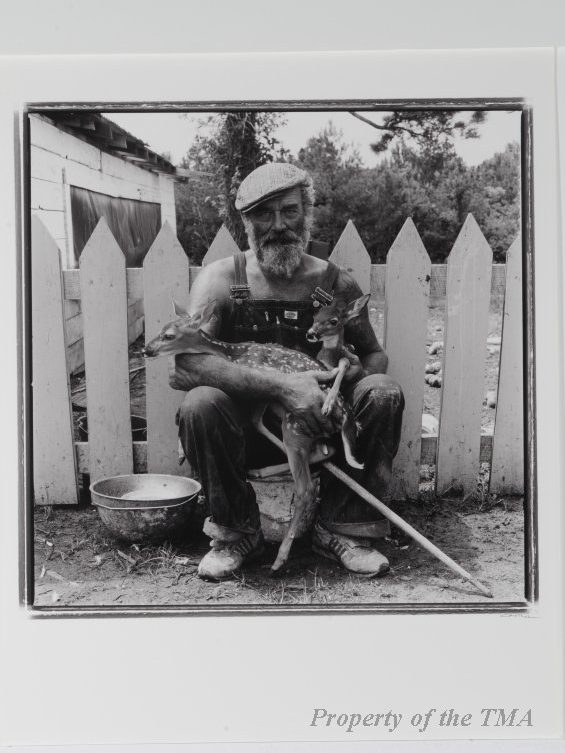
This lesson plan contains the National Learning Standards for Visual Arts and the Texas TEKS for High School art teachers. The students will study Keith Carter’s photography style by discussing the photograph Jack Whitt, Tyler, County. The class will plan an interview with a family member, friend, classmate, or a community member. The goal of the interview is to catalogue this person’s work, goals, and character. After the students conduct their interview, they will take a photograph of the individual. The students will use the information gathered from the interview to best represent the chosen person.
If you use or reference this lesson plan, please leave a comment with your feedback. The lesson plan can be downloaded in the link below.

Keith Carter, Jack Whitt, Tyler County, 1987, photograph, 15 inches X 15 inches, Tyler Museum of Art, Tyler, TX
https://tylermuseum.pastperfectonline.com/webobject/E9754165-7126-4420-BD24-603252886276
Culture: American
Subject: Fine Art, Art History
Collection: Tyler Museum of Art’s Permanent Collection
Grades: Elementary School, Middle School and High School
Topics: Artistic Practices, Art History, Critical Thinking, Photography, Interview, and Local History
Art Vocabulary
Activity Vocabulary:
Artist Biography
- Keith Carter was born in 1948.[1]
- He was inspired to be a photographer by his mother. She worked as a commercial photographer.[2]
- Carter studied business at Lamar University in Beaumont.[3]
- Primarily, his photographs represent moments of life in the Southern United States. They capture scenes that ask the viewer to examine the composition as an objective form of art that expands beyond the visual context.[4]
- He is a self-taught photographer. He learned how to use a camera by reading books and practicing photography techniques with his camera.[5]
Artwork Information
- This photograph is from Keith Carter’s The Blue Man series.[6]
- The series was inspired by East Texas stories. One particular story was about a man who was the color of blue smoke.[7]
- From this tale, he started to view the area where he lived for a majority of his life as a treasure trove of untold stories.[8]
- The photograph selected for the lesson plan features an individual named Jack Whitt.
- He wears overalls, sneakers, a newsies hat, and a cane that is leaning against his leg.
- He is holding two fawns in his arms. To his left is a bowl for the fawns.
- He is pictured in front of a white picket fence. Behind the fence, there is a house and a forest.
- Jack Whitt was an individual who helped rehabilitate animals who were injured.[9]
Photography:
- Photography is a method and style of art. Photographers will use a camera to capture images on light-sensitive film or digital records. Both process result in either a black and white or a color photograph. From this, the artist can alter the image in a additive or reductive process to create the final piece.[10]
Elements of Design[11]:
- Artists use the elements of design to create the foundation of the artwork. The elements of art include: line, shape, form, space, color, and texture.
Line:
- An element of design; line is created on a surface with a pointed moving tool. Lines can range in size, width, texture, and presentation. Common types of line are vertical, horizontal, diagonal, zig-zag, and curved.
Shape:
- An element of design; shape is a two-dimensional enclosed space that represents either an organic shape or a geometric shape. Geometric shapes include squares, circles, rectangles, triangles and other standard geometric shapes. Organic shapes include natural non-geometric shapes that are developed from curvilinear lines.
Form:
- An element of design; form is a three-dimensional enclosed space that represents organic and geometric shapes in a third space. Geometric forms include cubes, spheres, triangular prisms, rectangular prisms, and cones. Organic shapes include three-dimensional forms observed in nature, such as trees, rivers, and rocks.
Space:
- An element of design; this term defines the surface area between, before, and behind an object in a composition.
Color:
- An element of design; this term defines the pigments used in a painting. Color can be organized into categories, such as: hues, values, complements, and intensity.
Texture:
- An element of design; this term defines an artwork’s surface. The artist’s use of the chosen medium creates either implied or actual texture.
Principles of Design[12]:
- Artists used principles of design to build upon the foundational elements of design. This includes the following: rhythm, movement, balance, proportion, variety, emphasis, and unity.
Rhythm/ Pattern:
- A principle of design; this term defines repetitive imagery and elements of design found in a composition.
Movement:
- A principle of design; this term defines the visual movement observed in a painting. This can be identified as kinetic movement or implied movement. Additionally, movement can be defined as how the viewer’s eye moves throughout the composition.
Balance:
- A principle of design; this term defines the arrangement of the presented imagery with the elements of design. It refers to either asymmetrical compositions or symmetrical compositions.
Proportion:
- A principle of design; this term defines the comparative size between objects in the composition. It can refer to the imagery within a painting or the size between a sculpture and a real object.
Variety:
- A principle of design; this term defines the combination of imagery, objects, and ideas in an artwork.
Emphasis:
- A principle of design; this term defines the most prominent area in a composition. The viewer’s eye is drawn to this point because the artist used a mixture of the elements and principles of design.
Unity:
- A principle of design; this term defines how the elements and principles of design are combined within a composition.
[1] Montgomery, Robert, Garza, Monica, Goldstein, Jason A., and Greene, Alison de Lima. “Biographies.” Texas: 150 Works from the Museum of Fine Arts, Houston. Edited by Alison de Lima Greene. Houston: Harry N. Abrams, Inc., Publishers, 2000. Book, 227.
[2] Ibid.
[3] Ibid.
[4] Carter, Keith. “Biography.” Keith Carter Photographs. Updated 2021. Accessed August 29, 2022. https://www.keithcarterphotographs.com/about.
[5] Keith Carter: An interview”, Los Angeles Center of Photography, updated 2026, accessed January 19, 2026, https://lacphoto.org/people/keith-carter/.
[6] Anne W. Tucker and Keith Carter, “Afterward”, in The Blue Man, edited by Keith Carter, (Houston: Rice University Press, 1990), 125.
[7] Ibid. 126.
[8] Ibid. 132.
[9] Ibid. 135.
[10] “Art Term: Photograph,” Tate Modern, updated 2022, accessed November 17, 2022, https://www.tate.org.uk/art/art-terms/p/photography#:~:text=Photography%20refers%20to%20the%20process,on%20a%20light%2Dsensitive%20material.
[11] Rosalins Ragan, “Elements of Art,” in Art Talk, 61 – 211, edited by Bennett and McKnight Division, (San Francisco: Glencoe Publishing Company, 1988).
[12] Rosalins Ragan, “Principles of Design,” in Art Talk, 211 – 347, edited by Bennett and McKnight Division, (San Francisco: Glencoe Publishing Company, 1988).
Bibliography: Resources for Vocabulary and Lesson Plan
“Art Term: Photograph,” Tate Modern, updated 2022, accessed November 17, 2022, https://www.tate.org.uk/art/art-terms/p/photography#:~:text=Photography%20refers%20to%20the%20process,on%20a%20light%2Dsensitive%20material.
Carter, Keith. “Biography.” Keith Carter Photographs. Updated 2021. Accessed August 29, 2022. https://www.keithcarterphotographs.com/about.
“Keith Carter: An interview”, Los Angeles Center of Photography, updated 2026, accessed January 19, 2026, https://lacphoto.org/people/keith-carter/.
Montgomery, Robert, Garza, Monica, Goldstein, Jason A., and Greene, Alison de Lima. “Biographies.” Texas: 150 Works from the Museum of Fine Arts, Houston. Edited by Alison de Lima Greene. Houston: Harry N. Abrams, Inc., Publishers, 2000. Book, 227.
Office of the Secretary of State. “§117.302: Art, Level I, Adopted 2013.” Texas Education Agency: Education, updated 2013, accessed January 5, 2022, https://texreg.sos.state.tx.us/public/readtac$ext.TacPage?sl=R&app=9&p_dir=&p_rloc=&p_tloc=&p_ploc=&pg=1&p_tac=&ti=19&pt=2&ch=117&rl=302.
Office of the Secretary of State. “§117.303: Art, Level II, Adopted 2013.” Texas Education Agency: Education, updated 2013, accessed January 5, 2022, https://texreg.sos.state.tx.us/public/readtac$ext.TacPage?sl=R&app=9&p_dir=&p_rloc=&p_tloc=&p_ploc=&pg=1&p_tac=&ti=19&pt=2&ch=117&rl=303.
Office of the Secretary of State. “§117.304: Art, Level III, Adopted 2013.” Texas Education Agency: Education, updated 2013, accessed January 5, 2022, https://texreg.sos.state.tx.us/public/readtac$ext.TacPage?sl=R&app=9&p_dir=&p_rloc=&p_tloc=&p_ploc=&pg=1&p_tac=&ti=19&pt=2&ch=117&rl=304.
Office of the Secretary of State. “§117.305: Art, Level IV, Adopted 2013.” Texas Education Agency: Education, updated 2013, accessed January 5, 2022, https://texreg.sos.state.tx.us/public/readtac$ext.TacPage?sl=R&app=9&p_dir=&p_rloc=&p_tloc=&p_ploc=&pg=1&p_tac=&ti=19&pt=2&ch=117&rl=305.
Ragan, Rosalins. “Elements of Art.” In Art Talk, 61 – 211. Edited by Bennett and McKnight Division. San Francisco: Glencoe Publishing Company, 1988.
Ragan, Rosalins. “The Principles of Design.” In Art Talk, 211 – 347. Edited by Bennett and McKnight Division. San Francisco: Glencoe Publishing Company, 1988.
Tucker, Anne W. and Carter, Keith. “Afterward”, in The Blue Man, edited by Keith Carter, (Houston: Rice University Press, 1990), 125.
High School Lesson Plan: National Learning Standards
Goals:
High School Students of all Levels will be able to do the following:
- Identify the principles of design used in the artwork;
- Identify the elements of design used in the artwork;
- Learn about Keith Carter’s photography style;
- Conduct an interview with a family member, friend, classmate, or a community member;
- Write the questions and answers in an interview format;
- And, photograph the subject in a manner that best represents their character using the interview as context.
National Learning Standards for Visual Arts:
High School Proficient, High School Accomplished, and High School Advanced
High School Proficient
- Creating
- Anchor Standard 1
- Creating: Generate and conceptualize artistic ideas and work.
- VA:Cr1.1.Ia: Use multiple approaches to begin creative endeavors.
- VA:Cr1.2.Ia: Shape an artistic investigation of an aspect of present-day life using a contemporary practice of art or design.
- Creating: Generate and conceptualize artistic ideas and work.
- Anchor Standard 2
- Creating: Organize and develop artistic ideas and work.
- VA:Cr2.1.Ia: Engage in making a work of art or design without having a preconceived plan.
- VA:Cr2.2.Ia: Explain how traditional and non-traditional materials may impact human health and the environment and demonstrate safe handling of materials, tools, and equipment.
- Creating: Organize and develop artistic ideas and work.
- Anchor Standard 3
- Creating: Refine and complete artistic work.
- VA:Cr3.1.Ia: Apply relevant criteria from traditional and contemporary cultural contexts to examine, reflect on, and plan revisions for works of art and design in progress.
- Creating: Refine and complete artistic work.
- Anchor Standard 1
- Responding
- Anchor Standard 7
- Responding: Perceive and analyze artistic work
- VA:Re.7.1.Ia: Hypothesize ways in which art influences perception and understanding of human experiences.
- VA:Re.7.2.Ia: Analyze how one’s understanding of the world is affected by experiencing visual imagery.
- Responding: Perceive and analyze artistic work
- Anchor Standard 8
- Responding: Interpret intent and meaning in artistic work.
- VA:Re8.1.Ia: Interpret an artwork or collection of works, supported by relevant and sufficient evidence found in the work and its various contexts.
- Responding: Interpret intent and meaning in artistic work.
- Anchor Standard 9
- Responding: Apply criteria to evaluate artistic work.
- VA:Re9.1.Ia: Establish relevant criteria in order to evaluate a work of art or collection of works.
- Responding: Apply criteria to evaluate artistic work.
- Anchor Standard 7
- Connecting
- Anchor Standard 10
- Connecting: Synthesize and relate knowledge and personal experiences to make art.
- VA:Cn10.1.Ia: Document the process of developing ideas from early stages to fully elaborated ideas.
- Connecting: Synthesize and relate knowledge and personal experiences to make art.
- Anchor Standard 11
- Connecting: Relate artistic ideas and works with societal, cultural, and historical context to deepen understanding
- VA:Cn11.1.Ia: Describe how knowledge of culture, traditions, and history may influence personal responses to art.
- Connecting: Relate artistic ideas and works with societal, cultural, and historical context to deepen understanding
- Anchor Standard 10
High School Accomplished
- Creating
- Anchor Standard 1
- Creating: Generate and conceptualize artistic ideas and work.
- VA:Cr1.1.IIa: Individually or collaboratively formulate new creative problems based on student’s existing artwork.
- VA:Cr1.2.IIa: Choose from a range of materials and methods of traditional and contemporary artistic practices to plan works of art and design.
- Creating: Generate and conceptualize artistic ideas and work.
- Anchor Standard 2
- Creating: Organize and develop artistic ideas and work.
- VA:Cr2.1.IIa: Through experimentation, practice, and persistence, demonstrate acquisition of skills and knowledge in a chosen art form.
- VA:Cr2.2.IIa: Demonstrate awareness of ethical implications of making and distributing creative work.
- Creating: Organize and develop artistic ideas and work.
- Anchor Standard 3
- Creating: Refine and complete artistic work.
- VA:Cr3.1.IIa: Engage in constructive critique with peers, then reflect on, re-engage, revise, and refine works of art and design in response to personal artistic vision.
- Creating: Refine and complete artistic work.
- Anchor Standard 1
- Responding
- Anchor Standard 7
- Responding: Perceive and analyze artistic work
- VA:Re.7.1.IIa: Recognize and describe personal aesthetic and empathetic responses to the natural world and constructed environments.
- VA:Re.7.2.IIa: Evaluate the effectiveness of an image or images to influence ideas, feelings, and behaviors of specific audiences.
- Responding: Perceive and analyze artistic work
- Anchor Standard 8
- Responding: Interpret intent and meaning in artistic work.
- VA:Re8.1.IIa: Identify types of contextual information useful in the process of constructing interpretations of an artwork or collection of works.
- Responding: Interpret intent and meaning in artistic work.
- Anchor Standard 7
- Connecting
- Anchor Standard 10
- Connecting: Synthesize and relate knowledge and personal experiences to make art.
- VA:Cn10.1.IIa: Utilize inquiry methods of observation, research, and experimentation to explore unfamiliar subjects through art-making.
- Connecting: Synthesize and relate knowledge and personal experiences to make art.
- Anchor Standard 11
- Connecting: Relate artistic ideas and works with societal, cultural, and historical context to deepen understanding
- VA:Cn11.1.IIa: Compare uses of art in a variety of societal, cultural, and historical contexts and make connections to uses of art in contemporary and local contexts.
- Connecting: Relate artistic ideas and works with societal, cultural, and historical context to deepen understanding
- Anchor Standard 10
High School Advanced
- Creating
- Anchor Standard 1
- Creating: Generate and conceptualize artistic ideas and work.
- VA:Cr1.1.IIIa: Visualize and hypothesize to generate plans for ideas and directions for creating art and design that can affect social change.
- VA:Cr1.2.IIIa: Choose from a range of materials and methods of traditional and contemporary artistic practices, following or breaking established conventions, to plan the making of multiple works of art and design based on a theme, idea, or concept.
- Creating: Generate and conceptualize artistic ideas and work.
- Anchor Standard 2
- Creating: Organize and develop artistic ideas and work.
- VA:Cr2.1.IIIa: Experiment, plan, and make multiple works of art and design that explore a personally meaningful theme, idea, or concept.
- VA:Cr2.2.IIIa: Demonstrate understanding of the importance of balancing freedom and responsibility in the use of images, materials, tools, and equipment in the creation and circulation of creative work.
- VA:Cr2.3.IIIa: Demonstrate in works of art or design how visual and material culture defines, shapes, enhances, inhibits, and/or empowers people’s lives.
- Creating: Organize and develop artistic ideas and work.
- Anchor Standard 3
- Creating: Refine and complete artistic work.
- VA:Cr3.1.IIIa: Reflect on, re-engage, revise, and refine works of art or design considering relevant traditional and contemporary criteria as well as personal artistic vision.
- Creating: Refine and complete artistic work.
- Anchor Standard 1
- Responding
- Anchor Standard 7
- Responding: Perceive and analyze artistic work
- VA:Re.7.1.IIIa: Analyze how responses to art develop over time based on knowledge of and experience with art and life.
- VA:Re.7.2.IIIa: Determine the commonalities within a group of artists or visual images attributed to a particular type of art, timeframe, or culture.
- Responding: Perceive and analyze artistic work
- Anchor Standard 8
- Responding: Interpret intent and meaning in artistic work.
- VA:Re8.1.IIIa: Analyze differing interpretations of an artwork or collection of works in order to select and defend a plausible critical analysis.
- Responding: Interpret intent and meaning in artistic work.
- Anchor Standard 9
- Responding: Apply criteria to evaluate artistic work.
- VA:Re9.1.IIIa: Construct evaluations of a work of art or collection of works based on differing sets of criteria.
- Responding: Apply criteria to evaluate artistic work.
- Anchor Standard 7
- Connecting
- Anchor Standard 10
- Connecting: Synthesize and relate knowledge and personal experiences to make art.
- VA:Cn10.1.IIIa: Synthesize knowledge of social, cultural, historical, and personal life with art-making approaches to create meaningful works of art or design.
- Connecting: Synthesize and relate knowledge and personal experiences to make art.
- Anchor Standard 11
- Connecting: Relate artistic ideas and works with societal, cultural, and historical context to deepen understanding
- VA:Cn11.1.IIIa: Appraise the impact of an artist or a group of artists on the beliefs, values, and behaviors of a society.
- Connecting: Relate artistic ideas and works with societal, cultural, and historical context to deepen understanding
- Anchor Standard 10
High School Lesson Plan: Texas Essential Knowledge and Skills (TEKS)
Goals:
High School Students of all Levels will be able to do the following:
- Identify the principles of design used in the artwork;
- Identify the elements of design used in the artwork;
- Learn about Keith Carter’s photography style;
- Conduct an interview with a family member, friend, classmate, or a community member;
- Write the questions and answers in an interview format;
- And, photograph the subject in a manner that best represents their character using the interview as context.
Texas High School TEKS:
Art Level I, Level II, Level III, and Level IV
Level I
- §117.302.c.1.A / B / C / D
- Foundations: Observation and Perception:
- consider concepts and ideas from direct observation, original sources, experiences, and imagination for original artwork;
- identify and understand the elements of art, including line, shape, color, texture, form, space, and value, as the fundamentals of art in personal artwork;
- identify and understand the principles of design, including emphasis, repetition/pattern, movement/rhythm, contrast/variety, balance, proportion, and unity, in personal artwork;
- make judgments about the expressive properties such as content, meaning, message, and metaphor of artwork using art vocabulary accurately.
- Foundations: Observation and Perception:
- §117.302.c.2.A / B / D / E / F
- Creative Expression:
- use visual solutions to create original artwork by problem solving through direct observation, original sources, experiences, narrations, and imagination;
- communicate a variety of applications for design solutions;
- create original artwork to communicate thoughts, feelings, ideas, or impressions;
- collaborate to create original works of art;
- demonstrate effective use of art media and tools in drawing, painting, printmaking, sculpture, ceramics, fiber art, design, and digital art and media.
- Creative Expression:
- §117.302.c.3.A / B / C
- Historical and Cultural Relevance
- compare and contrast historical and contemporary styles while identifying general themes and trends;
- describe general characteristics in artwork from a variety of cultures, which might also include personal identity and heritage;
- collaborate on community-based art projects;
- Historical and Cultural Relevance
Level II
- §117.303.c.1.A / B / C / D
- Foundations: Observation and Perception:
- use visual comparisons to illustrate concepts and ideas from direct observation, original sources, experiences, narration, and imagination for original artworks;
- identify and apply the elements of art, including line, shape, color, texture, form, space, and value, as the fundamentals of art in personal artworks;
- identify and apply the principles of design, including emphasis, repetition/pattern, movement/rhythm, contrast/variety, balance, proportion, and unity in personal artworks;
- explore suitability of art media and processes to express specific ideas such as content, meaning, message, appropriation, and metaphor relating to visual themes of artworks using art vocabulary accurately.
- Foundations: Observation and Perception:
- §117.303.c.2.A / B / D / E / F
- Creative Expression:
- create original artwork using multiple solutions from direct observation, original sources, experiences, and imagination in order to expand personal themes that demonstrate artistic intent;
- apply design skills in creating practical applications, clarifying presentations, and examining consumer choices in order to make successful design decisions;
- create original artwork to communicate thoughts, feelings, ideas, or impressions;
- collaborate to create original works of art;
- select from a variety of art media and tools to communicate specific ideas in drawing, painting, printmaking, sculpture, ceramics, fiber art, jewelry, mixed media, photography, and digital art and media.
- Creative Expression:
- §117.303.c.3.A / B / C
- Historical and Cultural Relevance:
- examine selected historical periods or styles of art to identify general themes and trends;
- analyze specific characteristics in artwork from a variety of cultures;
- collaborate on community-based art projects;
- Historical and Cultural Relevance:
Level III
- §117.304.c.1.A / B / C / D
- Foundations: Observation and Perception:
- analyze visual characteristics of sources to illustrate concepts, demonstrate flexibility in solving problems, create multiple solutions, and think imaginatively;
- compare and contrast the elements of art, including line, shape, color, texture, form, space, and value, as the fundamentals of art in personal artwork;
- compare and contrast the principles of design, including emphasis, repetition/pattern, movement/rhythm, contrast/variety, balance, proportion, and unity, in personal artwork;
- explore the suitability of art media and processes and select those appropriate to express specific ideas such as content, meaning, message, and metaphor relating to visual themes to interpret the expressive qualities of artwork.
- Foundations: Observation and Perception:
- §117.304.c.2.A / B / D / E / F
- Creative Expression:
- create original artwork using multiple solutions from direct observation, original sources, experiences, and imagination in order to expand personal themes that demonstrate artistic intent;
- solve visual problems and develop multiple solutions for designing ideas, creating practical applications, clarifying presentations, and evaluating consumer choices in order to make successful design decisions;
- create original artwork to communicate thoughts, feelings, ideas, or impressions;
- collaborate to create original works of art;
- select from a variety of art media and tools to express intent in drawing, painting, printmaking, sculpture, ceramics, fiber art, design, digital art and media, photography, jewelry, and mixed media.
- Creative Expression:
- §117.304.c.3.A / B / C
- Historical and Cultural Relevance:
- research selected historical periods, artists, general themes, trends, and styles of art;
- distinguish the correlation between specific characteristics and influences of various cultures and contemporary artwork;
- collaborate on community-based art projects;
- Historical and Cultural Relevance:
Level IV
- §117.305.c.1.A / B / C / D
- Foundations: Observation and Perception:
- consider concepts and themes for personal artwork that integrate an extensive range of visual observations, experiences, and imagination;
- compare and contrast the elements of art, including line, shape, color, texture, form, space, and value, as the fundamentals of art in personal artwork;
- compare and contrast the principles of design, including emphasis, repetition/pattern, movement/rhythm, contrast/variety, balance, proportion, and unity, in personal artwork;
- discriminate between art media and processes to express complex visual relationships such as content, meaning, message, and metaphor using extensive art vocabulary.
- Foundations: Observation and Perception:
- §117.305.c.2.A / B / D / E / F
- Creative Expression:
- produce an original body of artwork that integrates information from a variety of sources, including original sources, and demonstrates sustained self-directed investigations into specific themes such as a series or concentration of works;
- evaluate and justify design ideas and concepts to create a body of personal artwork;
- create original artwork to communicate thoughts, feelings, ideas, or impressions;
- collaborate to create original works of art;
- create artwork, singularly and in a series, by selecting from a variety of art materials and tools appropriate to course work in drawing, painting, printmaking, sculpture, ceramics, fiber art, design, digital art and media, photography, jewelry, and mixed media.
- Creative Expression:
- §117.305.c.3.A / B / C
- Historical and Cultural Relevance:
- research and report on selected historical periods, artists, general themes, trends, and styles of art;
- analyze and evaluate the influence of contemporary cultures on artwork;
- collaborate on community-based art projects;
- Historical and Cultural Relevance:
High School Art Activities
Questions for High School Students:
- Examine Keith Carter’s photograph Jack Whitt, Tyler County. Identify where each element of art is located in the artwork.
- Examine Jack Whitt, Tyler County Identify where each principle of art is located in the artwork.
- What is an interview?
- Why are interviews important when conducting research? Explain your answer.
- Do you believe Keith Carter’s work is successful in cataloguing Jack Whitt’s character? Why or why not?
- Class Discussion: What are some questions to ask in an interview?
Activity: High School Fine Arts
- Activity Setting: Classroom
- Materials: Pencil/ Pen on Paper or Word Document
- Subject: Interview
- National Learning Standard in Visual Arts: High School Proficient, high School Accomplished, and High School Advanced
- Texas TEKS: Art Level I, Level II, Level III, and Level IV
- Duration: Extended Project
The students will learn about the photography methods of Keith Carter by examining the photograph Jack Whitt, Tyler County. The teacher will hold a class discussion on the topic of interviewing a person for the goal of learning about their character. The class will discuss questions that will help them better learn about of the interviewed subject.
Afterwards, the students will determine if they are going to interview a family member, a friend, a classmate, or a community member. The teacher will determine if there are interview waivers needed for both the student and the chosen subject. Once the subject is approved by the teacher, the student will begin making questions to ask on the interview. These questions should include “get to know me” questions and specialized inquiries about the subject’s work and interests. The teacher should approve the questions before the students begin planning their interview.
The students will schedule, hold, and record the interview. The students can either record the interview with a recorder, a phone, or write the subject’s answers as they are stated. To complete the written interview, the student will provide a paragraph where they detail how they took a photograph of their subject.
Activity: High School Art History
- Activity Setting: Classroom and/or outdoor location
- Materials: Phone / Camera
- Subject: Photography
- National Learning Standard in Visual Arts: High School Proficient, high School Accomplished, and High School Advanced
- Texas TEKS: Art Level I, Level II, Level III, and Level IV
- Duration: Extended Project
After the students have completed their interviews, they will take a photograph of their subject with the subject’s permission. The student must ensure their subject is comfortable with being photographed prior to the interview. Based on the information gathered from the interview, the student will set up the photograph to best represent their chosen subject.
For more educational resources created by the Tyler Museum of Art, visit our YouTube page by clicking on the YouTube button or clicking the link below.

And stay updated with the Tyler Museum of Art’s events by visiting our Facebook and Instagram pages:


If you use or references this lesson plan, please leave a comment with your feedback.
Thank you for visiting the Tyler Museum of Art’s Education Blog!
 Tyler Museum of Art Education Blog