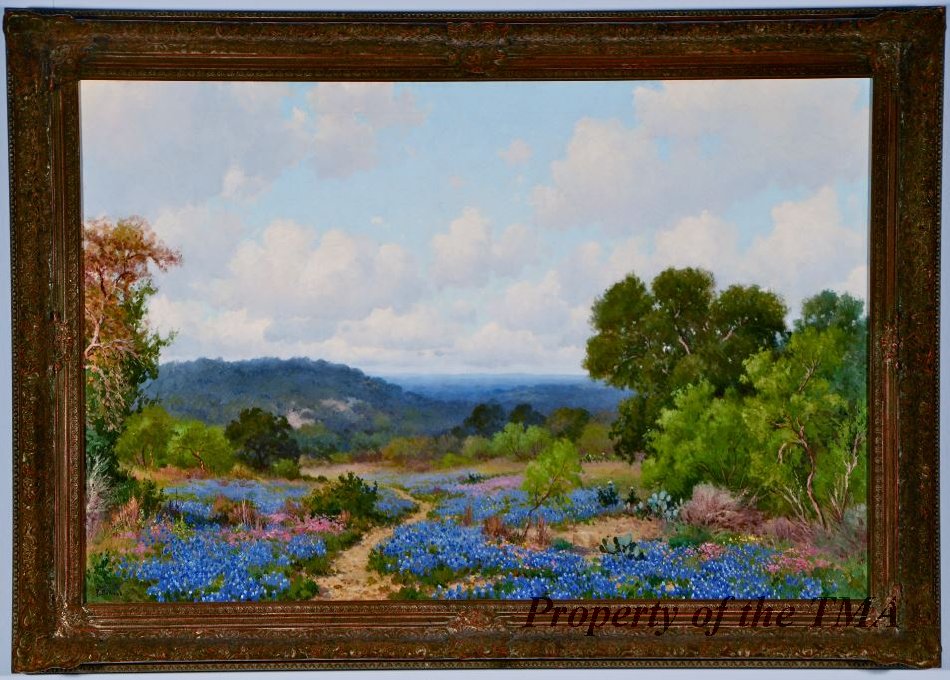
This lesson plan contains the Texas TEKS for Elementary, Middle, and High School art teachers. Students will study the art styles of Porfirio Salinas and Julian Onderdonk. Then, the class will write a compare and contrast writing analysis that examines the styles, subjects, and artistic background of the painters. The comparative analysis is scaled to the student’s grade level and helps develop observation and comprehension skills.
If you use or reference this lesson plan, please leave a comment with your feedback. The lesson plan can be downloaded in the link below.
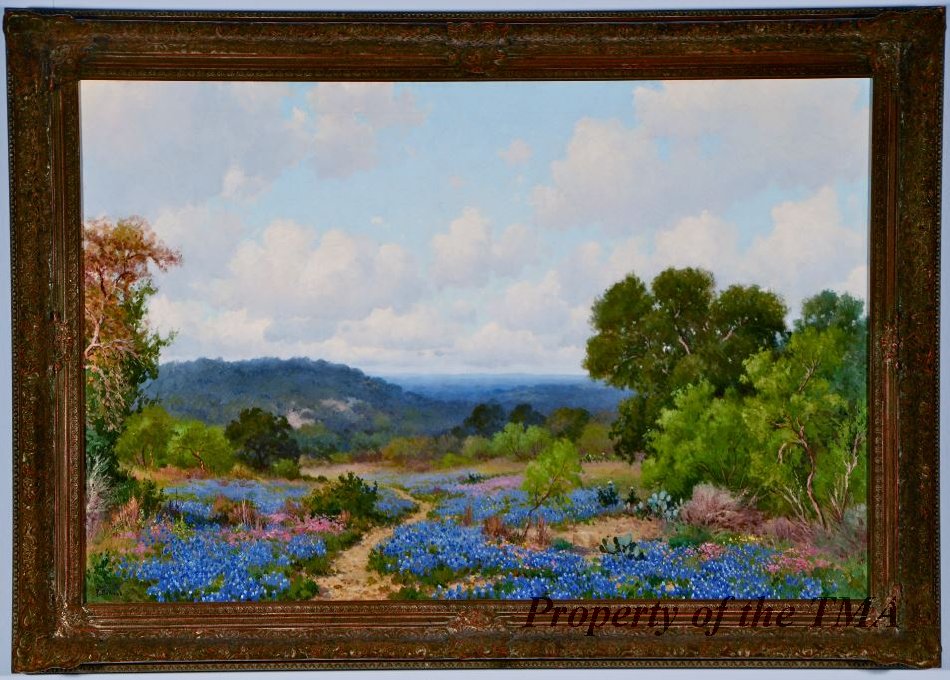
Porfirio Salinas, Bluebonnets Near San Antonio, Texas, 1935, oil on canvas, 24 inches X 36.75 inches, Tyler Museum of Art, Tyler, Texas.

Julian Onderdonk, Field of Bluebonnets, not dated, watercolor on paper, 12 inches X 18 inches, Tyler Museum of Art, Tyler, Texas.
Culture: American
Subject: Fine Art, Art History
Collection: Tyler Museum of Art’s Permanent Collection
Grades: Elementary School, Middle School and High School
Topics: Art History, Critical Thinking, Compare and Contrast, and Written Analysis
Art Vocabulary
Porfirio Salinas:
- Porfirio Salinas was born in 1910 and died in 1973.[1]
- Primarily a self taught artist, Salinas gained experience by working with the artists Robert Wood and José Arpa.[2]
- Both artists created works en plein aire, meaning they painted their artworks outside and observed nature.[3]
- Salinas’ experience with Wood and Arpa taught him how to work with light and color. This allowed his style of painting to adopt an Impressionistic quality.[4]
- He served in the United States Army between 1943 through 1945.[5]
- He was able to live in his home in San Antonio while assigned to Fort Sam Houston. Here, he painted landscapes and high ranking individuals in the Army.[6]
- Throughout his lifetime, he did not receive the same success other painters gained. Instead of exhibiting his artwork in museums and gallery spaces, his work was appreciated and collected by the people and politicians of Texas.[7]
- A notable politician and collector of Salinas’ work was Lyndon B. Johnson.[8]
- His themes of bluebonnets and warm summer days in the Texas Hill County expressed his appreciation of nature’s beauty.
Julian Onderdonk:
- Julian Onderdonk was born in 1882 and died in 1922.[9]
- Onderdonk studied and practiced art at the Shinnecock School of Art in Long Island, New York.[10]
- The school was taught by the famous American Impressionist William Merritt Chase.[11]
- Onderdonk often worked en plein aire, which enabled him to study the affects of light on various environments.[12]
- Moving from New York to Texas in 1909, he became known as an exemplary Texas Landscape painter.[13]
- He was most well known for his depiction of bluebonnets, which started in earnest in 1911.[14]
- A minimal collector of Onderdonk’s painting was President George W. Bush. When he was in office, President Bush had various paintings that celebrated the Texas bluebonnet.[15]
Impressionism:
- Impressionism was an art movement that began in the early 1860’s and continued until the late 1890’s. However, many artists continued to paint in an Impressionist style long after the movement gave way to new methods of art.[16]
- Impressionist artists, such as Claude Monet, Edgar Degas, and Camille Pissarro, were considered to be a handful of innovators within the style. [17]
- They, and their many counterparts, focused on light, color, and frozen moments in time captured in a composition.[18]
- Additionally, painting en plein aire allowed the artists to truly study their environment and how the light sources changed throughout the day.[19]
- Though the movement was most popular in France, the style spread throughout Europe and into America.[20]
Elements of Design[21]:
- Artists use the elements of design to create the foundation of the artwork. The elements of art include: line, shape, form, space, color, and texture.
Line:
- An element of design; line is created on a surface with a pointed moving tool. Lines can range in size, width, texture, and presentation. Common types of line are vertical, horizontal, diagonal, zig-zag, and curved.
Shape:
- An element of design; shape is a two-dimensional enclosed space that represents either an organic shape or a geometric shape. Geometric shapes include squares, circles, rectangles, triangles and other standard geometric shapes. Organic shapes include natural non-geometric shapes that are developed from curvilinear lines.
Form:
- An element of design; form is a three-dimensional enclosed space that represents organic and geometric shapes in a third space. Geometric forms include cubes, spheres, triangular prisms, rectangular prisms, and cones. Organic shapes include three-dimensional forms observed in nature, such as trees, rivers, and rocks.
Space:
- An element of design; this term defines the surface area between, before, and behind an object in a composition.
Color:
- An element of design; this term defines the pigments used in a painting. Color can be organized into categories, such as: hues, values, complements, and intensity.
Texture:
- An element of design; this term defines an artwork’s surface. The artist’s use of the chosen medium creates either implied or actual texture.
Principles of Design[22]:
- Artists used principles of design to build upon the foundational elements of design. This includes the following: rhythm, movement, balance, proportion, variety, emphasis, and unity.
Rhythm/ Pattern:
- A principle of design; this term defines the repetitive imagery and elements of design found in a composition.
Movement:
- A principle of design; this term defines the visual movement observed in a painting. This can be identified as kinetic movement or implied movement. Additionally, movement can be defined as how the viewer’s eye moves throughout the composition.
Balance:
- A principle of design; this term defines the arrangement of the presented imagery with the elements of design. It refers to either asymmetrical compositions or symmetrical compositions.
Proportion:
- A principle of design; this term defines the comparative size between objects in the composition. It can refer to the imagery within a painting or the size between a sculpture and a real object.
Variety:
- A principle of design; this term defines the combination of imagery, objects, and ideas in an artwork.
Emphasis:
- A principle of design; this term defines the most prominent area in a composition. The viewer’s eye is drawn to this point because the artist used a mixture of the elements and principles of design.
Unity:
- A principle of design; this term defines how the elements and principles of design are combined within a composition.
[1] “Porfirio Salinas,” Vintage Texas Paintings: Auction House, updated 2022, accessed May 12, 2023, https://www.vintagetexaspaintings.com/texas-art/2237-porfirio-salinas-fall-trees-oil.
[2] “Porfirio Salinas,” Art in Embassies: United States Department of State, updated 2022, accessed May 12, 2023, https://art.state.gov/personnel/porfirio_salinas/.
[3] Ibid.
[4] Kayla Meyertons, “Painting Presidential Bluebonnets: Porfirio Salinas’ Paintings Graced Lyndon B. Johnson’s White House,” Texas Parks and Wildlife Magazine, updated April 2019, accessed May 12, 2023, https://tpwmagazine.com/archive/2019/apr/legends/.
[5] “Porfirio Salinas,” Art in Embassies: United States Department of State, https://art.state.gov/personnel/porfirio_salinas/.
[6] Ibid.
[7] Ibid.
[8] Ibid.
[9] “Julian Onderdonk and the Texas Landscape: A Catalogue Raisonné,” The Museum of Fine Arts Houston, updated January 1, 2017, accessed May 12, 2023, https://www.mfah.org/exhibitions/julian-onderdonk-and-the-texan-landscape.
[10] Ibid.
[11] Ibid.
[12] Ibid.
[13] “Julian Onderdonk and the Texas Landscape,” San Antonio Museum of Art, updated April 23, 2017, accessed May 12, 2023, https://www.samuseum.org/artwork/exhibition/julian-onderdonk-and-the-texan-landscape/.
[14] Minnie B. Cameron, “Onderdonk, Julian (1882 – 1922)”, Texas State Historical Association, published 1952, edited by Laurie E. Jasinski, updated May 17, 2018, accessed May 12, 2023, https://www.tshaonline.org/handbook/entries/onderdonk-julian.
[15] Ibid.
[16] “Art Term: Impressionism,” Tate Modern, updated 2023, accessed May 12, 2023, https://www.tate.org.uk/art/art-terms/i/impressionism.
[17] Ibid.
[18] Ibid.
[19] Ibid.
[20] Ibid.
[21] Rosalins Ragan, “Elements of Art,” in Art Talk, 61 – 211, edited by Bennett and McKnight Division, (San Francisco: Glencoe Publishing Company, 1988).
[22] Rosalins Ragan, “Principles of Design,” in Art Talk, 211 – 347, edited by Bennett and McKnight Division, (San Francisco: Glencoe Publishing Company, 1988).
Bibliography: Resources for Vocabulary and Lesson Plan
“Art Term: Impressionism.” Tate Modern. Updated 2023. Accessed May 12, 2023. https://www.tate.org.uk/art/art-terms/i/impressionism.
Cameron, Minnie B. “Onderdonk, Julian (1882 – 1922).” Texas State Historical Association. Published 1952. Edited by Laurie E. Jasinski. Updated May 17, 2018. Accessed May 12, 2023. https://www.tshaonline.org/handbook/entries/onderdonk-julian.
“Julian Onderdonk and the Texas Landscape: A Catalogue Raisonné.” The Museum of Fine Arts Houston. Updated January 1, 2017. Accessed May 12, 2023. https://www.mfah.org/exhibitions/julian-onderdonk-and-the-texan-landscape.
“Julian Onderdonk and the Texas Landscape.” San Antonio Museum of Art. Updated April 23, 2017. Accessed May 12, 2023. https://www.samuseum.org/artwork/exhibition/julian-onderdonk-and-the-texan-landscape/.
Meyertons, Kayla. “Painting Presidential Bluebonnets: Porfirio Salinas’ Paintings Graced Lyndon B. Johnson’s White House.” Texas Parks and Wildlife Magazine. Updated April 2019. Accessed May 12, 2023. https://tpwmagazine.com/archive/2019/apr/legends/.
Office of the Secretary of State. “§117.102: Art, Kindergarten, Adopted 2013.” Texas Education Agency: Education, updated 2013, accessed January 5, 2022, https://texreg.sos.state.tx.us/public/readtac$ext.TacPage?sl=R&app=9&p_dir=&p_rloc=&p_tloc=&p_ploc=&pg=1&p_tac=&ti=19&pt=2&ch=117&rl=102.
Office of the Secretary of State. “§117.105: Art, Grade 1, Adopted 2013.” Texas Education Agency: Education, updated 2013, accessed January 5, 2022, https://texreg.sos.state.tx.us/public/readtac$ext.TacPage?sl=R&app=9&p_dir=&p_rloc=&p_tloc=&p_ploc=&pg=1&p_tac=&ti=19&pt=2&ch=117&rl=105.
Office of the Secretary of State. “§117.108: Art, Grade 2, Adopted 2013.” Texas Education Agency: Education, updated 2013, accessed January 5, 2022, https://texreg.sos.state.tx.us/public/readtac$ext.TacPage?sl=R&app=9&p_dir=&p_rloc=&p_tloc=&p_ploc=&pg=1&p_tac=&ti=19&pt=2&ch=117&rl=108.
Office of the Secretary of State. “§117.111: Art, Grade 3, Adopted 2013.” Texas Education Agency: Education, updated 2013, accessed January 5, 2022, https://texreg.sos.state.tx.us/public/readtac$ext.TacPage?sl=R&app=9&p_dir=&p_rloc=&p_tloc=&p_ploc=&pg=1&p_tac=&ti=19&pt=2&ch=117&rl=111.
Office of the Secretary of State. “§117.114: Art, Grade 4, Adopted 2013.” Texas Education Agency: Education, updated 2013, accessed January 5, 2022, https://texreg.sos.state.tx.us/public/readtac$ext.TacPage?sl=R&app=9&p_dir=&p_rloc=&p_tloc=&p_ploc=&pg=1&p_tac=&ti=19&pt=2&ch=117&rl=114.
Office of the Secretary of State. “§117.117: Art, Grade 5, Adopted 2013.” Texas Education Agency: Education, updated 2013, accessed January 5, 2022, https://texreg.sos.state.tx.us/public/readtac$ext.TacPage?sl=R&app=9&p_dir=&p_rloc=&p_tloc=&p_ploc=&pg=1&p_tac=&ti=19&pt=2&ch=117&rl=117.
Office of the Secretary of State. “§117.202: Art, Middle School 1, Adopted 2013.” Texas Education Agency: Education, updated 2013, accessed January 5, 2022, https://texreg.sos.state.tx.us/public/readtac$ext.TacPage?sl=R&app=9&p_dir=&p_rloc=&p_tloc=&p_ploc=&pg=1&p_tac=&ti=19&pt=2&ch=117&rl=202.
Office of the Secretary of State. “§117.203: Art, Middle School 2, Adopted 2013.” Texas Education Agency: Education, updated 2013, accessed January 5, 2022, https://texreg.sos.state.tx.us/public/readtac$ext.TacPage?sl=R&app=9&p_dir=&p_rloc=&p_tloc=&p_ploc=&pg=1&p_tac=&ti=19&pt=2&ch=117&rl=203.
Office of the Secretary of State. “§117.204: Art, Middle School 3, Adopted 2013.” Texas Education Agency: Education, updated 2013, accessed January 5, 2022, https://texreg.sos.state.tx.us/public/readtac$ext.TacPage?sl=R&app=9&p_dir=&p_rloc=&p_tloc=&p_ploc=&pg=1&p_tac=&ti=19&pt=2&ch=117&rl=204.
Office of the Secretary of State. “§117.302: Art, Level I, Adopted 2013.” Texas Education Agency: Education, updated 2013, accessed January 5, 2022, https://texreg.sos.state.tx.us/public/readtac$ext.TacPage?sl=R&app=9&p_dir=&p_rloc=&p_tloc=&p_ploc=&pg=1&p_tac=&ti=19&pt=2&ch=117&rl=302.
Office of the Secretary of State. “§117.303: Art, Level II, Adopted 2013.” Texas Education Agency: Education, updated 2013, accessed January 5, 2022, https://texreg.sos.state.tx.us/public/readtac$ext.TacPage?sl=R&app=9&p_dir=&p_rloc=&p_tloc=&p_ploc=&pg=1&p_tac=&ti=19&pt=2&ch=117&rl=303.
Office of the Secretary of State. “§117.304: Art, Level III, Adopted 2013.” Texas Education Agency: Education, updated 2013, accessed January 5, 2022, https://texreg.sos.state.tx.us/public/readtac$ext.TacPage?sl=R&app=9&p_dir=&p_rloc=&p_tloc=&p_ploc=&pg=1&p_tac=&ti=19&pt=2&ch=117&rl=304.
Office of the Secretary of State. “§117.305: Art, Level IV, Adopted 2013.” Texas Education Agency: Education, updated 2013, accessed January 5, 2022, https://texreg.sos.state.tx.us/public/readtac$ext.TacPage?sl=R&app=9&p_dir=&p_rloc=&p_tloc=&p_ploc=&pg=1&p_tac=&ti=19&pt=2&ch=117&rl=305.
“Porfirio Salinas.” Art in Embassies: United States Department of State. Updated 2022. Accessed May 12, 2023. https://art.state.gov/personnel/porfirio_salinas/.
“Porfirio Salinas.” Vintage Texas Paintings: Auction House. Updated 2022. Accessed May 12, 2023. https://www.vintagetexaspaintings.com/texas-art/2237-porfirio-salinas-fall-trees-oil.
Ragan, Rosalins. “Elements of Art.” In Art Talk, 61 – 211. Edited by Bennett and McKnight Division. San Francisco: Glencoe Publishing Company, 1988.
Ragan, Rosalins. “The Principles of Design.” In Art Talk, 211 – 347. Edited by Bennett and McKnight Division. San Francisco: Glencoe Publishing Company, 1988.
Elementary School Lesson Plan
Goals:
Elementary School Students of all levels will be able to do the following:
- Identify the principles of design used in the artwork;
- Identify the elements of design used in the artwork;
- Study Porfirio Salinas’ painting style in his work Bluebonnets Near San Antonio, Texas;
- Study Julian Onderdonk’s painting style in his work Field of Bluebonnets,
- And, compare and contrast the two artists in a written statement.
Texas Elementary School TEKS:
Kindergarten, First Grade, Second Grade, Third Grade, Fourth Grade, and Fifth Grade
Kindergarten:
- §117.102.b.1.A / B
- Foundations: Observation and Perception:
- gather information from subjects in the environment using the senses;
- identify the elements of art, including line, shape, color, texture, and form, and the principles of design, including repetition/pattern and balance, in the environment.
- Foundations: Observation and Perception:
- §117.102.b.3. A / B
- Historical and Cultural Relevance:
- identify simple subjects expressed in artworks;
- share ideas about personal experiences such as family and friends and develop awareness and sensitivity to differing experiences and opinions through artwork;
- Historical and Cultural Relevance:
- §117.102.b.4.B
- Critical Evaluation and Response:
- express ideas found in collections such as real or virtual art museums, galleries, portfolios, or exhibitions using original artworks created by artists or peers;
- Critical Evaluation and Response:
First Grade:
- §117.105.b.1.A / B
- Foundations: Observation and Perception:
- identify similarities, differences, and variations among subjects in the environment using the senses;
- identify the elements of art, including line, shape, color, texture, and form, and the principles of design, including emphasis, repetition/pattern, and balance, in nature and human-made environments.
- Foundations: Observation and Perception:
- §117.105.b.3. A / B
- Historical and Cultural Relevance:
- identify simple ideas expressed in artworks through different media;
- demonstrate an understanding that art is created globally by all people throughout time;
- Historical and Cultural Relevance:
- §117.105.b.4.B
- Critical Evaluation and Response:
- identify ideas found in collections such as real or virtual art museums, galleries, portfolios, or exhibitions using original artworks created by artists or peers.
- Critical Evaluation and Response:
Second Grade:
- §117.108.b.1.A / B
- Foundations: Observation and Perception:
- compare and contrast variations in objects and subjects from the environment using the senses;
- identify the elements of art, including line, shape, color, texture, form, and space, and the principles of design, including emphasis, repetition/pattern, movement/rhythm, and balance.
- Foundations: Observation and Perception:
- §117.108.b.3. A / B
- Historical and Cultural Relevance:
- interpret stories, content, and meanings in a variety of artworks;
- examine historical and contemporary artworks created by men and women, making connections to various cultures;
- Historical and Cultural Relevance:
- §117.108.b.4. B
- Critical Evaluation and Response:
- compare and contrast ideas found in collections such as real or virtual art museums, galleries, portfolios, or exhibitions using original artworks created by artists or peers;
- Critical Evaluation and Response:
Third Grade:
- §117.111.b.1.A / B / C
- Foundations: Observation and Perception:
- explore ideas from life experiences about self, peers, family, school, or community and from the imagination as sources for original works of art;
- use appropriate vocabulary when discussing the elements of art, including line, shape, color, texture, form, space, and value, and the principles of design, including emphasis, repetition/pattern, movement/rhythm, contrast/variety, balance, proportion, and unity;
- discuss the elements of art as building blocks and the principles of design as organizers of works of art.
- Foundations: Observation and Perception:
- §117.111.b.3. A / B
- Historical and Cultural Relevance:
- identify simple main ideas expressed in artworks from various times and places;
- compare and contrast artworks created by historical and contemporary men and women, making connections to various cultures;
- Historical and Cultural Relevance:
- §117.111.b.4. A / B
- Critical Evaluation and Response
- evaluate the elements of art, principles of design, or expressive qualities in artworks of self, peers, and historical and contemporary artists;
- use methods such as oral response or artist statements to identify main ideas found in collections of artworks created by self, peers, and major historical or contemporary artists in real or virtual portfolios, galleries, or art museums;
- Critical Evaluation and Response
Fourth Grade:
- §117.114.b.1.A / B / C
- Foundations: Observation and Perception:
- explore and communicate ideas drawn from life experiences about self, peers, family, school, or community and from the imagination as sources for original works of art;
- use appropriate vocabulary when discussing the elements of art, including line, shape, color, texture, form, space, and value, and the principles of design, including emphasis, repetition/pattern, movement/rhythm, contrast/variety, balance, proportion, and unity;
- discuss the elements of art as building blocks and the principles of design as organizers of works of art.
- Foundations: Observation and Perception:
- §117.114.b.3. A / B
- Historical and Cultural Relevance:
- compare content in artworks for various purposes such as the role art plays in reflecting life, expressing emotions, telling stories, or documenting history and traditions;
- compare purpose and content in artworks created by historical and contemporary men and women, making connections to various cultures;
- Historical and Cultural Relevance:
- §117.114.b.4. A / B
- Critical Evaluation and Response
- evaluate the elements of art, principles of design, intent, or expressive qualities in artworks of self, peers, and historical and contemporary artists.
- use methods such as written or oral response or artist statements to identify emotions found in collections of artworks created by self, peers, and major historical or contemporary artists in real or virtual portfolios, galleries, or art museums;
- Critical Evaluation and Response
Fifth Grade:
- §117.117.b.1.A / B / C
- Foundations: Observation and Perception:
- develop and communicate ideas drawn from life experiences about self, peers, family, school, or community and from the imagination as sources for original works of art;
- use appropriate vocabulary when discussing the elements of art, including line, shape, color, texture, form, space, and value, and the principles of design, including emphasis, repetition/pattern, movement/rhythm, contrast/variety, balance, proportion, and unity; and
- discuss the elements of art as building blocks and the principles of design as organizers of works of art.
- Foundations: Observation and Perception:
- §117.117.b.3. A / B
- Historical and Cultural Relevance:
- compare the purpose and effectiveness of artworks from various times and places, evaluating the artist’s use of media and techniques, expression of emotions, or use of symbols;
- compare the purpose and effectiveness of artworks created by historic and contemporary men and women, making connections to various cultures;
- Historical and Cultural Relevance:
- §117.117.b.4. A / B
- Critical Evaluation and Response
- evaluate the elements of art, principles of design, general intent, media and techniques, or expressive qualities in artworks of self, peers, or historical and contemporary artists;
- use methods such as written or oral response or artist statements to identify themes found in collections of artworks created by self, peers, and major historical or contemporary artists in real or virtual portfolios, galleries, or art museums;
- Critical Evaluation and Response
Elementary School Art Activities
Questions for Elementary School Students:
- Examine Porfirio Salinas’ painting Bluebonnets Near San Antonio, Texas. Identify where each element of art is located in the artwork.
- Examine Julian Onderdonk’s painting Field of Bluebonnets. Identify where each principle of art is located in the artwork.
- What is Impressionism?
- Why do you think these two Texas artists chose to paint bluebonnets?
- Which artist created a more successful composition? Explain your answer.
- What are some similarities between the two artists?
- What are the similarities between their paintings?
- What are some differences between the two artists?
- What are the differences between their paintings?
Activity: Elementary School Art History
- Activity Setting: Classroom
- Materials: Pencil/ Pen on Paper or Word Document
- Subject: Impressionism, Compare and Contrast, and Written Analysis
- Texas TEKS: Kindergarten, First Grade, Second Grade, Third Grade, Fourth Grade, and Fifth Grade
- Duration: Either a Short Term Project or an Extended Project
The students will study Porfirio Salinas’ painting Bluebonnets Near San Antonio, Texas and Julian Onderdonk’s painting Field of Bluebonnets. Afterwards, the students will write a compare and contrast analysis.
Kindergarten – 2nd Grade:
- Class will discuss a small selection of the similarities and differences in the paintings. The teacher will guide the conversation, helping the students identify and describe the observations.
- Then, the students will write what other similarities and differences are apparent. The written statement will be between three to five sentences and three paragraphs.
- The written statement will conclude with the students explaining which piece they like best. Their opinion should be supported with a short explanation.
- The teacher can choose hold a presentation of the observations.
3rd Grade – 5th Grade:
- Class will discuss a small selection of the similarities and differences in the paintings. The teacher will guide the conversation, helping the students identify and describe the observations.
- Then, the students will write what other similarities and differences are apparent. The written statement will be between one paragraph and three paragraphs.
- The written statement will conclude with the students explaining which piece they like best. Their opinion should be supported with a short explanation.
- The teacher can choose hold a presentation of the observations.
Middle School Lesson Plan
Goals:
Middle School Students of all Levels will be able to do the following:
- Identify the principles of design used in the artwork;
- Identify the elements of design used in the artwork;
- Study Porfirio Salinas’ painting style in his work Bluebonnets Near San Antonio, Texas;
- Study Julian Onderdonk’s painting style in his work Field of Bluebonnets,
- And, compare and contrast the two artists in a written statement.
Texas Middle School TEKS:
Art 1, Art 2, Art 3
Art 1:
- §117.202.c.1.A / B / C / D
- Foundations: Observation and Perception:
- identify and illustrate concepts from direct observation, original sources, personal experiences, and communities such as family, school, cultural, local, regional, national, and international;
- understand and apply the elements of art, including line, shape, color, texture, form, space, and value, as the fundamentals of art in personal artworks using art vocabulary appropriately;
- understand and apply the principles of design, including emphasis, repetition/pattern, movement/rhythm, contrast/variety, balance, proportion, and unity, in personal artworks using art vocabulary appropriately;
- discuss the expressive properties of artworks such as appropriation, meaning, narrative, message, and symbol using art vocabulary accurately.
- Foundations: Observation and Perception:
- §117.202.c.3.A / B
- Historical and Cultural Relevance:
- identify the influence of historical and political events in artworks;
- identify examples of art that convey universal themes such as beliefs, cultural narrative, life cycles, the passage of time, identity, conflict, and cooperation;
- Historical and Cultural Relevance:
- §117.202.c.4.A / D
- Critical Evaluation and Response
- create written or oral responses to artwork using appropriate art vocabulary;
- investigate and explore original artworks in a variety of venues outside of the classroom such as museums, galleries, or community art;
- Critical Evaluation and Response
Art 2:
- §117.203.b.1.A / B / C / D
- Foundations: Observation and Perception:
- identify and illustrate ideas from direct observation, original sources, imagination, personal experiences, and communities such as family, school, cultural, local, regional, national, and international;
- compare and contrast the elements of art, including line, shape, color, texture, form, space, and value, as the fundamentals of art in personal artworks using vocabulary accurately;
- compare and contrast the principles of design, including emphasis, repetition/pattern, movement/rhythm, contrast/variety, balance, proportion, and unity, in personal artworks using vocabulary accurately;
- understand and apply the expressive properties of artworks such as appropriation, meaning, narrative, message, and symbol using art vocabulary accurately.
- Foundations: Observation and Perception:
- §117.203.b.3.A / B
- Historical and Cultural Relevance:
- analyze ways that global, cultural, historical, and political issues influence artworks;
- analyze selected artworks to determine contemporary relevance in relationship to universal themes such as belief, cultural narrative, life cycles, the passage of time, identity, conflict, and cooperation;
- Historical and Cultural Relevance:
- §117.203.b.4.A / D
- Critical Evaluation and Response:
- create written or oral responses about personal or collaborative artworks addressing purpose, technique, organization, judgment, and personal expression;
- investigate and explore original artworks in a variety of venues outside of the classroom such as museums, galleries, or community art;
- Critical Evaluation and Response:
Art 3:
- §117.203.b.1.A / B / C / D
- Foundations: Observation and Perception:
- identify and illustrate concepts from direct observation, original sources, imagination, personal experience, and communities such as family, school, cultural, local, regional, national, and international;
- evaluate the elements of art, including line, shape, color, texture, form, space, and value, as the fundamentals of art in personal artworks using vocabulary accurately;
- evaluate the principles of design, including emphasis, repetition/pattern, movement/rhythm, contrast/variety, balance, proportion, and unity, in personal artworks using vocabulary accurately;
- compare and contrast the expressive properties of artworks, including appropriation, meaning, narrative, message, and symbol, using vocabulary accurately.
- Foundations: Observation and Perception:
- §117.203.b.3.A / B
- Historical and Cultural Relevance:
- analyze ways in which global, contemporary, historical, and political issues have influenced art;
- analyze cultural ideas expressed in artworks relating to social, political, and environmental themes such as environment/nature, conflict and power, relationships to others, and reality/fantasy;
- Historical and Cultural Relevance:
- §117.203.b.4.A / D
- Critical Evaluation and Response:
- create written and oral responses about personal or collaborative artworks addressing purpose, technique, organization, judgment, and personal expression;
- understand and demonstrate proper exhibition etiquette.
- Critical Evaluation and Response:
Middle School Art Activities
Questions for Middle School Students:
- Examine Porfirio Salinas’ painting Bluebonnets Near San Antonio, Texas. Identify where each element of art is located in the artwork.
- Examine Julian Onderdonk’s painting Field of Bluebonnets. Identify where each principle of art is located in the artwork.
- What is Impressionism?
- Why do you think these two Texas artists chose to paint bluebonnets?
- Which artist created a more successful composition? Explain your answer.
- What are some similarities between the two artists?
- What are the similarities between their paintings?
- What are some differences between the two artists?
- What are the differences between their paintings?
Activity: Middle School Art History
- Activity Setting: Classroom
- Materials: Pencil/ Pen on Paper or Word Document
- Subject: Impressionism, Compare and Contrast, and Written Analysis
- Texas TEKS: Art 1, Art 2, Art 3
- Duration: Extended Project
The students will study Porfirio Salinas’ painting Bluebonnets Near San Antonio, Texas and Julian Onderdonk’s painting Field of Bluebonnets. Afterwards, the students will write a compare and contrast analysis.
- The class will discuss the Impressionist movement, common styles and imagery in the movement, and famous artists who are classified as Impressionists.
- Then, the teacher will discuss the life and styles of Porfirio and Julian Onderdonk.
- Afterwards, the students will write a one to two page analysis that discusses the similarities and differences between the two artists and their artworks. The students will use the information discussed in class and their own observations of the artworks as evidence.
- The written statement will conclude with the students explaining which piece they like best. Their opinion should be supported with a short explanation and direct examples from the selected painting.
- If the student states that they do not like either painting, or conversely they like both equally, then they will need to support their opinion.
- The teacher can choose hold a presentation of the observations.
High School Lesson Plan
Goals:
High School Students of all Levels will be able to do the following:
- Identify the principles of design used in the artwork;
- Identify the elements of design used in the artwork;
- Study Porfirio Salinas’ painting style in his work Bluebonnets Near San Antonio, Texas;
- Study Julian Onderdonk’s painting style in his work Field of Bluebonnets,
- And, compare and contrast the two artists in a written statement.
Texas High School TEKS:
Art Level I, Level II, Level III, and Level IV
Level I:
- §117.302.c.1.A / B / C / D
- Foundations: Observation and Perception:
- consider concepts and ideas from direct observation, original sources, experiences, and imagination for original artwork;
- identify and understand the elements of art, including line, shape, color, texture, form, space, and value, as the fundamentals of art in personal artwork;
- identify and understand the principles of design, including emphasis, repetition/pattern, movement/rhythm, contrast/variety, balance, proportion, and unity, in personal artwork;
- make judgments about the expressive properties such as content, meaning, message, and metaphor of artwork using art vocabulary accurately.
- Foundations: Observation and Perception:
- §117.302.c.3.A / B
- Historical and Cultural Relevance
- compare and contrast historical and contemporary styles while identifying general themes and trends;
- describe general characteristics in artwork from a variety of cultures, which might also include personal identity and heritage;
- Historical and Cultural Relevance
- §117.302.c.4.A / B
- Critical Evaluation and Response
- interpret, evaluate, and justify artistic decisions in artwork by self, peers, and other artists such as that in museums, local galleries, art exhibits, and websites;
- evaluate and analyze artwork using a verbal or written method of critique such as describing the artwork, analyzing the way it is organized, interpreting the artist’s intention, and evaluating the success of the artwork;
- Critical Evaluation and Response
Level II:
- §117.303.c.1.A / B / C / D
- Foundations: Observation and Perception:
- use visual comparisons to illustrate concepts and ideas from direct observation, original sources, experiences, narration, and imagination for original artworks;
- identify and apply the elements of art, including line, shape, color, texture, form, space, and value, as the fundamentals of art in personal artworks;
- identify and apply the principles of design, including emphasis, repetition/pattern, movement/rhythm, contrast/variety, balance, proportion, and unity in personal artworks;
- explore suitability of art media and processes to express specific ideas such as content, meaning, message, appropriation, and metaphor relating to visual themes of artworks using art vocabulary accurately.
- Foundations: Observation and Perception:
- §117.303.c.3.A / B
- Historical and Cultural Relevance:
- examine selected historical periods or styles of art to identify general themes and trends;
- analyze specific characteristics in artwork from a variety of cultures;
- Historical and Cultural Relevance:
- §117.303.c.4.A / D
- Critical Evaluation and Response:
- interpret, evaluate, and justify artistic decisions in artwork by self, peers, and other artists such as that in museums, local galleries, art exhibits, and websites;
- construct a physical or electronic portfolio by evaluating and analyzing personal original artworks to provide evidence of learning;
- Critical Evaluation and Response:
Level III:
- §117.304.c.1.A / B / C / D
- Foundations: Observation and Perception:
- analyze visual characteristics of sources to illustrate concepts, demonstrate flexibility in solving problems, create multiple solutions, and think imaginatively;
- compare and contrast the elements of art, including line, shape, color, texture, form, space, and value, as the fundamentals of art in personal artwork;
- compare and contrast the principles of design, including emphasis, repetition/pattern, movement/rhythm, contrast/variety, balance, proportion, and unity, in personal artwork;
- explore the suitability of art media and processes and select those appropriate to express specific ideas such as content, meaning, message, and metaphor relating to visual themes to interpret the expressive qualities of artwork.
- Foundations: Observation and Perception:
- §117.304.c.3.A / B
- Historical and Cultural Relevance:
- research selected historical periods, artists, general themes, trends, and styles of art;
- distinguish the correlation between specific characteristics and influences of various cultures and contemporary artwork;
- Historical and Cultural Relevance:
- §117.304.c.4.A / D
- Critical Evaluation and Response:
- interpret, evaluate, and justify artistic decisions in artwork such as that in museums, local galleries, art exhibits, and websites based on evaluation of developmental progress, competency in problem solving, and a variety of visual ideas;
- use responses to artwork critiques to make decisions about future directions in personal work;
- Critical Evaluation and Response:
Level IV:
- §117.305.c.1.A / B / C / D
- Foundations: Observation and Perception:
- consider concepts and themes for personal artwork that integrate an extensive range of visual observations, experiences, and imagination;
- compare and contrast the elements of art, including line, shape, color, texture, form, space, and value, as the fundamentals of art in personal artwork;
- compare and contrast the principles of design, including emphasis, repetition/pattern, movement/rhythm, contrast/variety, balance, proportion, and unity, in personal artwork;
- discriminate between art media and processes to express complex visual relationships such as content, meaning, message, and metaphor using extensive art vocabulary.
- Foundations: Observation and Perception:
- §117.305.c.3.A / B
- Historical and Cultural Relevance:
- research and report on selected historical periods, artists, general themes, trends, and styles of art;
- analyze and evaluate the influence of contemporary cultures on artwork;
- Historical and Cultural Relevance:
- §117.305.c.4.A / D
- Critical Evaluation and Response:
- develop evaluative criteria to justify artistic decisions in artwork such as that in museums, local galleries, art exhibits, and websites based on a high level of creativity and expertise in one or more art areas;
- use responses to artwork critiques to make decisions about future directions in personal work;
- Critical Evaluation and Response:
High School Art Activity
Questions for High School Students:
- Examine Porfirio Salinas’ painting Bluebonnets Near San Antonio, Texas. Identify where each element of art is located in the artwork.
- Examine Julian Onderdonk’s painting Field of Bluebonnets. Identify where each principle of art is located in the artwork.
- What is Impressionism?
- Why do you think these two Texas artists chose to paint bluebonnets?
- Which artist created a more successful composition? Explain your answer.
- What are some similarities between the two artists?
- What are the similarities between their paintings?
- What are some differences between the two artists?
- What are the differences between their paintings?
Activity: High School Art History
- Activity Setting: Classroom
- Materials: Pencil/ Pen on Paper or Word Document
- Subject: Impressionism, Compare and Contrast, and Written Analysis
- Texas TEKS: Art Level I, Level II, Level III, and Level IV
- Duration: Extended Project
The students will study Porfirio Salinas’ painting Bluebonnets Near San Antonio, Texas and Julian Onderdonk’s painting Field of Bluebonnets. Afterwards, the students will write a compare and contrast analysis.
- The class will briefly discuss the Impressionist movement, common styles and imagery in the movement, and famous artists who are classified as Impressionists.
- Then, the teacher will briefly introduce Porfirio Salinas and Julian Onderdonk.
- Afterwards, the students will write a one to two page analysis that discusses the similarities and differences between the two artists and their artworks. The students research information about Impressionism, Porfirio Salinas, and Julian Onderdonk.
- All references and sources should be compiled into a works cited page and included at the end of the essay.
- The written statement will conclude with the students explaining which piece they like best. Their opinion should be supported with a short explanation and direct examples from the selected painting.
- If the student states that they do not like either painting, or conversely they like both equally, then they will need to support their opinion.
- The teacher can choose hold a presentation of the observations.
For more educational resources created by the Tyler Museum of Art, visit our YouTube page by clicking on the YouTube button or clicking the link below.

And stay updated with the Tyler Museum of Art’s events by visiting our Facebook and Instagram pages:


If you use or references this lesson plan, please leave a comment with your feedback.
Thank you for visiting the Tyler Museum of Art’s Education Blog!
 Tyler Museum of Art Education Blog
One thought on “Lesson Plan: Compare and Contrast – Porfirio Salinas’ “Bluebonnets Near San Antonio, Texas” and Julian Onderdonk’s “Field of Bluebonnets””