
This lesson plan contains the National Learning Standards for Visual Arts and the Texas TEKS for Elementary, Middle, and High School art teachers. The students will study the painting methods of Franklin Demetrius Willis by focusing on his painting The 7th Year Harvest. The class will discuss and define genre paintings and the German Expressionist art movement. Then, the students will write a response to questions about the painting The 7th Year Harvest.
If you use or reference this lesson plan, please leave a comment with your feedback. The lesson plan can be downloaded in the link below.
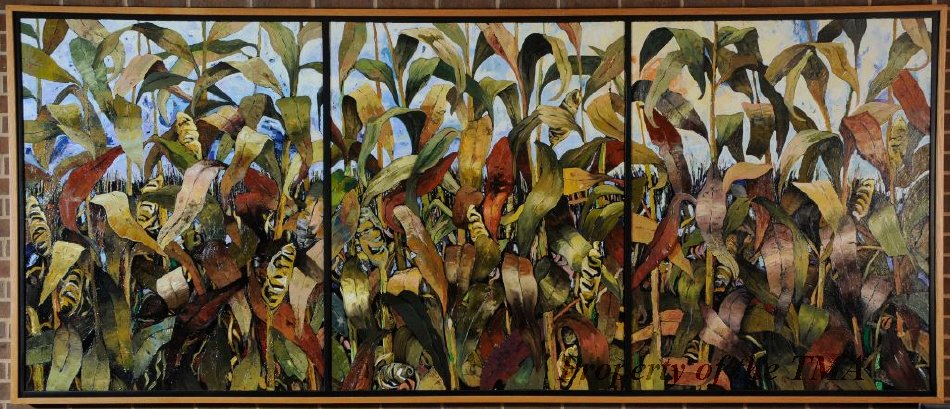
Franklin Demetrius Willis, The 7th Year Harvest, oil on canvas, 50.75 inches X 119.375 inches, Tyler Museum of Art, Tyler, Texas.
Culture: American
Subject: Fine Art, Art History
Collection: Tyler Museum of Art’s Permanent Collection
Grades: Elementary School, Middle School and High School
Topics: Artistic Practices, Art History, Critical Thinking, Landscape, Triptych, German Expressionism, Genre Scene, and Written Response
Art Vocabulary
Activity Vocabulary:
Franklin Demetrius Willis:
- Franklin Demetrius Willis was born in 1963 and is still alive today.[1]
- His interest in art began when he visited the Longview Museum of Art in 1975 when he was 12 years old.[2]
- He found interest in the human connection that is developed between the viewer and the artist through the work of art.[3]
- Throughout his high school and college career, he studied drawing and painting practices.[4]
- As he studied art, he was greatly influenced by the Texas painter Nathan Jones, who created compositions of African American culture and heritage.[5]
- He attended the Kilgore College Art Symposium in 1982 through the L’louise Grahm Art Scholarship.[6]
- In 1985, he received a Bachelors of Fine Arts in Printmaking from the Texas A&M University in Corpus Christi.[7]
- During this time, Willis’ work placed a focus on drawing.[8]
- Then, in 1987, he gained his Masters of Fine Arts in Studio Art Painting from the University of Michigan in Ann Arbor.[9]
- At this point, he broadened his artistic range to include oil painting and printmaking.[10]
- Two years later, in 1989, he received a Fulbright Grant to travel to Germany. Here, he found inspiration from the bold colors in German Expressionism.[11]
- His time abroad helped him learn how to connect the bold compositional designs with his representation of African American culture and history.[12]
- In 1985, he received a Bachelors of Fine Arts in Printmaking from the Texas A&M University in Corpus Christi.[7]
- His work focuses on representing the human experience though landscapes, architecture, agriculture, and objects commonly used in homes.[13]
- He believes this depiction allows the viewer to build a connection between the imagery and their personal life experiences.[14]
- In addition to the objects, he creates “Figurative Abstractions”, which are heavily inspired by German Expressionism. The closeness to the objects to the figures humanizes the renderings and allows the viewer to visually connect themselves to the scene.[15]
- Iconography Willis commonly uses includes: old clothes and shoes, cast-iron skillets, corn fields and other agricultural spaces, fish, and images of the hearth where family gathers.[16]
- These objects, abstracted figures, and agricultural landscapes creates unique genre scene.
- He has won various awards for his artistic representation of African American culture.
- These include: the Annie Giles Kimbrough Award from the Dallas Museum of Art, a grant from the Michigan Council of the Arts, a Faculty Development grant from the Northern Arizona University, and the Caroll Harris Sims Purchase Award from the African-American Museum in Dallas, Texas.[17]
- He currently lives in Arizona with a wife and a son.[18]
- He is a tenured professor at the Northern Arizona University, where he has been teaching since 2014.[19]
- The Tyler Museum of Art held a solo exhibition of his work in 2008 titled Influence of the Sabine: Work by Franklin Demetrius Willis.[20]
German Expersionism:
- German Expressionism was an art movement that began in 1909 for the Der Blaue Reiter group (translated as The Blue Rider) and Brücke group (translated as Bridge).[21]
- The Blue Rider group was developed and supported by the Expressionist artists Franz Marc, August Macke, Paul Klee, Gabriele Münter, and Wassliy Kandinsky. The goal was to create an art movement that championed freedom, power, and mystical thought. Additionally, they saw large scale world change as a good effect for the changing of art. However, The Blue Rider group came to an end during World War I. During the war, August Macke and Franz Marc died. This created a sense of lost idealism for the remining members.[22]
- The Bridge group is similar to The Blue Rider group. The most well known artists were Ernst Ludwig Kirchner, Karl Schmidt-Rottluff, and Emil Nolde. This group wanted to combine German, African, and South Pacific art style together to create bold designs. Similar to The Blue Rider group, the Bridge group ended after World War I.[23]
Genre Scene:
- A genre scene is a style of painting that showcases a moment of everyday life.[24]
- This scene is specific to the time period of the figures, ranging from ancient history to contemporary events.[25]
- This style of painting can provide a view of the past and provide social commentary on the conditions and reality of the selected moment.[26]
Elements of Design[27]:
- Artists use the elements of design to create the foundation of the artwork. The elements of art include: line, shape, form, space, color, and texture.
Line:
- An element of design; line is created on a surface with a pointed moving tool. Lines can range in size, width, texture, and presentation. Common types of line are vertical, horizontal, diagonal, zig-zag, and curved.
Shape:
- An element of design; shape is a two-dimensional enclosed space that represents either an organic shape or a geometric shape. Geometric shapes include squares, circles, rectangles, triangles and other standard geometric shapes. Organic shapes include natural non-geometric shapes that are developed from curvilinear lines.
Form:
- An element of design; form is a three-dimensional enclosed space that represents organic and geometric shapes in a third space. Geometric forms include cubes, spheres, triangular prisms, rectangular prisms, and cones. Organic shapes include three-dimensional forms observed in nature, such as trees, rivers, and rocks.
Space:
- An element of design; this term defines the surface area between, before, and behind an object in a composition.
Color:
- An element of design; this term defines the pigments used in a painting. Color can be organized into categories, such as: hues, values, complements, and intensity.
Texture:
- An element of design; this term defines an artwork’s surface. The artist’s use of the chosen medium creates either implied or actual texture.
Principles of Design[28]:
- Artists used principles of design to build upon the foundational elements of design. This includes the following: rhythm, movement, balance, proportion, variety, emphasis, and unity.
Rhythm/ Pattern:
- A principle of design; this term defines the repetitive imagery and elements of design found in a composition.
Movement:
- A principle of design; this term defines the visual movement observed in a painting. This can be identified as kinetic movement or implied movement. Additionally, movement can be defined as how the viewer’s eye moves throughout the composition.
Balance:
- A principle of design; this term defines the arrangement of the presented imagery with the elements of design. It refers to either asymmetrical compositions or symmetrical compositions.
Proportion:
- A principle of design; this term defines the comparative size between objects in the composition. It can refer to the imagery within a painting or the size between a sculpture and a real object.
Variety:
- A principle of design; this term defines the combination of imagery, objects, and ideas in an artwork.
Emphasis:
- A principle of design; this term defines the most prominent area in a composition. The viewer’s eye is drawn to this point because the artist used a mixture of the elements and principles of design.
Unity:
- A principle of design; this term defines how the elements and principles of design are combined within a composition.
[1] Franklin Demetrius Willis, “Biography”, Northern Arizona University, updated 2023, accessed January 26, 2024, https://directory.nau.edu/departments?id=19100&person=fdw.
[2] Ibid.
[3] Ibid.
[4] Ibid.
[5] “Paintings by Franklin Willis,” Parkland College, updated 2002, accessed January 26, 2024, https://www.parkland.edu/Audience/Community-Business/Parkland-Presents/Art-Gallery/Exhibitions-Events/Exhibits/2002-Exhibits/Paintings-by-Franklin-Willis.
[6] Franklin Demetrius Willis, “Biography”, Northern Arizona University, https://directory.nau.edu/departments?id=19100&person=fdw.
[7] Ibid.
[8] Ibid.
[9] Ibid.
[10] Ibid.
[11] “Paintings by Franklin Willis,” Parkland College, https://www.parkland.edu/Audience/Community-Business/Parkland-Presents/Art-Gallery/Exhibitions-Events/Exhibits/2002-Exhibits/Paintings-by-Franklin-Willis.
[12] Ibid.
[13] Ibid.
[14] Ibid.
[15] Ibid.
[16] Franklin Demetrius Willis, “In Case of Emergency Dial T for Tonka,” University of Michigan: STAMPS School of Art and Design, updated 2024, accessed January 29, 2024, https://stamps.umich.edu/work/24317.
[17] Franklin Demetrius Willis, “Biography”, Northern Arizona University, https://directory.nau.edu/departments?id=19100&person=fdw.
[18] Ibid.
[19] Ibid.
[20] “East Texas Native’s Work in Spotlight for TMA’s Black History Month Celebration,” Tyler Museum of Art, updated 2009, accessed January 29, 2024, https://www.mypawprint.com/TMA/press_Willis.htm.
[21] “Art Term: German Expressionism,” The Tate Modern, updated 2024, accessed January 29, 2024, https://www.tate.org.uk/art/art-terms/g/german-expressionism#:~:text=German%20expressionism%20was%20an%20early,and%20gestural%20marks%20or%20brushstrokes.
[22] “Art term: Der Blaue Reiter,” Tate Modern, updated 2024, accessed January 29, 2024, https://www.tate.org.uk/art/art-terms/d/der-blaue-reiter.
[23] “Art Term: Brücke,” tate Modern, updated 2024, accessed January 29, 2024, https://www.tate.org.uk/art/art-terms/b/brucke.
[24] “Art Term: Genre Painting,” Tate Modern, updated 2022, accessed September 22, 2023, https://www.tate.org.uk/art/art-terms/g/genre-painting.
[25] Ibid.
[26] Ibid.
[27] Rosalins Ragan, “Elements of Art,” in Art Talk, 61 – 211, edited by Bennett and McKnight Division, (San Francisco: Glencoe Publishing Company, 1988).
[28] Rosalins Ragan, “Principles of Design,” in Art Talk, 211 – 347, edited by Bennett and McKnight Division, (San Francisco: Glencoe Publishing Company, 1988).
Bibliography: Resources for Vocabulary and Lesson Plan
“Art Term: Brücke.” Tate Modern. Updated 2024. Accessed January 29, 2024. https://www.tate.org.uk/art/art-terms/b/brucke.
“Art term: Der Blaue Reiter.” Tate Modern. Updated 2024. Accessed January 29, 2024. https://www.tate.org.uk/art/art-terms/d/der-blaue-reiter.
“Art Term: Genre Painting.” Tate Modern. Updated 2022. Accessed September 22, 2023. https://www.tate.org.uk/art/art-terms/g/genre-painting.
“Art Term: German Expressionism.” The Tate Modern. Updated 2024. Accessed January 29, 2024. https://www.tate.org.uk/art/art-terms/g/german-expressionism#:~:text=German%20expressionism%20was%20an%20early,and%20gestural%20marks%20or%20brushstrokes.
“East Texas Native’s Work in Spotlight for TMA’s Black History Month Celebration.” Tyler Museum of Art. Updated 2009. Accessed January 29, 2024. https://www.mypawprint.com/TMA/press_Willis.htm.
Office of the Secretary of State. “§117.102: Art, Kindergarten, Adopted 2013.” Texas Education Agency: Education, updated 2013, accessed January 5, 2022, https://texreg.sos.state.tx.us/public/readtac$ext.TacPage?sl=R&app=9&p_dir=&p_rloc=&p_tloc=&p_ploc=&pg=1&p_tac=&ti=19&pt=2&ch=117&rl=102.
Office of the Secretary of State. “§117.105: Art, Grade 1, Adopted 2013.” Texas Education Agency: Education, updated 2013, accessed January 5, 2022, https://texreg.sos.state.tx.us/public/readtac$ext.TacPage?sl=R&app=9&p_dir=&p_rloc=&p_tloc=&p_ploc=&pg=1&p_tac=&ti=19&pt=2&ch=117&rl=105.
Office of the Secretary of State. “§117.108: Art, Grade 2, Adopted 2013.” Texas Education Agency: Education, updated 2013, accessed January 5, 2022, https://texreg.sos.state.tx.us/public/readtac$ext.TacPage?sl=R&app=9&p_dir=&p_rloc=&p_tloc=&p_ploc=&pg=1&p_tac=&ti=19&pt=2&ch=117&rl=108.
Office of the Secretary of State. “§117.111: Art, Grade 3, Adopted 2013.” Texas Education Agency: Education, updated 2013, accessed January 5, 2022, https://texreg.sos.state.tx.us/public/readtac$ext.TacPage?sl=R&app=9&p_dir=&p_rloc=&p_tloc=&p_ploc=&pg=1&p_tac=&ti=19&pt=2&ch=117&rl=111.
Office of the Secretary of State. “§117.114: Art, Grade 4, Adopted 2013.” Texas Education Agency: Education, updated 2013, accessed January 5, 2022, https://texreg.sos.state.tx.us/public/readtac$ext.TacPage?sl=R&app=9&p_dir=&p_rloc=&p_tloc=&p_ploc=&pg=1&p_tac=&ti=19&pt=2&ch=117&rl=114.
Office of the Secretary of State. “§117.117: Art, Grade 5, Adopted 2013.” Texas Education Agency: Education, updated 2013, accessed January 5, 2022, https://texreg.sos.state.tx.us/public/readtac$ext.TacPage?sl=R&app=9&p_dir=&p_rloc=&p_tloc=&p_ploc=&pg=1&p_tac=&ti=19&pt=2&ch=117&rl=117.
Office of the Secretary of State. “§117.202: Art, Middle School 1, Adopted 2013.” Texas Education Agency: Education, updated 2013, accessed January 5, 2022, https://texreg.sos.state.tx.us/public/readtac$ext.TacPage?sl=R&app=9&p_dir=&p_rloc=&p_tloc=&p_ploc=&pg=1&p_tac=&ti=19&pt=2&ch=117&rl=202.
Office of the Secretary of State. “§117.203: Art, Middle School 2, Adopted 2013.” Texas Education Agency: Education, updated 2013, accessed January 5, 2022, https://texreg.sos.state.tx.us/public/readtac$ext.TacPage?sl=R&app=9&p_dir=&p_rloc=&p_tloc=&p_ploc=&pg=1&p_tac=&ti=19&pt=2&ch=117&rl=203.
Office of the Secretary of State. “§117.204: Art, Middle School 3, Adopted 2013.” Texas Education Agency: Education, updated 2013, accessed January 5, 2022, https://texreg.sos.state.tx.us/public/readtac$ext.TacPage?sl=R&app=9&p_dir=&p_rloc=&p_tloc=&p_ploc=&pg=1&p_tac=&ti=19&pt=2&ch=117&rl=204.
Office of the Secretary of State. “§117.302: Art, Level I, Adopted 2013.” Texas Education Agency: Education, updated 2013, accessed January 5, 2022, https://texreg.sos.state.tx.us/public/readtac$ext.TacPage?sl=R&app=9&p_dir=&p_rloc=&p_tloc=&p_ploc=&pg=1&p_tac=&ti=19&pt=2&ch=117&rl=302.
Office of the Secretary of State. “§117.303: Art, Level II, Adopted 2013.” Texas Education Agency: Education, updated 2013, accessed January 5, 2022, https://texreg.sos.state.tx.us/public/readtac$ext.TacPage?sl=R&app=9&p_dir=&p_rloc=&p_tloc=&p_ploc=&pg=1&p_tac=&ti=19&pt=2&ch=117&rl=303.
Office of the Secretary of State. “§117.304: Art, Level III, Adopted 2013.” Texas Education Agency: Education, updated 2013, accessed January 5, 2022, https://texreg.sos.state.tx.us/public/readtac$ext.TacPage?sl=R&app=9&p_dir=&p_rloc=&p_tloc=&p_ploc=&pg=1&p_tac=&ti=19&pt=2&ch=117&rl=304.
Office of the Secretary of State. “§117.305: Art, Level IV, Adopted 2013.” Texas Education Agency: Education, updated 2013, accessed January 5, 2022, https://texreg.sos.state.tx.us/public/readtac$ext.TacPage?sl=R&app=9&p_dir=&p_rloc=&p_tloc=&p_ploc=&pg=1&p_tac=&ti=19&pt=2&ch=117&rl=305.
“Paintings by Franklin Willis.” Parkland College. Updated 2002. Accessed January 26, 2024. https://www.parkland.edu/Audience/Community-Business/Parkland-Presents/Art-Gallery/Exhibitions-Events/Exhibits/2002-Exhibits/Paintings-by-Franklin-Willis.
Ragan, Rosalins. “Elements of Art.” In Art Talk, 61 – 211. Edited by Bennett and McKnight Division. San Francisco: Glencoe Publishing Company, 1988.
Ragan, Rosalins. “The Principles of Design.” In Art Talk, 211 – 347. Edited by Bennett and McKnight Division. San Francisco: Glencoe Publishing Company, 1988.
Willis, Franklin Demetrius. “Biography.” Northern Arizona University. Updated 2023. Accessed January 26, 2024. https://directory.nau.edu/departments?id=19100&person=fdw.
Willis, Franklin Demetrius. “In Case of Emergency Dial T for Tonka.” University of Michigan: STAMPS School of Art and Design. Updated 2024. Accessed January 29, 2024. https://stamps.umich.edu/work/24317.
Elementary School Lesson Plans: National Learning Standards
Goals:
Elementary School Students of all levels will be able to do the following:
- Identify the principles of design used in the artwork;
- Identify the elements of design used in the artwork;
- Study the art style used by Franklin Demetrius Willis in his painting The 7th Year Harvest;
- Discuss and define genre scenes in connection to Willis’ artwork;
- Discuss and define German Expressionism and the bold colors used in this art style;
- And, write a written response about Willis’ painting.
National Learning Standards for Visual Arts:
Pre-Kindergarten, Kindergarten, First Grade, Second Grade, Third Grade, Fourth Grade, Fifth Grade
Pre-Kindergarten:
- Responding:
- Anchor Standard 7:
- Responding: Perceive and analyze artistic work
- VA:Re.7.1.PKa: Recognize art in one’s environment.
- VA:Re.7.2.PKa: Distinguish between images and real objects.
- Responding: Perceive and analyze artistic work
- Anchor Standard 8:
- Responding: Interpret intent and meaning in artistic work.
- VA:Re8.1.PKa: Interpret art by identifying and describing subject matter.
- Responding: Interpret intent and meaning in artistic work.
- Anchor Standard 9:
- Responding: Apply criteria to evaluate artistic work.
- VA:Re9.1.PKa: Select a preferred artwork.
- Responding: Apply criteria to evaluate artistic work.
- Anchor Standard 7:
- Connecting:
- Anchor Standard 10:
- Connecting: Synthesize and relate knowledge and personal experiences to make art.
- VA:Cn10.1.PKa: Explore the world using descriptive and expressive words and art-making.
- Connecting: Synthesize and relate knowledge and personal experiences to make art.
- Anchor Standard 11:
- Connecting: Relate artistic ideas and works with societal, cultural, and historical context to deepen understanding
- VA:Cn11.1.PKa: Recognize that people make art.
- Connecting: Relate artistic ideas and works with societal, cultural, and historical context to deepen understanding
- Anchor Standard 10:
Kindergarten:
- Responding:
- Anchor Standard 7:
- Responding: Perceive and analyze artistic work
- VA:Re.7.1.Ka: Identify uses of art within one’s personal environment.
- VA:Re.7.2.Ka: Describe what an image represents.
- Responding: Perceive and analyze artistic work
- Anchor Standard 8:
- Responding: Interpret intent and meaning in artistic work.
- VA:Re8.1.Ka: Interpret art by identifying subject matter and describing relevant details.
- Responding: Interpret intent and meaning in artistic work.
- Anchor Standard 9:
- Responding: Apply criteria to evaluate artistic work.
- VA:Re9.1.Ka: Explain reasons for selecting a preferred artwork
- Responding: Apply criteria to evaluate artistic work.
- Anchor Standard 7:
- Connecting:
- Anchor Standard 10:
- Connecting: Synthesize and relate knowledge and personal experiences to make art.
- VA:Cn10.1.Ka: Create art that tells a story about a life experience.
- Connecting: Synthesize and relate knowledge and personal experiences to make art.
- Anchor Standard 11:
- Connecting: Relate artistic ideas and works with societal, cultural, and historical context to deepen understanding
- VA:Cn11.1.Ka: Identify a purpose of an artwork.
- Connecting: Relate artistic ideas and works with societal, cultural, and historical context to deepen understanding
- Anchor Standard 10:
First Grade:
- Responding:
- Anchor Standard 7:
- Responding: Perceive and analyze artistic work
- VA:Re.7.1.1a: Select and describe works of art that illustrate daily life experiences of one’s self and others
- VA:Re.7.2.1a: Compare images that represent the same subject
- Responding: Perceive and analyze artistic work
- Anchor Standard 8:
- Responding: Interpret intent and meaning in artistic work.
- VA:Re8.1.1a: Interpret art by categorizing subject matter and identifying the characteristics of form
- Responding: Interpret intent and meaning in artistic work.
- Anchor Standard 9:
- Responding: Apply criteria to evaluate artistic work.
- VA:Re9.1.1a: Classify artwork based on different reasons for preferences.
- Responding: Apply criteria to evaluate artistic work.
- Anchor Standard 7:
- Connecting:
- Anchor Standard 10:
- Connecting: Synthesize and relate knowledge and personal experiences to make art.
- VA:Cn10.1.1a: Identify times, places, and reasons by which students make art outside of school.
- Connecting: Synthesize and relate knowledge and personal experiences to make art.
- Anchor Standard 11:
- Connecting: Relate artistic ideas and works with societal, cultural, and historical context to deepen understanding
- VA:Cn11.1.1a: Understand that people from different places and times have made art for a variety of reasons.
- Connecting: Relate artistic ideas and works with societal, cultural, and historical context to deepen understanding
- Anchor Standard 10:
Second Grade:
- Responding:
- Anchor Standard 7:
- Responding: Perceive and analyze artistic work
- VA:Re.7.1.2a: Perceive and describe aesthetic characteristics of one’s natural world and constructed environments
- VA:Re.7.2.2a: Categorize images based on expressive properties
- Responding: Perceive and analyze artistic work
- Anchor Standard 8:
- Responding: Interpret intent and meaning in artistic work.
- VA:Re8.1.2a: Interpret art by identifying the mood suggested by a work of art and describing relevant subject matter and characteristics of form
- Responding: Interpret intent and meaning in artistic work.
- Anchor Standard 9:
- Responding: Apply criteria to evaluate artistic work.
- VA:Re9.1.2a: Use learned art vocabulary to express preferences about artwork
- Responding: Apply criteria to evaluate artistic work.
- Anchor Standard 7:
- Connecting:
- Anchor Standard 10:
- Connecting: Synthesize and relate knowledge and personal experiences to make art.
- VA:Cn10.1.2a: Create works of art about events in home, school, or community life
- Connecting: Synthesize and relate knowledge and personal experiences to make art.
- Anchor Standard 11:
- Connecting: Relate artistic ideas and works with societal, cultural, and historical context to deepen understanding
- VA:Cn11.1.2a: Compare and contrast cultural uses of artwork from different times and places.
- Connecting: Relate artistic ideas and works with societal, cultural, and historical context to deepen understanding
- Anchor Standard 10:
Third Grade:
- Responding:
- Anchor Standard 7:
- Responding: Perceive and analyze artistic work
- VA:Re.7.1.3a: Speculate about processes an artist uses to create a work of art.
- VA:Re.7.2.3a: Determine messages communicated by an image.
- Responding: Perceive and analyze artistic work
- Anchor Standard 8:
- Responding: Interpret intent and meaning in artistic work.
- VA:Re8.1.3a: Interpret art by analyzing use of media to create subject matter, characteristics of form, and mood.
- Responding: Interpret intent and meaning in artistic work.
- Anchor Standard 9:
- Responding: Apply criteria to evaluate artistic work.
- VA:Re9.1.3a: Evaluate an artwork based on given criteria.
- Responding: Apply criteria to evaluate artistic work.
- Anchor Standard 7:
- Connecting:
- Anchor Standard 10:
- Connecting: Synthesize and relate knowledge and personal experiences to make art.
- VA:Cn10.1.3a: Develop a work of art based on observations of surroundings.
- Connecting: Synthesize and relate knowledge and personal experiences to make art.
- Anchor Standard 11:
- Connecting: Relate artistic ideas and works with societal, cultural, and historical context to deepen understanding
- VA:Cn11.1.3a: Recognize that responses to art change depending on knowledge of the time and place in which it was made.
- Connecting: Relate artistic ideas and works with societal, cultural, and historical context to deepen understanding
- Anchor Standard 10:
Fourth Grade:
- Responding:
- Anchor Standard 7:
- Responding: Perceive and analyze artistic work
- VA:Re.7.1.4a: Compare responses to a work of art before and after working in similar media.
- VA:Re.7.2.4a: Analyze components in visual imagery that convey messages.
- Responding: Perceive and analyze artistic work
- Anchor Standard 8:
- Responding: Interpret intent and meaning in artistic work.
- VA:Re8.1.4a: Interpret art by referring to contextual information and analyzing relevant subject matter, characteristics of form, and use of media.
- Responding: Interpret intent and meaning in artistic work.
- Anchor Standard 9:
- Responding: Apply criteria to evaluate artistic work.
- VA:Re9.1.4a: Apply one set of criteria to evaluate more than one work of art.
- Responding: Apply criteria to evaluate artistic work.
- Anchor Standard 7:
- Connecting:
- Anchor Standard 10:
- Connecting: Synthesize and relate knowledge and personal experiences to make art.
- VA:Cn10.1.4a: Create works of art that reflect community cultural traditions.
- Connecting: Synthesize and relate knowledge and personal experiences to make art.
- Anchor Standard 11:
- Connecting: Relate artistic ideas and works with societal, cultural, and historical context to deepen understanding
- VA:Cn11.1.4a: Through observation, infer information about time, place, and culture in which a work of art was created.
- Connecting: Relate artistic ideas and works with societal, cultural, and historical context to deepen understanding
- Anchor Standard 10:
Fifth Grade:
- Responding:
- Anchor Standard 7:
- Responding: Perceive and analyze artistic work
- VA:Re.7.1.5a: Compare one’s own interpretation of a work of art with the interpretation of others.
- VA:Re.7.2.5a: Identify and analyze cultural associations suggested by visual imagery.
- Responding: Perceive and analyze artistic work
- Anchor Standard 8:
- Responding: Interpret intent and meaning in artistic work.
- VA:Re8.1.5a: Interpret art by analyzing characteristics of form and structure, contextual information, subject matter, visual elements, and use of media to identify ideas and mood conveyed.
- Responding: Interpret intent and meaning in artistic work.
- Anchor Standard 9:
- Responding: Apply criteria to evaluate artistic work.
- VA:Re9.1.5a: Recognize differences in criteria used to evaluate works of art depending on styles, genres, and media as well as historical and cultural contexts.
- Responding: Apply criteria to evaluate artistic work.
- Anchor Standard 7:
- Connecting:
- Anchor Standard 10:
- Connecting: Synthesize and relate knowledge and personal experiences to make art.
- VA:Cn10.1.5a: Apply formal and conceptual vocabularies of art and design to view surroundings in new ways through art-making.
- Connecting: Synthesize and relate knowledge and personal experiences to make art.
- Anchor Standard 11:
- Connecting: Relate artistic ideas and works with societal, cultural, and historical context to deepen understanding
- VA:Cn11.1.5a: Identify how art is used to inform or change beliefs, values, or behaviors of an individual or society.
- Connecting: Relate artistic ideas and works with societal, cultural, and historical context to deepen understanding
- Anchor Standard 10:
Elementary School Lesson Plans: Texas Essential Knowledge and Skills (TEKS)
Goals:
Elementary School Students of all levels will be able to do the following:
- Identify the principles of design used in the artwork;
- Identify the elements of design used in the artwork;
- Study the art style used by Franklin Demetrius Willis in his painting The 7th Year Harvest;
- Discuss and define genre scenes in connection to Willis’ artwork;
- Discuss and define German Expressionism and the bold colors used in this art style;
- And, write a written response to Willis’ painting.
Texas Elementary School TEKS:
Kindergarten, First Grade, Second Grade, Third Grade, Fourth Grade, and Fifth Grade
Kindergarten:
- §117.102.b.1.A / B
- Foundations: Observation and Perception:
- gather information from subjects in the environment using the senses;
- identify the elements of art, including line, shape, color, texture, and form, and the principles of design, including repetition/pattern and balance, in the environment.
- Foundations: Observation and Perception:
- §117.102.b.3. A / B
- Historical and Cultural Relevance:
- identify simple subjects expressed in artworks;
- share ideas about personal experiences such as family and friends and develop awareness and sensitivity to differing experiences and opinions through artwork;
- Historical and Cultural Relevance:
- §117.102.b.4.B
- Critical Evaluation and Response:
- express ideas found in collections such as real or virtual art museums, galleries, portfolios, or exhibitions using original artworks created by artists or peers;
- Critical Evaluation and Response:
First Grade:
- §117.105.b.1.A / B
- Foundations: Observation and Perception:
- identify similarities, differences, and variations among subjects in the environment using the senses;
- identify the elements of art, including line, shape, color, texture, and form, and the principles of design, including emphasis, repetition/pattern, and balance, in nature and human-made environments.
- Foundations: Observation and Perception:
- §117.105.b.3. A / B
- Historical and Cultural Relevance:
- identify simple ideas expressed in artworks through different media;
- demonstrate an understanding that art is created globally by all people throughout time;
- Historical and Cultural Relevance:
- §117.105.b.4.B
- Critical Evaluation and Response:
- identify ideas found in collections such as real or virtual art museums, galleries, portfolios, or exhibitions using original artworks created by artists or peers.
- Critical Evaluation and Response:
Second Grade:
- §117.108.b.1.A / B
- Foundations: Observation and Perception:
- compare and contrast variations in objects and subjects from the environment using the senses;
- identify the elements of art, including line, shape, color, texture, form, and space, and the principles of design, including emphasis, repetition/pattern, movement/rhythm, and balance.
- Foundations: Observation and Perception:
- §117.108.b.3. A / B
- Historical and Cultural Relevance:
- interpret stories, content, and meanings in a variety of artworks;
- examine historical and contemporary artworks created by men and women, making connections to various cultures;
- Historical and Cultural Relevance:
- §117.108.b.4. B
- Critical Evaluation and Response:
- compare and contrast ideas found in collections such as real or virtual art museums, galleries, portfolios, or exhibitions using original artworks created by artists or peers;
- Critical Evaluation and Response:
Third Grade:
- §117.111.b.1.A / B / C
- Foundations: Observation and Perception:
- explore ideas from life experiences about self, peers, family, school, or community and from the imagination as sources for original works of art;
- use appropriate vocabulary when discussing the elements of art, including line, shape, color, texture, form, space, and value, and the principles of design, including emphasis, repetition/pattern, movement/rhythm, contrast/variety, balance, proportion, and unity;
- discuss the elements of art as building blocks and the principles of design as organizers of works of art.
- Foundations: Observation and Perception:
- §117.111.b.3. A / B
- Historical and Cultural Relevance:
- identify simple main ideas expressed in artworks from various times and places;
- compare and contrast artworks created by historical and contemporary men and women, making connections to various cultures;
- Historical and Cultural Relevance:
- §117.111.b.4. B
- Critical Evaluation and Response
- use methods such as oral response or artist statements to identify main ideas found in collections of artworks created by self, peers, and major historical or contemporary artists in real or virtual portfolios, galleries, or art museums;
- Critical Evaluation and Response
Fourth Grade:
- §117.114.b.1.A / B / C
- Foundations: Observation and Perception:
- explore and communicate ideas drawn from life experiences about self, peers, family, school, or community and from the imagination as sources for original works of art;
- use appropriate vocabulary when discussing the elements of art, including line, shape, color, texture, form, space, and value, and the principles of design, including emphasis, repetition/pattern, movement/rhythm, contrast/variety, balance, proportion, and unity;
- discuss the elements of art as building blocks and the principles of design as organizers of works of art.
- Foundations: Observation and Perception:
- §117.114.b.3. A / B
- Historical and Cultural Relevance:
- compare content in artworks for various purposes such as the role art plays in reflecting life, expressing emotions, telling stories, or documenting history and traditions;
- compare purpose and content in artworks created by historical and contemporary men and women, making connections to various cultures;
- Historical and Cultural Relevance:
- §117.114.b.4. B
- Critical Evaluation and Response
- use methods such as written or oral response or artist statements to identify emotions found in collections of artworks created by self, peers, and major historical or contemporary artists in real or virtual portfolios, galleries, or art museums;
- Critical Evaluation and Response
Fifth Grade:
- §117.117.b.1.A / B / C
- Foundations: Observation and Perception:
- develop and communicate ideas drawn from life experiences about self, peers, family, school, or community and from the imagination as sources for original works of art;
- use appropriate vocabulary when discussing the elements of art, including line, shape, color, texture, form, space, and value, and the principles of design, including emphasis, repetition/pattern, movement/rhythm, contrast/variety, balance, proportion, and unity; and
- discuss the elements of art as building blocks and the principles of design as organizers of works of art.
- Foundations: Observation and Perception:
- §117.117.b.3. A / B
- Historical and Cultural Relevance:
- compare the purpose and effectiveness of artworks from various times and places, evaluating the artist’s use of media and techniques, expression of emotions, or use of symbols;
- compare the purpose and effectiveness of artworks created by historic and contemporary men and women, making connections to various cultures;
- Historical and Cultural Relevance:
- §117.117.b.4. B
- Critical Evaluation and Response
- use methods such as written or oral response or artist statements to identify themes found in collections of artworks created by self, peers, and major historical or contemporary artists in real or virtual portfolios, galleries, or art museums;
- Critical Evaluation and Response
Elementary School Art Activities:
Questions for Elementary School Students:
- Examine Franklin Demetrius Willis’ painting The 7th Year Harvest. Identify where each element of art is located in the artwork.
- Examine Franklin Demetrius Willis’ painting The 7th Year Harvest. Identify where each principle of art is located in the artwork.
- What is Willis showing in his painting The 7th Year Harvest?
- Based on the title, what event is about to happen?
- Do you see any people in the painting?
- Why do you think Willis decided not to include people?
- How does he show that people are present within this space?
- What is a genre painting?
- Can you give an example of a scene of everyday life?
- What is German Expressionism?
- Why do you think bold colors were used in this art movement?
Activity: Elementary School Art History
- Activity Setting: Classroom
- Materials: Pencil/ Pen on Paper or Word Document
- Subject: Painting, German Expressionism, and Genre Scene
- National Learning Standards: Pre-Kindergarten, Kindergarten, First Grade, Second Grade, Third Grade, Fourth Grade, and Fifth Grade
- Texas TEKS: Kindergarten, First Grade, Second Grade, Third Grade, Fourth Grade, and Fifth Grade
- Duration: Either a Single Day Project or an Extended Project
The class will study the painting The 7th Year Harvest created by Franklin Demetrius Willis. The students will discuss the life and art created by Willis. Then, the group will define genre scenes and the German Expressionism art movement. Next, the students will write a response to the following questions:
- Why did the artist paint a field of corn?
- Why did he use bold colors in his painting?
- What is the meaning of the artwork to you?
The written response will be scaled to the student’s grade level and determined by the teacher. The answer can be either a single sentence, a paragraph, or a page in length. The students are encouraged to use the elements and principles of design as well as the discussed vocabulary to explain their answer.
Middle School Lesson Plan: National Learning Standards
Goals:
Middle School Students of all Levels will be able to do the following:
- Identify the principles of design used in the artwork;
- Identify the elements of design used in the artwork;
- Study the art style used by Franklin Demetrius Willis in his painting The 7th Year Harvest;
- Discuss and define genre scenes in connection to Willis’ artwork;
- Discuss and define German Expressionism and the bold colors used in this art style;
- And, write a written response about Willis’ painting.
National Learning Standards for Visual Arts:
Sixth Grade, Seventh Grade, and Eighth Grade
Sixth Grade:
- Responding:
- Anchor Standard 7:
- Responding: Perceive and analyze artistic work
- VA:Re.7.1.6a: Identify and interpret works of art or design that reveal how people live around the world and what they value.
- VA:Re.7.2.6a: Analyze ways that visual components and cultural associations suggested by images influence ideas, emotions, and actions.
- Responding: Perceive and analyze artistic work
- Anchor Standard 8:
- Responding: Interpret intent and meaning in artistic work.
- VA:Re8.1.6a: Interpret art by distinguishing between relevant and non-relevant contextual information and analyzing subject matter, characteristics of form and structure, and use of media to identify ideas and mood conveyed.
- Responding: Interpret intent and meaning in artistic work.
- Anchor Standard 9:
- Responding: Apply criteria to evaluate artistic work.
- VA:Re9.1.6a: Develop and apply relevant criteria to evaluate a work of art.
- Responding: Apply criteria to evaluate artistic work.
- Anchor Standard 7:
- Connecting:
- Anchor Standard 10:
- Connecting: Synthesize and relate knowledge and personal experiences to make art.
- VA:Cn10.1.6a: Generate a collection of ideas reflecting current interests and concerns that could be investigated in art-making.
- Connecting: Synthesize and relate knowledge and personal experiences to make art.
- Anchor Standard 11:
- Connecting: Relate artistic ideas and works with societal, cultural, and historical context to deepen understanding
- VA:Cn11.1.6a: Analyze how art reflects changing times, traditions, resources, and cultural uses.
- Connecting: Relate artistic ideas and works with societal, cultural, and historical context to deepen understanding
- Anchor Standard 10:
Seventh Grade:
- Responding:
- Anchor Standard 7:
- Responding: Perceive and analyze artistic work
- VA:Re.7.1.7a: Explain how the method of display, the location, and the experience of an artwork influence how it is perceived and valued.
- VA:Re.7.2.7a: Analyze multiple ways that images influence specific audiences.
- Responding: Perceive and analyze artistic work
- Anchor Standard 8:
- Responding: Interpret intent and meaning in artistic work.
- VA:Re8.1.7a: Interpret art by analyzing art-making approaches, the characteristics of form and structure, relevant contextual information, subject matter, and use of media to identify ideas and mood conveyed.
- Responding: Interpret intent and meaning in artistic work.
- Anchor Standard 9:
- Responding: Apply criteria to evaluate artistic work.
- VA:Re9.1.7a: Compare and explain the difference between an evaluation of an artwork based on personal criteria and an evaluation of an artwork based on a set of established criteria.
- Responding: Apply criteria to evaluate artistic work.
- Anchor Standard 7:
- Connecting:
- Anchor Standard 10:
- Connecting: Synthesize and relate knowledge and personal experiences to make art.
- VA:Cn10.1.7a: Individually or collaboratively create visual documentation of places and times in which people gather to make and experience art or design in the community.
- Connecting: Synthesize and relate knowledge and personal experiences to make art.
- Anchor Standard 11:
- Connecting: Relate artistic ideas and works with societal, cultural, and historical context to deepen understanding
- VA:Cn11.1.7a: Analyze how response to art is influenced by understanding the time and place in which it was created, the available resources, and cultural uses.
- Connecting: Relate artistic ideas and works with societal, cultural, and historical context to deepen understanding
- Anchor Standard 10:
Eighth Grade:
- Responding:
- Anchor Standard 7:
- Responding: Perceive and analyze artistic work
- VA:Re.7.1.8a: Explain how a person’s aesthetic choices are influenced by culture and environment and impact the visual image that one conveys to others.
- VA:Re.7.2.8a: Compare and contrast contexts and media in which viewers encounter images that influence ideas, emotions, and actions.
- Responding: Perceive and analyze artistic work
- Anchor Standard 8:
- Responding: Interpret intent and meaning in artistic work.
- VA:Re8.1.8a: Interpret art by analyzing how the interaction of subject matter, characteristics of form and structure, use of media, art-making approaches, and relevant contextual information contributes to understanding messages or ideas and mood conveyed.
- Responding: Interpret intent and meaning in artistic work.
- Anchor Standard 9:
- Responding: Apply criteria to evaluate artistic work.
- VA:Re9.1.8a: Create a convincing and logical argument to support an evaluation of art.
- Responding: Apply criteria to evaluate artistic work.
- Anchor Standard 7:
- Connecting:
- Anchor Standard 10:
- Connecting: Synthesize and relate knowledge and personal experiences to make art.
- VA:Cn10.1.8a: Make art collaboratively to reflect on and reinforce positive aspects of group identity.
- Connecting: Synthesize and relate knowledge and personal experiences to make art.
- Anchor Standard 11:
- Connecting: Relate artistic ideas and works with societal, cultural, and historical context to deepen understanding
- VA:Cn11.1.8a: Distinguish different ways art is used to represent, establish, reinforce, and reflect group identity.
- Connecting: Relate artistic ideas and works with societal, cultural, and historical context to deepen understanding
- Anchor Standard 10:
Middle School Lesson Plans: Texas Essential Knowledge and Skills (TEKS)
Goals:
Middle School Students of all Levels will be able to do the following:
- Identify the principles of design used in the artwork;
- Identify the elements of design used in the artwork;
- Study the art style used by Franklin Demetrius Willis in his painting The 7th Year Harvest;
- Discuss and define genre scenes in connection to Willis’ artwork;
- Discuss and define German Expressionism and the bold colors used in this art style;
- And, write a written response to Willis’ paintings.
Texas Middle School TEKS:
Art 1, Art 2, Art 3
Art 1:
- §117.202.c.1.A / B / C / D
- Foundations: Observation and Perception:
- identify and illustrate concepts from direct observation, original sources, personal experiences, and communities such as family, school, cultural, local, regional, national, and international;
- understand and apply the elements of art, including line, shape, color, texture, form, space, and value, as the fundamentals of art in personal artworks using art vocabulary appropriately;
- understand and apply the principles of design, including emphasis, repetition/pattern, movement/rhythm, contrast/variety, balance, proportion, and unity, in personal artworks using art vocabulary appropriately;
- discuss the expressive properties of artworks such as appropriation, meaning, narrative, message, and symbol using art vocabulary accurately.
- Foundations: Observation and Perception:
- §117.202.c.3.A / B
- Historical and Cultural Relevance:
- identify the influence of historical and political events in artworks;
- identify examples of art that convey universal themes such as beliefs, cultural narrative, life cycles, the passage of time, identity, conflict, and cooperation;
- Historical and Cultural Relevance:
- §117.202.c.4.A / B / D
- Critical Evaluation and Response
- create written or oral responses to artwork using appropriate art vocabulary;
- analyze original artworks using a method of critique such as describing the artwork, analyzing the way it is organized, interpreting the artist’s intention, and evaluating the success of the artwork;
- investigate and explore original artworks in a variety of venues outside of the classroom such as museums, galleries, or community art;
- Critical Evaluation and Response
Art 2:
- §117.203.b.1.A / B / C / D
- Foundations: Observation and Perception:
- identify and illustrate ideas from direct observation, original sources, imagination, personal experiences, and communities such as family, school, cultural, local, regional, national, and international;
- compare and contrast the elements of art, including line, shape, color, texture, form, space, and value, as the fundamentals of art in personal artworks using vocabulary accurately;
- compare and contrast the principles of design, including emphasis, repetition/pattern, movement/rhythm, contrast/variety, balance, proportion, and unity, in personal artworks using vocabulary accurately;
- understand and apply the expressive properties of artworks such as appropriation, meaning, narrative, message, and symbol using art vocabulary accurately.
- Foundations: Observation and Perception:
- §117.203.b.3.A / B
- Historical and Cultural Relevance:
- analyze ways that global, cultural, historical, and political issues influence artworks;
- analyze selected artworks to determine contemporary relevance in relationship to universal themes such as belief, cultural narrative, life cycles, the passage of time, identity, conflict, and cooperation;
- Historical and Cultural Relevance:
- §117.203.b.4.A / B / D
- Critical Evaluation and Response:
- create written or oral responses about personal or collaborative artworks addressing purpose, technique, organization, judgment, and personal expression;
- analyze original artworks using a method of critique such as describing the artwork, analyzing the way it is organized, interpreting the artist’s intention, and evaluating the success of the artwork;
- investigate and explore original artworks in a variety of venues outside of the classroom such as museums, galleries, or community art;
- Critical Evaluation and Response:
Art 3:
- §117.203.b.1.A / B / C / D
- Foundations: Observation and Perception:
- identify and illustrate concepts from direct observation, original sources, imagination, personal experience, and communities such as family, school, cultural, local, regional, national, and international;
- evaluate the elements of art, including line, shape, color, texture, form, space, and value, as the fundamentals of art in personal artworks using vocabulary accurately;
- evaluate the principles of design, including emphasis, repetition/pattern, movement/rhythm, contrast/variety, balance, proportion, and unity, in personal artworks using vocabulary accurately;
- compare and contrast the expressive properties of artworks, including appropriation, meaning, narrative, message, and symbol, using vocabulary accurately.
- Foundations: Observation and Perception:
- §117.203.b.3.A / B
- Historical and Cultural Relevance:
- analyze ways in which global, contemporary, historical, and political issues have influenced art;
- analyze cultural ideas expressed in artworks relating to social, political, and environmental themes such as environment/nature, conflict and power, relationships to others, and reality/fantasy;
- Historical and Cultural Relevance:
- §117.203.b.4.A / C
- Critical Evaluation and Response:
- create written and oral responses about personal or collaborative artworks addressing purpose, technique, organization, judgment, and personal expression;
- investigate and explore original artworks in a variety of venues outside of the classroom such as museums, galleries, or community art;
- Critical Evaluation and Response:
Middle School Art Activities:
Questions for Middle School Students:
- Examine Franklin Demetrius Willis’ painting The 7th Year Harvest. Identify where each element of art is located in the artwork.
- Examine Franklin Demetrius Willis’ painting The 7th Year Harvest. Identify where each principle of art is located in the artwork.
- What is Willis showing in his painting The 7th Year Harvest?
- Based on the title, what event is about to happen?
- Do you see any people in the painting?
- Why do you think Willis decided not to include people?
- How does he show that people are present within this space?
- What is a genre painting?
- Can you give an example of a scene of everyday life?
- What is German Expressionism?
- Why do you think bold colors were used in this art movement?
Activity: Middle School Art History
- Activity Setting: Classroom
- Materials: Pencil/ Pen on Paper or Word Document
- Subject: Painting, Genre Scene, and German Expressionism
- National Learning Standards: Sixth Grade, Seventh Grade, and Eighth Grade
- Texas TEKS: Art 1, Art 2, Art 3
- Duration: Either a Single Day or an Extended Project
The class will study the painting The 7th Year Harvest created by Franklin Demetrius Willis. The students will discuss the life and art created by Willis. Then, the group will define genre scenes and the German Expressionism art movement. Next, the students will write a response to the following questions:
- Why did the artist paint a field of corn?
- Why did he use bold colors in his painting?
- What is the meaning of the artwork to you?
- Do you think Willis’ painting is a successful mixture of a genre scene and the art style of German Expressionism? Why or why not?
The written response will be scaled to the student’s grade level and determined by the teacher. The answer can be either 1 – 3 paragraphs or 1 – 2 pages in length. The students will use the elements and principles of design as well as the discussed vocabulary to explain their answer. The teacher can have the students complete research into these subjects and include cited sources to support their responses.
High School Lesson Plans: National Learning Standards
Goals:
High School Students of all Levels will be able to do the following:
- Identify the principles of design used in the artwork;
- Identify the elements of design used in the artwork;
- Study the art style used by Franklin Demetrius Willis in his painting The 7th Year Harvest;
- Discuss and define genre scenes in connection to Willis’ artwork;
- Discuss and define German Expressionism and the bold colors used in this art style;
- And, write a written response to Willis’ painting.
National Learning Standards for Visual Arts:
High School Proficient, High School Accomplished, and High School Advanced
High School Proficient:
- Responding:
- Anchor Standard 7:
- Responding: Perceive and analyze artistic work
- VA:Re.7.1.Ia: Hypothesize ways in which art influences perception and understanding of human experiences.
- VA:Re.7.2.Ia: Analyze how one’s understanding of the world is affected by experiencing visual imagery.
- Responding: Perceive and analyze artistic work
- Anchor Standard 8:
- Responding: Interpret intent and meaning in artistic work.
- VA:Re8.1.Ia: Interpret an artwork or collection of works, supported by relevant and sufficient evidence found in the work and its various contexts.
- Responding: Interpret intent and meaning in artistic work.
- Anchor Standard 9:
- Responding: Apply criteria to evaluate artistic work.
- VA:Re9.1.Ia: Establish relevant criteria in order to evaluate a work of art or collection of works.
- Responding: Apply criteria to evaluate artistic work.
- Anchor Standard 7:
- Connecting:
- Anchor Standard 10:
- Connecting: Synthesize and relate knowledge and personal experiences to make art.
- VA:Cn10.1.Ia: Document the process of developing ideas from early stages to fully elaborated ideas.
- Connecting: Synthesize and relate knowledge and personal experiences to make art.
- Anchor Standard 11:
- Connecting: Relate artistic ideas and works with societal, cultural, and historical context to deepen understanding
- VA:Cn11.1.Ia: Describe how knowledge of culture, traditions, and history may influence personal responses to art.
- Connecting: Relate artistic ideas and works with societal, cultural, and historical context to deepen understanding
- Anchor Standard 10:
High School Accomplished:
- Responding:
- Anchor Standard 7:
- Responding: Perceive and analyze artistic work
- VA:Re.7.1.IIa: Recognize and describe personal aesthetic and empathetic responses to the natural world and constructed environments.
- VA:Re.7.2.IIa: Evaluate the effectiveness of an image or images to influence ideas, feelings, and behaviors of specific audiences.
- Responding: Perceive and analyze artistic work
- Anchor Standard 8:
- Responding: Interpret intent and meaning in artistic work.
- VA:Re8.1.IIa: Identify types of contextual information useful in the process of constructing interpretations of an artwork or collection of works.
- Responding: Interpret intent and meaning in artistic work.
- Anchor Standard 9:
- Responding: Apply criteria to evaluate artistic work.
- VA:Re9.1.IIa: Determine the relevance of criteria used by others to evaluate a work of art or collection of works.
- Responding: Apply criteria to evaluate artistic work.
- Anchor Standard 7:
- Connecting:
- Anchor Standard 10:
- Connecting: Synthesize and relate knowledge and personal experiences to make art.
- VA:Cn10.1.IIa: Utilize inquiry methods of observation, research, and experimentation to explore unfamiliar subjects through art-making.
- Connecting: Synthesize and relate knowledge and personal experiences to make art.
- Anchor Standard 11:
- Connecting: Relate artistic ideas and works with societal, cultural, and historical context to deepen understanding
- VA:Cn11.1.IIa: Compare uses of art in a variety of societal, cultural, and historical contexts and make connections to uses of art in contemporary and local contexts.
- Connecting: Relate artistic ideas and works with societal, cultural, and historical context to deepen understanding
- Anchor Standard 10:
High School Advanced:
- Responding:
- Anchor Standard 7:
- Responding: Perceive and analyze artistic work
- VA:Re.7.1.IIIa: Analyze how responses to art develop over time based on knowledge of and experience with art and life.
- VA:Re.7.2.IIIa: Determine the commonalities within a group of artists or visual images attributed to a particular type of art, timeframe, or culture.
- Responding: Perceive and analyze artistic work
- Anchor Standard 8:
- Responding: Interpret intent and meaning in artistic work.
- VA:Re8.1.IIIa: Analyze differing interpretations of an artwork or collection of works in order to select and defend a plausible critical analysis.
- Responding: Interpret intent and meaning in artistic work.
- Anchor Standard 9:
- Responding: Apply criteria to evaluate artistic work.
- VA:Re9.1.IIIa: Construct evaluations of a work of art or collection of works based on differing sets of criteria.
- Responding: Apply criteria to evaluate artistic work.
- Anchor Standard 7:
- Connecting:
- Anchor Standard 10:
- Connecting: Synthesize and relate knowledge and personal experiences to make art.
- VA:Cn10.1.IIIa: Synthesize knowledge of social, cultural, historical, and personal life with art-making approaches to create meaningful works of art or design.
- Connecting: Synthesize and relate knowledge and personal experiences to make art.
- Anchor Standard 11:
- Connecting: Relate artistic ideas and works with societal, cultural, and historical context to deepen understanding
- VA:Cn11.1.IIIa: Appraise the impact of an artist or a group of artists on the beliefs, values, and behaviors of a society.
- Connecting: Relate artistic ideas and works with societal, cultural, and historical context to deepen understanding
- Anchor Standard 10:
High School Lesson Plan: Texas Essential Knowledge and Skill (TEKS)
Goals:
High School Students of all Levels will be able to do the following:
- Identify the principles of design used in the artwork;
- Identify the elements of design used in the artwork;
- Study the art style used by Franklin Demetrius Willis in his painting The 7th Year Harvest;
- Discuss and define genre scenes in connection to Willis’ artwork;
- Discuss and define German Expressionism and the bold colors used in this art style;
- And, write a written response to Willis’ painting.
Texas High School TEKS:
Art Level I, Level II, Level III, and Level IV
Level I:
- §117.302.c.1.A / B / C / D
- Foundations: Observation and Perception:
- consider concepts and ideas from direct observation, original sources, experiences, and imagination for original artwork;
- identify and understand the elements of art, including line, shape, color, texture, form, space, and value, as the fundamentals of art in personal artwork;
- identify and understand the principles of design, including emphasis, repetition/pattern, movement/rhythm, contrast/variety, balance, proportion, and unity, in personal artwork;
- make judgments about the expressive properties such as content, meaning, message, and metaphor of artwork using art vocabulary accurately.
- Foundations: Observation and Perception:
- §117.302.c.3.A / B
- Historical and Cultural Relevance
- compare and contrast historical and contemporary styles while identifying general themes and trends;
- describe general characteristics in artwork from a variety of cultures, which might also include personal identity and heritage;
- Historical and Cultural Relevance
- §117.302.c.4.A / B / D
- Critical Evaluation and Response
- interpret, evaluate, and justify artistic decisions in artwork by self, peers, and other artists such as that in museums, local galleries, art exhibits, and websites;
- evaluate and analyze artwork using a verbal or written method of critique such as describing the artwork, analyzing the way it is organized, interpreting the artist’s intention, and evaluating the success of the artwork;
- select and analyze original artwork, portfolios, and exhibitions to form precise conclusions about formal qualities, historical and cultural contexts, intentions, and meanings.
- Critical Evaluation and Response
Level II:
- §117.303.c.1.A / B / C / D
- Foundations: Observation and Perception:
- use visual comparisons to illustrate concepts and ideas from direct observation, original sources, experiences, narration, and imagination for original artworks;
- identify and apply the elements of art, including line, shape, color, texture, form, space, and value, as the fundamentals of art in personal artworks;
- identify and apply the principles of design, including emphasis, repetition/pattern, movement/rhythm, contrast/variety, balance, proportion, and unity in personal artworks;
- explore suitability of art media and processes to express specific ideas such as content, meaning, message, appropriation, and metaphor relating to visual themes of artworks using art vocabulary accurately.
- Foundations: Observation and Perception:
- §117.303.c.3.A / B
- Historical and Cultural Relevance:
- examine selected historical periods or styles of art to identify general themes and trends;
- analyze specific characteristics in artwork from a variety of cultures;
- Historical and Cultural Relevance:
- §117.303.c.4.A / B / C / E
- Critical Evaluation and Response:
- interpret, evaluate, and justify artistic decisions in artwork by self, peers, and other artists such as that in museums, local galleries, art exhibits, and websites;
- evaluate and analyze artwork using a method of critique such as describing the artwork, analyzing the way it is organized, interpreting the artist’s intention, and evaluating the success of the artwork;
- use responses to artwork critiques to make decisions about future directions in personal work;
- select and analyze original artwork, portfolios, and exhibitions to form precise conclusions about formal qualities, historical and cultural contexts, intentions, and meanings.
- Critical Evaluation and Response:
Level III:
- §117.304.c.1.A / B / C / D
- Foundations: Observation and Perception:
- analyze visual characteristics of sources to illustrate concepts, demonstrate flexibility in solving problems, create multiple solutions, and think imaginatively;
- compare and contrast the elements of art, including line, shape, color, texture, form, space, and value, as the fundamentals of art in personal artwork;
- compare and contrast the principles of design, including emphasis, repetition/pattern, movement/rhythm, contrast/variety, balance, proportion, and unity, in personal artwork;
- explore the suitability of art media and processes and select those appropriate to express specific ideas such as content, meaning, message, and metaphor relating to visual themes to interpret the expressive qualities of artwork.
- Foundations: Observation and Perception:
- §117.304.c.3.A / B
- Historical and Cultural Relevance:
- research selected historical periods, artists, general themes, trends, and styles of art;
- distinguish the correlation between specific characteristics and influences of various cultures and contemporary artwork;
- Historical and Cultural Relevance:
- §117.304.c.4.A / B / C / F
- Critical Evaluation and Response:
- interpret, evaluate, and justify artistic decisions in artwork such as that in museums, local galleries, art exhibits, and websites based on evaluation of developmental progress, competency in problem solving, and a variety of visual ideas;
- evaluate and analyze artwork using a method of critique such as describing the artwork, analyzing the way it is organized, interpreting the artist’s intention, and evaluating the success of the artwork;
- analyze personal artwork in order to create a written response such as an artist’s statement reflecting intent, inspiration, the elements of art and principles of design within the artwork, and measure of uniqueness;
- select and analyze original artwork, portfolios, and exhibitions to demonstrate innovation and provide examples of in-depth exploration of qualities such as aesthetics; formal, historical, and cultural contexts; intentions; and meanings.
- Critical Evaluation and Response:
Level IV:
- §117.305.c.1.A / B / C / D
- Foundations: Observation and Perception:
- consider concepts and themes for personal artwork that integrate an extensive range of visual observations, experiences, and imagination;
- compare and contrast the elements of art, including line, shape, color, texture, form, space, and value, as the fundamentals of art in personal artwork;
- compare and contrast the principles of design, including emphasis, repetition/pattern, movement/rhythm, contrast/variety, balance, proportion, and unity, in personal artwork;
- discriminate between art media and processes to express complex visual relationships such as content, meaning, message, and metaphor using extensive art vocabulary.
- Foundations: Observation and Perception:
- §117.305.c.3.A / B
- Historical and Cultural Relevance:
- research and report on selected historical periods, artists, general themes, trends, and styles of art;
- analyze and evaluate the influence of contemporary cultures on artwork;
- Historical and Cultural Relevance:
- §117.305.c.4.A / B / C / F
- Critical Evaluation and Response:
- develop evaluative criteria to justify artistic decisions in artwork such as that in museums, local galleries, art exhibits, and websites based on a high level of creativity and expertise in one or more art areas;
- evaluate and analyze artwork using a method of critique such as describing the artwork, analyzing the way it is organized, interpreting the artist’s intention, and evaluating the success of the artwork;
- analyze personal artwork in order to create a written response such as an artist’s statement reflecting intent, inspiration, the elements of art and principles of design within the artwork, and the measure of uniqueness;
- evaluate a wide range of artwork to form conclusions about formal qualities, aesthetics, historical and cultural contexts, intents, and meanings.
- Critical Evaluation and Response:
High School Art Activities:
Questions for High School Students:
- Examine Franklin Demetrius Willis’ painting The 7th Year Harvest. Identify where each element of art is located in the artwork.
- Examine Franklin Demetrius Willis’ painting The 7th Year Harvest. Identify where each principle of art is located in the artwork.
- What is Willis showing in his painting The 7th Year Harvest?
- Based on the title, what event is about to happen?
- Do you see any people in the painting?
- Why do you think Willis decided not to include people?
- How does he show that people are present within this space?
- What is a genre painting?
- Can you give an example of a scene of everyday life?
- What is German Expressionism?
- Why do you think bold colors were used in this art movement?
- Why do you think World War I ended the German Expressionist movement?
- Do you think Willis’ painting is a successful mixture of a genre scene and the art style of german Expressionism? Why or why not?
Activity: High School Art History
- Activity Setting: Classroom
- Materials: Pencil/ Pen on Paper or Word Document
- Subject: Painting, Genre Scene, and German Expressionism
- National Learning Standard in Visual Arts: High School Proficient, high School Accomplished, and High School Advanced
- Texas TEKS: Art Level I, Level II, Level III, and Level IV
- Duration: Either a Single Day or an Extended Project
The class will study the painting The 7th Year Harvest created by Franklin Demetrius Willis. The students will discuss the life and art created by Willis. Then, the group will define genre scenes and the German Expressionism art movement. Next, the students will write a response to the following questions:
- Why did the artist paint a field of corn?
- Why did he use bold colors in his painting?
- What is the meaning of the artwork to you?
- Do you think Willis’ painting is a successful mixture of a genre scene and the art style of German Expressionism? Why or why not?
The written response will be scaled to the student’s grade level and determined by the teacher. The answer can be between 2 – 3 pages in length. The students will use the elements and principles of design as well as the discussed vocabulary to explain their answer. The teacher will have the students complete research into these subjects and include cited sources to support their responses. The sources will be cited in MLA Format or Chicago Manual of Style.
For more educational resources created by the Tyler Museum of Art, visit our YouTube page by clicking on the YouTube button or clicking the link below.

And stay updated with the Tyler Museum of Art’s events by visiting our Facebook and Instagram pages:


If you use or references this lesson plan, please leave a comment with your feedback.
Thank you for visiting the Tyler Museum of Art’s Education Blog!
 Tyler Museum of Art Education Blog