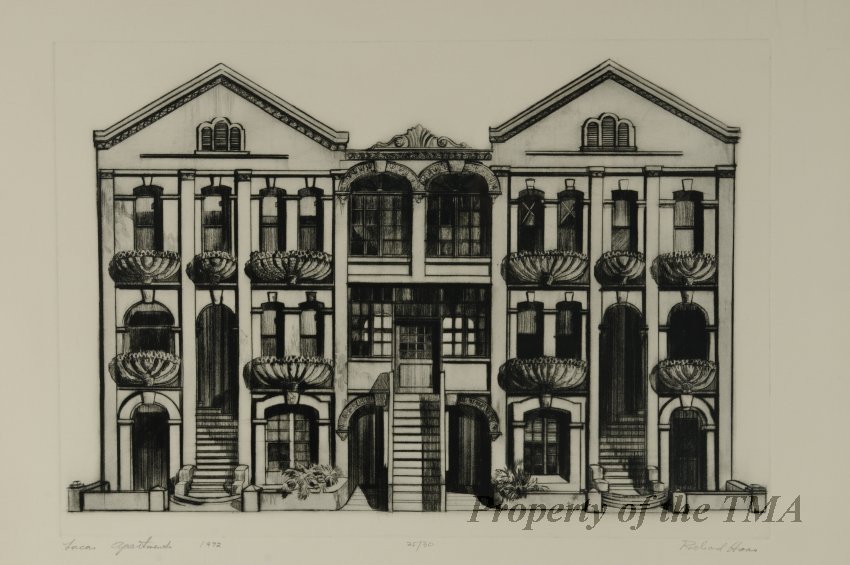
This lesson plan contains the National Learning Standards for Visual Arts and the Texas TEKS for Elementary, Middle, and High School art teachers. Students will learn about Richard Haas’ methods of representing architecture in his print Lucas Apartments. Then, the class will discuss how architecture is catalogued in both the past and the present. Afterwards, the students will select a historical building in their town to research and photograph. Next, each student will write a response to questions regarding their chosen building.
If you use or reference this lesson plan, please leave a comment with your feedback. The lesson plan can be downloaded in the link below.
Richard Haas, Lucas Apartments, 1972, drypoint etching, edition 25/30, 20 inches X 25.5 inches, Tyler Museum of Art, Tyler, Texas
Culture: American
Subject: Fine Art, Art History
Collection: Tyler Museum of Art’s Permanent Collection
Grades: Elementary School, Middle School and High School
Topics: Artistic Practices, Art History, Critical Thinking, Architecture, Photography, Printmaking, and Written Response
Art Vocabulary
Activity Vocabulary:
Richard Haas:
- Richard Haas was born in 1936 and is still alive today.[1]
- He gained his Bachelor of Science degree from the University of Wisconsin-Milwaukee.[2]
- Afterwards, he received his Master of Fine Arts from the University of Minnesota.[3]
- Starting in 1974, he has painted 120 largescale illusionistic murals across the United States.[4]
- His most recent mural was the restoration of the Prince Street Mural in New York City. The flat side of the building was painted to give the appearance of windows build into the side. Each window has character: some are closed with blinds, some have a pet sitting on the edge to look down at the cars, and some are open to show a false interior space.[5]
- This style of painting is known as Trompe L’oeil, a French term for illusion or to fool the eye.[6]
- Haas places a focus on architectural detail and design. Both his murals and small works examine the patterns, shapes, angles, and lines used to construct the depicted building.
Lucas Apartments:
- The Lucas Apartments is an old building in Galveston along Broadway Avenue in the Historic District.[7]
- The building is designed in an Art Nouveau style. This features flower-like brass decorations that adorn the building.[8]
- The building was demolished during 1900 Galveston Hurricane. The reconstruction sought to rebuild the apartment building to be as close to the original as possible.[9]
Galveston Series:
- The Lucas Apartment print is part of his Galveston Series print portfolio. The collection of works showcased various historical buildings in Galveston, Texas.[10]
- This depicts the front of the Lucas Apartments, which is in central Galveston.[11]
- The piece does not contain a landscape nor the horizon line. The focus is on the symmetrical layout of the building in a draftsman style.
- His works encourage the viewer to observe and appreciate the beauty of architecture.[12]
Architecture:
- The subject of architecture is derived from a combination of mathematics and meticulous design.[13]
- Buildings that range from early human shelters to massive towers are all studied as a type of architecture.[14]
- Similar to two-dimensional and three-dimensional artwork, architecture was designed following different art movements through the ages.[15]
Etching:
- A popular style of printmaking is a method known as etching.[16]
- The process requires the artist to cover a metal plate in a wax or asphaltum and “draw” onto the plate by removing the covering with a pen tool.[17]
- Then, the metal plate is placed in a chemical acid bath to burn the “drawn” imagery into the plate.[18]
- Next, the artist will clean the plate, roll ink on treated plate, place a piece of paper on top, and roll it through a printing press.[19]
- The result is an etching print.[20]
Elements of Design[21]:
- Artists use the elements of design to create the foundation of the artwork. The elements of art include: line, shape, form, space, color, and texture.
Line:
- An element of design; line is created on a surface with a pointed moving tool. Lines can range in size, width, texture, and presentation. Common types of line are vertical, horizontal, diagonal, zig-zag, and curved.
Shape:
- An element of design; shape is a two-dimensional enclosed space that represents either an organic shape or a geometric shape. Geometric shapes include squares, circles, rectangles, triangles and other standard geometric shapes. Organic shapes include natural non-geometric shapes that are developed from curvilinear lines.
Form:
- An element of design; form is a three-dimensional enclosed space that represents organic and geometric shapes in a third space. Geometric forms include cubes, spheres, triangular prisms, rectangular prisms, and cones. Organic shapes include three-dimensional forms observed in nature, such as trees, rivers, and rocks.
Space:
- An element of design; this term defines the surface area between, before, and behind an object in a composition.
Color:
- An element of design; this term defines the pigments used in a painting. Color can be organized into categories, such as: hues, values, complements, and intensity.
Texture:
- An element of design; this term defines an artwork’s surface. The artist’s use of the chosen medium creates either implied or actual texture.
Principles of Design[22]:
- Artists used principles of design to build upon the foundational elements of design. This includes the following: rhythm, movement, balance, proportion, variety, emphasis, and unity.
Rhythm/ Pattern:
- A principle of design; this term defines the repetitive imagery and elements of design found in a composition.
Movement:
- A principle of design; this term defines the visual movement observed in a painting. This can be identified as kinetic movement or implied movement. Additionally, movement can be defined as how the viewer’s eye moves throughout the composition.
Balance:
- A principle of design; this term defines the arrangement of the presented imagery with the elements of design. It refers to either asymmetrical compositions or symmetrical compositions.
Proportion:
- A principle of design; this term defines the comparative size between objects in the composition. It can refer to the imagery within a painting or the size between a sculpture and a real object.
Variety:
- A principle of design; this term defines the combination of imagery, objects, and ideas in an artwork.
Emphasis:
- A principle of design; this term defines the most prominent area in a composition. The viewer’s eye is drawn to this point because the artist used a mixture of the elements and principles of design.
Unity:
- A principle of design; this term defines how the elements and principles of design are combined within a composition.
[1] “Richard Haas,” Tandem Press: Fine Contemporary Prints, updated 2024, accessed April 10, 2024, https://tandempress.wisc.edu/artist/richard-haas/.
[2] Ibid.
[3] Ibid.
[4] “Richard Haas,” New York Social Diary, updated March 11, 2016, accessed August 29, 2024, https://www.newyorksocialdiary.com/richard-haas/.
[5] Ibid.
[6] “Art Term: Trompe L’oeil,” Tate Modern, updated 2023, accessed August 29, 2024, https://www.tate.org.uk/art/art-terms/t/trompe-loeil.
[7] “Lucas Apartments,” The Portal to Texas History, updated October 3, 2019, accessed August 30, 2024, https://texashistory.unt.edu/ark:/67531/metapth1122436/.
[8] Ibid.
[9] “Lucas Terrace Apartment Located at 8th St. and Broadway, 26 Lives were Saved out of 80,” Galveston and Texas: history Center, updated 2024, accessed September 3, 2024, https://www.galvestonhistorycenter.org/research/sc-204-3.
[10] “Richard Hass: Lucas Apartments,” in The Museum of Fine Art’s Houston, updated 2024, accessed April 10, 2024, https://emuseum.mfah.org/objects/63/lucas-apartments.
[11] Ibid.
[12] “Off the Wall with Artist Richard Haas,” CBS Good Morning News, December 1, 2013, video, 2:17, https://www.cbsnews.com/video/off-the-wall-with-artist-richard-haas/.
[13] “Architecture,” Museum of Modern Art, updated 2023, accessed August 30, 2024, https://www.moma.org/collection/terms/architecture.
[14] Ibid.
[15] Ibid.
[16] “Art Term: Etching,” Tate Modern, updated 2021, accessed January 5, 2023, https://www.tate.org.uk/art/art-terms/e/etching.
[17] Ibid.
[18] Ibid.
[19] Ibid.
[20] Ibid.
[21] Rosalins Ragan, “Elements of Art,” in Art Talk, 61 – 211, edited by Bennett and McKnight Division, (San Francisco: Glencoe Publishing Company, 1988).
[22] Rosalins Ragan, “Principles of Design,” in Art Talk, 211 – 347, edited by Bennett and McKnight Division, (San Francisco: Glencoe Publishing Company, 1988).
Bibliography: Resources for Vocabulary and Lesson Plan
“Architecture.” Museum of Modern Art. Updated 2023. Accessed August 30, 2024. https://www.moma.org/collection/terms/architecture.
“Art Term: Etching.” Tate Modern. Updated 2021. Accessed January 5, 2023. https://www.tate.org.uk/art/art-terms/e/etching.
“Art Term: Trompe L’oeil.” Tate Modern. Updated 2023. Accessed August 29, 2024. https://www.tate.org.uk/art/art-terms/t/trompe-loeil.
“Lucas Apartments.” The Portal to Texas History. Updated October 3, 2019. Accessed August 30, 2024. https://texashistory.unt.edu/ark:/67531/metapth1122436/.
“Lucas Terrace Apartment Located at 8th St. and Broadway, 26 Lives were Saved out of 80.” Galveston and Texas: History Center. Updated 2024. Accessed September 3, 2024. https://www.galvestonhistorycenter.org/research/sc-204-3.
Office of the Secretary of State. “§117.102: Art, Kindergarten, Adopted 2013.” Texas Education Agency: Education, updated 2013, accessed January 5, 2022, https://texreg.sos.state.tx.us/public/readtac$ext.TacPage?sl=R&app=9&p_dir=&p_rloc=&p_tloc=&p_ploc=&pg=1&p_tac=&ti=19&pt=2&ch=117&rl=102.
Office of the Secretary of State. “§117.105: Art, Grade 1, Adopted 2013.” Texas Education Agency: Education, updated 2013, accessed January 5, 2022, https://texreg.sos.state.tx.us/public/readtac$ext.TacPage?sl=R&app=9&p_dir=&p_rloc=&p_tloc=&p_ploc=&pg=1&p_tac=&ti=19&pt=2&ch=117&rl=105.
Office of the Secretary of State. “§117.108: Art, Grade 2, Adopted 2013.” Texas Education Agency: Education, updated 2013, accessed January 5, 2022, https://texreg.sos.state.tx.us/public/readtac$ext.TacPage?sl=R&app=9&p_dir=&p_rloc=&p_tloc=&p_ploc=&pg=1&p_tac=&ti=19&pt=2&ch=117&rl=108.
Office of the Secretary of State. “§117.111: Art, Grade 3, Adopted 2013.” Texas Education Agency: Education, updated 2013, accessed January 5, 2022, https://texreg.sos.state.tx.us/public/readtac$ext.TacPage?sl=R&app=9&p_dir=&p_rloc=&p_tloc=&p_ploc=&pg=1&p_tac=&ti=19&pt=2&ch=117&rl=111.
Office of the Secretary of State. “§117.114: Art, Grade 4, Adopted 2013.” Texas Education Agency: Education, updated 2013, accessed January 5, 2022, https://texreg.sos.state.tx.us/public/readtac$ext.TacPage?sl=R&app=9&p_dir=&p_rloc=&p_tloc=&p_ploc=&pg=1&p_tac=&ti=19&pt=2&ch=117&rl=114.
Office of the Secretary of State. “§117.117: Art, Grade 5, Adopted 2013.” Texas Education Agency: Education, updated 2013, accessed January 5, 2022, https://texreg.sos.state.tx.us/public/readtac$ext.TacPage?sl=R&app=9&p_dir=&p_rloc=&p_tloc=&p_ploc=&pg=1&p_tac=&ti=19&pt=2&ch=117&rl=117.
Office of the Secretary of State. “§117.202: Art, Middle School 1, Adopted 2013.” Texas Education Agency: Education, updated 2013, accessed January 5, 2022, https://texreg.sos.state.tx.us/public/readtac$ext.TacPage?sl=R&app=9&p_dir=&p_rloc=&p_tloc=&p_ploc=&pg=1&p_tac=&ti=19&pt=2&ch=117&rl=202.
Office of the Secretary of State. “§117.203: Art, Middle School 2, Adopted 2013.” Texas Education Agency: Education, updated 2013, accessed January 5, 2022, https://texreg.sos.state.tx.us/public/readtac$ext.TacPage?sl=R&app=9&p_dir=&p_rloc=&p_tloc=&p_ploc=&pg=1&p_tac=&ti=19&pt=2&ch=117&rl=203.
Office of the Secretary of State. “§117.204: Art, Middle School 3, Adopted 2013.” Texas Education Agency: Education, updated 2013, accessed January 5, 2022, https://texreg.sos.state.tx.us/public/readtac$ext.TacPage?sl=R&app=9&p_dir=&p_rloc=&p_tloc=&p_ploc=&pg=1&p_tac=&ti=19&pt=2&ch=117&rl=204.
Office of the Secretary of State. “§117.302: Art, Level I, Adopted 2013.” Texas Education Agency: Education, updated 2013, accessed January 5, 2022, https://texreg.sos.state.tx.us/public/readtac$ext.TacPage?sl=R&app=9&p_dir=&p_rloc=&p_tloc=&p_ploc=&pg=1&p_tac=&ti=19&pt=2&ch=117&rl=302.
Office of the Secretary of State. “§117.303: Art, Level II, Adopted 2013.” Texas Education Agency: Education, updated 2013, accessed January 5, 2022, https://texreg.sos.state.tx.us/public/readtac$ext.TacPage?sl=R&app=9&p_dir=&p_rloc=&p_tloc=&p_ploc=&pg=1&p_tac=&ti=19&pt=2&ch=117&rl=303.
Office of the Secretary of State. “§117.304: Art, Level III, Adopted 2013.” Texas Education Agency: Education, updated 2013, accessed January 5, 2022, https://texreg.sos.state.tx.us/public/readtac$ext.TacPage?sl=R&app=9&p_dir=&p_rloc=&p_tloc=&p_ploc=&pg=1&p_tac=&ti=19&pt=2&ch=117&rl=304.
Office of the Secretary of State. “§117.305: Art, Level IV, Adopted 2013.” Texas Education Agency: Education, updated 2013, accessed January 5, 2022, https://texreg.sos.state.tx.us/public/readtac$ext.TacPage?sl=R&app=9&p_dir=&p_rloc=&p_tloc=&p_ploc=&pg=1&p_tac=&ti=19&pt=2&ch=117&rl=305.
“Off the Wall with Artist Richard Haas.” CBS Good Morning News. December 1, 2013. Video. 2:17. https://www.cbsnews.com/video/off-the-wall-with-artist-richard-haas/.
Ragan, Rosalins. “Elements of Art.” In Art Talk, 61 – 211. Edited by Bennett and McKnight Division. San Francisco: Glencoe Publishing Company, 1988.
Ragan, Rosalins. “The Principles of Design.” In Art Talk, 211 – 347. Edited by Bennett and McKnight Division. San Francisco: Glencoe Publishing Company, 1988.
“Richard Hass: Lucas Apartments.” The Museum of Fine Art’s Houston. Updated 2024. Accessed April 10, 2024. https://emuseum.mfah.org/objects/63/lucas-apartments.
“Richard Haas.” New York Social Diary. Updated March 11, 2016. Accessed August 29, 2024. https://www.newyorksocialdiary.com/richard-haas/.
“Richard Haas.” Tandem Press: Fine Contemporary Prints. Updated 2024. Accessed April 10, 2024. https://tandempress.wisc.edu/artist/richard-haas/.
Elementary School Lesson Plan: National Learning Standards
Goals:
Elementary School Students of all levels will be able to do the following:
- Identify the principles of design used in the artwork;
- Identify the elements of design used in the artwork;
- Discuss how Richard Haas sought to record the architecture of Galveston through printmaking;
- Discuss the differences between his prints of architecture and his Trompe L’oeil murals;
- Compare and contrast Haas’ traditional cataloging of architecture and the modern-day photography via traditional cameras and cellphone cameras of architecture;
- And, take a photograph of a historical building or site in your town/city and write a response to questions about the photograph.
National Learning Standards for Visual Arts:
Pre-Kindergarten, Kindergarten, First Grade, Second Grade, Third Grade, Fourth Grade, Fifth Grade
Pre-Kindergarten:
- Creating:
- Anchor Standard 1:
- Creating: Generate and conceptualize artistic ideas and work.
- VA:Cr1.2.Pka: Engage in self-directed, creative making.
- Creating: Generate and conceptualize artistic ideas and work.
- Anchor Standard 2:
- Creating: Organize and develop artistic ideas and work.
- VA:Cr2.3.PKa: Create and tell about art that communicates a story about a familiar place or object.
- Creating: Organize and develop artistic ideas and work.
- Anchor Standard 3:
- Creating: Refine and complete artistic work.
- VA:Cr3.1.PKa: Share and talk about personal artwork.
- Creating: Refine and complete artistic work.
- Anchor Standard 1:
- Presenting:
- Anchor Standard 4:
- Presenting: Select, analyze, and interpret artistic work for presentation.
- VA: Pr4.1.PKa: Identify reasons for saving and displaying objects, artifacts, and artwork.
- Presenting: Select, analyze, and interpret artistic work for presentation.
- Anchor Standard 4:
- Responding:
- Anchor Standard 7:
- Responding: Perceive and analyze artistic work
- VA:Re.7.1.PKa: Recognize art in one’s environment.
- VA:Re.7.2.PKa: Distinguish between images and real objects.
- Responding: Perceive and analyze artistic work
- Anchor Standard 8:
- Responding: Interpret intent and meaning in artistic work.
- VA:Re8.1.PKa: Interpret art by identifying and describing subject matter.
- Responding: Interpret intent and meaning in artistic work.
- Anchor Standard 9:
- Responding: Apply criteria to evaluate artistic work.
- VA:Re9.1.PKa: Select a preferred artwork.
- Responding: Apply criteria to evaluate artistic work.
- Anchor Standard 7:
- Connecting:
- Anchor Standard 10:
- Connecting: Synthesize and relate knowledge and personal experiences to make art.
- VA:Cn10.1.PKa: Explore the world using descriptive and expressive words and art-making.
- Connecting: Synthesize and relate knowledge and personal experiences to make art.
- Anchor Standard 11:
- Connecting: Relate artistic ideas and works with societal, cultural, and historical context to deepen understanding
- VA:Cn11.1.PKa: Recognize that people make art.
- Connecting: Relate artistic ideas and works with societal, cultural, and historical context to deepen understanding
- Anchor Standard 10:
Kindergarten:
- Creating:
- Anchor Standard 1:
- Creating: Generate and conceptualize artistic ideas and work.
- VA:Cr1.2.Ka: Engage collaboratively in creative art-making in response to an artistic problem.
- Creating: Generate and conceptualize artistic ideas and work.
- Anchor Standard 2:
- Creating: Organize and develop artistic ideas and work.
- VA:Cr2.3.Ka: Create art that represents natural and constructed environments.
- Creating: Organize and develop artistic ideas and work.
- Anchor Standard 3:
- Creating: Refine and complete artistic work.
- VA:Cr3.1.Ka: Explain the process of making art while creating.
- Creating: Refine and complete artistic work.
- Anchor Standard 1:
- Presenting:
- Anchor Standard 4:
- Presenting: Select, analyze, and interpret artistic work for presentation.
- VA: Pr4.1.Ka: Select art objects for personal portfolio and display, explaining why they were chosen.
- Presenting: Select, analyze, and interpret artistic work for presentation.
- Anchor Standard 4:
- Responding:
- Anchor Standard 7:
- Responding: Perceive and analyze artistic work
- VA:Re.7.1.Ka: Identify uses of art within one’s personal environment.
- VA:Re.7.2.Ka: Describe what an image represents.
- Responding: Perceive and analyze artistic work
- Anchor Standard 8:
- Responding: Interpret intent and meaning in artistic work.
- VA:Re8.1.Ka: Interpret art by identifying subject matter and describing relevant details.
- Responding: Interpret intent and meaning in artistic work.
- Anchor Standard 9:
- Responding: Apply criteria to evaluate artistic work.
- VA:Re9.1.Ka: Explain reasons for selecting a preferred artwork
- Responding: Apply criteria to evaluate artistic work.
- Anchor Standard 7:
- Connecting:
- Anchor Standard 10:
- Connecting: Synthesize and relate knowledge and personal experiences to make art.
- VA:Cn10.1.Ka: Create art that tells a story about a life experience.
- Connecting: Synthesize and relate knowledge and personal experiences to make art.
- Anchor Standard 11:
- Connecting: Relate artistic ideas and works with societal, cultural, and historical context to deepen understanding
- VA:Cn11.1.Ka: Identify a purpose of an artwork.
- Connecting: Relate artistic ideas and works with societal, cultural, and historical context to deepen understanding
- Anchor Standard 10:
First Grade:
- Creating:
- Anchor Standard 1:
- Creating: Generate and conceptualize artistic ideas and work.
- VA:Cr1.1.1a: Engage collaboratively in exploration and imaginative play with materials.
- VA:Cr1.2.1a: Use observation and investigation in preparation for making a work of art.
- Creating: Generate and conceptualize artistic ideas and work.
- Anchor Standard 2:
- Creating: Organize and develop artistic ideas and work.
- VA:Cr2.2.1a: Demonstrate safe and proper procedures for using materials, tools, and equipment while making art.
- VA:Cr2.3.1a: Identify and classify uses of everyday objects through drawings, diagrams, sculptures, or other visual means.
- Creating: Organize and develop artistic ideas and work.
- Anchor Standard 1:
- Anchor Standard 3:
- Creating: Refine and complete artistic work.
- VA:Cr3.1.1a: Use art vocabulary to describe choices while creating art.
- Creating: Refine and complete artistic work.
- Presenting:
- Anchor Standard 4:
- Presenting: Select, analyze, and interpret artistic work for presentation.
- VA: Pr4.1.1a: Explain why some objects, artifacts, and artwork are valued over others.
- Presenting: Select, analyze, and interpret artistic work for presentation.
- Anchor Standard 5:
- Presenting: Develop and refine artistic techniques and work for presentation.
- VA:Pr5.1.1a: Ask and answer questions such as where, when, why, and how artwork should be prepared for presentation or preservation.
- Presenting: Develop and refine artistic techniques and work for presentation.
- Anchor Standard 4:
- Responding:
- Anchor Standard 7:
- Responding: Perceive and analyze artistic work
- VA:Re.7.2.1a: Compare images that represent the same subject
- Responding: Perceive and analyze artistic work
- Anchor Standard 8:
- Responding: Interpret intent and meaning in artistic work.
- VA:Re8.1.1a: Interpret art by categorizing subject matter and identifying the characteristics of form
- Responding: Interpret intent and meaning in artistic work.
- Anchor Standard 9:
- Responding: Apply criteria to evaluate artistic work.
- VA:Re9.1.1a: Classify artwork based on different reasons for preferences.
- Responding: Apply criteria to evaluate artistic work.
- Anchor Standard 7:
- Connecting:
- Anchor Standard 10:
- Connecting: Synthesize and relate knowledge and personal experiences to make art.
- VA:Cn10.1.1a: Identify times, places, and reasons by which students make art outside of school.
- Connecting: Synthesize and relate knowledge and personal experiences to make art.
- Anchor Standard 11:
- Connecting: Relate artistic ideas and works with societal, cultural, and historical context to deepen understanding
- VA:Cn11.1.1a: Understand that people from different places and times have made art for a variety of reasons.
- Connecting: Relate artistic ideas and works with societal, cultural, and historical context to deepen understanding
- Anchor Standard 10:
Second Grade:
- Creating:
- Anchor Standard 1:
- Creating: Generate and conceptualize artistic ideas and work.
- VA:Cr1.1.2a: Brainstorm collaboratively multiple approaches to an art or design problem
- Creating: Generate and conceptualize artistic ideas and work.
- Anchor Standard 2:
- Creating: Organize and develop artistic ideas and work.
- VA:Cr2.1.2a: Experiment with various materials and tools to explore personal interests in a work of art or design
- Creating: Organize and develop artistic ideas and work.
- Anchor Standard 3:
- Creating: Refine and complete artistic work.
- VA:Cr3.1.2a: Discuss and reflect with peers about choices made in creating artwork
- Creating: Refine and complete artistic work.
- Anchor Standard 1:
- Presenting:
- Anchor Standard 4:
- Presenting: Select, analyze, and interpret artistic work for presentation.
- VA: Pr4.1.2a: Categorize artwork based on a theme or concept for an exhibit.
- Presenting: Select, analyze, and interpret artistic work for presentation.
- Anchor Standard 5:
- Presenting: Develop and refine artistic techniques and work for presentation.
- VA:Pr5.1.2a: Distinguish between different materials or artistic techniques for preparing artwork for presentation
- Presenting: Develop and refine artistic techniques and work for presentation.
- Anchor Standard 4:
- Responding:
- Anchor Standard 7:
- Responding: Perceive and analyze artistic work
- VA:Re.7.1.2a: Perceive and describe aesthetic characteristics of one’s natural world and constructed environments
- VA:Re.7.2.2a: Categorize images based on expressive properties
- Responding: Perceive and analyze artistic work
- Anchor Standard 8:
- Responding: Interpret intent and meaning in artistic work.
- VA:Re8.1.2a: Interpret art by identifying the mood suggested by a work of art and describing relevant subject matter and characteristics of form
- Responding: Interpret intent and meaning in artistic work.
- Anchor Standard 9:
- Responding: Apply criteria to evaluate artistic work.
- VA:Re9.1.2a: Use learned art vocabulary to express preferences about artwork
- Responding: Apply criteria to evaluate artistic work.
- Anchor Standard 7:
- Connecting:
- Anchor Standard 10:
- Connecting: Synthesize and relate knowledge and personal experiences to make art.
- VA:Cn10.1.2a: Create works of art about events in home, school, or community life
- Connecting: Synthesize and relate knowledge and personal experiences to make art.
- Anchor Standard 10:
- Anchor Standard 11:
- Connecting: Relate artistic ideas and works with societal, cultural, and historical context to deepen understanding
- VA:Cn11.1.2a: Compare and contrast cultural uses of artwork from different times and places.
- Connecting: Relate artistic ideas and works with societal, cultural, and historical context to deepen understanding
Third Grade:
- Creating:
- Anchor Standard 1:
- Creating: Generate and conceptualize artistic ideas and work.
- VA:Cr1.1.3a: Elaborate on an imaginative idea.
- VA:Cr1.2.3a: Apply knowledge of available resources, tools, and technologies to investigate personal ideas through the art-making process.
- Creating: Generate and conceptualize artistic ideas and work.
- Anchor Standard 2:
- Creating: Organize and develop artistic ideas and work.
- VA:Cr2.1.3a: Create personally satisfying artwork using a variety of artistic processes and materials.
- VA:Cr2.3.3a: Individually or collaboratively construct representations, diagrams, or maps of places that are part of everyday life.
- Creating: Organize and develop artistic ideas and work.
- Anchor Standard 3:
- Creating: Refine and complete artistic work.
- VA:Cr3.1.3a: Elaborate visual information by adding details in an artwork to enhance emerging meaning.
- Creating: Refine and complete artistic work.
- Anchor Standard 1:
- Presenting:
- Anchor Standard 4:
- Presenting: Select, analyze, and interpret artistic work for presentation.
- VA: Pr4.1.3a: Investigate and discuss possibilities and limitations of spaces, including electronic, for exhibiting artwork.
- Presenting: Select, analyze, and interpret artistic work for presentation.
- Anchor Standard 5:
- Presenting: Develop and refine artistic techniques and work for presentation.
- VA:Pr5.1.3a: Identify exhibit space and prepare works of art including artists’ statements, for presentation.
- Presenting: Develop and refine artistic techniques and work for presentation.
- Anchor Standard 4:
- Responding:
- Anchor Standard 7:
- Responding: Perceive and analyze artistic work
- VA:Re.7.1.3a: Speculate about processes an artist uses to create a work of art.
- VA:Re.7.2.3a: Determine messages communicated by an image.
- Responding: Perceive and analyze artistic work
- Anchor Standard 7:
- Anchor Standard 8:
- Responding: Interpret intent and meaning in artistic work.
- VA:Re8.1.3a: Interpret art by analyzing use of media to create subject matter, characteristics of form, and mood.
- Anchor Standard 9:
- Responding: Apply criteria to evaluate artistic work.
- VA:Re9.1.3a: Evaluate an artwork based on given criteria.
- Responding: Apply criteria to evaluate artistic work.
- Responding: Interpret intent and meaning in artistic work.
- Connecting:
- Anchor Standard 10:
- Connecting: Synthesize and relate knowledge and personal experiences to make art.
- VA:Cn10.1.3a: Develop a work of art based on observations of surroundings.
- Connecting: Synthesize and relate knowledge and personal experiences to make art.
- Anchor Standard 11:
- Connecting: Relate artistic ideas and works with societal, cultural, and historical context to deepen understanding
- VA:Cn11.1.3a: Recognize that responses to art change depending on knowledge of the time and place in which it was made.
- Connecting: Relate artistic ideas and works with societal, cultural, and historical context to deepen understanding
- Anchor Standard 10:
Fourth Grade:
- Creating:
- Anchor Standard 1:
- Creating: Generate and conceptualize artistic ideas and work.
- VA:Cr1.2.4a: Collaboratively set goals and create artwork that is meaningful and has purpose to the makers.
- Creating: Generate and conceptualize artistic ideas and work.
- Anchor Standard 2:
- Creating: Organize and develop artistic ideas and work.
- VA:Cr2.1.4a: Explore and invent art-making techniques and approaches.
- VA:Cr2.3.4a: Document, describe, and represent regional constructed environments.
- Creating: Organize and develop artistic ideas and work.
- Anchor Standard 3:
- Creating: Refine and complete artistic work.
- VA:Cr3.1.4a: Revise artwork in progress on the basis of insights gained through peer discussion.
- Creating: Refine and complete artistic work.
- Anchor Standard 1:
- Presenting:
- Anchor Standard 4:
- Presenting: Select, analyze, and interpret artistic work for presentation.
- VA: Pr4.1.4a: Analyze how past, present, and emerging technologies have impacted the preservation and presentation of artwork.
- Presenting: Select, analyze, and interpret artistic work for presentation.
- Anchor Standard 4:
- Anchor Standard 5:
- Presenting: Develop and refine artistic techniques and work for presentation.
- VA:Pr5.1.4a: Analyze the various considerations for presenting and protecting art in various locations, indoor or outdoor settings, in temporary or permanent forms, and in physical or digital formats.
- Presenting: Develop and refine artistic techniques and work for presentation.
- Responding:
- Anchor Standard 7:
- Responding: Perceive and analyze artistic work
- VA:Re.7.1.4a: Compare responses to a work of art before and after working in similar media.
- VA:Re.7.2.4a: Analyze components in visual imagery that convey messages.
- Responding: Perceive and analyze artistic work
- Anchor Standard 8:
- Responding: Interpret intent and meaning in artistic work.
- VA:Re8.1.4a: Interpret art by referring to contextual information and analyzing relevant subject matter, characteristics of form, and use of media.
- Responding: Interpret intent and meaning in artistic work.
- Anchor Standard 9:
- Responding: Apply criteria to evaluate artistic work.
- VA:Re9.1.4a: Apply one set of criteria to evaluate more than one work of art.
- Responding: Apply criteria to evaluate artistic work.
- Anchor Standard 7:
- Connecting:
- Anchor Standard 10:
- Connecting: Synthesize and relate knowledge and personal experiences to make art.
- VA:Cn10.1.4a: Create works of art that reflect community cultural traditions.
- Connecting: Synthesize and relate knowledge and personal experiences to make art.
- Anchor Standard 11:
- Connecting: Relate artistic ideas and works with societal, cultural, and historical context to deepen understanding
- VA:Cn11.1.4a: Through observation, infer information about time, place, and culture in which a work of art was created.
- Connecting: Relate artistic ideas and works with societal, cultural, and historical context to deepen understanding
- Anchor Standard 10:
Fifth Grade:
- Creating:
- Anchor Standard 1:
- Creating: Generate and conceptualize artistic ideas and work.
- VA:Cr1.2.5a: Identify and demonstrate diverse methods of artistic investigation to choose an approach for beginning a work of art.
- Creating: Generate and conceptualize artistic ideas and work.
- Anchor Standard 2:
- Creating: Organize and develop artistic ideas and work.
- VA:Cr2.1.5a: Experiment and develop skills in multiple art-making techniques and approaches through practice.
- VA:Cr2.3.5a: Identify, describe, and visually document places and/or objects of personal significance.
- Creating: Organize and develop artistic ideas and work.
- Anchor Standard 3:
- Creating: Refine and complete artistic work.
- VA:Cr3.1.5a: Create artist statements using art vocabulary to describe personal choices in art-making.
- Creating: Refine and complete artistic work.
- Anchor Standard 1:
- Responding:
- Anchor Standard 7:
- Responding: Perceive and analyze artistic work
- VA:Re.7.1.5a: Compare one’s own interpretation of a work of art with the interpretation of others.
- VA:Re.7.2.5a: Identify and analyze cultural associations suggested by visual imagery.
- Responding: Perceive and analyze artistic work
- Anchor Standard 8:
- Responding: Interpret intent and meaning in artistic work.
- VA:Re8.1.5a: Interpret art by analyzing characteristics of form and structure, contextual information, subject matter, visual elements, and use of media to identify ideas and mood conveyed.
- Responding: Interpret intent and meaning in artistic work.
- Anchor Standard 9:
- Responding: Apply criteria to evaluate artistic work.
- VA:Re9.1.5a: Recognize differences in criteria used to evaluate works of art depending on styles, genres, and media as well as historical and cultural contexts.
- Responding: Apply criteria to evaluate artistic work.
- Anchor Standard 7:
- Connecting:
- Anchor Standard 10:
- Connecting: Synthesize and relate knowledge and personal experiences to make art.
- VA:Cn10.1.5a: Apply formal and conceptual vocabularies of art and design to view surroundings in new ways through art-making.
- Connecting: Synthesize and relate knowledge and personal experiences to make art.
- Anchor Standard 11:
- Connecting: Relate artistic ideas and works with societal, cultural, and historical context to deepen understanding
- VA:Cn11.1.5a: Identify how art is used to inform or change beliefs, values, or behaviors of an individual or society.
- Connecting: Relate artistic ideas and works with societal, cultural, and historical context to deepen understanding
- Anchor Standard 10:
Elementary School Lesson Plans: Texas essential Knowledge and Skills (TEKS)
Goals:
Elementary School Students of all levels will be able to do the following:
- Identify the principles of design used in the artwork;
- Identify the elements of design used in the artwork;
- Discuss how Richard Haas sought to record the architecture of Galveston through printmaking;
- Discuss the differences between his prints of architecture and his Trompe L’oeil murals;
- Compare and contrast Haas’ traditional cataloging of architecture and the modern-day photography via cameras and cellphones of architecture;
- And, take a photograph of a historical building or site in your town/city and write a response to questions about the photograph.
Texas Elementary School TEKS:
Kindergarten, First Grade, Second Grade, Third Grade, Fourth Grade, and Fifth Grade
Kindergarten:
- §117.102.b.1.A / B
- Foundations: Observation and Perception:
- gather information from subjects in the environment using the senses;
- identify the elements of art, including line, shape, color, texture, and form, and the principles of design, including repetition/pattern and balance, in the environment.
- Foundations: Observation and Perception:
- §117.102.b.2. A / B
- Creative Expression:
- create artworks using a variety of lines, shapes, colors, textures, and forms;
- arrange components intuitively to create artworks;
- Creative Expression:
- §117.102.b.3. A / B / C / D
- Historical and Cultural Relevance:
- identify simple subjects expressed in artworks;
- share ideas about personal experiences such as family and friends and develop awareness and sensitivity to differing experiences and opinions through artwork;
- identify the uses of art in everyday life;
- relate visual art concepts to other disciplines.
- Historical and Cultural Relevance:
- §117.102.b.4.B
- Critical Evaluation and Response:
- express ideas found in collections such as real or virtual art museums, galleries, portfolios, or exhibitions using original artworks created by artists or peers;
- Critical Evaluation and Response:
First Grade:
- §117.105.b.1.A / B
- Foundations: Observation and Perception:
- identify similarities, differences, and variations among subjects in the environment using the senses;
- identify the elements of art, including line, shape, color, texture, and form, and the principles of design, including emphasis, repetition/pattern, and balance, in nature and human-made environments.
- Foundations: Observation and Perception:
- §117.105.b.2. A / B
- Creative Expression:
- invent images that combine a variety of lines, shapes, colors, textures, and forms;
- place components in orderly arrangements to create designs;
- Creative Expression:
- §117.105.b.3. A / B / C / D
- Historical and Cultural Relevance:
- identify simple ideas expressed in artworks through different media;
- demonstrate an understanding that art is created globally by all people throughout time;
- discuss the use of art in everyday life;
- relate visual art concepts to other disciplines.
- Historical and Cultural Relevance:
- §117.105.b.4.A / B
- Critical Evaluation and Response:
- explain ideas about personal artworks;
- identify ideas found in collections such as real or virtual art museums, galleries, portfolios, or exhibitions using original artworks created by artists or peers.
- Critical Evaluation and Response:
Second Grade:
- §117.108.b.1.A / B
- Foundations: Observation and Perception:
- compare and contrast variations in objects and subjects from the environment using the senses;
- identify the elements of art, including line, shape, color, texture, form, and space, and the principles of design, including emphasis, repetition/pattern, movement/rhythm, and balance.
- Foundations: Observation and Perception:
- §117.108.b.2. A / B
- Creative Expression:
- express ideas and feelings in personal artworks using a variety of lines, shapes, colors, textures, forms, and space;
- create compositions using the elements of art and principles of design;
- Creative Expression:
- §117.108.b.3. A / B / C / D
- Historical and Cultural Relevance:
- interpret stories, content, and meanings in a variety of artworks;
- examine historical and contemporary artworks created by men and women, making connections to various cultures;
- analyze how art affects everyday life and is connected to jobs in art and design;
- relate visual art concepts to other disciplines.
- Historical and Cultural Relevance:
- §117.108.b.4. A / B
- Critical Evaluation and Response:
- support reasons for preferences in personal artworks;
- compare and contrast ideas found in collections such as real or virtual art museums, galleries, portfolios, or exhibitions using original artworks created by artists or peers;
- Critical Evaluation and Response:
Third Grade:
- §117.111.b.1.A / B / C
- Foundations: Observation and Perception:
- explore ideas from life experiences about self, peers, family, school, or community and from the imagination as sources for original works of art;
- use appropriate vocabulary when discussing the elements of art, including line, shape, color, texture, form, space, and value, and the principles of design, including emphasis, repetition/pattern, movement/rhythm, contrast/variety, balance, proportion, and unity;
- discuss the elements of art as building blocks and the principles of design as organizers of works of art.
- Foundations: Observation and Perception:
- §117.111.b.2. A / B
- Creative Expression
- integrate ideas drawn from life experiences to create original works of art;
- create compositions using the elements of art and principles of design;
- Creative Expression
- §117.111.b.3. A / B / C / D
- Historical and Cultural Relevance:
- identify simple main ideas expressed in artworks from various times and places;
- compare and contrast artworks created by historical and contemporary men and women, making connections to various cultures;
- connect art to career opportunities for positions such as architects, animators, cartoonists, engineers, fashion designers, film makers, graphic artists, illustrators, interior designers, photographers, and web designers;
- investigate the connections of visual art concepts to other disciplines.
- Historical and Cultural Relevance:
- §117.111.b.4. A / B
- Critical Evaluation and Response
- evaluate the elements of art, principles of design, or expressive qualities in artworks of self, peers, and historical and contemporary artists;
- use methods such as oral response or artist statements to identify main ideas found in collections of artworks created by self, peers, and major historical or contemporary artists in real or virtual portfolios, galleries, or art museums;
- Critical Evaluation and Response
Fourth Grade:
- §117.114.b.1.A / B / C
- Foundations: Observation and Perception:
- explore and communicate ideas drawn from life experiences about self, peers, family, school, or community and from the imagination as sources for original works of art;
- use appropriate vocabulary when discussing the elements of art, including line, shape, color, texture, form, space, and value, and the principles of design, including emphasis, repetition/pattern, movement/rhythm, contrast/variety, balance, proportion, and unity;
- discuss the elements of art as building blocks and the principles of design as organizers of works of art.
- Foundations: Observation and Perception:
- §117.114.b.2. A / B
- Creative Expression:
- integrate ideas drawn from life experiences to create original works of art;
- create compositions using the elements of art and principles of design; and
- Creative Expression:
- §117.114.b.3. A / B / C / D
- Historical and Cultural Relevance:
- compare content in artworks for various purposes such as the role art plays in reflecting life, expressing emotions, telling stories, or documenting history and traditions;
- compare purpose and content in artworks created by historical and contemporary men and women, making connections to various cultures;
- connect art to career opportunities for positions such as architects, animators, cartoonists, engineers, fashion designers, film makers, graphic artists, illustrators, interior designers, photographers, and web designers;
- investigate connections of visual art concepts to other disciplines.
- Historical and Cultural Relevance:
- §117.114.b.4. A / B
- Critical Evaluation and Response
- evaluate the elements of art, principles of design, intent, or expressive qualities in artworks of self, peers, and historical and contemporary artists.
- use methods such as written or oral response or artist statements to identify emotions found in collections of artworks created by self, peers, and major historical or contemporary artists in real or virtual portfolios, galleries, or art museums;
- Critical Evaluation and Response
Fifth Grade:
- §117.117.b.1.A / B / C
- Foundations: Observation and Perception:
- develop and communicate ideas drawn from life experiences about self, peers, family, school, or community and from the imagination as sources for original works of art;
- use appropriate vocabulary when discussing the elements of art, including line, shape, color, texture, form, space, and value, and the principles of design, including emphasis, repetition/pattern, movement/rhythm, contrast/variety, balance, proportion, and unity; and
- discuss the elements of art as building blocks and the principles of design as organizers of works of art.
- Foundations: Observation and Perception:
- §117.117.b.2. A / B
- Creative Expression:
- integrate ideas drawn from life experiences to create original works of art;
- create compositions using the elements of art and principles of design;
- Creative Expression:
- §117.117.b.3. A / B / C / D
- Historical and Cultural Relevance:
- compare the purpose and effectiveness of artworks from various times and places, evaluating the artist’s use of media and techniques, expression of emotions, or use of symbols;
- compare the purpose and effectiveness of artworks created by historic and contemporary men and women, making connections to various cultures;
- connect art to career opportunities for positions such as architects, animators, cartoonists, engineers, fashion designers, film makers, graphic artists, illustrators, interior designers, photographers, and web designers;
- investigate connections of visual art concepts to other disciplines.
- Historical and Cultural Relevance:
- §117.117.b.4. A / B
- Critical Evaluation and Response
- evaluate the elements of art, principles of design, general intent, media and techniques, or expressive qualities in artworks of self, peers, or historical and contemporary artists;
- use methods such as written or oral response or artist statements to identify themes found in collections of artworks created by self, peers, and major historical or contemporary artists in real or virtual portfolios, galleries, or art museums;
- Critical Evaluation and Response
Elementary School Art Activities
Questions for Elementary School Students:
- Examine Richard Haas’ etching Lucas Apartments. Identify where each element of art is located in the artwork.
- Examine Richard Haas’ etching Lucas Apartments. Identify where each principle of art is located in the artwork.
- What is architecture? Can you name any examples?
- Why do you think Haas chose to print an image of the building instead of taking a photograph of the building? Explain your answer.
- Do you prefer to photograph buildings or draw/print/paint the buildings? Why?
- What is an etching?
- Why do you think Haas’ etching does not use color?
- What is the difference between a photograph of a building and a print of a building? Explain your answer.
Activity: Elementary School Art History
- Activity Setting: Classroom
- Materials: Historical Building in the Town/City provided by Parent/Guardian or Teacher, and Pencil/Paper or Computer
- Subject: Historical Buildings, Photography, Art History
- National Learning Standards: Pre-Kindergarten, Kindergarten, First Grade, Second Grade, Third Grade, Fourth Grade, and Fifth Grade
- Texas TEKS: Kindergarten, First Grade, Second Grade, Third Grade, Fourth Grade, and Fifth Grade
- Duration: Can be Either a Day-Long Project or an Extended Project
The class will discuss Richard Haas’ process and purpose for creating his etching Lucas Apartments. Specifically, the students will discuss why it is important for historical buildings to be catalogued. The class will discuss the above questions in groups. The teacher will ask the question and the pre-assigned groups will talk together to find an answer amongst themselves. Then, the teacher will call on a group to answer each question with a group-selected answer.
Once the discussion is completed, the teacher will begin the assignment. The teacher will either supply the class with photographs of selected historical buildings, or, give the students a take-home sheet that provides a selection historical buildings in the city/town. If the take-home sheet is selected, the parents/guardians will help their student take a photograph of a historical building.
Once the students have their images the teacher will do the following:
Early Childhood – Second Grade:
The teacher provide a selection of historical locations. In a class discussion, the students will learn about the history of these buildings. Next, the teacher will ask the student’s questions to answer in complete sentences:
- What does your building have in common with Richard Haas’ etching?
- Is your building new or old?
- If you took a photograph of a building: Where did you see this building in your city/town?
- If you did not take a photograph of a building: Where is your building located?
- Why are these buildings important?
Third Grade – Fifth Grade
The teacher will have the student’s research the selected historical buildings that were chosen for this project. The students will find online sources that use “org” or “gov” in the URL’s. The teacher will help the students cite the information they find for their answers. Once the students have researched their chosen building, they will answer the following questions in a written response:
- What is your selected building?
- Where is your building located?
- What is the history behind your building?
- Why is it important to catalogue the local architecture in art?
The teacher will complete the class discussion by asking the students to read their answers to the class.
Middle School Lesson Plan: National Learning Standards
Goals:
Middle School Students of all Levels will be able to do the following:
- Identify the principles of design used in the artwork;
- Identify the elements of design used in the artwork;
- Discuss how Richard Haas sought to record the architecture of Galveston through printmaking;
- Discuss the differences between his prints of architecture and his Trompe L’oeil murals;
- Compare and contrast Haas’ traditional cataloging of architecture and the modern-day photography via cameras and cellphones of architecture;
- And, take a photograph of a historical building or site in your town/city and write a response to questions about the photograph.
National Learning Standards for Visual Arts:
Sixth Grade, Seventh Grade, and Eighth Grade
Sixth Grade:
- Creating:
- Anchor Standard 1:
- Creating: Generate and conceptualize artistic ideas and work.
- VA:Cr1.1.6a: Combine concepts collaboratively to generate innovative ideas for creating art.
- VA:Cr1.2.6a: Formulate an artistic investigation of personally relevant content for creating art.
- Creating: Generate and conceptualize artistic ideas and work.
- Anchor Standard 2:
- Creating: Organize and develop artistic ideas and work.
- VA:Cr2.1.6a: Demonstrate openness in trying new ideas, materials, methods, and approaches in making works of art and design.
- VA:Cr2.3.6a: Design or redesign objects, places, or systems that meet the identified needs of diverse users.
- Creating: Organize and develop artistic ideas and work.
- Anchor Standard 3:
- Creating: Refine and complete artistic work.
- VA:Cr3.1.6a: Reflect on whether personal artwork conveys the intended meaning and revise accordingly.
- Creating: Refine and complete artistic work.
- Anchor Standard 1:
- Presenting:
- Anchor Standard 5:
- Presenting: Develop and refine artistic techniques and work for presentation.
- VA:Pr5.1.6a: Individually or collaboratively, develop a visual plan for displaying works of art, analyzing exhibit space, the needs of the viewer, and the layout of the exhibit.
- Presenting: Develop and refine artistic techniques and work for presentation.
- Anchor Standard 6:
- Presenting: Convey meaning through the presentation of artistic work.
- VA:Pr6.1.6a: Assess, explain, and provide evidence of how museums or other venues reflect history and values of a community.
- Presenting: Convey meaning through the presentation of artistic work.
- Anchor Standard 5:
- Responding:
- Anchor Standard 7:
- Responding: Perceive and analyze artistic work
- VA:Re.7.1.6a: Identify and interpret works of art or design that reveal how people live around the world and what they value.
- VA:Re.7.2.6a: Analyze ways that visual components and cultural associations suggested by images influence ideas, emotions, and actions.
- Responding: Perceive and analyze artistic work
- Anchor Standard 8:
- Responding: Interpret intent and meaning in artistic work.
- VA:Re8.1.6a: Interpret art by distinguishing between relevant and non-relevant contextual information and analyzing subject matter, characteristics of form and structure, and use of media to identify ideas and mood conveyed.
- Responding: Interpret intent and meaning in artistic work.
- Anchor Standard 9:
- Responding: Apply criteria to evaluate artistic work.
- VA:Re9.1.6a: Develop and apply relevant criteria to evaluate a work of art.
- Responding: Apply criteria to evaluate artistic work.
- Anchor Standard 7:
- Connecting:
- Anchor Standard 10:
- Connecting: Synthesize and relate knowledge and personal experiences to make art.
- VA:Cn10.1.6a: Generate a collection of ideas reflecting current interests and concerns that could be investigated in art-making.
- Connecting: Synthesize and relate knowledge and personal experiences to make art.
- Anchor Standard 11:
- Connecting: Relate artistic ideas and works with societal, cultural, and historical context to deepen understanding
- VA:Cn11.1.6a: Analyze how art reflects changing times, traditions, resources, and cultural uses.
- Connecting: Relate artistic ideas and works with societal, cultural, and historical context to deepen understanding
- Anchor Standard 10:
Seventh Grade:
- Creating:
- Anchor Standard 1:
- Creating: Generate and conceptualize artistic ideas and work.
- VA:Cr1.1.7a: Apply methods to overcome creative blocks.
- VA:Cr1.2.7a: Develop criteria to guide making a work of art or design to meet an identified goal.
- Creating: Generate and conceptualize artistic ideas and work.
- Anchor Standard 2:
- Creating: Organize and develop artistic ideas and work.
- VA:Cr2.1.7a: Demonstrate persistence in developing skills with various materials, methods, and approaches in creating works of art or design.
- VA:Cr2.3.7a: Apply visual organizational strategies to design and produce a work of art, design, or media that clearly communicates information or ideas.
- Creating: Organize and develop artistic ideas and work.
- Anchor Standard 3:
- Creating: Refine and complete artistic work.
- VA:Cr3.1.7a: Reflect on and explain important information about personal artwork in an artist statement or another format.
- Creating: Refine and complete artistic work.
- Anchor Standard 1:
- Presenting:
- Anchor Standard 4:
- Presenting: Select, analyze, and interpret artistic work for presentation.
- VA: Pr4.1.7a: Compare and contrast how technologies have changed the way artwork is preserved, presented, and experienced.
- Presenting: Select, analyze, and interpret artistic work for presentation.
- Anchor Standard 5:
- Presenting: Develop and refine artistic techniques and work for presentation.
- VA:Pr5.1.7a: Based on criteria, analyze and evaluate methods for preparing and presenting art.
- Presenting: Develop and refine artistic techniques and work for presentation.
- Anchor Standard 4:
- Responding:
- Anchor Standard 7:
- Responding: Perceive and analyze artistic work
- VA:Re.7.1.7a: Explain how the method of display, the location, and the experience of an artwork influence how it is perceived and valued.
- Responding: Perceive and analyze artistic work
- Anchor Standard 8:
- Responding: Interpret intent and meaning in artistic work.
- VA:Re8.1.7a: Interpret art by analyzing art-making approaches, the characteristics of form and structure, relevant contextual information, subject matter, and use of media to identify ideas and mood conveyed.
- Responding: Interpret intent and meaning in artistic work.
- Anchor Standard 7:
- Anchor Standard 9:
- Responding: Apply criteria to evaluate artistic work.
- VA:Re9.1.7a: Compare and explain the difference between an evaluation of an artwork based on personal criteria and an evaluation of an artwork based on a set of established criteria.
- Responding: Apply criteria to evaluate artistic work.
- Connecting:
- Anchor Standard 10:
- Connecting: Synthesize and relate knowledge and personal experiences to make art.
- VA:Cn10.1.7a: Individually or collaboratively create visual documentation of places and times in which people gather to make and experience art or design in the community.
- Connecting: Synthesize and relate knowledge and personal experiences to make art.
- Anchor Standard 11:
- Connecting: Relate artistic ideas and works with societal, cultural, and historical context to deepen understanding
- VA:Cn11.1.7a: Analyze how response to art is influenced by understanding the time and place in which it was created, the available resources, and cultural uses.
- Connecting: Relate artistic ideas and works with societal, cultural, and historical context to deepen understanding
- Anchor Standard 10:
Eighth Grade:
- Creating:
- Anchor Standard 1:
- Creating: Generate and conceptualize artistic ideas and work.
- VA:Cr1.1.8a: Document early stages of the creative process visually and/or verbally in traditional or new media.
- VA:Cr1.2.8a: Collaboratively shape an artistic investigation of an aspect of present-day life using a contemporary practice of art and design.
- Creating: Generate and conceptualize artistic ideas and work.
- Anchor Standard 2:
- Creating: Organize and develop artistic ideas and work.
- VA:Cr2.1.8a: Demonstrate willingness to experiment, innovate, and take risks to pursue ideas, forms, and meanings that emerge in the process of art-making or designing.
- VA:Cr2.3.8a: Select, organize, and design images and words to make visually clear and compelling presentations.
- Creating: Organize and develop artistic ideas and work.
- Anchor Standard 3:
- Creating: Refine and complete artistic work.
- VA:Cr3.1.8a: Apply relevant criteria to examine, reflect on, and plan revisions for a work of art or design in progress.
- Creating: Refine and complete artistic work.
- Anchor Standard 1:
- Presenting:
- Anchor Standard 4:
- Presenting: Select, analyze, and interpret artistic work for presentation.
- VA: Pr4.1.8a: Develop and apply criteria for evaluating a collection of artwork for presentation.
- Presenting: Select, analyze, and interpret artistic work for presentation.
- Anchor Standard 5:
- Presenting: Develop and refine artistic techniques and work for presentation.
- VA:Pr5.1.8a: Collaboratively prepare and present selected theme-based artwork for display, and formulate exhibition narratives for the viewer.
- Presenting: Develop and refine artistic techniques and work for presentation.
- Anchor Standard 4:
- Responding:
- Anchor Standard 7:
- Responding: Perceive and analyze artistic work
- VA:Re.7.1.8a: Explain how a person’s aesthetic choices are influenced by culture and environment and impact the visual image that one conveys to others.
- VA:Re.7.2.8a: Compare and contrast contexts and media in which viewers encounter images that influence ideas, emotions, and actions.
- Responding: Perceive and analyze artistic work
- Anchor Standard 8:
- Responding: Interpret intent and meaning in artistic work.
- VA:Re8.1.8a: Interpret art by analyzing how the interaction of subject matter, characteristics of form and structure, use of media, art-making approaches, and relevant contextual information contributes to understanding messages or ideas and mood conveyed.
- Responding: Interpret intent and meaning in artistic work.
- Anchor Standard 9:
- Responding: Apply criteria to evaluate artistic work.
- VA:Re9.1.8a: Create a convincing and logical argument to support an evaluation of art.
- Responding: Apply criteria to evaluate artistic work.
- Anchor Standard 7:
- Connecting:
- Anchor Standard 11:
- Connecting: Relate artistic ideas and works with societal, cultural, and historical context to deepen understanding
- VA:Cn11.1.8a: Distinguish different ways art is used to represent, establish, reinforce, and reflect group identity.
- Connecting: Relate artistic ideas and works with societal, cultural, and historical context to deepen understanding
- Anchor Standard 11:
Middle School Lesson Plans: Texas Essential Knowledge and Skills (TEKS)
Goals:
Middle School Students of all Levels will be able to do the following:
- Identify the principles of design used in the artwork;
- Identify the elements of design used in the artwork;
- Discuss how Richard Haas sought to record the architecture of Galveston through printmaking;
- Discuss the differences between his prints of architecture and his Trompe L’oeil murals;
- Compare and contrast Haas’ traditional cataloging of architecture and the modern-day photography via cameras and cellphones of architecture;
- And, take a photograph of a historical building or site in your town/city and write a response to questions about the photograph.
Texas Middle School TEKS:
Art 1, Art 2, Art 3
Art 1:
- §117.202.c.1.A / B / C / D
- Foundations: Observation and Perception:
- identify and illustrate concepts from direct observation, original sources, personal experiences, and communities such as family, school, cultural, local, regional, national, and international;
- understand and apply the elements of art, including line, shape, color, texture, form, space, and value, as the fundamentals of art in personal artworks using art vocabulary appropriately;
- understand and apply the principles of design, including emphasis, repetition/pattern, movement/rhythm, contrast/variety, balance, proportion, and unity, in personal artworks using art vocabulary appropriately;
- discuss the expressive properties of artworks such as appropriation, meaning, narrative, message, and symbol using art vocabulary accurately.
- Foundations: Observation and Perception:
- §117.202.c.1.A / B
- Creative Expression:
- create original artworks based on direct observations, original sources, personal experiences, and the community;
- apply the art-making process to solve problems and generate design solutions;
- Creative Expression:
- §117.202.c.3.A / B / C / D
- Historical and Cultural Relevance:
- identify the influence of historical and political events in artworks;
- identify examples of art that convey universal themes such as beliefs, cultural narrative, life cycles, the passage of time, identity, conflict, and cooperation;
- explain the relationships that exist between societies and their art and architecture;
- explore career and avocational opportunities in art such as various design, museum, and fine arts fields.
- Historical and Cultural Relevance:
- §117.202.c.4.A / B / D
- Critical Evaluation and Response
- create written or oral responses to artwork using appropriate art vocabulary;
- analyze original artworks using a method of critique such as describing the artwork, analyzing the way it is organized, interpreting the artist’s intention, and evaluating the success of the artwork;
- investigate and explore original artworks in a variety of venues outside of the classroom such as museums, galleries, or community art;
- Critical Evaluation and Response
Art 2:
- §117.203.b.1.A / B / C / D
- Foundations: Observation and Perception:
- identify and illustrate ideas from direct observation, original sources, imagination, personal experiences, and communities such as family, school, cultural, local, regional, national, and international;
- compare and contrast the elements of art, including line, shape, color, texture, form, space, and value, as the fundamentals of art in personal artworks using vocabulary accurately;
- compare and contrast the principles of design, including emphasis, repetition/pattern, movement/rhythm, contrast/variety, balance, proportion, and unity, in personal artworks using vocabulary accurately;
- understand and apply the expressive properties of artworks such as appropriation, meaning, narrative, message, and symbol using art vocabulary accurately.
- Foundations: Observation and Perception:
- §117.203.b.1.A / B
- Creative Expression:
- create original artworks that express a variety of ideas based on direct observations, original sources, and personal experiences, including memory, identity, imagination, and the community;
- apply the art-making process to solve problems and generate design solutions;
- Creative Expression:
- §117.203.b.3.A / B / C / D
- Historical and Cultural Relevance:
- analyze ways that global, cultural, historical, and political issues influence artworks;
- analyze selected artworks to determine contemporary relevance in relationship to universal themes such as belief, cultural narrative, life cycles, the passage of time, identity, conflict, and cooperation;
- compare and contrast relationships that exist between a society’s art and its music, literature, and architecture;
- identify career and avocational choices in art such as various design, museum, and fine arts fields.
- Historical and Cultural Relevance:
- §117.203.b.4.A / B / D
- Critical Evaluation and Response:
- create written or oral responses about personal or collaborative artworks addressing purpose, technique, organization, judgment, and personal expression;
- analyze original artworks using a method of critique such as describing the artwork, analyzing the way it is organized, interpreting the artist’s intention, and evaluating the success of the artwork;
- investigate and explore original artworks in a variety of venues outside of the classroom such as museums, galleries, or community art;
- Critical Evaluation and Response:
Art 3:
- §117.203.b.1.A / B / C / D
- Foundations: Observation and Perception:
- identify and illustrate concepts from direct observation, original sources, imagination, personal experience, and communities such as family, school, cultural, local, regional, national, and international;
- evaluate the elements of art, including line, shape, color, texture, form, space, and value, as the fundamentals of art in personal artworks using vocabulary accurately;
- evaluate the principles of design, including emphasis, repetition/pattern, movement/rhythm, contrast/variety, balance, proportion, and unity, in personal artworks using vocabulary accurately;
- compare and contrast the expressive properties of artworks, including appropriation, meaning, narrative, message, and symbol, using vocabulary accurately.
- Foundations: Observation and Perception:
- §117.203.b.1.A / B
- Creative Expression:
- create original artworks expressing themes found through direct observation; original sources; personal experiences, including memory, identity, and imagination; and the community;
- apply the art-making process to solve problems and generate design solutions;
- Creative Expression:
- §117.203.b.3.A / B / C / D
- Historical and Cultural Relevance:
- analyze ways in which global, contemporary, historical, and political issues have influenced art;
- analyze cultural ideas expressed in artworks relating to social, political, and environmental themes such as environment/nature, conflict and power, relationships to others, and reality/fantasy;
- evaluate the relationships that exist among a society’s art, music, theatre, and dance;
- compare and contrast career and avocational opportunities in art such as various design, museum, and fine arts fields.
- Historical and Cultural Relevance:
- §117.203.b.4.A / B / C
- Critical Evaluation and Response:
- create written and oral responses about personal or collaborative artworks addressing purpose, technique, organization, judgment, and personal expression;
- analyze original artworks and portfolios using a method of critique such as describing the artwork, analyzing the way it is organized, interpreting the artist’s intention, and evaluating the success of the artwork;
- investigate and explore original artworks in a variety of venues outside of the classroom such as museums, galleries, or community art;
- Critical Evaluation and Response:
Middle School Art Activities
Questions for Middle School Students:
- Examine Richard Haas’ etching Lucas Apartments. Identify where each element of art is located in the artwork.
- Examine Richard Haas’ etching Lucas Apartments. Identify where each principle of art is located in the artwork.
- What is architecture? Can you name any examples?
- Why do you think Haas chose to print an image of the building instead of taking a photograph of the building? Explain your answer.
- Do you prefer to photograph buildings or draw/print/paint the buildings? Why?
- What is an etching?
- Why do you think Haas’ etching does not use color?
- What is the difference between a photograph of a building and a print of a building? Explain your answer.
Activity: Middle School Art History
- Activity Setting: Classroom
- Materials: Historical Building in the Town/City provided by Parent/Guardian or Teacher, and Pencil/Paper or Computer
- Subject: Historical Buildings, Photography, Art History
- National Learning Standards: Sixth Grade, Seventh Grade, and Eighth Grade
- Texas TEKS: Art 1, Art 2, Art 3
- Duration: Can be Either a Day-Long Project or an Extended Project
The class will discuss Richard Haas’ process and purpose for creating his etching Lucas Apartments. Specifically, the students will discuss why it is important for historical buildings to be catalogued. The class will discuss the above questions in groups. The teacher will ask the question and the pre-assigned groups will talk together to find an answer amongst themselves. Then, the teacher will call on a group to answer each question with a group-selected answer.
Once the discussion is completed, the teacher will begin the assignment. The teacher will either supply the class with photographs of selected historical buildings, or, give the students a take-home sheet that provides a selection historical buildings in the city/town. If the take-home sheet is selected, the parents/guardians will help their student take a photograph of a historical building.
Once the students have their images the teacher will do the following:
The teacher will have the students research the selected historical buildings that were chosen for this project. The students will find online sources that use “org” or “gov” in the URLs. The teacher will help the students cite the information they find for their answers. Once the students have researched their chosen building, they will answer the following questions in a written response:
- Where is your building located?
- What is the history behind your building?
- Why is it important to catalogue the local architecture in art?
The teacher will complete the class discussion by asking the students to read their answers to the class.
High School Lesson Plans: National Learning Standards
Goals:
High School Students of all Levels will be able to do the following:
- Identify the principles of design used in the artwork;
- Identify the elements of design used in the artwork;
- Discuss how Richard Haas sought to record the architecture of Galveston through printmaking;
- Discuss the differences between his prints of architecture and his Trompe L’oeil murals;
- Compare and contrast Haas’ traditional cataloging of architecture and the modern-day photography via cameras and cellphones of architecture;
- And, take a photograph of a historical building or site in your town/city and write a response to questions about the photograph.
National Learning Standards for Visual Arts:
High School Proficient, High School Accomplished, and High School Advanced
High School Proficient:
- Creating:
- Anchor Standard 1:
- Creating: Generate and conceptualize artistic ideas and work.
- VA:Cr1.2.Ia: Shape an artistic investigation of an aspect of present-day life using a contemporary practice of art or design.
- Creating: Generate and conceptualize artistic ideas and work.
- Anchor Standard 2:
- Creating: Organize and develop artistic ideas and work.
- VA:Cr2.1.Ia: Engage in making a work of art or design without having a preconceived plan.
- Creating: Organize and develop artistic ideas and work.
- Anchor Standard 3:
- Creating: Refine and complete artistic work.
- VA:Cr3.1.Ia: Apply relevant criteria from traditional and contemporary cultural contexts to examine, reflect on, and plan revisions for works of art and design in progress.
- Creating: Refine and complete artistic work.
- Anchor Standard 1:
- Presenting:
- Anchor Standard 4:
- Presenting: Select, analyze, and interpret artistic work for presentation.
- VA: Pr4.1.Ia: Analyze, select, and curate artifacts and/or artworks for presentation and preservation.
- Presenting: Select, analyze, and interpret artistic work for presentation.
- Anchor Standard 4:
- Responding:
- Anchor Standard 7:
- Responding: Perceive and analyze artistic work
- VA:Re.7.1.Ia: Hypothesize ways in which art influences perception and understanding of human experiences.
- VA:Re.7.2.Ia: Analyze how one’s understanding of the world is affected by experiencing visual imagery.
- Responding: Perceive and analyze artistic work
- Anchor Standard 8:
- Responding: Interpret intent and meaning in artistic work.
- VA:Re8.1.Ia: Interpret an artwork or collection of works, supported by relevant and sufficient evidence found in the work and its various contexts.
- Responding: Interpret intent and meaning in artistic work.
- Anchor Standard 9:
- Responding: Apply criteria to evaluate artistic work.
- VA:Re9.1.Ia: Establish relevant criteria in order to evaluate a work of art or collection of works.
- Responding: Apply criteria to evaluate artistic work.
- Anchor Standard 7:
- Connecting:
- Anchor Standard 11:
- Connecting: Relate artistic ideas and works with societal, cultural, and historical context to deepen understanding
- VA:Cn11.1.Ia: Describe how knowledge of culture, traditions, and history may influence personal responses to art.
- Connecting: Relate artistic ideas and works with societal, cultural, and historical context to deepen understanding
- Anchor Standard 11:
High School Accomplished:
- Creating:
- Anchor Standard 1:
- Creating: Generate and conceptualize artistic ideas and work.
- VA:Cr1.1.IIa: Individually or collaboratively formulate new creative problems based on student’s existing artwork.
- Creating: Generate and conceptualize artistic ideas and work.
- Anchor Standard 2:
- Creating: Organize and develop artistic ideas and work.
- VA:Cr2.1.IIa: Through experimentation, practice, and persistence, demonstrate acquisition of skills and knowledge in a chosen art form.
- VA:Cr2.2.IIa: Demonstrate awareness of ethical implications of making and distributing creative work.
- VA:Cr2.3.IIa: Redesign an object, system, place, or design in response to contemporary issues.
- Creating: Organize and develop artistic ideas and work.
- Anchor Standard 3:
- Creating: Refine and complete artistic work.
- VA:Cr3.1.IIa: Engage in constructive critique with peers, then reflect on, re-engage, revise, and refine works of art and design in response to personal artistic vision.
- Creating: Refine and complete artistic work.
- Anchor Standard 1:
- Presenting:
- Anchor Standard 4:
- Presenting: Select, analyze, and interpret artistic work for presentation.
- VA: Pr4.1.IIa: Analyze, select, and critique personal artwork for a collection or portfolio presentation.
- Presenting: Select, analyze, and interpret artistic work for presentation.
- Anchor Standard 6:
- Presenting: Convey meaning through the presentation of artistic work.
- VA:Pr6.1.IIa: Make, explain, and justify connections between artists or artwork and social, cultural, and political history.
- Presenting: Convey meaning through the presentation of artistic work.
- Anchor Standard 4:
- Responding:
- Anchor Standard 7:
- Responding: Perceive and analyze artistic work
- VA:Re.7.1.IIa: Recognize and describe personal aesthetic and empathetic responses to the natural world and constructed environments.
- VA:Re.7.2.IIa: Evaluate the effectiveness of an image or images to influence ideas, feelings, and behaviors of specific audiences.
- Responding: Perceive and analyze artistic work
- Anchor Standard 8:
- Responding: Interpret intent and meaning in artistic work.
- VA:Re8.1.IIa: Identify types of contextual information useful in the process of constructing interpretations of an artwork or collection of works.
- Responding: Interpret intent and meaning in artistic work.
- Anchor Standard 9:
- Responding: Apply criteria to evaluate artistic work.
- VA:Re9.1.IIa: Determine the relevance of criteria used by others to evaluate a work of art or collection of works.
- Responding: Apply criteria to evaluate artistic work.
- Anchor Standard 7:
- Connecting:
- Anchor Standard 10:
- Connecting: Synthesize and relate knowledge and personal experiences to make art.
- VA:Cn10.1.IIa: Utilize inquiry methods of observation, research, and experimentation to explore unfamiliar subjects through art-making.
- Connecting: Synthesize and relate knowledge and personal experiences to make art.
- Anchor Standard 11:
- Connecting: Relate artistic ideas and works with societal, cultural, and historical context to deepen understanding
- VA:Cn11.1.IIa: Compare uses of art in a variety of societal, cultural, and historical contexts and make connections to uses of art in contemporary and local contexts.
- Connecting: Relate artistic ideas and works with societal, cultural, and historical context to deepen understanding
- Anchor Standard 10:
High School Advanced:
- Creating:
- Anchor Standard 1:
- Creating: Generate and conceptualize artistic ideas and work.
- VA:Cr1.1.IIIa: Visualize and hypothesize to generate plans for ideas and directions for creating art and design that can affect social change.
- Creating: Generate and conceptualize artistic ideas and work.
- Anchor Standard 2:
- Creating: Organize and develop artistic ideas and work.
- VA:Cr2.1.IIIa: Experiment, plan, and make multiple works of art and design that explore a personally meaningful theme, idea, or concept.
- VA:Cr2.3.IIIa: Demonstrate in works of art or design how visual and material culture defines, shapes, enhances, inhibits, and/or empowers people’s lives.
- Creating: Organize and develop artistic ideas and work.
- Anchor Standard 3:
- Creating: Refine and complete artistic work.
- VA:Cr3.1.IIIa: Reflect on, re-engage, revise, and refine works of art or design considering relevant traditional and contemporary criteria as well as personal artistic vision.
- Creating: Refine and complete artistic work.
- Anchor Standard 1:
- Presenting:
- Anchor Standard 4:
- Presenting: Select, analyze, and interpret artistic work for presentation.
- VA: Pr4.1.IIIa: Critique, justify, and present choices in the process of analyzing, selecting, curating, and presenting artwork for a specific exhibit or event.
- Presenting: Select, analyze, and interpret artistic work for presentation.
- Anchor Standard 4:
- Responding:
- Anchor Standard 7:
- Responding: Perceive and analyze artistic work
- VA:Re.7.1.IIIa: Analyze how responses to art develop over time based on knowledge of and experience with art and life.
- VA:Re.7.2.IIIa: Determine the commonalities within a group of artists or visual images attributed to a particular type of art, timeframe, or culture.
- Responding: Perceive and analyze artistic work
- Anchor Standard 8:
- Responding: Interpret intent and meaning in artistic work.
- VA:Re8.1.IIIa: Analyze differing interpretations of an artwork or collection of works in order to select and defend a plausible critical analysis.
- Responding: Interpret intent and meaning in artistic work.
- Anchor Standard 9:
- Responding: Apply criteria to evaluate artistic work.
- VA:Re9.1.IIIa: Construct evaluations of a work of art or collection of works based on differing sets of criteria.
- Responding: Apply criteria to evaluate artistic work.
- Anchor Standard 7:
- Connecting:
- Anchor Standard 10:
- Connecting: Synthesize and relate knowledge and personal experiences to make art.
- VA:Cn10.1.IIIa: Synthesize knowledge of social, cultural, historical, and personal life with art-making approaches to create meaningful works of art or design.
- Connecting: Synthesize and relate knowledge and personal experiences to make art.
- Anchor Standard 11:
- Connecting: Relate artistic ideas and works with societal, cultural, and historical context to deepen understanding
- VA:Cn11.1.IIIa: Appraise the impact of an artist or a group of artists on the beliefs, values, and behaviors of a society.
- Connecting: Relate artistic ideas and works with societal, cultural, and historical context to deepen understanding
- Anchor Standard 10:
High School Lesson Plans: Texas Essential Knowledge and Skills (TEKS)
Goals:
High School Students of all Levels will be able to do the following:
- Identify the principles of design used in the artwork;
- Identify the elements of design used in the artwork;
- Discuss how Richard Haas sought to record the architecture of Galveston through printmaking;
- Discuss the differences between his prints of architecture and his Trompe L’oeil murals;
- Compare and contrast Haas’ traditional cataloging of architecture and the modern-day photography via cameras and cellphones of architecture;
- And, take a photograph of a historical building or site in your town/city and write a response to questions about the photograph.
Texas High School TEKS:
Art Level I, Level II, Level III, and Level IV
Level I:
- §117.302.c.1.A / B / C / D
- Foundations: Observation and Perception:
- consider concepts and ideas from direct observation, original sources, experiences, and imagination for original artwork;
- identify and understand the elements of art, including line, shape, color, texture, form, space, and value, as the fundamentals of art in personal artwork;
- identify and understand the principles of design, including emphasis, repetition/pattern, movement/rhythm, contrast/variety, balance, proportion, and unity, in personal artwork;
- make judgments about the expressive properties such as content, meaning, message, and metaphor of artwork using art vocabulary accurately.
- Foundations: Observation and Perception:
- §117.302.c.2.A / D / E
- Creative Expression:
- use visual solutions to create original artwork by problem solving through direct observation, original sources, experiences, narrations, and imagination;
- create original artwork to communicate thoughts, feelings, ideas, or impressions;
- collaborate to create original works of art;
- Creative Expression:
- §117.302.c.3.A / B
- Historical and Cultural Relevance
- compare and contrast historical and contemporary styles while identifying general themes and trends;
- describe general characteristics in artwork from a variety of cultures, which might also include personal identity and heritage;
- Historical and Cultural Relevance
- §117.302.c.4.A / B / D
- Critical Evaluation and Response
- interpret, evaluate, and justify artistic decisions in artwork by self, peers, and other artists such as that in museums, local galleries, art exhibits, and websites;
- evaluate and analyze artwork using a verbal or written method of critique such as describing the artwork, analyzing the way it is organized, interpreting the artist’s intention, and evaluating the success of the artwork;
- select and analyze original artwork, portfolios, and exhibitions to form precise conclusions about formal qualities, historical and cultural contexts, intentions, and meanings.
- Critical Evaluation and Response
Level II:
- §117.303.c.1.A / B / C / D
- Foundations: Observation and Perception:
- use visual comparisons to illustrate concepts and ideas from direct observation, original sources, experiences, narration, and imagination for original artworks;
- identify and apply the elements of art, including line, shape, color, texture, form, space, and value, as the fundamentals of art in personal artworks;
- identify and apply the principles of design, including emphasis, repetition/pattern, movement/rhythm, contrast/variety, balance, proportion, and unity in personal artworks;
- explore suitability of art media and processes to express specific ideas such as content, meaning, message, appropriation, and metaphor relating to visual themes of artworks using art vocabulary accurately.
- Foundations: Observation and Perception:
- §117.303.c.2.A / D / E
- Creative Expression:
- create original artwork using multiple solutions from direct observation, original sources, experiences, and imagination in order to expand personal themes that demonstrate artistic intent;
- create original artwork to communicate thoughts, feelings, ideas, or impressions;
- collaborate to create original works of art;
- Creative Expression:
- §117.303.c.3.A / B
- Historical and Cultural Relevance:
- examine selected historical periods or styles of art to identify general themes and trends;
- analyze specific characteristics in artwork from a variety of cultures;
- Historical and Cultural Relevance:
- §117.303.c.4.A / B / C / E
- Critical Evaluation and Response:
- interpret, evaluate, and justify artistic decisions in artwork by self, peers, and other artists such as that in museums, local galleries, art exhibits, and websites;
- evaluate and analyze artwork using a method of critique such as describing the artwork, analyzing the way it is organized, interpreting the artist’s intention, and evaluating the success of the artwork;
- use responses to artwork critiques to make decisions about future directions in personal work;
- select and analyze original artwork, portfolios, and exhibitions to form precise conclusions about formal qualities, historical and cultural contexts, intentions, and meanings.
- Critical Evaluation and Response:
Level III:
- §117.304.c.1.A / B / C / D
- Foundations: Observation and Perception:
- analyze visual characteristics of sources to illustrate concepts, demonstrate flexibility in solving problems, create multiple solutions, and think imaginatively;
- compare and contrast the elements of art, including line, shape, color, texture, form, space, and value, as the fundamentals of art in personal artwork;
- compare and contrast the principles of design, including emphasis, repetition/pattern, movement/rhythm, contrast/variety, balance, proportion, and unity, in personal artwork;
- explore the suitability of art media and processes and select those appropriate to express specific ideas such as content, meaning, message, and metaphor relating to visual themes to interpret the expressive qualities of artwork.
- Foundations: Observation and Perception:
- §117.304.c.2.A / D / E
- Creative Expression:
- create original artwork using multiple solutions from direct observation, original sources, experiences, and imagination in order to expand personal themes that demonstrate artistic intent;
- create original artwork to communicate thoughts, feelings, ideas, or impressions;
- collaborate to create original works of art;
- Creative Expression:
- §117.304.c.3.A / B / C / D
- Historical and Cultural Relevance:
- research selected historical periods, artists, general themes, trends, and styles of art;
- distinguish the correlation between specific characteristics and influences of various cultures and contemporary artwork;
- collaborate on community-based art projects;
- examine, research, and develop a plan of action for relevant career, entrepreneurial, and avocational art opportunities within a global economy.
- Historical and Cultural Relevance:
- §117.304.c.4.A / B / C / D / F
- Critical Evaluation and Response:
- interpret, evaluate, and justify artistic decisions in artwork such as that in museums, local galleries, art exhibits, and websites based on evaluation of developmental progress, competency in problem solving, and a variety of visual ideas;
- evaluate and analyze artwork using a method of critique such as describing the artwork, analyzing the way it is organized, interpreting the artist’s intention, and evaluating the success of the artwork;
- analyze personal artwork in order to create a written response such as an artist’s statement reflecting intent, inspiration, the elements of art and principles of design within the artwork, and measure of uniqueness;
- use responses to artwork critiques to make decisions about future directions in personal work;
- select and analyze original artwork, portfolios, and exhibitions to demonstrate innovation and provide examples of in-depth exploration of qualities such as aesthetics; formal, historical, and cultural contexts; intentions; and meanings.
- Critical Evaluation and Response:
Level IV:
- §117.305.c.1.A / B / C / D
- Foundations: Observation and Perception:
- consider concepts and themes for personal artwork that integrate an extensive range of visual observations, experiences, and imagination;
- compare and contrast the elements of art, including line, shape, color, texture, form, space, and value, as the fundamentals of art in personal artwork;
- compare and contrast the principles of design, including emphasis, repetition/pattern, movement/rhythm, contrast/variety, balance, proportion, and unity, in personal artwork;
- discriminate between art media and processes to express complex visual relationships such as content, meaning, message, and metaphor using extensive art vocabulary.
- Foundations: Observation and Perception:
- §117.305.c.2.A / D / E
- Creative Expression:
- produce an original body of artwork that integrates information from a variety of sources, including original sources, and demonstrates sustained self-directed investigations into specific themes such as a series or concentration of works;
- create original artwork to communicate thoughts, feelings, ideas, or impressions;
- collaborate to create original works of art;
- Creative Expression:
- §117.305.c.3.A / B / C / D
- Historical and Cultural Relevance:
- research and report on selected historical periods, artists, general themes, trends, and styles of art;
- analyze and evaluate the influence of contemporary cultures on artwork;
- collaborate on community-based art projects;
- examine, research, and develop a plan of action for relevant career or entrepreneurial art opportunities within a global economy, justifying the choice.
- Historical and Cultural Relevance:
- §117.305.c.4.A / B / C / D / F
- Critical Evaluation and Response:
- develop evaluative criteria to justify artistic decisions in artwork such as that in museums, local galleries, art exhibits, and websites based on a high level of creativity and expertise in one or more art areas;
- evaluate and analyze artwork using a method of critique such as describing the artwork, analyzing the way it is organized, interpreting the artist’s intention, and evaluating the success of the artwork;
- analyze personal artwork in order to create a written response such as an artist’s statement reflecting intent, inspiration, the elements of art and principles of design within the artwork, and the measure of uniqueness;
- use responses to artwork critiques to make decisions about future directions in personal work;
- evaluate a wide range of artwork to form conclusions about formal qualities, aesthetics, historical and cultural contexts, intents, and meanings.
- Critical Evaluation and Response:
High School Art Activities
Questions for High School Students:
- Examine Richard Haas’ etching Lucas Apartments. Identify where each element of art is located in the artwork.
- Examine Richard Haas’ etching Lucas Apartments. Identify where each principle of art is located in the artwork.
- What is architecture? Can you name any examples?
- Why do you think Haas chose to print an image of the building instead of taking a photograph of the building? Explain your answer.
- Do you prefer to photograph buildings or draw/print/paint the buildings? Why?
- What is an etching?
- Why do you think Haas’ etching does not use color?
- What is the difference between a photograph of a building and a print of a building? Explain your answer.
Activity: High School Art History
- Activity Setting: Classroom
- Materials: Historical Building in the Town/City provided by Parent/Guardian or Teacher, and Pencil/Paper or Computer
- Subject: Historical Buildings, Photography, Art History
- National Learning Standard in Visual Arts: High School Proficient, high School Accomplished, and High School Advanced
- Texas TEKS: Art Level I, Level II, Level III, and Level IV
- Duration: Can be Either a Day-Long Project or an Extended Project
The class will discuss Richard Haas’ process and purpose for creating his etching Lucas Apartments. Specifically, the students will discuss why it is important for historical buildings to be catalogued. The class will discuss the above questions in groups. The teacher will ask the question and the pre-assigned groups will talk together to find an answer amongst themselves. Then, the teacher will call on a group to answer each question with a group-selected answer.
Once the discussion is completed, the teacher will begin the assignment. The teacher will either supply the class with photographs of selected historical buildings, or, give the students a take-home sheet that provides a selection historical buildings in the city/town. If the take-home sheet is selected, the parents/guardians will help their student take a photograph of a historical building.
Once the students have their images the teacher will do the following:
The teacher will have the students research the selected historical buildings that were chosen for this project. The students will find online sources that use “org” or “gov” in the URLs. The teacher will help the students cite the information they find for their answers. Once the students have researched their chosen building, they will answer the following questions in a written response:
- Where is your building located?
- What is the history behind your building?
- Why is it important to catalogue the local architecture in art?
The teacher will complete the class discussion by asking the students to read their answers to the class.
For more educational resources created by the Tyler Museum of Art, visit our YouTube page by clicking on the YouTube button or clicking the link below.

And stay updated with the Tyler Museum of Art’s events by visiting our Facebook and Instagram pages:


If you use or references this lesson plan, please leave a comment with your feedback.
Thank you for visiting the Tyler Museum of Art’s Education Blog!
 Tyler Museum of Art Education Blog
One thought on “Lesson Plan: Richard Haas, “Lucas Apartments””