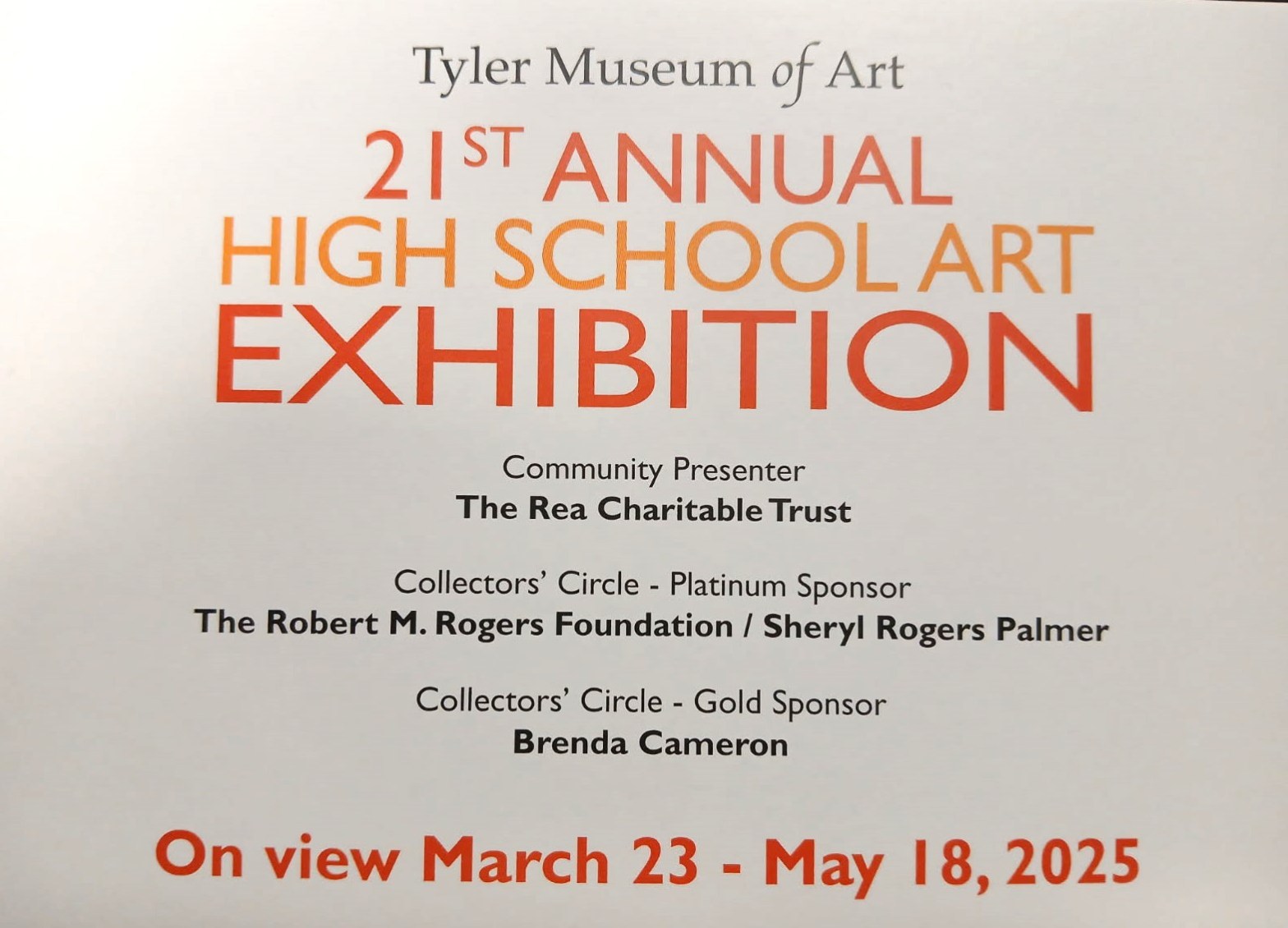
For the past 21 years, the Tyler Museum of Art has exhibited high school artwork from students in the East Texas area. This year, the following schools and teachers have participated in this exhibition:
- All Saints Episcopal School — Teacher: Lisa Horlander
- Bullard High School — Teacher: Rachel Crain
- Chapel Hill High School — Teacher: Lauryn Campos
- Chisum High School — Teacher: Mario Munguia
- Christian Heritage School — Teacher: John Martindale
- Elkhart High School — Teacher: Brandon Franklin
- Frankston High School — Teacher: Elizabeth Lade
- Hawkins High School — Teacher: Trudy Atteberry
- Jacksonville High School — Teachers: Adam Phifer
- Jacksonville High School — Teachers: Alayna Clague
- Kilgore High School — Teacher: Holly Harper
- Mt. Pleasant High School — Teacher: Laura Kirkland
- Sulphur Springs High School — Teacher: Dr. Phillip Dick
- Tyler High School — Teacher: Norma McClung
- Tyler Legacy High School — Teacher: Mark Anderson
- Tyler Legacy High School — Teacher: Melinda Tefteller
- Westwood High School — Teacher: Jessica Puckett
- Whitehouse High School — Teacher: Chelsea Baranski
- Winona High School — Teacher: Chauncy Williams
This lesson examines selected artwork from the 21st Annual High School Art Exhibition to discuss how each piece expresses the Elements and Principles of Design.
If you use or reference this lesson plan, please leave a comment with your feedback. The lesson plan can be downloaded in the link below.
Elements of Design
Line
An element of design; line is created on a surface with a pointed moving tool. Lines can range in size, width, texture, and presentation. Common types of line are vertical, horizontal, diagonal, zig-zag, and curved.
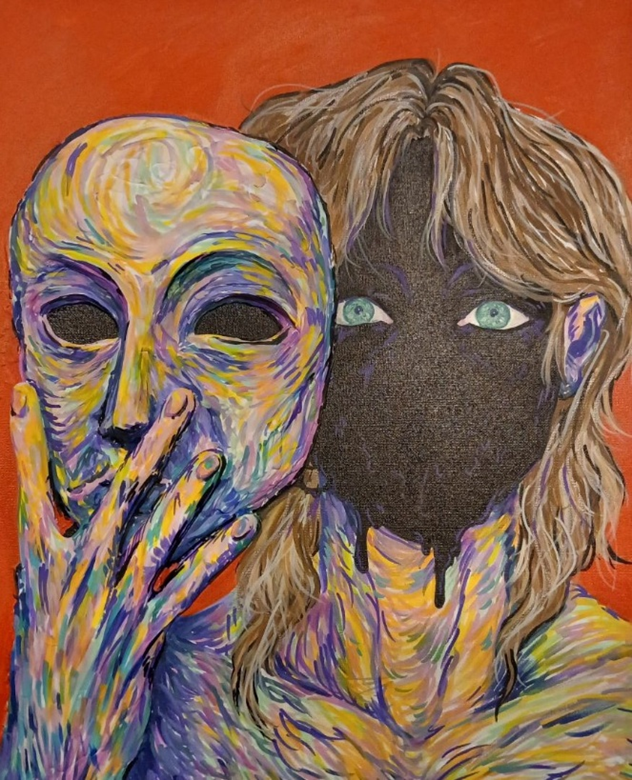
Logan Kapphahn, Breaking Point
In Logan Kapphahn’s work, Breaking Point, line is found in the following locations:
- Multiple colors of lines are used to define the form of the figure and the mask.
- The lines move in a variety of directions. A majority of the lines are curvilinear in design.
- The lines are not blended. Instead, they are layered to create a wash of color throughout both subjects.
- The figure’s hair is the exception to the vibrant color. The lines to create the hairstyle are different shades of brown.
Shape
An element of design; shape is a two-dimensional enclosed space that represents either an organic shape or a geometric shape. Geometric shapes include squares, circles, rectangles, triangles and other standard geometric shapes. Organic shapes include natural non-geometric shapes that are developed from curvilinear lines.
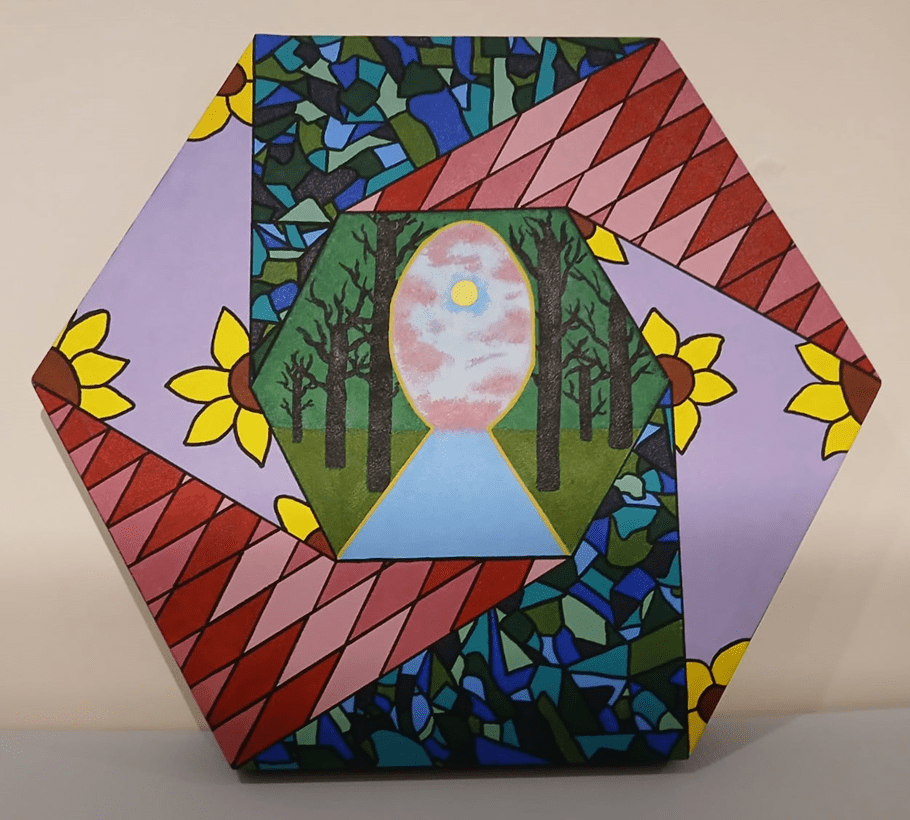
Adriana Serrano, Mas Alla Del Sol
In Adriana Serrano’s work, Mas Alla Del Sol, shape is found in the following locations:
- At the center of the composition, there is an oval shaped window to the morning sky.
- Moving outwards, a heptagon, which is a six-sided polygon, features a forest of dormant trees.
- Surrounding the heptagon, triangular-like shapes that consist of 4 sides are painted. Each shape features an alternating design, such as sunflowers, red diamond shapes, and blue shapes arranged in a mosaic pattern.
Form
An element of design; form is a three-dimensional enclosed space that represents organic and geometric shapes in a third space. Geometric forms include cubes, spheres, triangular prisms, rectangular prisms, and cones. Organic shapes include three-dimensional forms observed in nature, such as trees, rivers, and rocks.
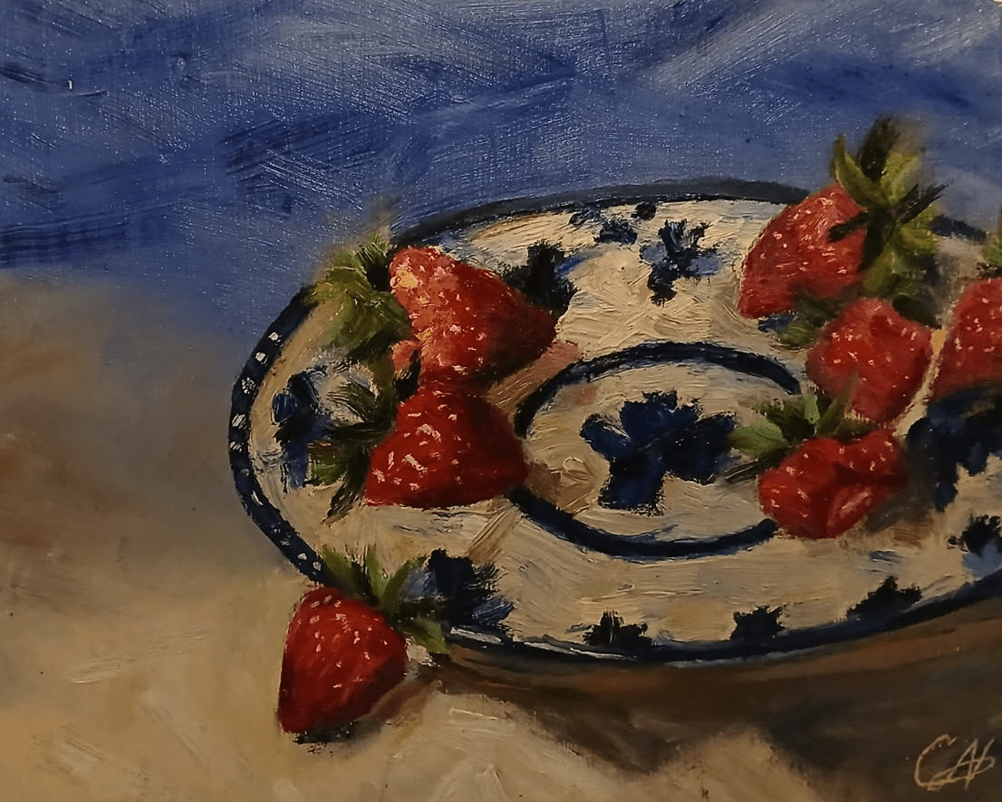
Catalina Nguyen, Summer’s Kiss
In Catalina Nguyen’s work, Summer’s Kiss, form is found in the following locations:
- The composition features seven ripe strawberries resting on or beside a white and blue porcelain plate.
- Though the composition is rendered in a painterly manner, the realistic quality of the objects is found is found in the artist’s attention to the shadows and highlights.
- By emphasizing the shadows and highlights, the three-dimensional form of the objects is realized.
Space
An element of design; this term defines the surface area between, before, and behind an object in a composition.

Josue Vega, Green Tree
In Josue Vega’s work, Green Tree, space is found in the following locations:
- Distance is presented between the viewer’s perspective in the foreground and the large tree in the background.
- The open cloudy sky, paired with the marshland that separates the two subjects, helps to define both the height of the tree and the depth of the piece.
- Additionally, with the arrangement of the horizon-line, the viewer can perceive the marshlands stretching into the distance.
Color
An element of design; this term defines the pigments used in a painting. Color can be organized into categories, such as: hues, values, complements, and intensity.

Lainey Tatum, Dissonant
In Lainey Tatum’s work, Dissonant, color is found in the following locations:
- Dissonant uses a simple and effective color harmony to help create a successful composition.
- The two bears have brown and orange hues in the fur, helping the viewer to identify them as grizzly bears.
- These warm tones form a color complement with the blue hue of the rushing water, the salmons that are swimming upstream, and the trash that is imbedded into the fish.
Value
Value is a spectrum applied to a hue. The color can have a dark value or a light hue. This process of changing the value is caused by adding white for light hues and black for dark hues.
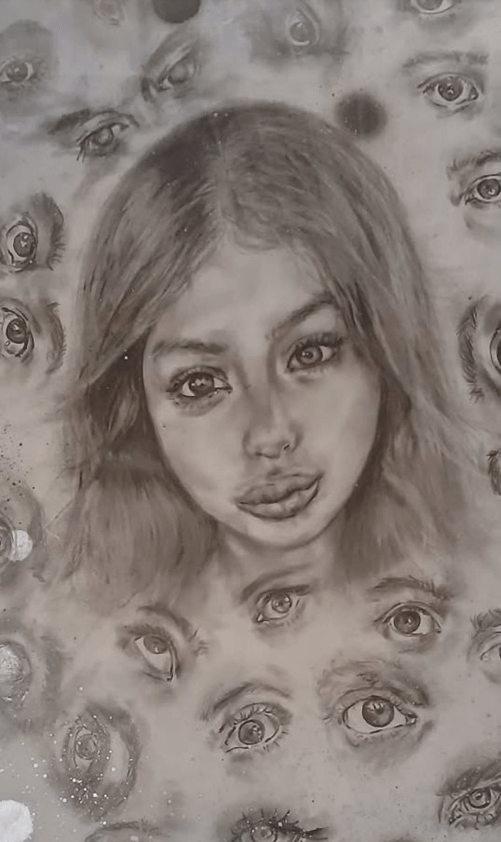
Jordan Rodriguez’s To Be Seen Is To Be Loved
In Jordan Rodriguez’s work, To Be Seen Is To Be Loved, value is found in the following locations:
- The composition was made using dark and light tones of gray.
- Shading defined the eyes in the background and the figure’s face in the foreground.
- Each of the background eyes are slightly different in size, arrangement, and emotion.
- To help convey these changes, the artist used different levels of shading around the eyes and the pupils.
Texture
An element of design; this term defines an artwork’s surface. The artist’s use of the chosen medium creates either implied or actual texture.
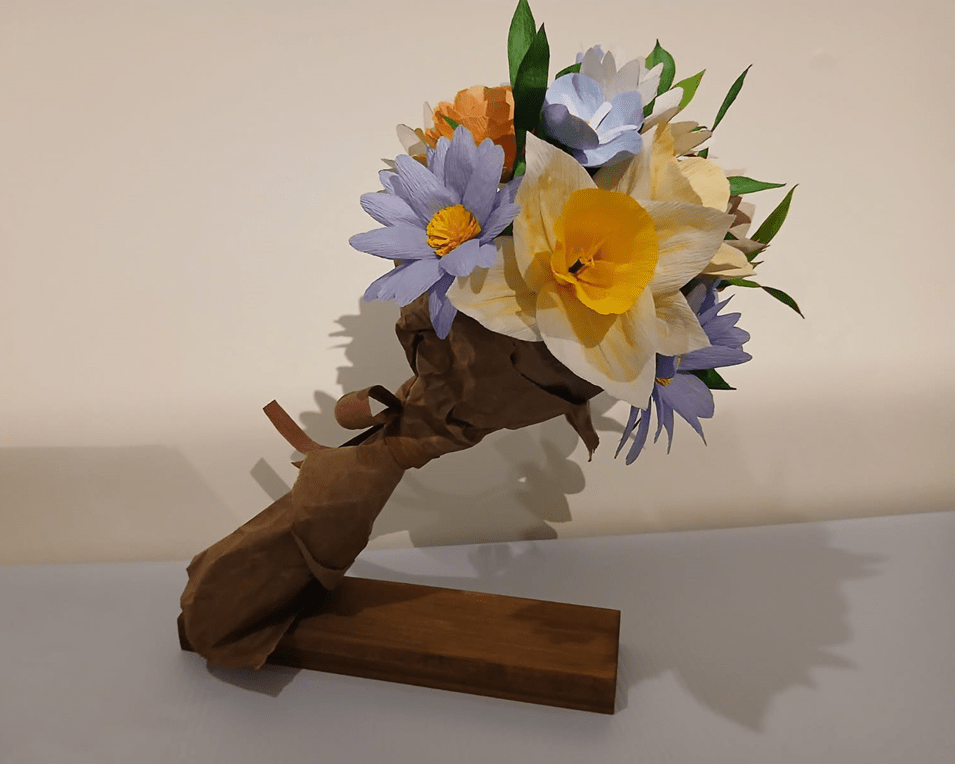
Ella Dobbins, Paper Garden
In Ella Dobbins’s work, Paper Garden, texture is found in the following locations:
- Each of the flowers were made with different types of paper.
- The crepe paper, construction paper, and tissue paper each provide a different type of texture to the varied flowers.
- Additionally, the crinkled texture of the flowers are contrasted by the roughness of the paper bag wrapped around the suspended sculpture and the smooth wooden base that keeps the sculpture steady.
Principles of Design
Balance
A principle of design; this term defines the arrangement of the presented imagery with the elements of design. It refers to either asymmetrical compositions or symmetrical compositions.
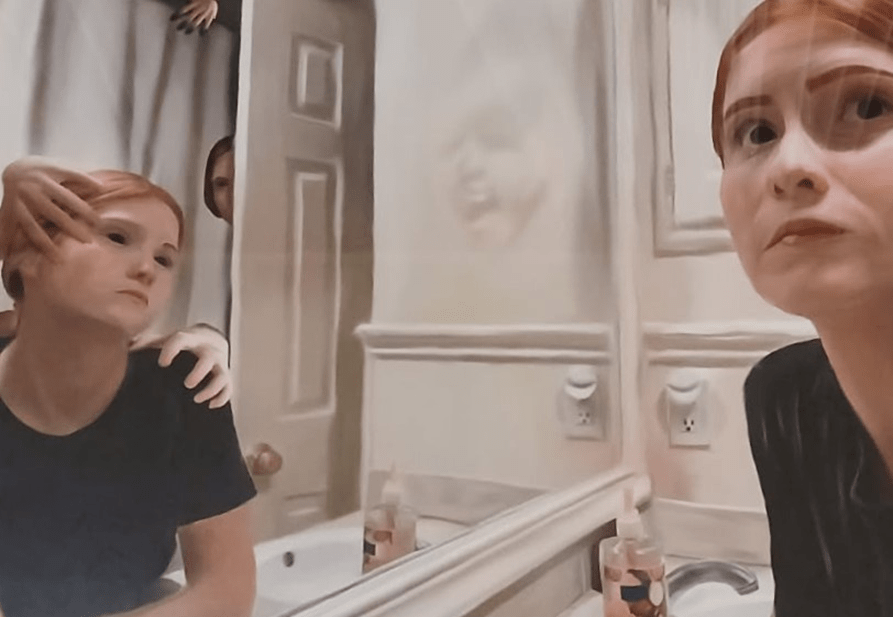
Katie Anderson, The Mirror Lies
In Katie Anderson’s work, The Mirror Lies, balance is found in the following locations:
- The composition can be divided into two halves that showcase asymmetrical balance.
- On the smaller right half, a figure is partially seen standing next to a mirror and a sink.
- On the larger left half of the composition, the reflected figures are arranged in both the foreground and the background.
- A transparent face can be seen in the mirror’s surface. A full reflection of the figure is looking directly at the real individual. She is framed by two disembodied hands that rest on either side of her.
- Peeking out from behind the shower curtain, an additional face and hand are seen in the background.
Unity
A principle of design; this term defines how the elements and principles of design are combined within a composition.

Elizabeth Hornsby, Metamorphosis
In Elizabeth Hornsby’s work, Metamorphosis, unity is found in the following locations:
- This painting is unified through three different art methods.
- The color of the butterflies matches the color found in the background.
- Though the butterflies change in size, the rounded triangles that form the butterflies are similar in design.
- Visual movement can be found in both the rounded shapes of the wings, the antennae, and the abstract curvilinear lines that move between the butterflies and the background.
Variety
A principle of design; this term defines the combination of imagery, objects, and ideas in an artwork.
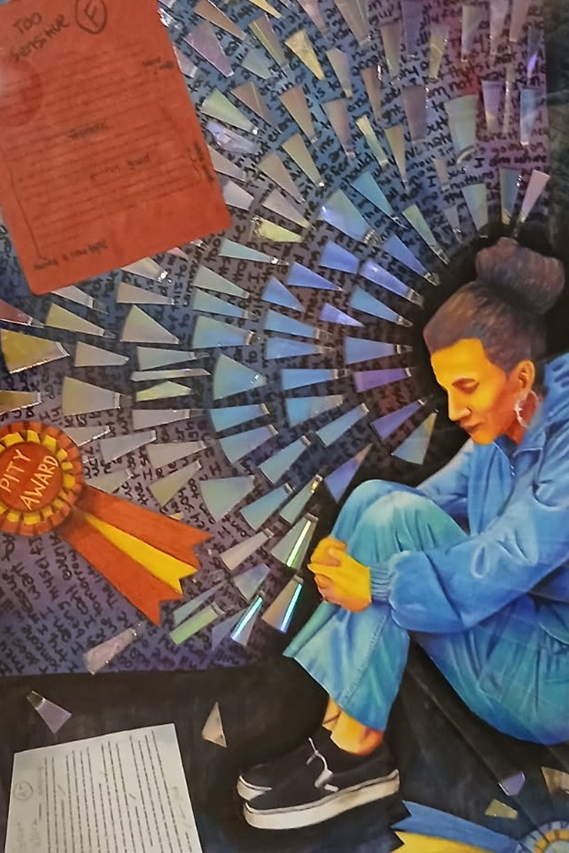
Lily Bonds, The Real Weapon of an Overthinker
In Lily Bonds’ work, The Real Weapon of an Overthinker, variety is found in the following locations:
- This composition uses a variety of materials and subjects to create a colorful collage.
- The artist used CD pieces, coloring pencils, watercolors, and markers. Each of these mediums provides a different technique, style, and texture to the final piece.
- The subjects presented in the composition range from a portrait of the artist, representations of positive and negative grades via ribbons and written papers, as well as a patterned background of phrases and cut pieces of CD.
Emphasis
A principle of design; this term defines the most prominent area in a composition. The viewer’s eye is drawn to this point because the artist used a mixture of the elements and principles of design.

Hannia Campa, The Weight of Worry
In Hannia Campa’s work, The Weight of Worry, emphasis is found in the primary locations:
- The emphasis of the composition is the elephant in the center of the composition.
- The elephant is framed by two partially visible floating heads. A painted web is attached to the visible ears. The elephant rests on this web, suspended in the air.
- Directly above the animal, the yellow-orange sun sits in the cloudy sky.
- Likewise, below the elephant, an active anthill can be found on the ground.
- Each of these attributes frames the elephant as the most important image in the composition.
Movement
A principle of design; this term defines the visual movement observed in a painting. This can be identified as kinetic movement or implied movement. Additionally, movement can be defined as how the viewer’s eye moves throughout the composition.

Jordan Pettit, Hapalochlaena
In Jordan Pettit’s work, Hapalochlaena, movement is found in the following locations:
- The three-dimensional sculpture of an octopus has tentacles that are curling in different directions.
- The viewer’s eye follows the movement of the tentacles, which gives the appearance that the octopus is moving in a whimsical way.
- Additionally, the painted blue rings mimic the circular motion of the curling tentacles and the round suction cups.
Pattern
A principle of design; this term defines the repetitive imagery and elements of design found in a composition.
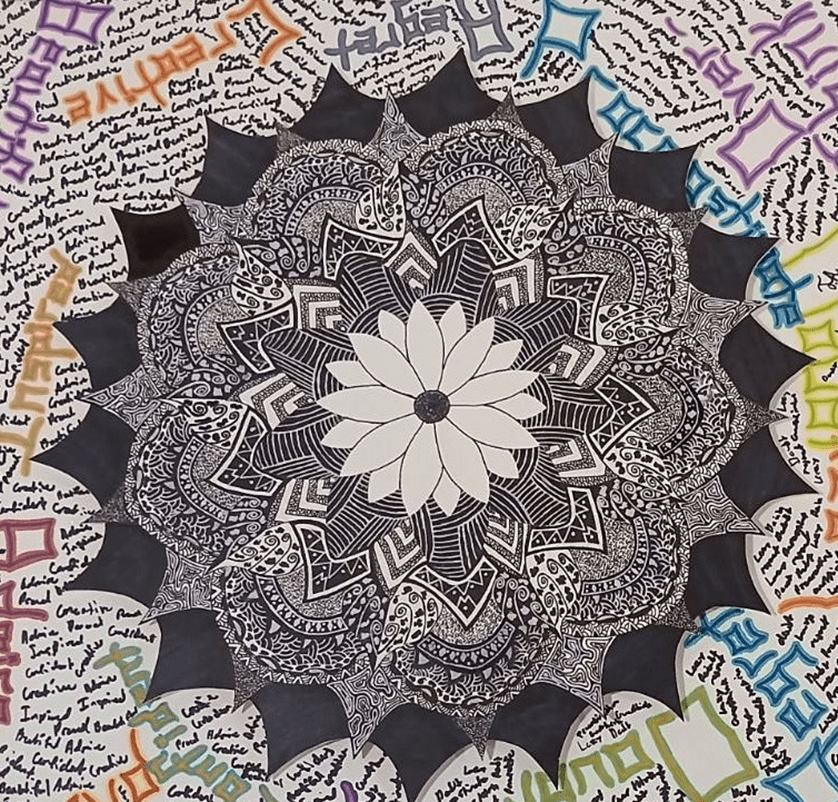
Joel Armas, Patience
In Joel Armas’ work, Patience, pattern is found in the following locations:
- There is a primary pattern found in this composition.
- The mandala design, arranged in the center of the composition, is made from a series of repeating patterns. These designs range from zig-zag lines, dots, swirls, full-color shapes, and intersecting diagonal lines.
- Outside of the mandala, a sea of words decorate the background.
- Ranging in phrases and single bolded words, the collection of chaotic phrases helps to emphasize the structured pattern found in the mandala.
Proportion
A principle of design; this term defines the comparative size between objects in the composition. It can refer to the imagery within a painting or the size between a sculpture and a real object.

Zhan Boyd, Heightened Perspectives
In Zhan Boyd’s work, Heightened Perspectives, proportion is found in the following locations:
- A simplified portrait of a person is seen standing at an impossible height in a living space.
- This perspective shift is dramatic due to the comparison between the accurately sized bedroom and the exaggerated proportion of the figure.
You can see all of these artworks and more in-person at the Tyler Museum of Art’s current exhibition: 21st Annual High School Art Exhibition.

For more educational resources created by the Tyler Museum of Art, visit our YouTube page by clicking on the YouTube button or clicking the link below.

If you use or references this lesson plan, please leave a comment with your feedback.
Thank you for visiting the Tyler Museum of Art’s Education Blog!
 Tyler Museum of Art Education Blog