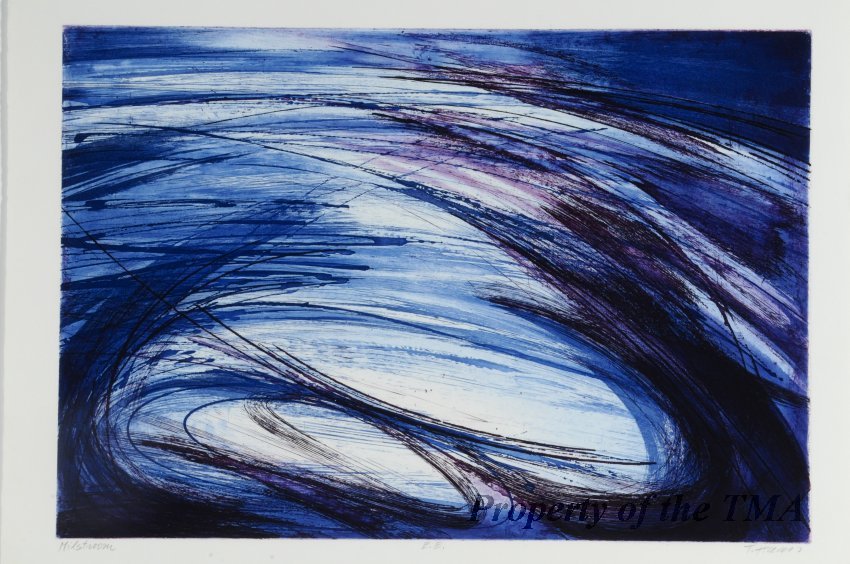
This lesson plan contains the National Learning Standards for Visual Arts and the Texas TEKS for Elementary art teachers. Students will learn about the printmaking methods used by Terry Haass. Afterwards, the students will create a print series and an artist statement that describes their art process.
If you use or reference this lesson plan, please leave a comment with your feedback. The lesson plan can be downloaded in the link below.
Terry Haass, Milstroms, 1977, intaglio, 19.5 inches X 25.75 inches, Tyler Museum of Art, Tyler, Texas.
Subject: Fine Art, Art History
Collection: Tyler Museum of Art’s Permanent Collection
Grades: Elementary School, Middle School and High School
Topics: Artistic Practices, Art History, Critical Thinking, Printmaking and Intaglio
Art Vocabulary
Activity Vocabulary:
Terry Haass:
- Terry Haass was born in 1923 and died in 2016. [1]
- She was a Czechoslovakian French artist.[2]
- She fled from the Nazi Regime and traveled to Paris in the 1930s.[3]
- Haass was proficient in printmaking, painting, and sculpture.[4]
- She studied fine arts and art history until she was forced to leave Europe due to World War II.[5]
- After receiving an Art Students League Scholarship, she traveled to New York and immersed herself in the art scene.[6]
- In New York, she worked at Stanley Willam Hayter’s Atelier 17 studio.[7]
- In 1950, when Hayter moved back to Paris, Haass took over the studio.[8]
- After taking fashion and design classes, Haass developed a love for fashion techniques.[9]
- Her work mainly focused on the thematic application of color, texture, and movement in a composition.[10]
- She played with the ideas of time and space, specifically examining how these two concepts work together.[11]
- Her prints often used a method called ‘simultaneous color printing’, an art style created and taught by Stanley William Hayter.[12]
Artwork Information
Abstract Expressionism:
- Abstract Expressionism is defined by spontaneity and gestural marks that result in an action painting.[13]
- In Milstroms, Terry Haass used gestural lines to create non-representational forms in a dynamic pattern that evoke rapid movement.
- The print features various hues of purple and blue in a sea of lines in a whirlpool pattern.
Printmaking Process Vocabulary:
- Printmaking is the process of transferring images across multiple surfaces using a wide range of methods.[14]
- Intaglio is a printmaking method where incised areas are inscribed onto a printing plate to create an image.[15]
- An edition is a total number of prints in a series.[16]
- A key is the primary outline that holds the image together and can be printed in the first or last layer in a multi-step print.[17]
- Working Proof is an impression made throughout the printing process before the image is finalized.[18]
- A bead is consistent strand of ink across the matrix or printing surface.[19]
- A brayer is a roller used for inking a surface.[20]
- Registration is how the various color layers align to make the print. It is a very crucial step in screen print, if not the most important.[21]
Elements of Design[22]:
- Artists use the elements of design to create the foundation of the artwork. The elements of art include: line, shape, form, space, color, and texture.
Line:
- An element of design; line is created on a surface with a pointed moving tool. Lines can range in size, width, texture, and presentation. Common types of line are vertical, horizontal, diagonal, zig-zag, and curved.
Shape:
- An element of design; shape is a two-dimensional enclosed space that represents either an organic shape or a geometric shape. Geometric shapes include squares, circles, rectangles, triangles and other standard geometric shapes. Organic shapes include natural non-geometric shapes that are developed from curvilinear lines.
Form:
- An element of design; form is a three-dimensional enclosed space that represents organic and geometric shapes in a third space. Geometric forms include cubes, spheres, triangular prisms, rectangular prisms, and cones. Organic shapes include three-dimensional forms observed in nature, such as trees, rivers, and rocks.
Space:
- An element of design; this term defines the surface area between, before, and behind an object in a composition.
Color:
- An element of design; this term defines the pigments used in a painting. Color can be organized into categories, such as: hues, values, complements, and intensity.
Texture:
- An element of design; this term defines an artwork’s surface. The artist’s use of the chosen medium creates either implied or actual texture.
Principles of Design[23]:
- Artists used principles of design to build upon the foundational elements of design. This includes the following: rhythm, movement, balance, proportion, variety, emphasis, and unity.
Rhythm/ Pattern:
- A principle of design; this term defines repetitive imagery and elements of design found in a composition.
Movement:
- A principle of design; this term defines the visual movement observed in a painting. This can be identified as kinetic movement or implied movement. Additionally, movement can be defined as how the viewer’s eye moves throughout the composition.
Balance:
- A principle of design; this term defines the arrangement of the presented imagery with the elements of design. It refers to either asymmetrical compositions or symmetrical compositions.
Proportion:
- A principle of design; this term defines the comparative size between objects in the composition. It can refer to the imagery within a painting or the size between a sculpture and a real object.
Variety:
- A principle of design; this term defines the combination of imagery, objects, and ideas in an artwork.
Emphasis:
- A principle of design; this term defines the most prominent area in a composition. The viewer’s eye is drawn to this point because the artist used a mixture of the elements and principles of design.
Unity:
- A principle of design; this term defines how the elements and principles of design are combined within a composition.
[1] “Browse Record: Milstroms,” Tyler Museum of Art, accessed July 14, 2026, https://tylermuseum.pastperfectonline.com/webobject/20D2098D-9EA9-447D-B25B-485447201448.
[2] Ibid.
[3] “Tereza (Terry) HAASS,” Armstrong Fine Art, accessed July 14, 2026, https://armstrongfineart.com/collections/terry-haass?srsltid=AfmBOooTSN0BKnxMyi_Yyr8hS3dUheS_g-tMMaZjSo44S9Fbj_aj3LjE.
[4] “Browse Record: Milstroms,” Tyler Museum of Art, accessed July 14, 2026, https://tylermuseum.pastperfectonline.com/webobject/20D2098D-9EA9-447D-B25B-485447201448.
[5] “Tereza (Terry) HAASS,” Armstrong Fine Art, accessed July 14, 2026, https://armstrongfineart.com/collections/terry-haass?srsltid=AfmBOooTSN0BKnxMyi_Yyr8hS3dUheS_g-tMMaZjSo44S9Fbj_aj3LjE.
[6] Ibid.
[7] Ibid.
[8] Ibid.
[9] “Browse Record: Milstroms,” Tyler Museum of Art, accessed July 14, 2026, https://tylermuseum.pastperfectonline.com/webobject/20D2098D-9EA9-447D-B25B-485447201448.
[10] Ibid.
[11] Ibid.
[12] “Tereza (Terry) HAASS,” Armstrong Fine Art, accessed July 14, 2026, https://armstrongfineart.com/collections/terry-haass?srsltid=AfmBOooTSN0BKnxMyi_Yyr8hS3dUheS_g-tMMaZjSo44S9Fbj_aj3LjE.
[13] “Abstract Expressionism,” TATE, accessed July 14, 2026, https://www.tate.org.uk/art/art-terms/a/abstract-expressionism.
[14] “What is Printmaking,” The Metropolitan Museum of Art, accessed October 28, 2025, https://www.metmuseum.org/about-the-met/collection-areas/drawings-and-prints/materials-and-techniques/printmaking.
[15] “Intaglio,” TATE, accessed July 14, 2026, https://www.tate.org.uk/art/art-terms/i/intaglio.
[16] “Printmaking through the Ages,” Utah Museum of Fine Arts, accessed October 28, 2025, https://umfa.utah.edu/lessons/printmaking-through-the-ages/, 4, 6.
[17] Ibid.
[18] Ibid.
[19] “Screenprint,” The Metropolitan Museum of Art, accessed December 9, 2025, https://www.metmuseum.org/perspectives/materials-and-techniques-printmaking-screenprint.
[20] “Printmaking through the Ages,” Utah Museum of Fine Arts, accessed October 28, 2025, https://umfa.utah.edu/lessons/printmaking-through-the-ages/, 6.
[21] Ibid.
[22] Rosalins Ragan, “Elements of Art,” in Art Talk, 61 – 211, edited by Bennett and McKnight Division, (San Francisco: Glencoe Publishing Company, 1988).
[23] Rosalins Ragan, “Principles of Design,” in Art Talk, 211 – 347, edited by Bennett and McKnight Division, (San Francisco: Glencoe Publishing Company, 1988).
Bibliography: Resources for Vocabulary and Lesson Plan
Armstrong Fine Art. “Tereza (Terry) HAASS.” Accessed July 14, 2026, https://armstrongfineart.com/collections/terry-haass?srsltid=AfmBOooTSN0BKnxMyi_Yyr8hS3dUheS_g-tMMaZjSo44S9Fbj_aj3LjE.
Guenard, Christine. “CD-ROM to Art! (Part 1) – Intaglio Printmaking – AND Scratch Art.” Posted November 3, 2024, YouTube, 8:46. https://www.youtube.com/watch?v=bFSQWlr0YS4.
Guenard, Christine. “(Part 2) Print WITHOUT a Press! CD-Rom to Art – Dry Point Intaglio Printmaking.” Posted November 9, 2024, YouTube, 6:27, https://www.youtube.com/watch?v=ZIf7tvGbqEw.
Office of the Secretary of State. “§117.114: Art, Grade 4, Adopted 2013.” Texas Education Agency: Education, updated 2013, accessed January 5, 2022, https://texas-sos.appianportalsgov.com/rules-and-meetings?$locale=en_US&interface=VIEW_TAC_SUMMARY&queryAsDate=09%2F09%2F2026&recordId=173911.
Office of the Secretary of State. “§117.117: Art, Grade 5, Adopted 2013.” Texas Education Agency: Education, updated 2013, accessed January 5, 2022, https://texas-sos.appianportalsgov.com/rules-and-meetings?$locale=en_US&interface=VIEW_TAC_SUMMARY&queryAsDate=09%2F09%2F2026&recordId=173914.
Ragan, Rosalins. “Elements of Art.” In Art Talk, 61 – 211. Edited by Bennett and McKnight Division. San Francisco: Glencoe Publishing Company, 1988.
Ragan, Rosalins. “The Principles of Design.” In Art Talk, 211 – 347. Edited by Bennett and McKnight Division. San Francisco: Glencoe Publishing Company, 1988.
TATE. “Abstract Expressionism.” Accessed July 14, 2026, https://www.tate.org.uk/art/art-terms/a/abstract-expressionism.
TATE. “Intaglio.” Accessed July 14, 2026, https://www.tate.org.uk/art/art-terms/i/intaglio.
The Annex Galleries, “Terry Haass.” Accessed July 14, 2026. https://www.annexgalleries.com/artists/biography/908/Haass/Terry.
The Metropolitan Museum of Art. “Screenprint.” Accessed October 28, 2025. https://www.metmuseum.org/perspectives/materials-and-techniques-printmaking-screenprint.
The Metropolitan Museum of Art. “What is Printmaking.” Accessed October 28, 2025. https://www.metmuseum.org/about-the-met/collection-areas/drawings-and-prints/materials-and-techniques/printmaking.
Tyler Museum of Art. “Browse Record: Milstroms.” Accessed July 14, 2026. https://tylermuseum.pastperfectonline.com/webobject/20D2098D-9EA9-447D-B25B-485447201448.
Utah Museum of Fine Arts. “Printmaking through the Ages.” Accessed October 28, 2025. https://umfa.utah.edu/lessons/printmaking-through-the-ages/, 4, 6.
Elementary School Lesson Plans: National Learning Standards
Goals:
Elementary School Students of all levels will be able to do the following:
- Identify the principles of design used in the artwork;
- Identify the elements of design used in the artwork;
- Understand and utilize printmaking vocabulary;
- And, understand and identify elements of Abstract Expressionism.
National Learning Standards for Visual Arts:
Fourth Grade and Fifth Grade
Fourth Grade
- Creating
- Anchor Standard 1
- Creating: Generate and conceptualize artistic ideas and work.
- VA:Cr1.1.4a: Brainstorm multiple approaches to a creative art or design problem.
- VA:Cr1.2.4a: Collaboratively set goals and create artwork that is meaningful and has purpose to the makers.
- Creating: Generate and conceptualize artistic ideas and work.
- Anchor Standard 2
- Creating: Organize and develop artistic ideas and work.
- VA:Cr2.1.4a: Explore and invent art-making techniques and approaches.
- VA:Cr2.2.4a: When making works of art, utilize and care for materials, tools, and equipment in a manner that prevents danger to oneself and others.
- Creating: Organize and develop artistic ideas and work.
- Anchor Standard 1
- Responding
- Anchor Standard 7
- Responding: Perceive and analyze artistic work
- VA:Re.7.1.4a: Compare responses to a work of art before and after working in similar media.
- VA:Re.7.2.4a: Analyze components in visual imagery that convey messages.
- Responding: Perceive and analyze artistic work
- Anchor Standard 8
- Responding: Interpret intent and meaning in artistic work.
- VA:Re8.1.4a: Interpret art by referring to contextual information and analyzing relevant subject matter, characteristics of form, and use of media.
- Responding: Interpret intent and meaning in artistic work.
- Anchor Standard 9
- Responding: Apply criteria to evaluate artistic work.
- VA:Re9.1.4a: Apply one set of criteria to evaluate more than one work of art.
- Responding: Apply criteria to evaluate artistic work.
- Anchor Standard 7
- Connecting
- Anchor Standard 10
- Connecting: Synthesize and relate knowledge and personal experiences to make art.
- VA:Cn10.1.4a: Create works of art that reflect community cultural traditions.
- Connecting: Synthesize and relate knowledge and personal experiences to make art.
- Anchor Standard 11
- Connecting: Relate artistic ideas and works with societal, cultural, and historical context to deepen understanding
- VA:Cn11.1.4a: Through observation, infer information about time, place, and culture in which a work of art was created.
- Connecting: Relate artistic ideas and works with societal, cultural, and historical context to deepen understanding
- Anchor Standard 10
Fifth Grade
- Creating
- Anchor Standard 1
- Creating: Generate and conceptualize artistic ideas and work.
- VA:Cr1.1.5a: Combine ideas to generate an innovative idea for art-making.
- VA:Cr1.2.5a: Identify and demonstrate diverse methods of artistic investigation to choose an approach for beginning a work of art.
- Creating: Generate and conceptualize artistic ideas and work.
- Anchor Standard 2
- Creating: Organize and develop artistic ideas and work.
- VA:Cr2.1.5a: Experiment and develop skills in multiple art-making techniques and approaches through practice.
- VA:Cr2.2.5a: Demonstrate quality craftsmanship through care for and use of materials, tools, and equipment.
- VA:Cr2.3.5a: Identify, describe, and visually document places and/or objects of personal significance.
- Creating: Organize and develop artistic ideas and work.
- Anchor Standard 3
- Creating: Refine and complete artistic work.
- VA:Cr3.1.5a: Create artist statements using art vocabulary to describe personal choices in art-making.
- Creating: Refine and complete artistic work.
- Anchor Standard 1
- Presenting
- Anchor Standard 6
- Presenting: Convey meaning through the presentation of artistic work.
- VA:Pr6.1.5a: Cite evidence about how an exhibition in a museum or other venue presents ideas and provides information about a specific concept or topic.
- Presenting: Convey meaning through the presentation of artistic work.
- Anchor Standard 6
- Responding
- Anchor Standard 7
- Responding: Perceive and analyze artistic work
- VA:Re.7.1.5a: Compare one’s own interpretation of a work of art with the interpretation of others.
- VA:Re.7.2.5a: Identify and analyze cultural associations suggested by visual imagery.
- Responding: Perceive and analyze artistic work
- Anchor Standard 8
- Responding: Interpret intent and meaning in artistic work.
- VA:Re8.1.5a: Interpret art by analyzing characteristics of form and structure, contextual information, subject matter, visual elements, and use of media to identify ideas and mood conveyed.
- Responding: Interpret intent and meaning in artistic work.
- Anchor Standard 9
- Responding: Apply criteria to evaluate artistic work.
- VA:Re9.1.5a: Recognize differences in criteria used to evaluate works of art depending on styles, genres, and media as well as historical and cultural contexts.
- Responding: Apply criteria to evaluate artistic work.
- Anchor Standard 7
- Connecting
- Anchor Standard 10
- Connecting: Synthesize and relate knowledge and personal experiences to make art.
- VA:Cn10.1.5a: Apply formal and conceptual vocabularies of art and design to view surroundings in new ways through art-making.
- Connecting: Synthesize and relate knowledge and personal experiences to make art.
- Anchor Standard 11
- Connecting: Relate artistic ideas and works with societal, cultural, and historical context to deepen understanding
- VA:Cn11.1.5a: Identify how art is used to inform or change beliefs, values, or behaviors of an individual or society.
- Connecting: Relate artistic ideas and works with societal, cultural, and historical context to deepen understanding
- Anchor Standard 10
Elementary School Lesson Plans: Texas Essential Knowledge and Skills (TEKS)
Goals:
Elementary School Students of all levels will be able to do the following:
- Identify the principles of design used in the artwork;
- Identify the elements of design used in the artwork;
- Understand and utilize printmaking vocabulary;
- And, understand and identify elements of Abstract Expressionism.
Texas Elementary School TEKS:
Fourth Grade and Fifth Grade
Fourth Grade
- §117.114.b.1.A / B / C
- Foundations: Observation and Perception:
- explore and communicate ideas drawn from life experiences about self, peers, family, school, or community and from the imagination as sources for original works of art;
- use appropriate vocabulary when discussing the elements of art, including line, shape, color, texture, form, space, and value, and the principles of design, including emphasis, repetition/pattern, movement/rhythm, contrast/variety, balance, proportion, and unity;
- discuss the elements of art as building blocks and the principles of design as organizers of works of art.
- Foundations: Observation and Perception:
- §117.114.b.2. A / B / C
- Creative Expression:
- integrate ideas drawn from life experiences to create original works of art;
- create compositions using the elements of art and principles of design; and
- produce drawings; paintings; prints; sculpture, including modeled forms; and other art forms such as ceramics, fiber art, constructions, mixed media, installation art, digital art and media, and photographic imagery using a variety of art media and materials.
- Creative Expression:
- §117.114.b.3. A / B
- Historical and Cultural Relevance:
- compare content in artworks for various purposes such as the role art plays in reflecting life, expressing emotions, telling stories, or documenting history and traditions;
- compare purpose and content in artworks created by historical and contemporary men and women, making connections to various cultures;
- Historical and Cultural Relevance:
- §117.114.b.4. A / B
- Critical Evaluation and Response
- evaluate the elements of art, principles of design, intent, or expressive qualities in artworks of self, peers, and historical and contemporary artists.
- use methods such as written or oral response or artist statements to identify emotions found in collections of artworks created by self, peers, and major historical or contemporary artists in real or virtual portfolios, galleries, or art museums;
- Critical Evaluation and Response
Firth Grade
- §117.117.b.1.A / B / C
- Foundations: Observation and Perception:
- develop and communicate ideas drawn from life experiences about self, peers, family, school, or community and from the imagination as sources for original works of art;
- use appropriate vocabulary when discussing the elements of art, including line, shape, color, texture, form, space, and value, and the principles of design, including emphasis, repetition/pattern, movement/rhythm, contrast/variety, balance, proportion, and unity; and
- discuss the elements of art as building blocks and the principles of design as organizers of works of art.
- Foundations: Observation and Perception:
- §117.117.b.2. A / B / C
- Creative Expression:
- integrate ideas drawn from life experiences to create original works of art;
- create compositions using the elements of art and principles of design;
- produce drawings; paintings; prints; sculpture, including modeled forms; and other art forms such as ceramics, fiber art, constructions, digital art and media, and photographic imagery using a variety of materials.
- Creative Expression:
- §117.117.b.3. A / B
- Historical and Cultural Relevance:
- compare the purpose and effectiveness of artworks from various times and places, evaluating the artist’s use of media and techniques, expression of emotions, or use of symbols;
- compare the purpose and effectiveness of artworks created by historic and contemporary men and women, making connections to various cultures;
- Historical and Cultural Relevance:
- §117.117.b.4. A / B
- Critical Evaluation and Response
- evaluate the elements of art, principles of design, general intent, media and techniques, or expressive qualities in artworks of self, peers, or historical and contemporary artists;
- use methods such as written or oral response or artist statements to identify themes found in collections of artworks created by self, peers, and major historical or contemporary artists in real or virtual portfolios, galleries, or art museums;
- Critical Evaluation and Response
Elementary Art Activities
Questions for Elementary School Students:
- Examine Terry Haass, Milstorms. Identify where each element of art is located in the artwork.
- Examine Terry Haass, Milstorms.. Identify where each principle of art is located in the artwork.
- Can you describe a print?
- How do you make a print? Please describe the process using art vocabulary.
- What is an element of Abstract Expressionism? Explain how it can be used in art.
Activity: Elementary School Fine Arts
- Activity Setting: Classroom
- Materials: CDs/DVDs (polycarbonate surfaces), tempera paint, paintbrush, painter’s tape, soft pastel/chalk, pencil, paper towels, water, gloves, scratch tool, color pencil, phonebook/newspaper, trashcan, towels, newsprint, paper, pan, drawing paper, spoon, felt/old t-shirt, foil, etching ink, and cardstock.
- Subject: Art History, Printmaking, and Abstract Expressionism
- National Learning Standards: Fourth Grade and Fifth Grade
- Texas TEKS: Fourth Grade and Fifth Grade
- Duration: Extended Project
The students will explore the printmaking method of Intaglio using CDs. Each edition should have a minimum of one color and a series of three total prints.
Students will first sketch out a design they want to print. They will paint the back of the CDs with black tempera paint. This may take a couple layers to create a solid base. When painting, be sure to paint in one single direction to properly apply the pigment. The students will rub white chalk on the back of the sketch. This will be the side that will be placed onto the CD. Affix the sketch to the CD using tape. Using a pencil and slight pressure, retrace the design. Remove the sketch and a white transfer design should be seen. Using a sharp tool with teacher supervision, such as an engraving tool, the students will scratch the design into the CD. They will follow the traced lines to create the etching. Afterwards, either the teacher or the students will clean the CD. The result should be a CD that has the design scratched into the surface.
Once the CD is ready, the students will begin the printing process. A day before inking the CDs, the teacher should prepare printing paper. Cut to be the size of a CD, the pages will soak in the water for a full day. A day later, the students will scoop out ink onto foil. Using a paddle or a piece of cardstock, the class will cover the entire CD with the ink. The goal is to push the ink into the scratched design. With the teacher’s assistance, the CD will be cleaned using cheese cloth and newsprint to minimize plate tone. The students will place the prepared printing paper on top of the CD, followed by a piece of felt. The cloth will act as a printing blanket. The students will use a spoon to apply pressure to the felt or cloth. The wet paper will pull the ink from the CD with this pressure. After a minute, the felt and paper can be removed from the CD. The new print can be placed on a drying rack. The CD can be reused multiple times. The students can make two more prints from the CD to complete a print series.
Activity: Elementary School Art History
- Activity Setting: Classroom
- Materials: Pencil/ Pen on Paper or Word Document
- Subject: Fine Art, Art History, Printmaking, and Abstract Expressionism
- National Learning Standards: Fourth Grade and Fifth Grade
- Texas TEKS: Fourth Grade and Fifth Grade
- Duration: Extended Project
When the students have each completed their print series, they will write an artist statement. Using the art vocabulary, the class will explain how they designed their prints. The artist statement needs to be more than 10 sentences.
For more educational resources created by the Tyler Museum of Art, visit our YouTube page by clicking on the YouTube button or clicking the link below.

And stay updated with the Tyler Museum of Art’s events by visiting our Facebook and Instagram pages:


If you use or references this lesson plan, please leave a comment with your feedback.
Thank you for visiting the Tyler Museum of Art’s Education Blog!


One thought on “Lesson Plan: Terry Haass, Milstroms”