This lesson plan was researched and written by Juliet Janeway, a Fall 2026 University of Texas at Tyler Intern at the Tyler Museum of Art. The lesson plan was edited by Rachel Anthony, the Tyler Museum of Art’s Education Manager.
This lesson plan contains the National Learning Standards for Visual Arts and the Texas TEKS for Elementary, Middle, and High School art teachers. The students will learn how to create prints using non-traditional print materials.
If you use or reference this lesson plan, please leave a comment with your feedback. The lesson plan can be downloaded in the link below.
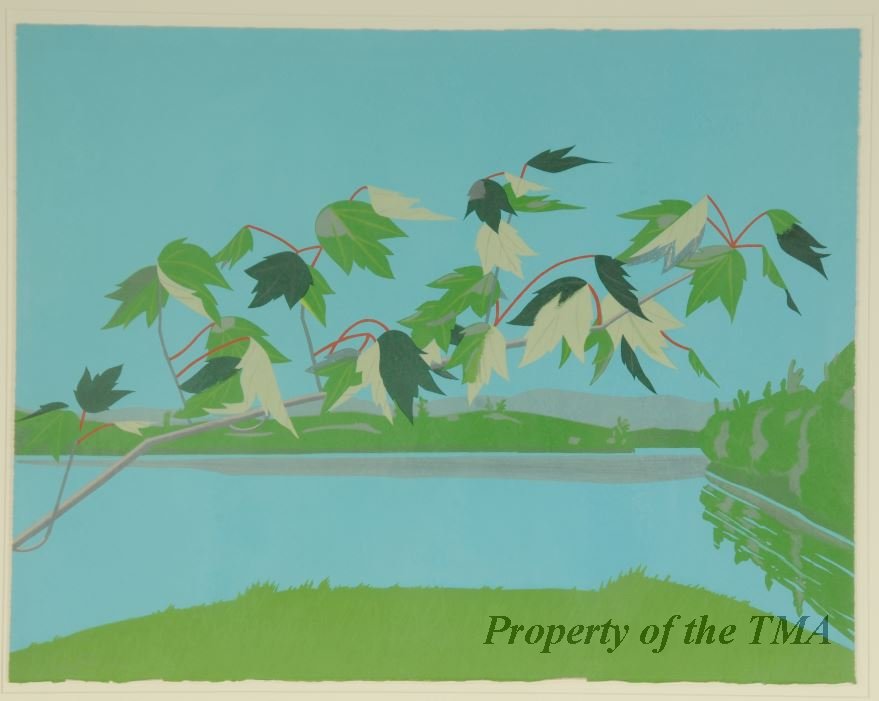
Alex Katz, Late July, n.d., Lithograph print, 22 inches X 30 inches, Tyler Museum of Art, Tyler, Texas.
Culture: American
Subject: Fine Art, Art History
Collection: Tyler Museum of Art’s Permanent Collection
Grades: Elementary School, Middle School and High School
Topics: Artistic Practices, Art History, Critical Thinking, Lithography, and Printmaking.
Art Vocabulary
Artist Biography
- Alex Katz was born in 1927 in Brooklyn, New York.[1]
- He was raised by his parents who were both interested in poetry and the arts.[2]
- Katz attended Woodrow Wilson High School which allowed him to participate in an unique program that allowed him to split his time between academics in the morning and the arts in the afternoon.[3]
- Later, in 1946, Katz joined The Cooper Union Art School in Manhattan where he studied under Morris Kantor.[4]
- During his time at Cooper Union, Katz was primarily taught Modern Art theories, contemporary techniques, and was trained to paint from drawings.[5]
- In 1949, Katz received a scholarship for summer study at the Skowhegan School for Painting and Sulpture in Maine.[6]
- While at Skowhegan, Katz was encouraged to paint from life. This was pivotal to his development as a painter, which is part of his practice today.[7]
- Held at the Roko Gallery, Katz had his first solo show in 1954.[8]
- Alex Katz’s work has been in over 250 solo exhibitions and about 500 group exhibitions internationally since 1951.[9]
- His early work consist of trees standing against a light background, which emphasizes an energy and sensation instead of an exact rendering of the landscape.[10]
- Katz developed a modern style of figurative painting by combining traditional techniques with his own experineces and his modernist training.[11]
Artwork Information
- Late July is a lithograph print depicting tree branches in front of a body of water.
- This edition is number 24 out of a 120 piece series.
- The thin tree branches are a pale grey-brown color and have leaves in varying shades of green.
- Beneath the tree branches, there is a lush field with a body of water. The water reflects the surrounding trees and landscape.
Vocabulary Terms
- Lithography is a type of printmaking process where the image is drawn directly onto a flat surface, such as metal or stone. Then, a special medium and a solution are used to transfer the design onto a piece of paper.[12]
- Printmaking is an artistic process where an image is transferred from a matrix or template onto another surface. There is a wide range of printmaking techniques.[13]
- A print is a work of art on paper, usually having multiple copies. It is created through a transfer process, not created by drawing directly onto the paper.[14]
- Modernism is a rejection of traditional artistic methods in favor of new experimentation and abstraction.[15]
- Modern art is a way for artists to explore the very idea of art, including how it’s made, what it means, and the target audience.[16]
Elements of Design[17]:
- Artists use the elements of design to create the foundation of the artwork. The elements of art include: line, shape, form, space, color, and texture.
Line:
- An element of design; line is created on a surface with a pointed moving tool. Lines can range in size, width, texture, and presentation. Common types of line are vertical, horizontal, diagonal, zig-zag, and curved.
Shape:
- An element of design; shape is a two-dimensional enclosed space that represents either an organic shape or a geometric shape. Geometric shapes include squares, circles, rectangles, triangles and other standard geometric shapes. Organic shapes include natural non-geometric shapes that are developed from curvilinear lines.
Form:
- An element of design; form is a three-dimensional enclosed space that represents organic and geometric shapes in a third space. Geometric forms include cubes, spheres, triangular prisms, rectangular prisms, and cones. Organic shapes include three-dimensional forms observed in nature, such as trees, rivers, and rocks.
Space:
- An element of design; this term defines the surface area between, before, and behind an object in a composition.
Color:
- An element of design; this term defines the pigments used in a painting. Color can be organized into categories, such as: hues, values, complements, and intensity.
Texture:
- An element of design; this term defines an artwork’s surface. The artist’s use of the chosen medium creates either implied or actual texture.
Principles of Design[18]:
- Artists used principles of design to build upon the foundational elements of design. This includes the following: rhythm, movement, balance, proportion, variety, emphasis, and unity.
Rhythm/ Pattern:
- A principle of design; this term defines repetitive imagery and elements of design found in a composition.
Movement:
- A principle of design; this term defines the visual movement observed in a painting. This can be identified as kinetic movement or implied movement. Additionally, movement can be defined as how the viewer’s eye moves throughout the composition.
Balance:
- A principle of design; this term defines the arrangement of the presented imagery with the elements of design. It refers to either asymmetrical compositions or symmetrical compositions.
Proportion:
- A principle of design; this term defines the comparative size between objects in the composition. It can refer to the imagery within a painting or the size between a sculpture and a real object.
Variety:
- A principle of design; this term defines the combination of imagery, objects, and ideas in an artwork.
Emphasis:
- A principle of design; this term defines the most prominent area in a composition. The viewer’s eye is drawn to this point because the artist used a mixture of the elements and principles of design.
Unity:
- A principle of design; this term defines how the elements and principles of design are combined within a composition.
[1] “Narrative Bio,” Alex Katz, accessed August 28, 2026, https://alexkatz.com/biography/narrative_bio.
[2] Ibid.
[3] Ibid.
[4] Ibid.
[5] Ibid.
[6] Ibid.
[7] Ibid.
[8] Ibid.
[9] Ibid.
[10] “Alex Katz,” The Art Story, accessed September 1, 2026, https://www.theartstory.org/artist/katz-alex/.
[11] Ibid.
[12] “Lithography,” Tate Galleries, accessed September 1, 2026, https://www.tate.org.uk/art/art-terms/l/lithography.
[13] “Materials and Techniques,” The MET Museum, accessed September 1, 2026, https://www.metmuseum.org/perspectives/series/materials-and-techniques.
[14] Print,” Museum of Modern Art, accessed September 1, 2026, https://www.moma.org/collection/terms/print.
[15] “Modernism,” Tate Galleries, accessed September 1, 2026, https://www.tate.org.uk/art/art-terms/m/modernism.
[16] What is modern art?,” Museum of Modern Art, accessed September 1, 2026, https://www.moma.org/collection/terms/modern-art/what-is-modern-art.
[17] Rosalins Ragan, “Elements of Art,” in Art Talk, 61 – 211, edited by Bennett and McKnight Division, (San Francisco: Glencoe Publishing Company, 1988).
[18] Rosalins Ragan, “Principles of Design,” in Art Talk, 211 – 347, edited by Bennett and McKnight Division, (San Francisco: Glencoe Publishing Company, 1988).
Bibliography: Resources for Vocabulary and Lesson Plan
Alex Katz. “Narrative Bio.” Accessed August 28, 2026. https://alexkatz.com/biography/narrative_bio.
Museum of Modern Art. “Print.” Accessed September 1, 2026. https://www.moma.org/collection/terms/print.
Museum of Modern Art. “What is modern art?” Accessed September 1, 2026. https://www.moma.org/collection/terms/modern-art/what-is-modern-art.
Office of the Secretary of State. “§117.102: Art, Kindergarten, Adopted 2013.” Texas Education Agency: Education, updated 2013, accessed January 5, 2022, https://texreg.sos.state.tx.us/public/readtac$ext.TacPage?sl=R&app=9&p_dir=&p_rloc=&p_tloc=&p_ploc=&pg=1&p_tac=&ti=19&pt=2&ch=117&rl=102.
Office of the Secretary of State. “§117.105: Art, Grade 1, Adopted 2013.” Texas Education Agency: Education, updated 2013, accessed January 5, 2022, https://texreg.sos.state.tx.us/public/readtac$ext.TacPage?sl=R&app=9&p_dir=&p_rloc=&p_tloc=&p_ploc=&pg=1&p_tac=&ti=19&pt=2&ch=117&rl=105.
Office of the Secretary of State. “§117.108: Art, Grade 2, Adopted 2013.” Texas Education Agency: Education, updated 2013, accessed January 5, 2022, https://texreg.sos.state.tx.us/public/readtac$ext.TacPage?sl=R&app=9&p_dir=&p_rloc=&p_tloc=&p_ploc=&pg=1&p_tac=&ti=19&pt=2&ch=117&rl=108.
Office of the Secretary of State. “§117.111: Art, Grade 3, Adopted 2013.” Texas Education Agency: Education, updated 2013, accessed January 5, 2022, https://texreg.sos.state.tx.us/public/readtac$ext.TacPage?sl=R&app=9&p_dir=&p_rloc=&p_tloc=&p_ploc=&pg=1&p_tac=&ti=19&pt=2&ch=117&rl=111.
Office of the Secretary of State. “§117.114: Art, Grade 4, Adopted 2013.” Texas Education Agency: Education, updated 2013, accessed January 5, 2022, https://texreg.sos.state.tx.us/public/readtac$ext.TacPage?sl=R&app=9&p_dir=&p_rloc=&p_tloc=&p_ploc=&pg=1&p_tac=&ti=19&pt=2&ch=117&rl=114.
Office of the Secretary of State. “§117.117: Art, Grade 5, Adopted 2013.” Texas Education Agency: Education, updated 2013, accessed January 5, 2022, https://texreg.sos.state.tx.us/public/readtac$ext.TacPage?sl=R&app=9&p_dir=&p_rloc=&p_tloc=&p_ploc=&pg=1&p_tac=&ti=19&pt=2&ch=117&rl=117.
Office of the Secretary of State. “§117.202: Art, Middle School 1, Adopted 2013.” Texas Education Agency: Education, updated 2013, accessed January 5, 2022, https://texreg.sos.state.tx.us/public/readtac$ext.TacPage?sl=R&app=9&p_dir=&p_rloc=&p_tloc=&p_ploc=&pg=1&p_tac=&ti=19&pt=2&ch=117&rl=202.
Office of the Secretary of State. “§117.203: Art, Middle School 2, Adopted 2013.” Texas Education Agency: Education, updated 2013, accessed January 5, 2022, https://texreg.sos.state.tx.us/public/readtac$ext.TacPage?sl=R&app=9&p_dir=&p_rloc=&p_tloc=&p_ploc=&pg=1&p_tac=&ti=19&pt=2&ch=117&rl=203.
Office of the Secretary of State. “§117.204: Art, Middle School 3, Adopted 2013.” Texas Education Agency: Education, updated 2013, accessed January 5, 2022, https://texreg.sos.state.tx.us/public/readtac$ext.TacPage?sl=R&app=9&p_dir=&p_rloc=&p_tloc=&p_ploc=&pg=1&p_tac=&ti=19&pt=2&ch=117&rl=204.
Office of the Secretary of State. “§117.302: Art, Level I, Adopted 2013.” Texas Education Agency: Education, updated 2013, accessed January 5, 2022, https://texreg.sos.state.tx.us/public/readtac$ext.TacPage?sl=R&app=9&p_dir=&p_rloc=&p_tloc=&p_ploc=&pg=1&p_tac=&ti=19&pt=2&ch=117&rl=302.
Office of the Secretary of State. “§117.303: Art, Level II, Adopted 2013.” Texas Education Agency: Education, updated 2013, accessed January 5, 2022, https://texreg.sos.state.tx.us/public/readtac$ext.TacPage?sl=R&app=9&p_dir=&p_rloc=&p_tloc=&p_ploc=&pg=1&p_tac=&ti=19&pt=2&ch=117&rl=303.
Office of the Secretary of State. “§117.304: Art, Level III, Adopted 2013.” Texas Education Agency: Education, updated 2013, accessed January 5, 2022, https://texreg.sos.state.tx.us/public/readtac$ext.TacPage?sl=R&app=9&p_dir=&p_rloc=&p_tloc=&p_ploc=&pg=1&p_tac=&ti=19&pt=2&ch=117&rl=304.
Office of the Secretary of State. “§117.305: Art, Level IV, Adopted 2013.” Texas Education Agency: Education, updated 2013, accessed January 5, 2022, https://texreg.sos.state.tx.us/public/readtac$ext.TacPage?sl=R&app=9&p_dir=&p_rloc=&p_tloc=&p_ploc=&pg=1&p_tac=&ti=19&pt=2&ch=117&rl=305.
Ragan, Rosalins. “Elements of Art.” In Art Talk, 61 – 211. Edited by Bennett and McKnight Division. San Francisco: Glencoe Publishing Company, 1988.
Ragan, Rosalins. “The Principles of Design.” In Art Talk, 211 – 347. Edited by Bennett and McKnight Division. San Francisco: Glencoe Publishing Company, 1988.
Tate Galleries. “Lithography.” Accessed September 1, 2026. https://www.tate.org.uk/art/art-terms/lithiography.
Tate Galleries. “Modernism.” Accessed September 1, 2026. https://www.tate.org.uk/art/art-terms/m/modernism.
The Art Story. “Alex Katz.” Accessed September 1, 2026. https://www.theartstory.org/artist/katz-alex/.
The MET Museum. “Materials and Techniques.” Accessed September 1, 2026. https://www.metmuseum.org/perspectives/series/materials-and-techniques.
Elementary School Lesson Plans: National Learning Standards
Goals:
Elementary School Students of all levels will be able to do the following:
- Identify the principles of design used in the artwork;
- Identify the elements of design used in the artwork;
- Create a nature-inspired print by experimenting with flowers or other natural objects as printing tools using paint pressure, placement and other techniques to produce an original artwork;
- And, demonstrate an understanding of art vocabulary by writing an artist statement that describes and explains choices, ideas, and techniques represented in their original artwork.
National Learning Standards for Visual Arts:
Pre-Kindergarten, Kindergarten, First Grade, Second Grade, Third Grade, Fourth Grade, Fifth Grade
Pre-Kindergarten:
- Creating
- Anchor Standard 1
- Creating: Generate and conceptualize artistic ideas and work.
- VA:Cr1.1.Pka: Engage in self-directed play with materials;
- VA:Cr1.2.Pka: Engage in self-directed, creative making.
- Creating: Generate and conceptualize artistic ideas and work.
- Anchor Standard 2
- Creating: Organize and develop artistic ideas and work.
- VA:Cr2.1.PKa: Use a variety of artmaking tools;
- VA:Cr2.2.PKa: Share materials with others;
- Creating: Organize and develop artistic ideas and work.
- Anchor Standard 3
- Creating: Refine and complete artistic work.
- VA:Cr3.1.PKa: Share and talk about personal artwork.
- Creating: Refine and complete artistic work.
- Anchor Standard 1
- Responding
- Anchor Standard 8
- Responding: Interpret intent and meaning in artistic work.
- VA:Re8.1.PKa: Interpret art by identifying and describing subject matter.
- Responding: Interpret intent and meaning in artistic work.
- Anchor Standard 8
- Connecting
- Anchor Standard 10
- Connecting: Synthesize and relate knowledge and personal experiences to make art.
- VA:Cn10.1.PKa: Explore the world using descriptive and expressive words and art-making.
- Connecting: Synthesize and relate knowledge and personal experiences to make art.
- Anchor Standard 10
Kindergarten:
- Creating
- Anchor Standard 1
- Creating: Generate and conceptualize artistic ideas and work.
- VA:Cr1.1.Ka: Engage in exploration and imaginative play with materials.
- VA:Cr1.2.Ka: Engage collaboratively in creative art-making in response to an artistic problem.
- Creating: Generate and conceptualize artistic ideas and work.
- Anchor Standard 2
- Creating: Organize and develop artistic ideas and work.
- VA:Cr2.1.Ka: Through experimentation, build skills in various media and approaches to art-making.
- VA:Cr2.2.Ka: Identify safe and non-toxic art materials, tools, and equipment.
- VA:Cr2.3.Ka: Create art that represents natural and constructed environments.
- Creating: Organize and develop artistic ideas and work.
- Anchor Standard 3
- Creating: Refine and complete artistic work.
- VA:Cr3.1.Ka: Explain the process of making art while creating.
- Creating: Refine and complete artistic work.
- Anchor Standard 1
- Responding
- Anchor Standard 7
- Responding: Perceive and analyze artistic work
- VA:Re.7.1.Ka: Identify uses of art within one’s personal environment.
- VA:Re.7.2.Ka: Describe what an image represents.
- Responding: Perceive and analyze artistic work
- Anchor Standard 8
- Responding: Interpret intent and meaning in artistic work.
- VA:Re8.1.Ka: Interpret art by identifying subject matter and describing relevant details.
- Responding: Interpret intent and meaning in artistic work.
- Anchor Standard 7
First Grade
- Creating
- Anchor Standard 1
- Creating: Generate and conceptualize artistic ideas and work.
- VA:Cr1.1.1a: Engage collaboratively in exploration and imaginative play with materials.
- VA:Cr1.2.1a: Use observation and investigation in preparation for making a work of art.
- Creating: Generate and conceptualize artistic ideas and work.
- Anchor Standard 2
- Creating: Organize and develop artistic ideas and work.
- VA:Cr2.1.1a: Explore uses of materials and tools to create works of art or design.
- VA:Cr2.2.1a: Demonstrate safe and proper procedures for using materials, tools, and equipment while making art.
- Creating: Organize and develop artistic ideas and work.
- Anchor Standard 3
- Creating: Refine and complete artistic work.
- VA:Cr3.1.1a: Use art vocabulary to describe choices while creating art.
- Creating: Refine and complete artistic work.
- Anchor Standard 1
- Responding
- Anchor Standard 7
- Responding: Perceive and analyze artistic work
- VA:Re.7.1.1a: Select and describe works of art that illustrate daily life experiences of one’s self and others
- Responding: Perceive and analyze artistic work
- Anchor Standard 8
- Responding: Interpret intent and meaning in artistic work.
- VA:Re8.1.1a: Interpret art by categorizing subject matter and identifying the characteristics of form
- Responding: Interpret intent and meaning in artistic work.
- Anchor Standard 7
Second Grade
- Creating
- Anchor Standard 1
- Creating: Generate and conceptualize artistic ideas and work.
- VA:Cr1.1.2a: Brainstorm collaboratively multiple approaches to an art or design problem
- VA:Cr1.2.2a: Make art or design with various materials and tools to explore personal interests, questions, and curiosity
- Creating: Generate and conceptualize artistic ideas and work.
- Anchor Standard 2
- Creating: Organize and develop artistic ideas and work.
- VA:Cr2.1.2a: Experiment with various materials and tools to explore personal interests in a work of art or design
- VA:Cr2.2.2a: Demonstrate safe procedures for using and cleaning art tools, equipment, and studio spaces
- VA:Cr2.3.2a: Repurpose objects to make something new.
- Creating: Organize and develop artistic ideas and work.
- Anchor Standard 3
- Creating: Refine and complete artistic work.
- VA:Cr3.1.2a: Discuss and reflect with peers about choices made in creating artwork
- Creating: Refine and complete artistic work.
- Anchor Standard 1
- Responding
- Anchor Standard 8
- Responding: Interpret intent and meaning in artistic work.
- VA:Re8.1.2a: Interpret art by identifying the mood suggested by a work of art and describing relevant subject matter and characteristics of form
- Responding: Interpret intent and meaning in artistic work.
- Anchor standard 9
- Responding: Apply criteria to evaluate artistic work.
- VA:Re9.1.2a: Use learned art vocabulary to express preferences about artwork
- Responding: Apply criteria to evaluate artistic work.
- Anchor Standard 8
Third Grade
- Creating
- Anchor Standard 1
- Creating: Generate and conceptualize artistic ideas and work.
- VA:Cr1.1.3a: Elaborate on an imaginative idea.
- VA:Cr1.2.3a: Apply knowledge of available resources, tools, and technologies to investigate personal ideas through the art-making process.
- Creating: Generate and conceptualize artistic ideas and work.
- Anchor Standard 2
- Creating: Organize and develop artistic ideas and work.
- VA:Cr2.1.3a: Create personally satisfying artwork using a variety of artistic processes and materials.
- VA:Cr2.2.3a: Demonstrate an understanding of the safe and proficient use of materials, tools, and equipment for a variety of artistic processes.
- Creating: Organize and develop artistic ideas and work.
- Anchor Standard 3
- Creating: Refine and complete artistic work.
- VA:Cr3.1.3a: Elaborate visual information by adding details in an artwork to enhance emerging meaning.
- Creating: Refine and complete artistic work.
- Anchor Standard 1
- Responding
- Anchor Standard 7
- Responding: Perceive and analyze artistic work
- VA:Re.7.1.3a: Speculate about processes an artist uses to create a work of art.
- VA:Re.7.2.3a: Determine messages communicated by an image.
- Responding: Perceive and analyze artistic work
- Anchor Standard 8
- Responding: Interpret intent and meaning in artistic work.
- VA:Re8.1.3a: Interpret art by analyzing use of media to create subject matter, characteristics of form, and mood.
- Anchor Standard 9
- Responding: Apply criteria to evaluate artistic work.
- VA:Re9.1.3a: Evaluate an artwork based on given criteria.
- Responding: Apply criteria to evaluate artistic work.
- Responding: Interpret intent and meaning in artistic work.
- Anchor Standard 7
Fourth Grade
- Creating
- Anchor Standard 1
- Creating: Generate and conceptualize artistic ideas and work.
- VA:Cr1.1.4a: Brainstorm multiple approaches to a creative art or design problem.
- VA:Cr1.2.4a: Collaboratively set goals and create artwork that is meaningful and has purpose to the makers.
- Creating: Generate and conceptualize artistic ideas and work.
- Anchor Standard 2
- Creating: Organize and develop artistic ideas and work.
- VA:Cr2.1.4a: Explore and invent art-making techniques and approaches.
- VA:Cr2.2.4a: When making works of art, utilize and care for materials, tools, and equipment in a manner that prevents danger to oneself and others.
- Creating: Organize and develop artistic ideas and work.
- Anchor Standard 3
- Creating: Refine and complete artistic work.
- VA:Cr3.1.4a: Revise artwork in progress on the basis of insights gained through peer discussion.
- Creating: Refine and complete artistic work.
- Anchor Standard 1
- Responding
- Anchor Standard 7
- Responding: Perceive and analyze artistic work
- VA:Re.7.1.4a: Compare responses to a work of art before and after working in similar media.
- VA:Re.7.2.4a: Analyze components in visual imagery that convey messages.
- Responding: Perceive and analyze artistic work
- Anchor Standard 7
Fifth Grade
- Creating
- Anchor Standard 1
- Creating: Generate and conceptualize artistic ideas and work.
- VA:Cr1.1.5a: Combine ideas to generate an innovative idea for art-making.
- VA:Cr1.2.5a: Identify and demonstrate diverse methods of artistic investigation to choose an approach for beginning a work of art.
- Creating: Generate and conceptualize artistic ideas and work.
- Anchor Standard 2
- Creating: Organize and develop artistic ideas and work.
- VA:Cr2.1.5a: Experiment and develop skills in multiple art-making techniques and approaches through practice.
- VA:Cr2.2.5a: Demonstrate quality craftsmanship through care for and use of materials, tools, and equipment.
- Creating: Organize and develop artistic ideas and work.
- Anchor Standard 3
- Creating: Refine and complete artistic work.
- VA:Cr3.1.5a: Create artist statements using art vocabulary to describe personal choices in art-making.
- Creating: Refine and complete artistic work.
- Anchor Standard 1
- Responding
- Anchor Standard 7
- Responding: Perceive and analyze artistic work
- VA:Re.7.1.5a: Compare one’s own interpretation of a work of art with the interpretation of others.
- Responding: Perceive and analyze artistic work
- Anchor Standard 8
- Responding: Interpret intent and meaning in artistic work.
- VA:Re8.1.5a: Interpret art by analyzing characteristics of form and structure, contextual information, subject matter, visual elements, and use of media to identify ideas and mood conveyed.
- Responding: Interpret intent and meaning in artistic work.
- Anchor Standard 7
- Connecting
- Anchor Standard 10
- Connecting: Synthesize and relate knowledge and personal experiences to make art.
- VA:Cn10.1.5a: Apply formal and conceptual vocabularies of art and design to view surroundings in new ways through art-making.
- Connecting: Synthesize and relate knowledge and personal experiences to make art.
- Anchor Standard 10
Elementary School Lesson Plans: Texas Essential Knowledge and Skills (TEKS)
Goals:
Elementary School Students of all levels will be able to do the following:
- Identify the principles of design used in the artwork;
- Identify the elements of design used in the artwork;
- Create a nature-inspired print by experimenting with flowers or other natural objects as printing tools using paint pressure, placement, and other techniques to produce an original artwork;
- And, demonstrate an understanding of art vocabulary by writing an artist statement that describes and explains choices, ideas, and techniques represented in their original artwork.
Texas Elementary School TEKS:
Kindergarten, First Grade, Second Grade, Third Grade, Fourth Grade, and Fifth Grade
Kindergarten
- §117.102.b.1.A / B
- Foundations: Observation and Perception:
- gather information from subjects in the environment using the senses;
- identify the elements of art, including line, shape, color, texture, and form, and the principles of design, including repetition/pattern and balance, in the environment.
- Foundations: Observation and Perception:
- §117.102.b.2. A / B / C
- Creative Expression:
- create artworks using a variety of lines, shapes, colors, textures, and forms;
- arrange components intuitively to create artworks;
- use a variety of materials to develop manipulative skills while engaging in opportunities for exploration through drawing, painting, printmaking, constructing artworks, and sculpting, including modeled forms.
- Creative Expression:
- §117.102.b.3. A
- Historical and Cultural Relevance:
- identify simple subjects expressed in artworks;
- Historical and Cultural Relevance:
- §117.102.b.4.A
- Critical Evaluation and Response:
- express ideas about personal artworks or portfolios;
- Critical Evaluation and Response:
First Grade
- §117.105.b.1.B
- Foundations: Observation and Perception:
- identify the elements of art, including line, shape, color, texture, and form, and the principles of design, including emphasis, repetition/pattern, and balance, in nature and human-made environments.
- Foundations: Observation and Perception:
- §117.105.b.2. A / B / C
- Creative Expression:
- invent images that combine a variety of lines, shapes, colors, textures, and forms;
- place components in orderly arrangements to create designs;
- increase manipulative skills necessary for using a variety of materials to produce drawings, paintings, prints, constructions, and sculptures, including modeled forms.
- Creative Expression:
- §117.105.b.4.A
- Critical Evaluation and Response:
- explain ideas about personal artworks;
- Critical Evaluation and Response:
Second Grade
- §117.108.b.1.A / B
- Foundations: Observation and Perception:
- compare and contrast variations in objects and subjects from the environment using the senses;
- identify the elements of art, including line, shape, color, texture, form, and space, and the principles of design, including emphasis, repetition/pattern, movement/rhythm, and balance.
- Foundations: Observation and Perception:
- §117.108.b.2. A / B / C
- Creative Expression:
- express ideas and feelings in personal artworks using a variety of lines, shapes, colors, textures, forms, and space;
- create compositions using the elements of art and principles of design;
- identify and practice skills necessary for producing drawings, paintings, prints, constructions, and sculpture, including modeled forms, using a variety of materials.
- Creative Expression:
- §117.108.b.4. A
- Critical Evaluation and Response:
- support reasons for preferences in personal artworks;
- Critical Evaluation and Response:
Third Grade
- §117.111.b.1.B / C
- Foundations: Observation and Perception:
- use appropriate vocabulary when discussing the elements of art, including line, shape, color, texture, form, space, and value, and the principles of design, including emphasis, repetition/pattern, movement/rhythm, contrast/variety, balance, proportion, and unity;
- discuss the elements of art as building blocks and the principles of design as organizers of works of art.
- Foundations: Observation and Perception:
- §117.111.b.2. B / C
- Creative Expression
- create compositions using the elements of art and principles of design;
- produce drawings; paintings; prints; sculpture, including modeled forms; and other art forms such as ceramics, fiber art, constructions, mixed media, installation art, digital art and media, and photographic imagery using a variety of materials.
- Creative Expression
- §117.111.b.4. A / B
- Critical Evaluation and Response
- evaluate the elements of art, principles of design, or expressive qualities in artworks of self, peers, and historical and contemporary artists;
- use methods such as oral response or artist statements to identify main ideas found in collections of artworks created by self, peers, and major historical or contemporary artists in real or virtual portfolios, galleries, or art museums;
- Critical Evaluation and Response
Fourth Grade
- §117.114.b.1.B / C
- Foundations: Observation and Perception:
- use appropriate vocabulary when discussing the elements of art, including line, shape, color, texture, form, space, and value, and the principles of design, including emphasis, repetition/pattern, movement/rhythm, contrast/variety, balance, proportion, and unity;
- discuss the elements of art as building blocks and the principles of design as organizers of works of art.
- Foundations: Observation and Perception:
- §117.114.b.2. B / C
- Creative Expression:
- create compositions using the elements of art and principles of design; and
- produce drawings; paintings; prints; sculpture, including modeled forms; and other art forms such as ceramics, fiber art, constructions, mixed media, installation art, digital art and media, and photographic imagery using a variety of art media and materials.
- Creative Expression:
- §117.114.b.4. A / B
- Critical Evaluation and Response
- evaluate the elements of art, principles of design, intent, or expressive qualities in artworks of self, peers, and historical and contemporary artists.
- use methods such as written or oral response or artist statements to identify emotions found in collections of artworks created by self, peers, and major historical or contemporary artists in real or virtual portfolios, galleries, or art museums;
- Critical Evaluation and Response
Firth Grade
- §117.117.b.1.B / C
- Foundations: Observation and Perception:
- develop and communicate ideas drawn from life experiences about self, peers, family, school, or community and from the imagination as sources for original works of art;
- use appropriate vocabulary when discussing the elements of art, including line, shape, color, texture, form, space, and value, and the principles of design, including emphasis, repetition/pattern, movement/rhythm, contrast/variety, balance, proportion, and unity; and
- Foundations: Observation and Perception:
- §117.117.b.2. B / C
- Creative Expression:
- create compositions using the elements of art and principles of design;
- produce drawings; paintings; prints; sculpture, including modeled forms; and other art forms such as ceramics, fiber art, constructions, digital art and media, and photographic imagery using a variety of materials.
- Creative Expression:
- §117.117.b.4. A / B
- Critical Evaluation and Response
- evaluate the elements of art, principles of design, general intent, media and techniques, or expressive qualities in artworks of self, peers, or historical and contemporary artists;
- use methods such as written or oral response or artist statements to identify themes found in collections of artworks created by self, peers, and major historical or contemporary artists in real or virtual portfolios, galleries, or art museums;
- Critical Evaluation and Response
Elementary Art Activities
Questions for Elementary School Students:
- Examine Alex Katz, Late July. Identify where each element of art is located in the artwork.
- Examine Alex Katz, Late July. Identify where each principle of art is located in the artwork.
- What is the first thing you see when looking at the artwork?
- What textures or shapes do you see when looking at the artwork?
- Why do you think the artist made this print?
Activity: Elementary School Fine Arts
- Activity Setting: Classroom
- Materials: Natural objects: Flowers or leaves of varying size, shape, and texture (Plastic versions of the items also work.), Paint (Washable or Tempera), Palettes / Paper Plates, Paint Brushes / Plastic Spoons, Paper Towels, and Construction Paper or Cardstock
- Subject: Fine Art, Art History, and Printmaking
- National Learning Standards: Pre-Kindergarten, Kindergarten, First Grade, Second Grade, Third Grade, Fourth Grade, and Fifth Grade
- Texas TEKS: Kindergarten, First Grade, Second Grade, Third Grade, Fourth Grade, and Fifth Grade
- Duration: Extended Projects
Printmaking Using Natural Objects
Steps:
- Begin by laying out the flowers and leaves. (Optional: Have a class activity where students collect their own natural objects).
- Explain that today, the flower or leaf will become their tool to create art.
- Demonstrate how natural objects can create different textures or shapes when dipped into paint and then pressed onto a piece of paper. The resulting image is called a print.
- Have students pick out 1-3 flowers or leaves.
- Encourage students to look carefully at their choices.
- You can ask them to notice the shape, size, texture or details.
- Explain how there is no “perfect” flower or leaf to choose and everyone’s art will be different.
- Place a small amount of paint onto a paper plate or paint palette.
- Show students two ways to apply the paint: lightly dip the flower or leaf directly into the paint, or use a spoon or paintbrush to carefully spread paint onto the flower or leaf.
- Demonstrate using each method and explain that they are left with a print of their object.
- Explain that too much paint can make the print blurry, so a thin layer of paint works best.
- Have students place their painted flower or leaf onto a piece of paper.
- Place the object paint side down and press it to the paper.
- Use their fingers to help press down the object.
- Have the students carefully lift the object straight up and place it on a paper towel.
- Then they can see the finished print they created with their flower or leaf.
- The students can make additional prints on the same paper or a new one.
- Encourage students to experiment. They can turn the flower or leaf a different direction. They can use a different object they picked. They can overlap shapes when they press their print.
- Once students complete their artwork, invite them to observe those of their classmates. Seeing different perspectives and artistic choices help students understand there are multiple ways to approach the same activity.
- Ask the following questions to share and discuss as a class:
- What do you notice about the print(s)?
- What choices stand out?
- Have students return their flowers or leaves to a designated area
- Students can:
- Place paint-covered objects onto a collection tray.
- Help put paint supplies away.
- Wipe their workspace with a paper towel.
- Wash their hands.
- Put their artwork away to dry
The natural objects in this project can change to reflect the current season. Possible objects include: flowers, petals, leaves, pinecones or sticks. Plastic versions of the objects also work for this activity.
Activity: Elementary School Art History
- Activity Setting: Classroom
- Materials: Pencil/ Pen on Paper or Word Document
- Subject: art history, writing, fine art, prints, printmaking
- National Learning Standards: Pre-Kindergarten, Kindergarten, First Grade, Second Grade, Third Grade, Fourth Grade, and Fifth Grade
- Texas TEKS: Kindergarten, First Grade, Second Grade, Third Grade, Fourth Grade, and Fifth Grade
- Duration: Single Day
Steps:
- The teacher will explain to students that artists often talk or write about their art.
- An artist statement is a short explanation that tells others about their artwork and the choices an artist makes.
- Have students retrieve their artwork and place it in front of them so they can look at it while writing.
- Ask students to quietly look at their artwork and make observations.
- Students can make some observations about:
- What flower or leaf did they use?
- What color(s) did they use?
- Where did I place my prints?
- Did I make a pattern?
- What part of my artwork do I like the best?
- Explain to students that there are multiple ways to make art, so their artist statement should explain their individual choices.
- Have students write a short artist statement about their artwork that answers their observations.
- Students should use art vocabulary, and terms from elements and principles of design when writing their artist statement.
- For younger students an example can be provided for them to follow. Alternatively, sentence starters can be used to help them create their artist statement.
- Older students should be able to combine their sentences into a paragraph.
- Encourage students to share their artist statements with a partner, small group, or the class.
Middle School Lesson Plans: National Learning Standards
Goals:
Middle School Students of all Levels will be able to do the following:
- Identify the principles of design used in the artwork;
- Identify the elements of design used in the artwork;
- Create a nature-inspired print by experimenting with flowers or other natural objects as printing tools using paint pressure, placement, and other techniques to produce an original artwork;
- And, demonstrate an understanding of art vocabulary by writing an artist statement that describes and explains choices, ideas, and techniques represented in their original artwork.
National Learning Standards for Visual Arts:
Sixth Grade, Seventh Grade, and Eighth Grade
Sixth Grade
- Creating
- Anchor Standard 1
- Creating: Generate and conceptualize artistic ideas and work.
- VA:Cr1.1.6a: Combine concepts collaboratively to generate innovative ideas for creating art.
- VA:Cr1.2.6a: Formulate an artistic investigation of personally relevant content for creating art.
- Creating: Generate and conceptualize artistic ideas and work.
- Anchor Standard 2
- Creating: Organize and develop artistic ideas and work.
- VA:Cr2.1.6a: Demonstrate openness in trying new ideas, materials, methods, and approaches in making works of art and design.
- Creating: Organize and develop artistic ideas and work.
- Anchor standard 3
- Creating: Refine and complete artistic work.
- VA:Cr3.1.6a: Reflect on whether personal artwork conveys the intended meaning and revise accordingly.
- Creating: Refine and complete artistic work.
- Anchor Standard 1
- Responding
- Anchor Standard 8
- Responding: Interpret intent and meaning in artistic work.
- VA:Re8.1.6a: Interpret art by distinguishing between relevant and non-relevant contextual information and analyzing subject matter, characteristics of form and structure, and use of media to identify ideas and mood conveyed.
- Responding: Interpret intent and meaning in artistic work.
- Anchor Standard 9
- Responding: Apply criteria to evaluate artistic work.
- VA:Re9.1.6a: Develop and apply relevant criteria to evaluate a work of art.
- Responding: Apply criteria to evaluate artistic work.
- Anchor Standard 8
- Connecting
- Anchor Standard 10
- Connecting: Synthesize and relate knowledge and personal experiences to make art.
- VA:Cn10.1.6a: Generate a collection of ideas reflecting current interests and concerns that could be investigated in art-making.
- Connecting: Synthesize and relate knowledge and personal experiences to make art.
- Anchor Standard 10
Seventh Grade
- Creating
- Anchor standard 1
- Creating: Generate and conceptualize artistic ideas and work.
- VA:Cr1.1.7a: Apply methods to overcome creative blocks.
- VA:Cr1.2.7a: Develop criteria to guide making a work of art or design to meet an identified goal.
- Creating: Generate and conceptualize artistic ideas and work.
- Anchor Standard 2
- Creating: Organize and develop artistic ideas and work.
- VA:Cr2.1.7a: Demonstrate persistence in developing skills with various materials, methods, and approaches in creating works of art or design.
- VA:Cr2.3.7a: Apply visual organizational strategies to design and produce a work of art, design, or media that clearly communicates information or ideas.
- Creating: Organize and develop artistic ideas and work.
- Anchor Standard 3
- Creating: Refine and complete artistic work.
- VA:Cr3.1.7a: Reflect on and explain important information about personal artwork in an artist statement or another format.
- Creating: Refine and complete artistic work.
- Anchor standard 1
- Presenting
- Anchor Standard 5
- Presenting: Develop and refine artistic techniques and work for presentation.
- VA:Pr5.1.7a: Based on criteria, analyze and evaluate methods for preparing and presenting art.
- Presenting: Develop and refine artistic techniques and work for presentation.
- Anchor Standard 5
- Responding
- Anchor Standard 8
- Responding: Interpret intent and meaning in artistic work.
- VA:Re8.1.7a: Interpret art by analyzing art-making approaches, the characteristics of form and structure, relevant contextual information, subject matter, and use of media to identify ideas and mood conveyed.
- Responding: Interpret intent and meaning in artistic work.
- Anchor Standard 9
- Responding: Apply criteria to evaluate artistic work.
- VA:Re9.1.7a: Compare and explain the difference between an evaluation of an artwork based on personal criteria and an evaluation of an artwork based on a set of established criteria.
- Responding: Apply criteria to evaluate artistic work.
- Anchor Standard 8
Eighth Grade
- Creating
- Anchor Standard 1
- Creating: Generate and conceptualize artistic ideas and work.
- VA:Cr1.1.8a: Document early stages of the creative process visually and/or verbally in traditional or new media.
- Creating: Generate and conceptualize artistic ideas and work.
- Anchor Standard 2
- Creating: Organize and develop artistic ideas and work.
- VA:Cr2.1.8a: Demonstrate willingness to experiment, innovate, and take risks to pursue ideas, forms, and meanings that emerge in the process of art-making or designing.
- Creating: Organize and develop artistic ideas and work.
- Anchor Standard 3
- Creating: Refine and complete artistic work.
- VA:Cr3.1.8a: Apply relevant criteria to examine, reflect on, and plan revisions for a work of art or design in progress.
- Creating: Refine and complete artistic work.
- Anchor Standard 1
- Responding
- Anchor Standard 8
- Responding: Interpret intent and meaning in artistic work.
- VA:Re8.1.8a: Interpret art by analyzing how the interaction of subject matter, characteristics of form and structure, use of media, art-making approaches, and relevant contextual information contributes to understanding messages or ideas and mood conveyed.
- Responding: Interpret intent and meaning in artistic work.
- Anchor Standard 8
Middle School Lesson Plans: Texas Essential Knowledge and Skills (TEKS)
Goals:
Middle School Students of all Levels will be able to do the following:
- Identify the principles of design used in the artwork;
- Identify the elements of design used in the artwork;
- Create a nature-inspired print by experimenting with flowers or other natural objects as printing tools using paint pressure, placement, and other techniques to produce an original artwork;
- And, demonstrate an understanding of art vocabulary by writing an artist statement that describes and explains choices, ideas, and techniques represented in their original artwork.
Texas Middle School TEKS:
Art 1, Art 2, Art 3
Art 1
- §117.202.c.1.B / C
- Foundations: Observation and Perception:
- understand and apply the elements of art, including line, shape, color, texture, form, space, and value, as the fundamentals of art in personal artworks using art vocabulary appropriately;
- understand and apply the principles of design, including emphasis, repetition/pattern, movement/rhythm, contrast/variety, balance, proportion, and unity, in personal artworks using art vocabulary appropriately;
- Foundations: Observation and Perception:
- §117.202.c.2.A / B / C
- Creative Expression:
- create original artworks based on direct observations, original sources, personal experiences, and the community;
- apply the art-making process to solve problems and generate design solutions;
- produce artworks, including drawings, paintings, prints, sculptures/modeled forms, ceramics, fiber art, photographic imagery, and digital art and media, using a variety of materials.
- Creative Expression:
- §117.202.c.4.A / B / C
- Critical Evaluation and Response
- create written or oral responses to artwork using appropriate art vocabulary;
- analyze original artworks using a method of critique such as describing the artwork, analyzing the way it is organized, interpreting the artist’s intention, and evaluating the success of the artwork;
- develop a portfolio;
- Critical Evaluation and Response
Art 2
- §117.203.b.1.B / C
- Foundations: Observation and Perception:
- compare and contrast the elements of art, including line, shape, color, texture, form, space, and value, as the fundamentals of art in personal artworks using vocabulary accurately;
- compare and contrast the principles of design, including emphasis, repetition/pattern, movement/rhythm, contrast/variety, balance, proportion, and unity, in personal artworks using vocabulary accurately;
- Foundations: Observation and Perception:
- §117.203.b.1.A / B / C
- Creative Expression:
- create original artworks that express a variety of ideas based on direct observations, original sources, and personal experiences, including memory, identity, imagination, and the community;
- apply the art-making process to solve problems and generate design solutions;
- apply technical skills effectively using a variety of materials to produce artworks, including drawings, paintings, prints, sculptures/modeled forms, ceramics, fiber art, photographic imagery, and digital art and media;
- Creative Expression:
- §117.203.b.4.A / B / C
- Critical Evaluation and Response:
- create written or oral responses about personal or collaborative artworks addressing purpose, technique, organization, judgment, and personal expression;
- analyze original artworks using a method of critique such as describing the artwork, analyzing the way it is organized, interpreting the artist’s intention, and evaluating the success of the artwork;
- develop a portfolio that demonstrates progress;
- Critical Evaluation and Response:
Art 3
- §117.203.b.1.B / C / D
- Foundations: Observation and Perception:
- evaluate the elements of art, including line, shape, color, texture, form, space, and value, as the fundamentals of art in personal artworks using vocabulary accurately;
- evaluate the principles of design, including emphasis, repetition/pattern, movement/rhythm, contrast/variety, balance, proportion, and unity, in personal artworks using vocabulary accurately;
- compare and contrast the expressive properties of artworks, including appropriation, meaning, narrative, message, and symbol, using vocabulary accurately.
- Foundations: Observation and Perception:
- §117.203.b.1.A / B / C
- Creative Expression:
- create original artworks expressing themes found through direct observation; original sources; personal experiences, including memory, identity, and imagination; and the community;
- apply the art-making process to solve problems and generate design solutions;
- create artworks by selecting appropriate art materials, including drawings, paintings, prints, sculptures/modeled forms, ceramics, fiber art, photographic imagery, and digital art and media;
- Creative Expression:
- §117.203.b.4.A / B
- Critical Evaluation and Response:
- create written and oral responses about personal or collaborative artworks addressing purpose, technique, organization, judgment, and personal expression;
- analyze original artworks and portfolios using a method of critique such as describing the artwork, analyzing the way it is organized, interpreting the artist’s intention, and evaluating the success of the artwork;
- Critical Evaluation and Response:
Middle School Art Activities
Questions for Middle School Students:
- Examine Alex Katz, Late July. Identify where each element of art is located in the artwork.
- Examine Alex Katz, Late July. Identify where each principle of art is located in the artwork.
- What is the first thing you see when looking at the artwork?
- What textures or shapes do they see when looking at the artwork?
- Why do you think the artist made this print?
Activity: Middle School Fine Arts
- Activity Setting: Classroom
- Materials: Natural objects: Flowers or leaves of varying size, shape, and texture (Plastic versions of the items also work.), Paint (Washable or Tempera), Palettes / Paper Plates, Paint Brushes / Plastic Spoons, Paper Towels, and Construction Paper or Cardstock
- Subject: fine art, art history, prints, printmaking
- National Learning Standards: Sixth Grade, Seventh Grade, and Eighth Grade
- Texas TEKS: Art 1, Art 2, Art 3
- Duration: Extended Project
Steps:
- Introduce printmaking. Printmaking is creating an artwork by transferring an image, texture or design from one surface to another.
- Discuss the different types of printmaking and introduce vocabulary.
- Begin by laying out the flowers and leaves. (Optional: Have a class activity where students collect their own natural objects).
- Explain that today, the flower or leaf will become their tool to create art.
- Have students pick out at least 1-3 natural objects.
- Encourage students to look carefully at their choices.
- You can ask them to notice the shape, size, texture or details.
- Provide an example for students to follow or reference.
- Place a small amount of paint onto a paper plate or paint palette.
- Show students two ways to apply the paint:
- Lightly dip the flower or leaf directly into the paint.
- Use a spoon or paintbrush to carefully spread paint onto the flower or leaf.
- Students should gently and evenly press their chosen natural object onto the paper.
- Then, lift slowly and place the object on a nearby paper towel.
- Demonstrate using each method and show how they are left with a print of the object.
- Encourage students to experiment and explain how each print may look different.
- At this point students can make additional prints on the same paper or a new one.
- Encourage students to experiment with changes, such as amount of paint, pressure, direction, placement, use of color, overlapping or repetition.
- Have students make observations about how each change affects the print.
- Once students complete their artwork, invite them to observe those of their classmates. Seeing different persepctives and artistic choices help students understand there are multiple ways to approach the same activity.
- Ask questions to share and discuss as a class.
- What do you notice about the print(s)?
- What choices stand out?
- Have students return supplies to a designated area and place their prints in a designated area to dry.
The natural objects in this project can change to reflect the current season. Possible objects include: flowers, petals, leaves, pinecones or sticks. Plastic versions of the objects also work for this activity.
Activity: Middle School Art History
- Activity Setting: Classroom
- Materials: Pencil/ Pen on Paper or Word Document
- Subject: fine art, art history, prints, printmaking, writing
- National Learning Standards: Sixth Grade, Seventh Grade, and Eighth Grade
- Texas TEKS: Art 1, Art 2, Art 3
- Duration: Single Day
Steps:
- Introduce the artist statement. An artist statement is a written explanation that tells others about their artwork and the choices an artist makes.
- Have students retrieve their artwork and place it in front of them so they can look at it while writing.
- Ask students to quietly look at their artwork and make observations.
- Students can make some observations about:
- Material choices and inspiration
- Explaining the process / how they created their print
- Artistic choices such as why they chose certain colors
- What they want the viewer to notice, feel or think about
- What part of their artwork do they like best
- How did using natural objects as a printmaking tool change their thoughts on art
- Students should use complete sentences and practice critical thinking.
- Have students write a 1-3 paragraph artist statement.
- Students should use art vocabulary, and terms from elements and principles of design when writing their artist statement.
- Encourage students to explain why they made decisions and how those decisisons impacted their artwork.
- Encourage students to share their artist statements with a parter, small group, or the class.
High School Lesson Plan: National Learning Standards
Goals:
High School Students of all Levels will be able to do the following:
- Identify the principles of design used in the artwork;
- Identify the elements of design used in the artwork;
- Design a nature-inspired print by experimenting with flowers or other natural objects as printing tools to create an original artwork;
- And, demonstrate an understanding of art vocabulary by writing an artist statement that describes and explains choices, ideas, and techniques represented in their original artwork.
National Learning Standards for Visual Arts:
High School Proficient, High School Accomplished, and High School Advanced
High School Proficient
- Creating
- Anchor Standard 1
- Creating: Generate and conceptualize artistic ideas and work.
- VA:Cr1.1.Ia: Use multiple approaches to begin creative endeavors.
- Creating: Generate and conceptualize artistic ideas and work.
- Anchor Standard 2
- Creating: Organize and develop artistic ideas and work.
- VA:Cr2.1.Ia: Engage in making a work of art or design without having a preconceived plan.
- Creating: Organize and develop artistic ideas and work.
- Anchor Standard 1
- Responding
- Anchor Standard 8
- Responding: Interpret intent and meaning in artistic work.
- VA:Re8.1.Ia: Interpret an artwork or collection of works, supported by relevant and sufficient evidence found in the work and its various contexts.
- Responding: Interpret intent and meaning in artistic work.
- Anchor Standard 9
- Responding: Apply criteria to evaluate artistic work.
- VA:Re9.1.Ia: Establish relevant criteria in order to evaluate a work of art or collection of works.
- Responding: Apply criteria to evaluate artistic work.
- Anchor Standard 8
- Connecting
- Anchor Standard 10
- Connecting: Synthesize and relate knowledge and personal experiences to make art.
- VA:Cn10.1.Ia: Document the process of developing ideas from early stages to fully elaborated ideas.
- Connecting: Synthesize and relate knowledge and personal experiences to make art.
- Anchor Standard 10
High School Accomplished
- Creating
- Anchor Standard 1
- Creating: Generate and conceptualize artistic ideas and work.
- VA:Cr1.1.IIa: Individually or collaboratively formulate new creative problems based on student’s existing artwork.
- VA:Cr1.2.IIa: Choose from a range of materials and methods of traditional and contemporary artistic practices to plan works of art and design.
- Creating: Generate and conceptualize artistic ideas and work.
- Anchor Standard 2
- Creating: Organize and develop artistic ideas and work.
- VA:Cr2.1.IIa: Through experimentation, practice, and persistence, demonstrate acquisition of skills and knowledge in a chosen art form.
- Creating: Organize and develop artistic ideas and work.
- Anchor Standard 3
- Creating: Refine and complete artistic work.
- VA:Cr3.1.IIa: Engage in constructive critique with peers, then reflect on, re-engage, revise, and refine works of art and design in response to personal artistic vision.
- Creating: Refine and complete artistic work.
- Anchor Standard 1
- Responding
- Anchor Standard 7
- Responding: Perceive and analyze artistic work
- VA:Re.7.1.IIa: Recognize and describe personal aesthetic and empathetic responses to the natural world and constructed environments.
- VA:Re.7.2.IIa: Evaluate the effectiveness of an image or images to influence ideas, feelings, and behaviors of specific audiences.
- Responding: Perceive and analyze artistic work
- Anchor Standard 8
- Responding: Interpret intent and meaning in artistic work.
- VA:Re8.1.IIa: Identify types of contextual information useful in the process of constructing interpretations of an artwork or collection of works.
- Responding: Interpret intent and meaning in artistic work.
- Anchor Standard 7
- Connecting
- Anchor Standard 10
- Connecting: Synthesize and relate knowledge and personal experiences to make art.
- VA:Cn10.1.IIa: Utilize inquiry methods of observation, research, and experimentation to explore unfamiliar subjects through art-making.
- Connecting: Synthesize and relate knowledge and personal experiences to make art.
- Anchor Standard 10
High School Advanced
- Creating
- Anchor Standard 1
- Creating: Generate and conceptualize artistic ideas and work.
- VA:Cr1.2.IIIa: Choose from a range of materials and methods of traditional and contemporary artistic practices, following or breaking established conventions, to plan the making of multiple works of art and design based on a theme, idea, or concept.
- Creating: Generate and conceptualize artistic ideas and work.
- Anchor Standard 2
- Creating: Organize and develop artistic ideas and work.
- VA:Cr2.1.IIIa: Experiment, plan, and make multiple works of art and design that explore a personally meaningful theme, idea, or concept.
- Creating: Organize and develop artistic ideas and work.
- Anchor Standard 3
- Creating: Refine and complete artistic work.
- VA:Cr3.1.IIIa: Reflect on, re-engage, revise, and refine works of art or design considering relevant traditional and contemporary criteria as well as personal artistic vision.
- Creating: Refine and complete artistic work.
- Anchor Standard 1
- Responding
- Anchor Standard 7
- Responding: Perceive and analyze artistic work
- VA:Re.7.1.IIIa: Analyze how responses to art develop over time based on knowledge of and experience with art and life.
- Responding: Perceive and analyze artistic work
- Anchor Standard 9
- Responding: Apply criteria to evaluate artistic work.
- VA:Re9.1.IIIa: Construct evaluations of a work of art or collection of works based on differing sets of criteria.
- Responding: Apply criteria to evaluate artistic work.
- Anchor Standard 7
- Connecting
- Anchor Standard 10
- Connecting: Synthesize and relate knowledge and personal experiences to make art.
- VA:Cn10.1.IIIa: Synthesize knowledge of social, cultural, historical, and personal life with art-making approaches to create meaningful works of art or design.
- Connecting: Synthesize and relate knowledge and personal experiences to make art.
- Anchor Standard 10
High School Lesson Plan: Texas Essential Knowledge and Skills (TEKS)
Goals:
High School Students of all Levels will be able to do the following:
- Identify the principles of design used in the artwork;
- Identify the elements of design used in the artwork;
- Design a nature-inspired print by experimenting with flowers or other natural objects as printing tools to create an original artwork;
- And, demonstrate an understanding of art vocabulary by writing an artist statement that describes and explains choices, ideas, and techniques represented in their original artwork.
Texas High School TEKS:
Art Level I, Level II, Level III, and Level IV
Level I
- §117.302.c.1.A / B / C / D
- Foundations: Observation and Perception:
- consider concepts and ideas from direct observation, original sources, experiences, and imagination for original artwork;
- identify and understand the elements of art, including line, shape, color, texture, form, space, and value, as the fundamentals of art in personal artwork;
- identify and understand the principles of design, including emphasis, repetition/pattern, movement/rhythm, contrast/variety, balance, proportion, and unity, in personal artwork;
- make judgments about the expressive properties such as content, meaning, message, and metaphor of artwork using art vocabulary accurately.
- Foundations: Observation and Perception:
- §117.302.c.2.A / B / D / F
- Creative Expression:
- use visual solutions to create original artwork by problem solving through direct observation, original sources, experiences, narrations, and imagination;
- communicate a variety of applications for design solutions;
- create original artwork to communicate thoughts, feelings, ideas, or impressions;
- demonstrate effective use of art media and tools in drawing, painting, printmaking, sculpture, ceramics, fiber art, design, and digital art and media.
- Creative Expression:
- §117.302.c.4.A / B / C
- Critical Evaluation and Response
- interpret, evaluate, and justify artistic decisions in artwork by self, peers, and other artists such as that in museums, local galleries, art exhibits, and websites;
- evaluate and analyze artwork using a verbal or written method of critique such as describing the artwork, analyzing the way it is organized, interpreting the artist’s intention, and evaluating the success of the artwork;
- construct a physical or electronic portfolio by evaluating and analyzing personal original artwork to provide evidence of learning;
- Critical Evaluation and Response
Level II
- §117.303.c.1.A / B / C
- Foundations: Observation and Perception:
- use visual comparisons to illustrate concepts and ideas from direct observation, original sources, experiences, narration, and imagination for original artworks;
- identify and apply the elements of art, including line, shape, color, texture, form, space, and value, as the fundamentals of art in personal artworks;
- identify and apply the principles of design, including emphasis, repetition/pattern, movement/rhythm, contrast/variety, balance, proportion, and unity in personal artworks;
- Foundations: Observation and Perception:
- §117.303.c.2.A / D / E / F
- Creative Expression:
- create original artwork using multiple solutions from direct observation, original sources, experiences, and imagination in order to expand personal themes that demonstrate artistic intent;
- create original artwork to communicate thoughts, feelings, ideas, or impressions;
- collaborate to create original works of art;
- select from a variety of art media and tools to communicate specific ideas in drawing, painting, printmaking, sculpture, ceramics, fiber art, jewelry, mixed media, photography, and digital art and media.
- Creative Expression:
- §117.303.c.4.A / B / C / D
- Critical Evaluation and Response:
- interpret, evaluate, and justify artistic decisions in artwork by self, peers, and other artists such as that in museums, local galleries, art exhibits, and websites;
- evaluate and analyze artwork using a method of critique such as describing the artwork, analyzing the way it is organized, interpreting the artist’s intention, and evaluating the success of the artwork;
- use responses to artwork critiques to make decisions about future directions in personal work;
- construct a physical or electronic portfolio by evaluating and analyzing personal original artworks to provide evidence of learning;
- Critical Evaluation and Response:
Level III
- §117.304.c.1.B / C
- Foundations: Observation and Perception:
- compare and contrast the elements of art, including line, shape, color, texture, form, space, and value, as the fundamentals of art in personal artwork;
- compare and contrast the principles of design, including emphasis, repetition/pattern, movement/rhythm, contrast/variety, balance, proportion, and unity, in personal artwork;
- Foundations: Observation and Perception:
- §117.304.c.2.A / D / F
- Creative Expression:
- create original artwork using multiple solutions from direct observation, original sources, experiences, and imagination in order to expand personal themes that demonstrate artistic intent;
- create original artwork to communicate thoughts, feelings, ideas, or impressions;
- select from a variety of art media and tools to express intent in drawing, painting, printmaking, sculpture, ceramics, fiber art, design, digital art and media, photography, jewelry, and mixed media.
- Creative Expression:
- §117.304.c.4.B / C / D / E / F
- Critical Evaluation and Response:
- evaluate and analyze artwork using a method of critique such as describing the artwork, analyzing the way it is organized, interpreting the artist’s intention, and evaluating the success of the artwork;
- analyze personal artwork in order to create a written response such as an artist’s statement reflecting intent, inspiration, the elements of art and principles of design within the artwork, and measure of uniqueness;
- use responses to artwork critiques to make decisions about future directions in personal work;
- construct a physical or electronic portfolio by evaluating and analyzing personal original artwork to provide evidence of learning;
- select and analyze original artwork, portfolios, and exhibitions to demonstrate innovation and provide examples of in-depth exploration of qualities such as aesthetics; formal, historical, and cultural contexts; intentions; and meanings.
- Critical Evaluation and Response:
Level IV
- §117.305.c.1.A / B / C
- Foundations: Observation and Perception:
- consider concepts and themes for personal artwork that integrate an extensive range of visual observations, experiences, and imagination;
- compare and contrast the elements of art, including line, shape, color, texture, form, space, and value, as the fundamentals of art in personal artwork;
- compare and contrast the principles of design, including emphasis, repetition/pattern, movement/rhythm, contrast/variety, balance, proportion, and unity, in personal artwork;
- Foundations: Observation and Perception:
- §117.305.c.2.A / B / D / F
- Creative Expression:
- produce an original body of artwork that integrates information from a variety of sources, including original sources, and demonstrates sustained self-directed investigations into specific themes such as a series or concentration of works;
- evaluate and justify design ideas and concepts to create a body of personal artwork;
- create original artwork to communicate thoughts, feelings, ideas, or impressions;
- create artwork, singularly and in a series, by selecting from a variety of art materials and tools appropriate to course work in drawing, painting, printmaking, sculpture, ceramics, fiber art, design, digital art and media, photography, jewelry, and mixed media.
- Creative Expression:
- §117.305.c.4.B / C / D / E
- Critical Evaluation and Response:
- evaluate and analyze artwork using a method of critique such as describing the artwork, analyzing the way it is organized, interpreting the artist’s intention, and evaluating the success of the artwork;
- analyze personal artwork in order to create a written response such as an artist’s statement reflecting intent, inspiration, the elements of art and principles of design within the artwork, and the measure of uniqueness;
- use responses to artwork critiques to make decisions about future directions in personal work;
- construct a physical or electronic portfolio by evaluating and analyzing personal original artwork to provide evidence of learning;
- Critical Evaluation and Response:
High School Art Activities
Questions for High School Students:
- Examine Alex Katz, Late July. Identify where each element of art is located in the artwork.
- Examine Alex Katz, Late July. Identify where each principle of art is located in the artwork.
- Why do you think the artist made this print?
- How does the artist organize the composition?
- What ideas or feelings do you see when looking at the artwork?
Activity: High School Fine Arts
- Activity Setting: Classroom and/or outdoor location
- Materials: Natural objects: Flowers or leaves of varying size, shape, and texture (Plastic versions of the items also work.), Paint (Washable or Tempera), Palettes / Paper Plates, Paint Brushes / Plastic Spoons, Paper Towels, and Construction Paper or Cardstock
- Subject: fine art, art history, prints, printmaking
- National Learning Standard in Visual Arts: High School Proficient, high School Accomplished, and High School Advanced
- Texas TEKS: Art Level I, Level II, Level III, and Level IV
- Duration: Extended Project
Steps:
- Introduce or review the topic of printmaking. Printmaking is creating an artwork by transferring an image, texture or design from one surface to another.
- Discuss the different types of printmaking and introduce art vocabulary.
- Printmaking does not always use traditional materials. Modern art involves experimentation. Explain that today, the flower or leaf will become their tool to create art.
- Begin by laying out the flowers and leaves. (Optional: Have a class activity where students collect their own natural objects).
- Students will select 2-5 natural objects to use for printmaking.
- Encourage students to look carefully at their choices and how that will impact their final artwork.
- Students could consider consider shape, texture, lines, symmetry, organic forms or positive/negative space.
- Demonstrate the printing technique.
- Place a small amount of paint onto a paper plate or paint palette.
- Students will lightly dip the natural object in the paint. Alternatively, students will use a spoon/paint brush to apply a think layer of paint onto the object
- Students should use gentle and even pressure when pressuing the object(s) onto the paper.
- Then lift slowly and place the object on a nearby paper towel.
- Students will examine the results.
- Encourage students to experiment and practice before beginning their final artwork, reminding students that each print may look slightly different.
- Students can practice and sketch out possible final composition ideas.
- Students should incorporate the elements and principles of design in their work.
- Have students make observations about how each change affects the print.
- Students should create an intentional design for their final print (ex. garden scene, monochrome pattern, etc.)
- Once the students finish their artwork, invite them to look over their completed artwork.
- They can also look at other classmates if they sit at a table together.
- Ask questions to share and discuss:
- What do you notice about the print(s)?
- What choices stand out?
- What ideas or feelings does it communicate?
- What elements/principals of art were used?
- Have students return supplies and place their prints in a designated area to dry.
The natural objects in this project can change to reflect the current season. Possible objects include: flowers, petals, leaves, pinecones or sticks. Plastic versions of the objects also work for this activity.
Activity: High School Art History
- Activity Setting: Classroom
- Materials: Pencil/ Pen on Paper or Word Document
- Subject: fine art, art history, prints, printmaking, writing
- National Learning Standard in Visual Arts: High School Proficient, high School Accomplished, and High School Advanced
- Texas TEKS: Art Level I, Level II, Level III, and Level IV
- Duration: Single Day
Steps:
- Introduce the artist statement. An artist statement is a written explanation that gives insight into the artist’s ideas and choices.
- Have students retrieve their artwork and place it in front of them so they can look at it while writing.
- Ask students to quietly look at their artwork and make observations.
- Students can reflect about the following questions:
- What inspired their artwork?
- What materials and techniques did they experiment with?
- What materials and techniques did they use in their final artwork?
- Why did they choose certain colors?
- Why did they arrange the composition in the way they did?
- How did they use line, shape, texture, color, space, value or form?
- How did they use repetition, contrast, balance, movement or emphasis?
- What idea or feelings do I want my artwork to say?
- What do I want the viewer to thik about?
- What was challenging and what worked well?
- Students should use complete sentences and practice critical thinking.
- Have students write a 1-3 paragraph artist statement.
- Students should use art vocabulary, and terms from elements and principles of design when writing their artist statement.
- Encourage students to explain why they made decisions and how those decisisons impacted their artwork.
- Encourage students to share their artist statements with a parter, small group, or the class.
For more educational resources created by the Tyler Museum of Art, visit our YouTube page by clicking on the YouTube button or clicking the link below.

And stay updated with the Tyler Museum of Art’s events by visiting our Facebook and Instagram pages:


If you use or references this lesson plan, please leave a comment with your feedback.
Thank you for visiting the Tyler Museum of Art’s Education Blog!

