For the past 22 years, the Tyler Museum of Art has exhibited high school artwork from students in the East Texas area. This year, the following schools and teachers have participated in this exhibition:
- All Saints Episcopal School — Teacher: Lisa Horlander
- Bullard High School — Teacher: Rachel Crain
- Canton High School — Teacher: Lauren Harber
- Chapel Hill High School — Teacher: Victoria Trevino
- Christian Heritage School — Teacher: John Martindale
- Cumberland Academy High School — Teacher: Sarah Mays
- Elkhart High School — Teacher: Brandon Franklin
- Frankston High School — Teacher: Elizabeth Lade
- Hawkins High School — Teacher: Trudy Atteberry
- Jacksonville High School — Teachers: Adam Phifer
- Kilgore High School — Teacher: Holly Harper
- Mt. Pleasant High School — Teacher: Laura Kirkland
- Pine Tree High School — Teacher: Carly Garcia
- Rains High School — Teacher: Lisa Batchelder
- Sulphur Springs High School — Teacher: Dr. Phillip Dick
- Tyler High School — Teacher: Norma McClung
- Tyler Legacy High School — Teacher: Mark Anderson
- Tyler Legacy High School — Teacher: Melinda Tefteller
- Westwood High School — Teacher: Jessica Puckett
- Whitehouse High School — Teacher: Chelsea Baranski
- Winona High School — Teacher: Chauncy Williams
This lesson examines selected artwork from the 22nd Annual High School Art Exhibition to discuss how each piece expresses the Elements and Principles of Design.
If you use or reference this lesson plan, please leave a comment with your feedback. The lesson plan can be downloaded in the link below.
Elements of Design
Line
An element of design; line is created on a surface with a pointed moving tool. Lines can range in size, width, texture, and presentation. Common types of line are vertical, horizontal, diagonal, zig-zag, and curved.
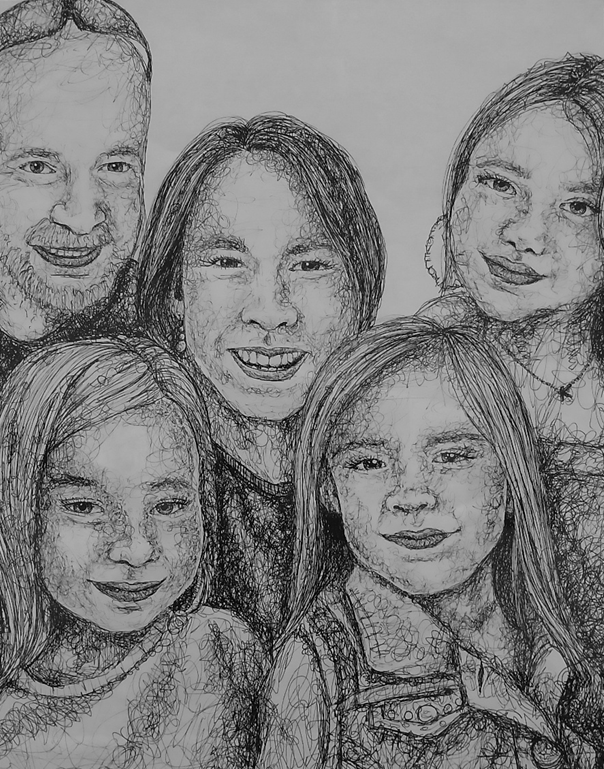
Kenadi Carmichael, Scribbles of Love
In Kenadi Carmichael’s work, Scribbles of Love, line is found in the following locations:
- The composition was created entirely from interconnected lines. They move in unpredictable ways, often overlapping the previously drawn lines.
- By layering the lines in specific areas, the artist was able to build shading and dimension in her chosen subjects.
- The curvier linear lines connect each of the family members to create a cohesive composition.
Shape
An element of design; shape is a two-dimensional enclosed space that represents either an organic shape or a geometric shape. Geometric shapes include squares, circles, rectangles, triangles and other standard geometric shapes. Organic shapes include natural non-geometric shapes that are developed from curvilinear lines.
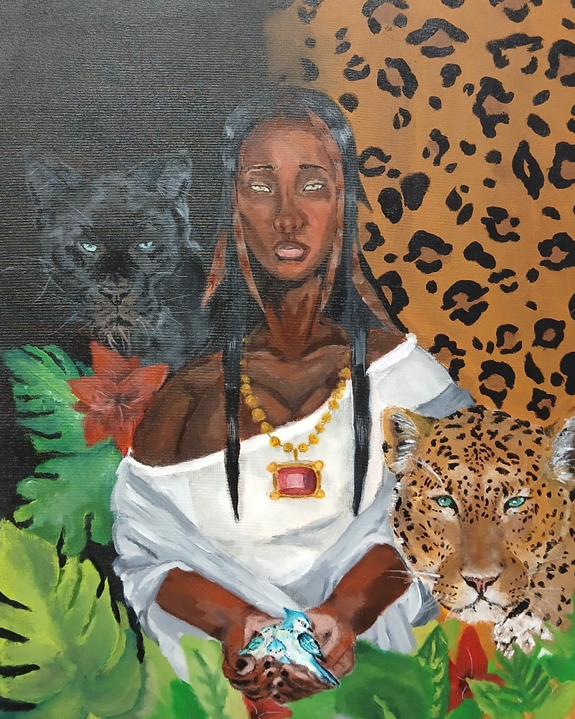
Cobey Duncan, Mother of Three
In Cobey Duncan’s work, Mother of Three, shape is found in the following locations:
- The painting is a representation of a mother surrounded by animals that hold important meanings for the artist. These subjects are rendered with painting techniques to help define their details. However, each of these figures started as a shape.
- The mother, plants, leopard, panther, and baby birds each started as a collection of shapes with a base color. This color blocking helps the artist build complex compositions.
- Other examples of shapes can be identified in the patterns found on the leopard print in the background and the physical animal. The patterns were made with organic and repeated shapes to provide identifying details.
Form
An element of design; form is a three-dimensional enclosed space that represents organic and geometric shapes in a third space. Geometric forms include cubes, spheres, triangular prisms, rectangular prisms, and cones. Organic shapes include three-dimensional forms observed in nature, such as trees, rivers, and rocks.
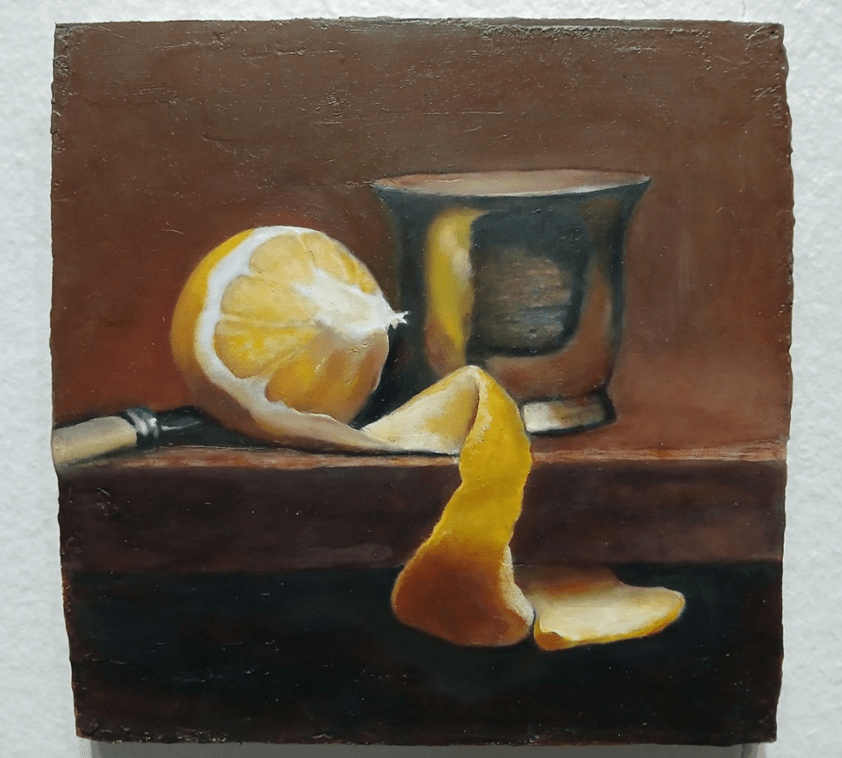
Emma Kirby, Sour
In Emma Kirby’s work, Sour, form is found in the following locations:
- The painting is a realistic still life composition, featuring a partially peeled lemon sitting on a table. The peel curls in a dynamic manner, curving over the edge of the table in a spiral formation.
- A silver reflective glass and a knife are found on either side of the lemon.
- The artist rendered the composition by gradually layering various shades of color to create the appearance of three-dimensional space.
- The use of light, shadow, and painted reflections allows the composition to appear highly detailed.
Space
An element of design; this term defines the surface area between, before, and behind an object in a composition.
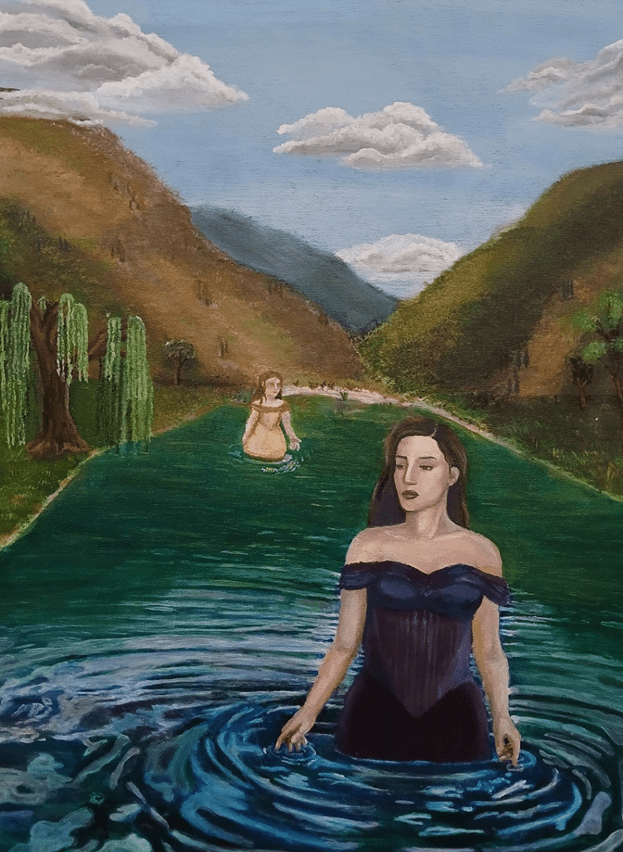
Grace Banner, Marcher Dans L’eau
In Grace Banner’s work, Marcher Dans L’eau, space is found in the following locations:
- The two figures, presumably representations of the artist, are wading out into an expansive lake.
- The body of water stretches into the distance, where it meets tall mountains.
- The artist identifies the distance by painting the background mountains with a hazy blue hue.
- The viewer is able to determine a sense of scale and space by comparing the human figures in the foreground to the sprawling landscape in the background.
Color
An element of design; this term defines the pigments used in a painting. Color can be organized into categories, such as: hues, values, complements, and intensity.
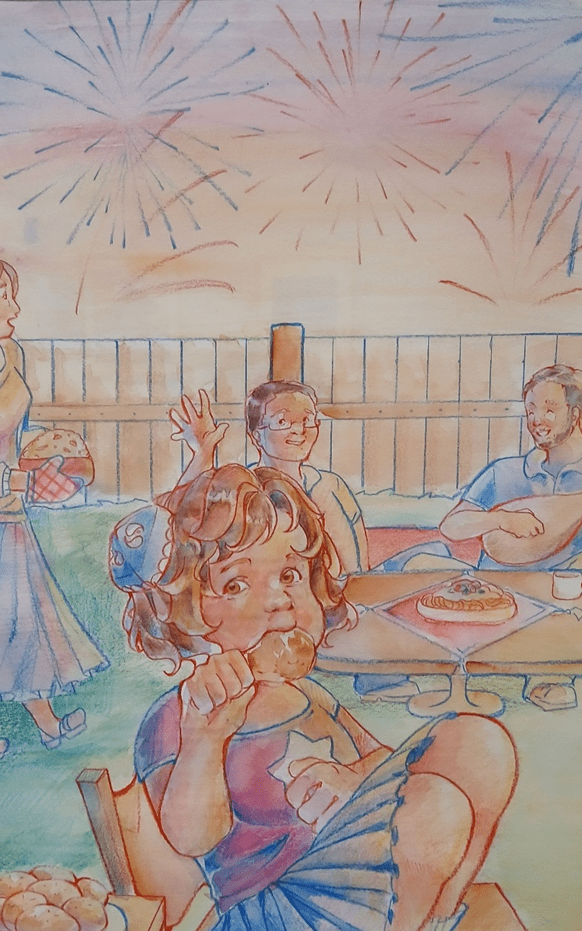
Qadria Yasin, Melting Pot
In Qadria Yasin’s work, Melting Pot, color is found in the following locations:
- The composition was made from bright colors, causing the celebratory scene to feel joyful.
- Bold colorful lines are used to tell a story of a gathering of neighbors in a backyard setting.
- In between and behind the bold line art is a wash of watercolor tones. The artist chose to match the bold line art to the wash colors.
- The effect is an illustrated scene of the Fourth of July.
Value
Value is a spectrum applied to a hue. The color can have a dark value or a light hue. This process of changing the value is caused by adding white for light hues and black for dark hues.
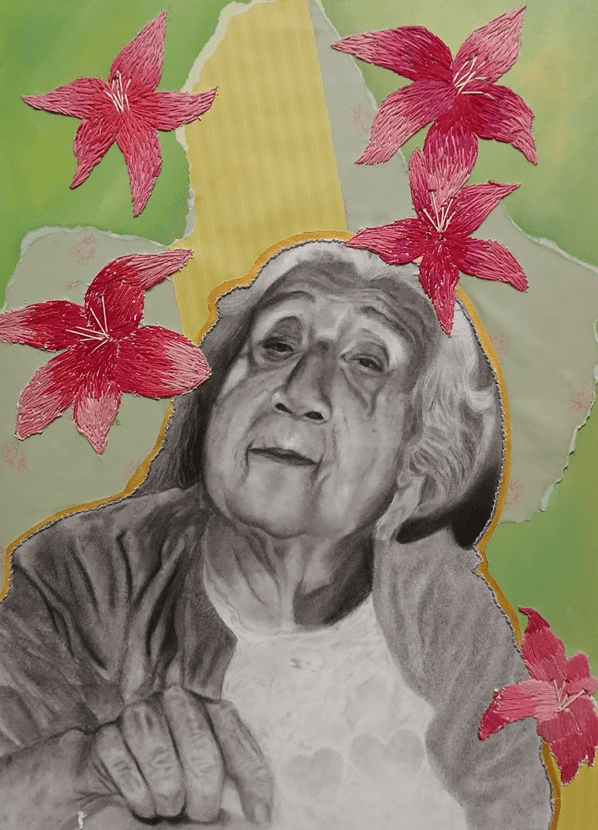
Ailyen de la Rosa, Fabi
In Ailyen de la Rosa’s work, Fabi, value is found in the following locations:
- The artist used gray pigment to create a monochromatic portrait of her great grandmother.
- The portrait does not need color. A balance of shadows and highlights build form, depth, and texture. The result is an accurate portrayal of the subject.
- Her portrait is surrounded by patterned green wallpaper, embroidered pink flowers, and a green background.
- The contrast of the color that surrounds the grayscale portrait emphasizes the artist’s successful use of value.
Texture
An element of design; this term defines an artwork’s surface. The artist’s use of the chosen medium creates either implied or actual texture.
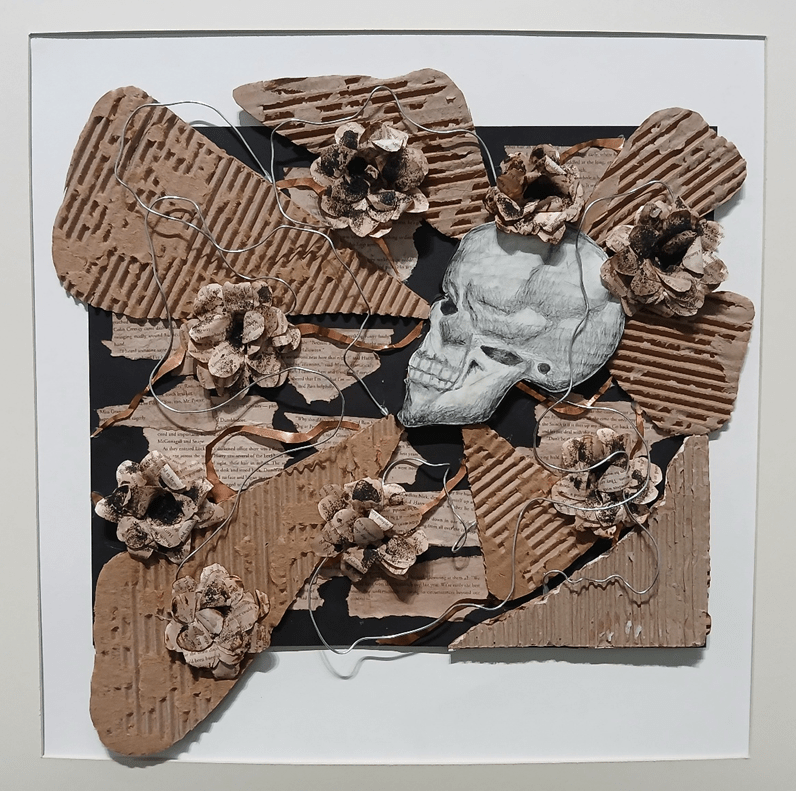
Chloe Hedger, Repurposed
In Chloe Hedger’s work, Repurposed, texture is found in the following locations:
- The artwork uses a mixture of metal wire, cardboard, and dyed book pages to create a highly textured work.
- The student removed the top layer of corrugated cardboard and assembled them in an organic radial design. The rough texture provides shadows in these cardboard forms.
- A long segment of wire was bent into a curvier linear line and attached in a meandering manner on the composition. The wire is smooth with a metallic shine.
- Lastly, pages from various books were cut, dyed with coffee, and glued to the background as both readable excepts and carefully formed flowers.
Principles of Design
Balance
A principle of design; this term defines the arrangement of the presented imagery with the elements of design. It refers to either asymmetrical compositions or symmetrical compositions.
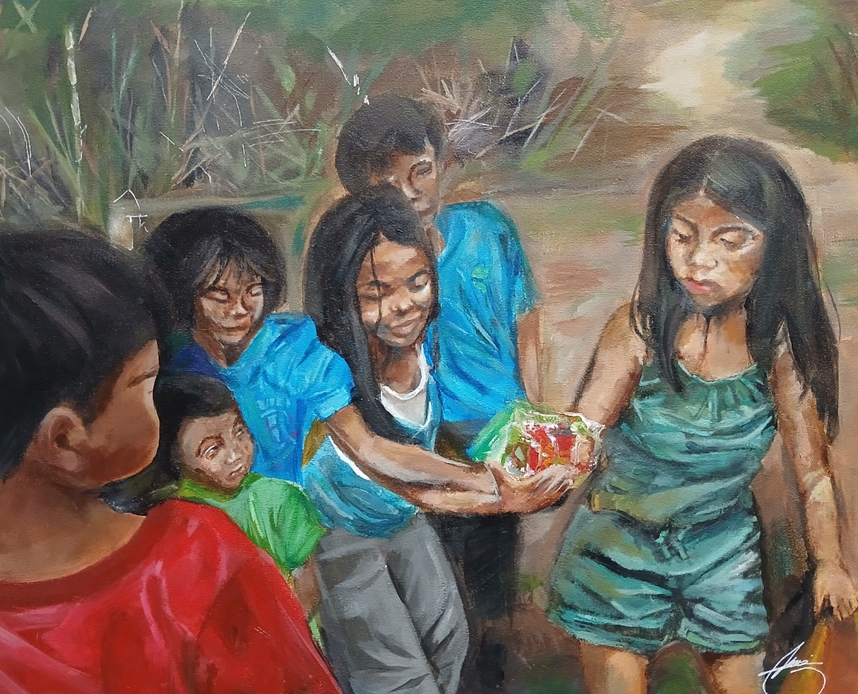
Keisha Molina, Sagbayan, Bohol
In Keisha Molina’s work, Sagbayan, Bohol, balance is found in the following locations:
- The composition is divided into asymmetrical vertical and horizontal sections.
- From the vertical perspective, a group of students are standing next to each other in a small gathering to the left of the composition. To the right of the group is a student who is by themselves. The lone individual visually balances the larger group.
- From the horizontal perspective, the composition is divided between the area with people and the area with nature. Similar to the vertical sections, the small nature section found at the top of the composition balances the larger lower section that contains the figures.
Unity
A principle of design; this term defines how the elements and principles of design are combined within a composition.
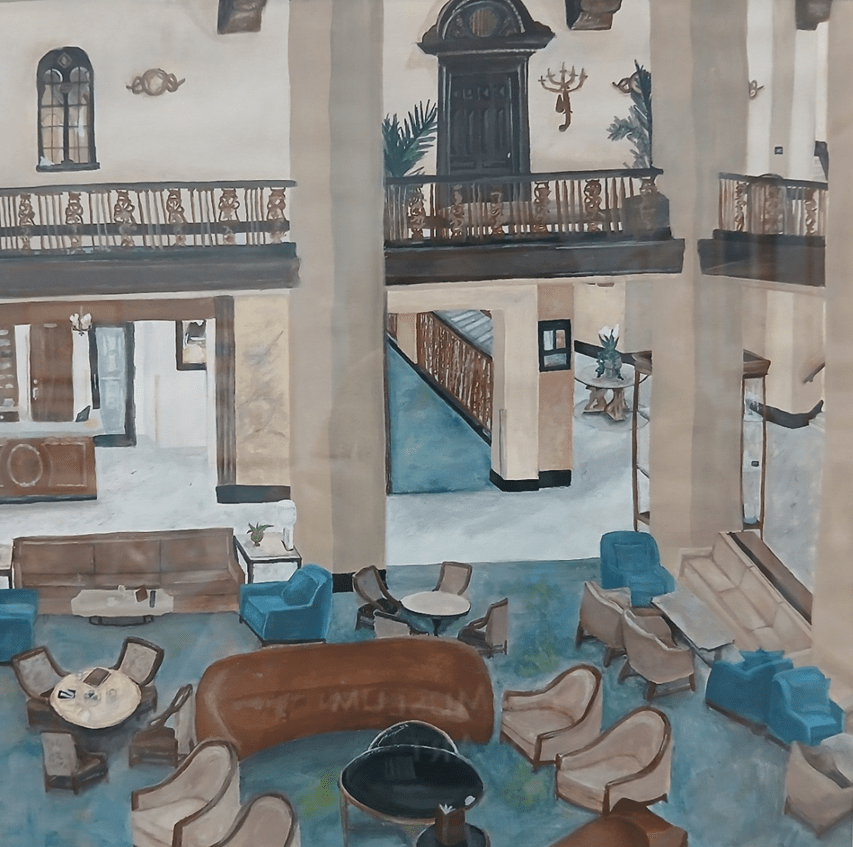
Kaitlynn Cook, Perseverance
In Kaitlynn Cook’s work, Perseverance, unity is found in the following locations:
- The architectural space is unified through the use of repeated structural elements and the color palette.
- The interior space includes repeated columns, chairs, and railings that unify the imagery within the room. The chairs are found in the lower area, the railing is found on the upper area, and the columns connect the two spaces.
- Additionally, the common colors are tan, blue, and light gray. These hues are found throughout the composition.
Variety
A principle of design; this term defines the combination of imagery, objects, and ideas in an artwork.
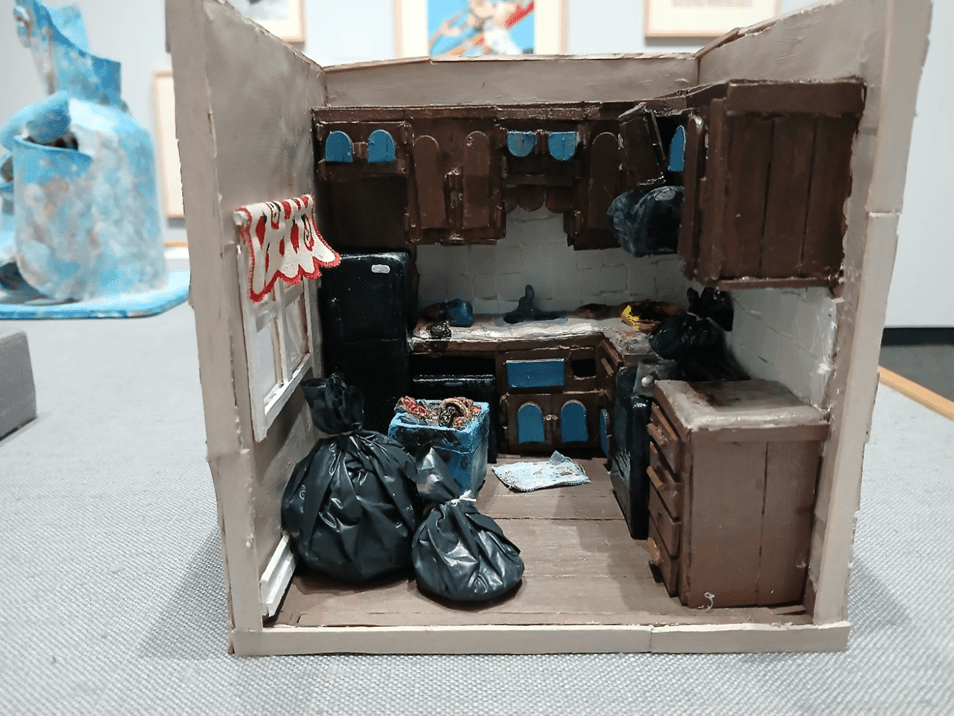
Rebekah Park, The Kitchen that Raised Me
In Rebekah Park’s work, The Kitchen that Raised Me, variety is found in the following locations:
- Rebekah Park used many different elements and principles in the creation of this piece.
- The sculpture was made by physically building each object, countertop, and kitchen details. The student was mindful of form, balance and unity when arranging each of the three-dimensional structures.
- Form is within the structural design of the sculpture. Balance and unity are found in the specific arrangement of the kitchen details and items to make it look like a convincing replica of a real space.
- The emphasis of the sculpture is the collection of trash bags sitting on the floor of the kitchen.
Emphasis
A principle of design; this term defines the most prominent area in a composition. The viewer’s eye is drawn to this point because the artist used a mixture of the elements and principles of design.
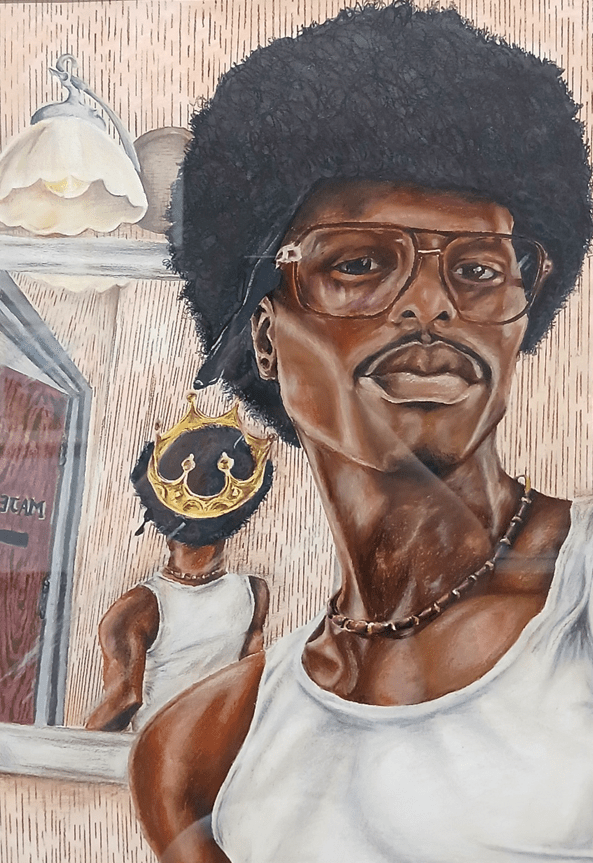
Jabryn Carston, Reflections of Royalty
In Jabryn Carston’s work, Reflections of Royalty, emphasis is found in the primary locations:
- The crown adorned on the artist’s head is the emphasis of composition.
- It is the only gold element within the artwork, allowing its design to stand out.
- A self portrait of the artist looks directly at the viewer, asking them to understand why the crown is important to him.
- The title of the piece, Reflection of Royalty, perfectly highlights the significance of the crown in context with the composition.
Movement
A principle of design; this term defines the visual movement observed in a painting. This can be identified as kinetic movement or implied movement. Additionally, movement can be defined as how the viewer’s eye moves throughout the composition.
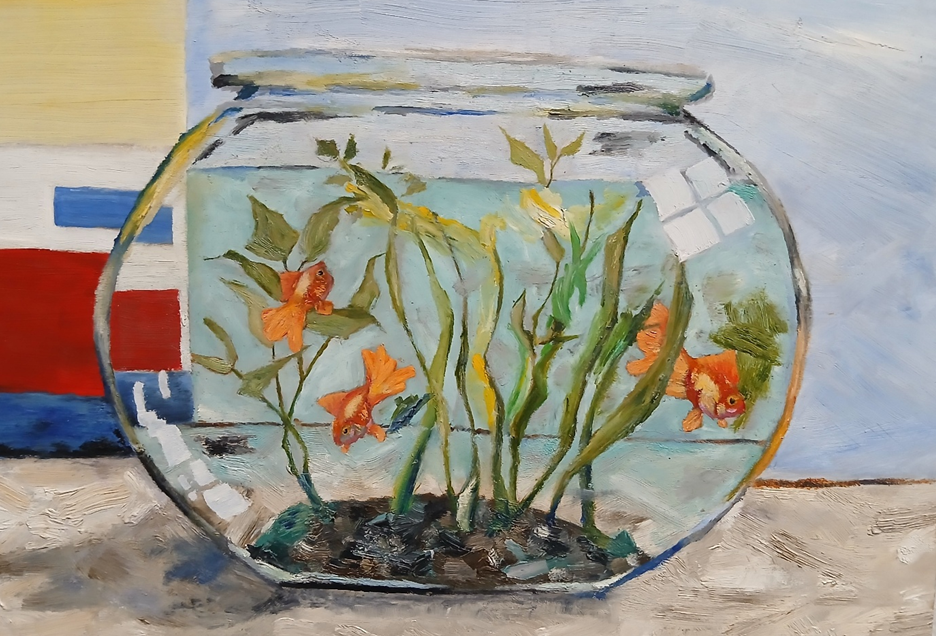
Catalina Nguyen, Life is a Bowl
In Catalina Nguyen’s work, Life is a Bowl, movement is found in the following locations:
- Goldfish are seen swimming in crystal clear water.
- The viewer can recognize that the fish are swimming by the arrangement of their bodies.
- They are each pointed in a direction and their tail is designed to give the idea that they are slowly moving.
- The painting was made to look like a frozen moment. The artist’s impressionistic painting style gives the illusion that if you blink, the fish will swim to a new area of the fishbowl.
- The aquatic plant life helps with the visual idea of movement. The curvier linear lines appear to flow and shift in the water.
Pattern
A principle of design; this term defines the repetitive imagery and elements of design found in a composition.
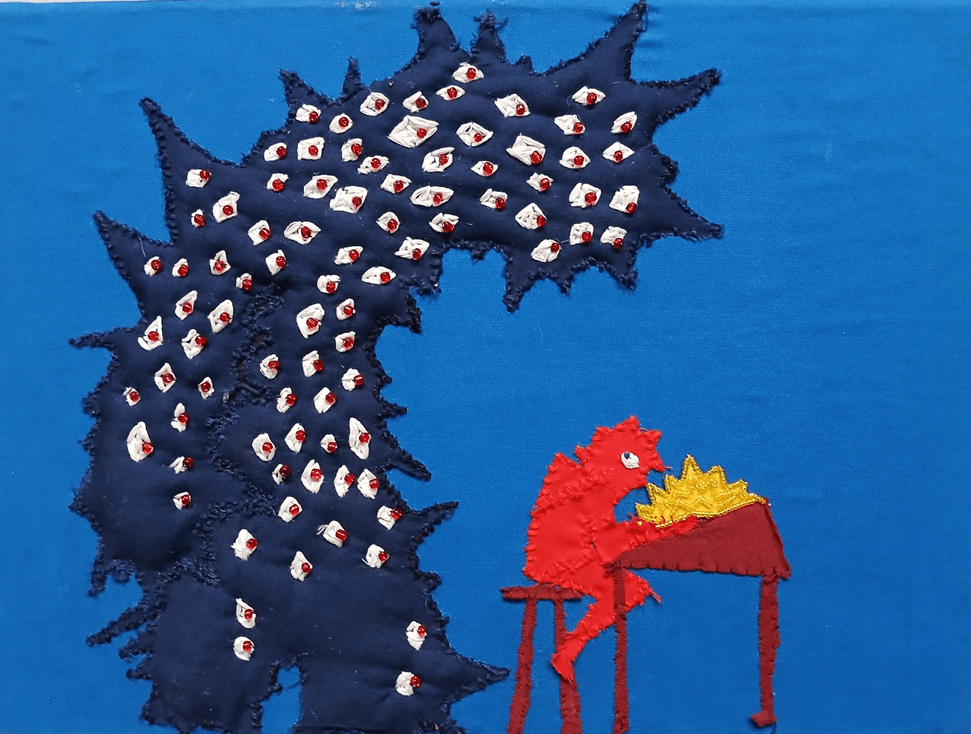
Hailie Sims, Please Don’t Perceive Me
In Hailie Sims’s work, Please Don’t Perceive Me, pattern is found in the following locations:
- The abstracted monster, which is representative of the artist’s anxiety, is comprised of multiple eyes all over its body.
- These eyes are designed as ovular white shapes with a single red dot near the center.
- The collected pattern of eyes creates a sense of dread and fear, which is directed towards the smaller red figure.
- The small individual has a single eye that is looking back at the monster.
Proportion
A principle of design; this term defines the comparative size between objects in the composition. It can refer to the imagery within a painting or the size between a sculpture and a real object.
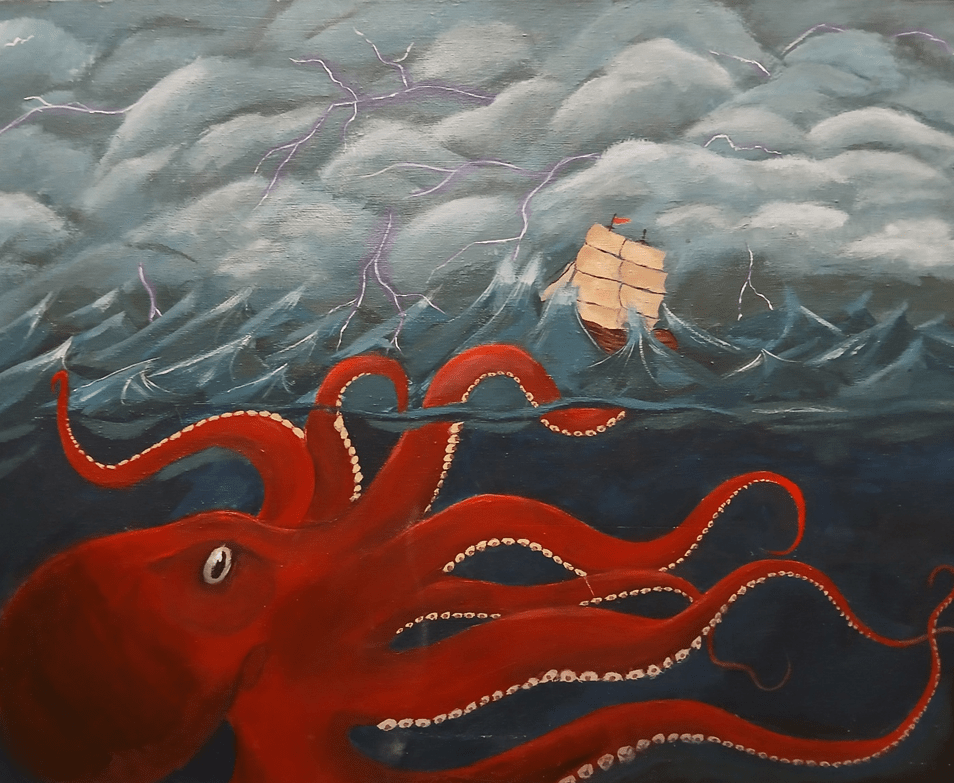
Valerie Moss, The Kraken’s Wrath
In Valerie Moss’s work, The Kraken’s Wrath, proportion is found in the following locations:
- An undersea kraken lurks beneath a large sailing vessel.
- The viewer can visually connect to the approximate size of the ship based on the imagined sailors abord.
- With this context, the viewer can recognize the massive scale difference between the Kraken and the ship.
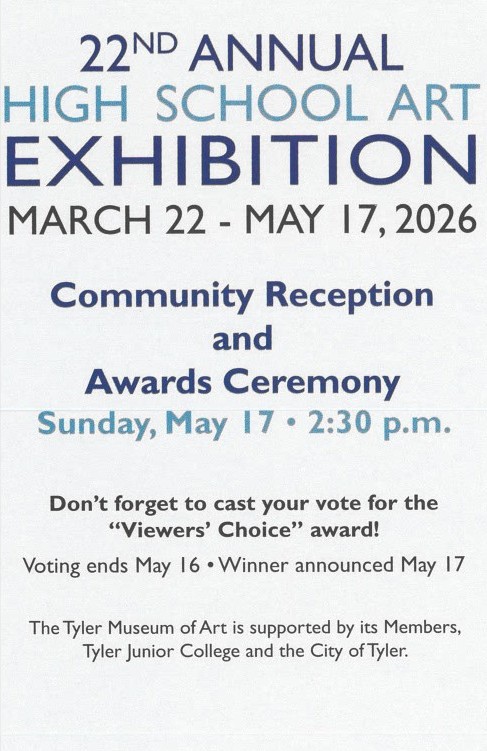
You can see all of these artworks and more in-person at the Tyler Museum of Art’s current exhibition: 22nd Annual High School Art Exhibition.
For more educational resources created by the Tyler Museum of Art, visit our YouTube page by clicking on the YouTube button or clicking the link below.

If you use or references this lesson plan, please leave a comment with your feedback.
Thank you for visiting the Tyler Museum of Art’s Education Blog!

